Art as the Disclosure of Existential Truth
Art is not merely about beauty; it is the disclosure of existential truth hidden within lived experience.
We have already looked at the human world and how it is interpreted. In other words, how human beings make sense of lived experience. There are many ways of doing this. We have seen some of them already: science, philosophy, religion, and, inevitably, art.
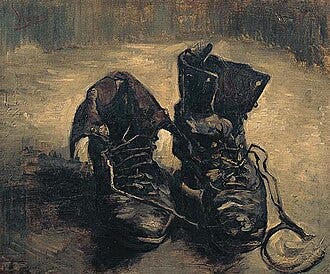
A painting that reveals (aletheia) a whole world. Heidegger mentions this particular work of Van Gogh’s (Pair of Shoes, 1895) in The Origin of the Work of Art.
What I ultimately want to emphasize is this: in relation to the Lebenswelt—the human lifeworld, the world of lived experience—art is not merely concerned with beauty, as I briefly suggested earlier. Rather, art is fundamentally concerned with truth. More specifically, it is concerned with existential truth.
This idea emerges particularly in the notion of an aesthetics of existence, and when thinkers such as Friedrich Nietzsche and Martin Heidegger reoriented aesthetics toward human existence itself. Aesthetics eventually became an aesthetics of existence: a way of understanding how human beings create their own worlds of meaning.
For a long time, this dimension of art was neglected, but today it has returned to prominence. Art is connected with nearly every aspect of human civilization because every act of creation is, ultimately, a process of creating one's own world. This is what an aesthetics of existence means.
In contemporary neuroscience there is a related concept called autopoiesis, developed by Humberto Maturana and Francisco Varela. "Auto" means self, and "poiesis" means creation or bringing-forth. It does not merely refer to writing poetry. Poiesis means bringing something into presence, revealing what was previously hidden.
Heidegger expresses a similar idea when he says that art is truth setting itself to work, or that art is the happening of truth.
The Greek word he uses for truth is aletheia. Truth, in this sense, means unconcealment—the emergence of something from hiddenness into visibility.
This is not moral truth or religious truth. It is not about norms, commandments, or judgments of right and wrong. Moral truth asks what ought to be done. It deals with ideals and obligations.
In German philosophy this is often expressed as das Sollen—what should be.
Art, however, is not primarily concerned with das Sollen. It is concerned with das Sein—what is.
Art is interested in facts as they are actually lived, often in all their complexity.
Take love, for example.
Moral truth tells us that genuine love should be caring, faithful, and honest. Yet actual human experience is far more complicated. Love can lead people to lie. Love can motivate betrayal. In extreme circumstances, love can even become destructive.
Imagine a mother overwhelmed by despair, poverty, or psychological collapse. She may commit an unthinkable act against her own child while believing she is acting out of love. Morality may condemn such actions, but art is interested in understanding the complexity of the experience itself.
Or consider the assassination of John Lennon by a devoted admirer. Here again, affection and violence become entangled in disturbing ways.
Life is full of contradictions like these.
A famous example appears in the film Life Is Beautiful. During the horrors of a Nazi concentration camp, a father constantly lies to his son, pretending that everything is part of a game. Morally speaking, lying is wrong. Yet his deception arises from profound love and a desire to protect the child.
Reality is more complicated than moral formulas.
This complexity is precisely what art seeks to reveal: the dimensions of existence that remain hidden beneath simplistic distinctions between black and white.
Nor is artistic truth the same as scientific truth.
Scientific truth often depends upon abstraction. It identifies general patterns and categories. Intelligence quotients, for example, classify people into numerical groups. Such categories may suggest that someone with an IQ of 140 is inherently superior to someone with an IQ of 90.
Art challenges such simplifications.
A person with an average IQ may possess extraordinary wisdom, creativity, or humanity. Meanwhile, a mathematical genius may struggle profoundly in life. Films such as A Beautiful Mind explore precisely these tensions.
Art reveals the singular, the concrete, the irreducible uniqueness of human existence.
This is why artistic truth is existential truth.
Generally speaking, truth means correspondence with reality. Yet Heidegger deepens this definition. Consider marble lying unnoticed in the hills of Italy. Most people walk past it without recognizing its significance.
Then someone like Michelangelo transforms that marble into the statue of David or the Pietà. Suddenly we perceive the astonishing qualities hidden within the stone. What was previously concealed becomes manifest.
The same material existed all along, but its essence remained hidden until artistic creation disclosed it.
That disclosure is aletheia.
Or think about ordinary life. You may see bicycles every day without ever noticing the beauty of motion, speed, balance, or rhythm. Then a sculptor creates a work that captures these qualities, and suddenly you see them differently.
The artwork has revealed something that was always there but had remained unnoticed.
Art therefore functions as an act of disclosure.
It uncovers realities concealed beneath habit and familiarity.
For Heidegger, art is fundamentally a revealing. It opens what was closed. It brings into visibility dimensions of existence that ordinarily remain hidden.
This is why artistic truth can sometimes conflict with morality.
Many forms of contemporary art employ nudity, violence, or shocking imagery. Performance art, for example, often uses the human body itself as a medium rather than canvas, paint, or music.
A performance artist may appear naked before an audience, not merely to provoke but to communicate an idea.
One artist invited spectators to take photographs with him while he stood completely nude. The work suggested that modern culture is fundamentally voyeuristic: we constantly watch others while simultaneously wanting to be watched ourselves.
Social media provides an obvious example. People display their lives online while eagerly observing the lives of others. We enjoy both looking and being looked at.
The artist's nudity was therefore not the point. It was a strategy for revealing a hidden truth about contemporary culture.
Such works often provoke controversy because they push against psychological and moral boundaries. They challenge feelings of discomfort, disgust, anxiety, or fascination.
Yet their purpose is not merely to shock. Their purpose is to disclose deeper truths about human existence.
This emphasis on truth is particularly characteristic of what is traditionally called fine art.
Although distinctions between fine art, design, advertising, and applied art have become increasingly blurred, fine art still tends to prioritize reflection and contemplation.
An advertisement may be visually sophisticated and artistically impressive, but its ultimate purpose is usually to sell a product.
Fine art, by contrast, is primarily created to provoke reflection.
Even highly abstract painters such as Wassily Kandinsky were motivated by spiritual questions. Kandinsky believed that colors correspond to profound emotional and spiritual states. A composition of blue, red, and yellow could activate resonances within the viewer's inner life, much like pressing keys on a piano.
Blue might evoke tranquility. Red might suggest passion or intensity. Green might suggest freshness or renewal.
The artwork is therefore not simply decoration. It becomes a vehicle for revealing dimensions of experience that words alone cannot express.
In that sense, art seeks to formulate the unformulated, to make visible the invisible, and to allow truth—aletheia—to emerge from concealment into presence.
메타데이터
- post_id
- bb3392bf7ecd
- slug
- art-as-the-disclosure-of-existential-truth-bb3392bf7ecd
- url
- https://medium.com/@shrimpmindparadox/art-as-the-disclosure-of-existential-truth-bb3392bf7ecd
- canonical_url
- https://medium.com/@shrimpmindparadox/art-as-the-disclosure-of-existential-truth-bb3392bf7ecd
- author_url
- https://medium.com/@shrimpmindparadox
- status
- ok
- fetched_at
- 2026-06-09 15:37:30