The Emergence of a Freedman Status Amongst Black American Reparations Advocates
Kevin L. Thomas, J.D., M.Ed.
The Emergence of a Freedman Status Amongst Black American Reparations Advocates
Kevin L. Thomas, J.D., M.Ed.
Edited by: Alexander A. Padis, Jr., J.D. and Linda Kleinschmidt, M.A.
E-mail: klthomas@smu.edu
April 12, 2025
A Freedman status has emerged among advocates who are part of the Reparations Movement within the United States. This status is said to encompasses all individuals who are descended from slaves who were emancipated in the United States under the authority of pivotal legal instruments such as, but not limited, to the Emancipation Proclamation and the 13th Amendment to the United States Constitution. Further still, services granted by legislative acts such as the Act establishing the Bureau for the Relief of Freedmen and Refugees,1 and the Act to incorporate the Freedman’s Savings and Trust Company, along with the rights solidified by the 14th and 15th Amendments to the United States Constitution, when taken all together have been proposed as the basis for the Freedman status.
At its core, these reparations advocates propose utilizing a race neutral status and, propose to use a Freedman status in hopes that an enacted reparations or other political policy for African American descendants of slaves will avoid judicial review under the strict scrutiny standard. The focus of this inquiry is not related to these or other subsequent implications of a Freedman status, nor is it related to racial or ethnic self-identification preferences. The focus herein is solely related to the Freedman legal, social and political status.
For the purposes of this analysis, a Freedman (or a Freedman descendant) is defined as an individual who is descended from African persons who were enslaved or were free Africans in British colonial America and/or the United States of America between August 20, 1619, and December 6, 1865, and were victims of the Trans-Atlantic Slave Trade, the Intra-American Slave Trade, and/or the Domestic Slave Trade. This definition includes those whose ancestors are documented in historical records such as census data up to and including 1870, records of free African American populations, or the Freedmen’s Bureau and Freedman’s Savings Bank archives. These ancestors may have been identified in these historical records by such terminology as “slave”, “Black”, “Negro”, “colored”, “mulatto”, “free Black”, “freedmen”, “free man”, “freedman”, along with many other related terms.
This discourse is being offered by reparations advocates who here make a fascinating case and draws parallels between these Freedman descendants and those of the Freedmen from the Five Civilized Tribes (Cherokee, Choctaw, Chickasaw, Muscogee (Creek), and Seminole). This inquiry is especially relevant considering the ongoing reparations advocacy movement within the United States, which seeks to address historical and continuing injustices faced by Americans who are descendants of enslaved Africans. Some reparations advocates are seeking to pursue reparative justice and other political initiatives using a Freedman status as a permanent, multi-generational status for emancipated Africans and their descendants within the United States.
Despite a long history of legal jurisprudence related to the issues and concerns of African Americans, much of the law concerning issues relevant to modern African American justice movements is unclear, not well established, and has not been revisited or explored thoroughly.2 Therefore, this matter clearly warrants meticulous and legally grounded discussions within the reparations and African American political advocacy movement(s) exploring Freedman status and Freedman descent (especially using the consultation of legal and subject matter experts working in conjunction with advocates). This Freedman status as a permanent, multi-generational framework for emancipated Africans and their descendants in the United States may facilitate African American activists in finally achieving their vision which includes notions of sovereignty, repatriation, obtaining various forms of reparations; and reestablishing the Freedmen’s Bureau and Freedman’s Savings and Trust Bank to complete the long still unfinished work of Reconstruction.
Keywords: Reparations, Status, Legal Status, Social Status, Political Status, Black, Black American, African American, Negro, Colored, Mulatto, Free Man, Freedmen, Freedman, American Freedmen, American Freedman
- The Freedmen Status and the Descendants of the Freedmen of the Five Civilized Tribes
The postbellum Treaties of 1866 between the United States and several of the Five Civilized Tribes: 1. Cherokee,3 2. Choctaw and Chickasaw (joint treaty),4 3. Muscogee (Creek),5 and 4. Seminole6 — contain provisions that inter alia conferred specific rights upon Freedmen (the formerly enslaved individuals within these tribes). These rights, when interpreted expansively, suggest the granting of full tribal citizenship to Freedmen and their descendants, underpinned by the sovereignty of each tribe.7
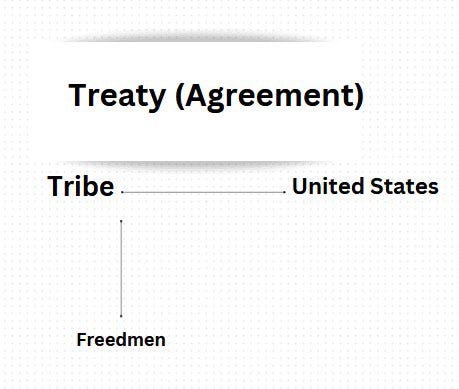
However, the practical realization of such rights has been mired in complexity due to the ongoing recognition of tribal sovereignty, treaty obligations and the implementation or lack thereof of provisions within the Treaties of 1866. While the treaties themselves were Federal instruments, their implementation fell within the ambit of tribal governance structures. Most tribes, exercising their sovereign prerogative, did not enact laws congruent with the terms of the 1866 Treaties, resulting in the Freedmen’s eventual struggle for recognition and parity and leading to instances where they were, de facto if not de jure, treated as second-class members within the tribal polities. Thus, the Freedmen’s status emerged as being tied to a tripartite relationship: 1. the tribes, 2. the Freedmen, and 3. the United States. Each party negotiating the complex interplay of treaty rights, implementation, and contemporary interpretations of tribal sovereignty leading to circumstances wherein the tribes did not implement laws that fully aligned with the terms of the 1866 Treaties, and thereby affecting the Freedmen’s rights within those tribes.
Figure 1
The Tripartite Relationship Between the Tribes, the Freedmen and the United States
1.1 Cherokee
Several pivotal cases have arisen, that have shaped the contours of tribal sovereignty and citizenship rights for the Freedmen of the Cherokee Nation.
Cherokee Nation v. Hitchcock,8 decided in 1902 by the United States Supreme Court, underscored the authority of the United States Congress to unilaterally modify agreements with the Cherokee Nation. The Cherokee Nation brought an action to enjoin the leasing of tribal oil lands by the Secretary of the Interior, arguing that prior treaties (1835, 1846, and 1866) vested the Cherokee Nation with a fee simple title to tribal lands. However, the Curtis Act of 1898, approved by Congress on June 28, 1898, granted the Secretary of the Interior lawful authority to lease tribal lands for mineral extraction. The Court affirmed Congress’s authority over tribal affairs and upheld the 1898 legislative act (an act that also had profound implications on the rights of the Freedmen among other issues),9 thereby reinforcing the Congressional prerogative in matters relating to tribal agreements.
The Dawes Commission, organized in 1893 by Congress, was authorized to divide tribal land into single lots to be allotted to individual members within the tribe. In 1896, the Dawes Commission was directed to create membership rolls for each of the Five Civilized Tribes. The Cherokee rolls were completed in 1907 listing native Cherokees on a “Blood Roll”, and former slaves and their descendants on a “Freedmen Roll.” Final supplements to the Rolls were added on September 25, 1914. Many individuals who were formerly enslaved by the tribes make their first appearance on Federal documents, on the Freedmen Rolls, prior existing only as unnamed property of their former masters. One such example is Sallie Walton — an ancestor of Angela Y. Walton Raji, author, genealogist, and scholar — who first appeared on the Freedmen Rolls and received a small land allotment from the Dawes Commission. Despite some land allotments being distributed by the Dawes Commission, most Freedmen remained second-class citizens within their own tribes.
In Vann v. Kempthorne,10 the descendants of the Freedmen sought to assert their full citizenship rights within the Cherokee Nation. Their claim, rooted once again in the protections afforded by the 1866 treaty, was particularly focused on their exclusion from voting in two tribal elections due to absence of a lineal tie to the Blood Roll.
Cherokee Nation v. Nash,11 adjudicated in 2017 stemmed from a 2007 Constitutional amendment by the Cherokee Nation that sought to redefine tribal citizenship as being strictly those with “by blood” lineage, effectively excluding the Cherokee Freedmen once again. However, on petition for relief, the United States District Court for the District of Columbia intervened and ruled that the Cherokee Freedmen were indeed entitled to full Cherokee citizenship rights as guaranteed by the 1866 treaty. This decision was key and marked a significant shift, underscoring the fact that the prior exclusions of the Freedmen conflicted with treaty obligations and affirming the rights of those individuals to all aspects of Cherokee citizenship, including voting and healthcare benefits.
1.2 Choctaw
The legal journey undertaken by the Choctaw Freedmen has been complex and marked by significant litigation. The Choctaw Nation, similar to other tribes, was a party to an 1866 joint treaty, which included specific provisions for the rights of the Choctaw Freedmen. Despite these treaty obligations, the tribal government did not grant citizenship rights to the Freedmen as stipulated in the treaty. Choctaw Nation v. United States, delved into the complexities surrounding the rights of both Choctaw and Chickasaw Freedmen.12 Subsequent to the 1866 treaty, Choctaw Freedmen were not immediately adopted into the tribe and later excluded due to absence of a lineal tie to the Blood Roll.
Instead, for a lengthy period that has lasted up to the present day, the status and rights of Choctaw Freedmen has been precariously positioned, often even marginalized within the tribal framework. Their recognition and inclusion within the tribe remains subject to the vagaries of tribal politics, rather than being firmly grounded in the clear legal directives set forth by the 1866 treaty.
1.3 Chickasaw
The Chickasaw Nation did not adopt any provisions in its 1866 joint treaty that would grant full citizenship to their Freedmen. Instead, they agreed to terms that effectively allowed the Chickasaw Freedmen rights to having land while leaving them only subject to United States law (see, e.g., Chickasaw Nation v. United States).13 This initial stance set the stage for a series of legal challenges that aimed at clarifying whether the Freedmen were entitled merely to specific rights or to full citizenship within the tribe. This absence of immediate and clear citizenship rights left the Chickasaw Freedmen in an unclear political position and resulted in prolonged struggles for the Chickasaw Freedmen’s recognition within the Chickasaw Nation. As of today, the Chickasaw Freedmen have not yet secured full citizenship rights.
1.4 Muscogee (Creek)
The Treaty of 1866, which the Muscogee (Creek) Nation entered into with the United States government was similar to those made with other tribes and stipulated various conditions including provisions for the Freedmen. Under this treaty, the Muscogee (Creek) Freedmen were granted certain rights, including the right to land and other entitlements within the Muscogee (Creek) Nation’s territory. However, the interpretation and implementation of these rights became a subject of contention. While the Treaty was intended to grant the Freedmen full citizenship in the Muscogee (Creek) Nation, in actual practice, this did not happen. The Muscogee (Creek) Nation weaponized their tribal sovereignty and enacted key provisions in its 1979 Constitution dictating that citizenship be determined by blood resulting in the exclusion of Freedmen from citizenship. As late as 2024, Muscogee (Creek) Freedmen have continued to petition the Courts in an attempt to enforce their citizenship rights.
1.5 Seminole
Seminole Nation v. Norton,14 adjudicated in 2002, presented a clash between the United States Department of the Interior (DOI) and the Seminole Nation. This dispute arose after the tribe amended its Constitution to preclude Seminole Freedmen from participating in tribal elections. The DOI, in response, refused to recognize the elections conducted under this amended constitution. A United States District Court rendered its decision affirming the rights of the Seminole Freedmen. The Court found that they were entitled to participate in the tribal process as outlined by the 1866 Treaty.
Despite this ruling, however, the Seminole Nation still instituted mechanisms to effectively grant only limited citizenship to Seminole Freedmen.
1.6 These 1866 Treaties, Subsequent Agreements and Legal Jurisprudence Have Shaped the Status and Rights of Freedmen Within Their Respective Tribal Nations
The Freedmen are the formerly enslaved individuals and their descendants who became tribal members by approval of the Dawes Commission and who were listed on the Final Rolls of Citizens and Freedmen of the Five Civilized Tribes (commonly referred to as the Dawes Rolls).15 The descendants of Freedmen are the direct progeny of the Freedmen listed on the Dawes Rolls.16 Legal, social and political Freedmen statuses emerge as relational statuses between Freedmen and their descendants, and the tribe and its members.
The descendants of Freedmen have sought to enforce their rights through numerous legal challenges over the years. These have led to various interpretations of the original treaty stipulations. Tribes have often contested these claims, resulting in ongoing litigation and negotiations regarding the exact scope of Freedmen rights within tribal nations.
In each case, the central legal issue involves the interpretation and enforcement of the 1866 Treaties and subsequent legislation, as well as the tribes’ sovereignty and their powers to define citizenship. Consequently, the Freedmen and their descendants recurrently have had to seek legal recourse to ascertain and claim their rights.
1.7 Tribal Freedmen are Citizens of the United States
Tribal Freedmen are also United States citizens as clearly derived from two primary legal sources: the 14th Amendment and the Indian Citizenship Act of 1924.
With the ratification of the 14th Amendment to the United States Constitution in 1868, all persons born or naturalized in the United States, which included former slaves and those who had been living within the boundaries of the United States, were granted United States citizenship.17 This provision overarched all tribal affiliations and endowed citizenship upon all individuals born within the country, irrespective of race or previous conditions of servitude.
The Indian Citizenship Act of 1924,18 also known as the Snyder Act, conferred United States citizenship on all Native Americans born within the territorial limits of the country. Prior to this act, Native Americans were not universally recognized as United States citizens, although many had acquired citizenship through various treaties, statutes, military service, or the allotment process under the Dawes Act.19 While the 1924 Act was primarily aimed at Native Americans, it did underscore the concept that tribal members, which would include Freedmen who were members of their tribes, were also citizens of the United States.
If recognized as members of their tribes, tribal Freedmen have a unique legal relationship with the United States as indigenous peoples through their tribes in addition to their individual United States citizenship. Consequently, while there might be complexities in their status within their respective tribes — stemming from treaties, tribal laws, and other conditions — their standing as United States citizens is unequivocal and separate from their tribal citizenship. This dual identity affords them rights and privileges at the national level while also entailing they receive certain rights within their tribes where their ancestry is recognized.
The Snyder Act was required to clarify the citizenship status of Native Americans, because the 14th Amendment’s citizenship clause had not been consistently interpreted or applied to grant citizenship to all Native Americans. Despite the 14th Amendment’s broad language, which provides citizenship to all persons born or naturalized in the United States, its application to Native Americans was ambiguous for several reasons. In the years following the ratification of the 14th Amendment, its citizenship provisions were not interpreted as extending to Native Americans due to their legal, social and political20 status as members of sovereign tribal nations.21 The United States government typically regarded them as “domestic dependent nations,” which meant that they had a nation-to-nation relationship with the United States, and their tribal lands were also often considered quasi-independent territories.22
In its landmark decision in Elk v. Wilkins (1884),23 the Supreme Court held that being born in the United States did not automatically grant Native Americans citizenship. John Elk, a Native American, was denied citizenship, because the Court decided that the 14th Amendment did not apply to Native Americans due to their allegiance to their tribes and not to the United States. United States policies regarding Native Americans were inconsistent, and many Native Americans did not hold the full legal rights and the responsibilities of United States citizenship, including the right to vote. A patchwork of treaties, statutes, and agreements also conferred citizenship on individual Native Americans or specific groups, which only created a confusing legal landscape.
The Snyder Act was introduced to resolve this inconsistency and universally grant United States citizenship to all Native Americans born within the territorial limits of the United States regardless of their allegiance to a tribe. The act made it clear that Native Americans could be both United States citizens and members of their tribes, thereby enjoying the legal rights and privileges afforded by United States citizenship while still retaining their social and political identities as members of sovereign nations. In essence, the Snyder Act was a necessary legislative step to ensure that all Native Americans were unequivocally recognized as United States citizens, a status that the prior legal and governmental frameworks had not actually guaranteed. It was a Federal effort to rectify that historical oversight and fully acknowledge the dual character of Native American identity as encompassing both tribal and national citizenship.
1.8 The United States Constitution Apples to Native Americans and Tribes
The United States Constitution applies to Native Americans as individual citizens. However, the application and implications of the Constitution can be complex due to the unique nature of tribes as sovereign entities.
Once Native Americans were granted United States citizenship, either through earlier individual treaties, statutes, military service, the allotment process, or more universally through the Snyder Act, they were afforded all rights and protections under the Constitution just like all other United States citizens. This right includes the protections of the Bill of Rights and other Constitutional amendments. Tribes are also recognized as sovereign entities with a nation-to-nation relationship to the United States government. Tribal sovereignty is a legal principle that, while not explicitly referenced in the Constitution, has been upheld by Supreme Court decisions and is also implied in the Commerce Clause, which grants Congress the power to regulate commerce with foreign nations, among the several states, and also with the Indian tribes.
The Constitution protects the individual rights of Native Americans (and non-Native Americans on tribal lands), but the scope and application of certain rights can vary within tribal law and its governance. Tribes retain the right to enact and enforce their own laws through their governments and courts. Through the Supremacy Clause, the Constitution ensures that Federal laws and treaties are the “supreme law of the land”, which also prescribes the relationship between Federal legislation, treaties that involve tribes, and tribal law. However, Congress does have the power to limit tribal sovereignty, as it has done on certain occasions with specific legislation.
The interpretation of Native American rights and tribal sovereignty within the United States judiciary has been extensively shaped by the Supreme Court decisions known as the “Marshall Trilogy”: Johnson v. M’Intosh (1823),24 Cherokee Nation v. Georgia (1831),25 and Worcester v. Georgia (1832).26 These cases established foundational principles for understanding the Constitution’s application to tribes and their members. Many tribes have drafted their own Constitutions, which may also incorporate aspects of the United States Constitution but operate primarily within the scope of their own inherent sovereign rights. Thus, while the Constitution does apply to Native Americans and establishes the parameters of tribal relations with the Federal Government, the dynamics of Constitutional law within tribal jurisdictions can be distinct and are also subject to ongoing legal interpretation and evolution.
- African Americans
Black Americans (both first generation and multi-generational) have contended with analogous legal, social and political struggles within the broader United States as the tribal Freedmen have within their own respective tribes.
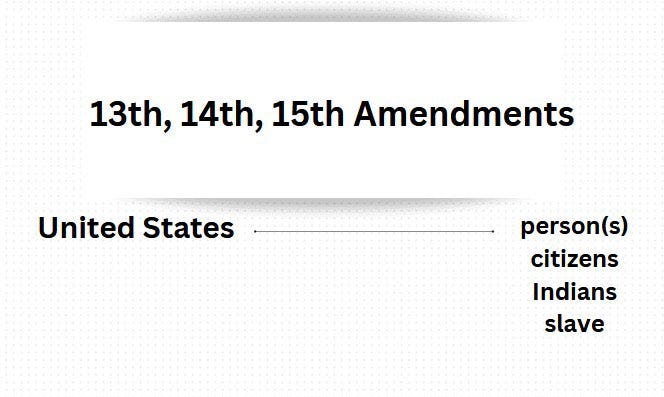
The Reconstruction Amendments — the 13th,27 abolishing slavery (ratified on December 6, 1865); the 14th,28 assuring equal protection and birthright citizenship (ratified on July 9, 1868); and the 15th,29 protecting voting rights irrespective of race (ratified on February 3, 1870) — like the 1866 treaties, where aimed at integrating former slaves into society as full citizens with equal rights under law at the state, territorial and federal levels. In this bi-dimensional context, with 1. the United States and 2. the individual as the primary parties irrespective of race (including, but not limited to African Americans), the Amendments sought to integrate African American individuals fully and unequivocally into the American polity.
Figure 2
The Binary Relationship Between the United States and the Individual
More specifically, the 13th Amendment to the United States Constitution, ratified in 1865, abolished slavery and involuntary servitude in the United States. Its primary legal effect was to outlaw slavery across the United States. The 13th Amendment applies Universally across the United States to all individuals under its jurisdiction. The 14th Amendment, ratified in 1868, conferred citizenship to all persons born or naturalized in the United States (which includes, but is not limited to, former slaves). It ensured equal protection under the laws. It provided a constitutional guarantee of citizenship and legal equality to African Americans. Like the 13th amendment, the 14th Amendment applies universally across the United States to all citizens and persons under its jurisdiction. The 15th Amendment, ratified in 1870, granted African American men the right to vote by stating that the right to vote could not be denied based on race, color, or previous condition of servitude. Like the previous two amendments, the 15th aimed to ensure rights and protections universally across the United States to all (although the 15th Amendment at the time was limited to male citizens.)
Subsequent legal battles fought by African Americans primarily involved the interpretation and enforcement of equality under the law protected within the Constitutional amendments and the provisions of civil rights legislation passed by Congress contemporaneously with the Reconstruction Amendments or thereafter. The well-known, less well-known, and untold legal battles confronted by African Americans, like those confronting the tribal Freedmen, have entailed an arduous and protracted path toward freedom and full citizenship with equal Constitutional and civil rights, both for themselves and for all persons domestically, and persons in analogous international contexts.
Black Codes were laws passed by State and local governments throughout various periods of time, primarily in the Southern United States after the end of the American Civil War. These laws were aimed at interfering with voting and other rights gained by freed African Americans and their descendants after the war. Similarly, Jim Crow laws were introduced by State and local governments to enforce racial segregation. In Plessy v. Ferguson, decided on May 18, 1896, the Supreme Court affirmed the Constitutionality of racial segregation as long as the segregated facilities were of equal character and quality. In Brown v. Board of Education, decided over half a century later, on May 17, 1954, the Supreme Court rejected segregation in public schools in a decision that had profound influence on the burgeoning Civil Rights Movement. The Civil Rights Movement lasted from 1954 to 1968 and culminated in part with the passages of the Civil Rights Act of 1964 (eliminating enforced racial segregation), the Voting Rights Act of 1965, and the Fair Housing Act of 1968.
The Reparations Movement is a movement that began after emancipation and first gained traction in the late 1800’s, shaped by pioneers, such as Callie House, a leader, who fought for a Federal ex-slave pension. At the present time, activists and advocates have recently reignited the movement for reparative justice for African American Freedman descendants and for political policy directly aimed at the broader Black American community.
2.1 The Freedmen’s Bureau, The Freedman’s Savings Bank and 1870 Census
The Bureau of Freedmen, Refugees, and Abandoned Lands, commonly known as the Freedmen’s Bureau, was established on March 3, 1865, by an act of Congress30 and was part of the United States Army. Similarly, the Freedman’s Saving and Trust Company, usually referred to as the Freedman’s Savings Bank, was chartered on the same day in 1865 by an act of Congress. These legislative acts were designed to assist the millions of Freedmen (the formerly enslaved and their descendants) during the Reconstruction Era in the United States, which was a period of military occupation of Southern states from 1865 to 1877 following the end of the American Civil War. Congressional legislators drafted and debated many versions of these bills before their eventual passage. These drafts and debates clarify the scope of the bills’ mandates. The final mandates focused on assistance with education, employment, health care, and legal claims among other issues. Furthermore, the Freedman’s Savings Bank was incorporated to assist Freedmen in saving funds and promote general economic development among the Freedmen. At one point, the bank deposits totaled over $2.9 million from 61,131 depositors. Both the Bureau and the Bank were established with the specific intent of aiding the transition from slavery to freedom and facilitating the establishment of equal legal, social and political status for all Freedmen and their descendants.
Almost all newly emancipated African Americans make their first appearance in a Federal census in 1870. Scott Joplin, who would later become the “King of Ragtime,” a music genre that would serve as a precursor to jazz, appeared in the 1870 census along with family members. That was an occurrence that would not have been possible a decade earlier. Prior to 1870, enslaved African Americans were listed as property on slave schedules, and only denoted as a total tally of slaves owned by the named slave holder. Although occasionally slave names were listed on these records, that was a rare exception.
2.2 Fairfield v. Lawson and Davenport v. Caldwell
Two judicial cases shine further light on the legal, social and political status of Freedmen, now referred to as Freedman descendants in the post-Reconstruction era both in the Northern and the Southern regions within the United States.
Fairfield v. Lawson,31 a decision rendered by the Supreme Court of Errors of Connecticut in its January term of 1883, dealt with the interpretation of the Last Will and Testament of David Lawson and the disposition of his estate that was intended to benefit the education of Freedmen as directed by Mr. Lawson’s wishes. The Court needed to decide on the admissibility of certain evidence and determine the proper organization to receive the legacy (the testator’s intent). The case involved the application of trusts and estate law to a bequest that Mr. Lawson made to the Freedmen. It addressed how to carry out the philanthropic intent of Mr. Lawson’s Last Will and Testament regarding the term Freedmen by discussing how the term Freedmen was understood by the Courts and society at that time, a time subsequent to the end of the Reconstruction era. What follows are the most salient portions of the Court’s decision in regard to Freedmen and Freedman descendants.
“A testator gave certain property to a trustee, for the use of his widow during her life, and after her death “the income to be devoted to the education of the freedmen, and paid over annually to the proper officers of the Freedmen’s Association for that purpose by the trustee.” The term “freedmen” was one generally applied to the lately emancipated slaves and their descendants.”…“That evidence that the testator told the scrivener who drew the will that he wanted to give the income of the property in trust for the education of the freedmen, and that there was a freedmen’s association organized by the Methodist church”…“Besides, the freedmen were several millions in number, and no power was given to the trustee, or to any one, to select the individuals who should receive the benefit. Every individual would therefore have a right to share in the bounty, and it would be impossible to administer the trust.”
The Supreme Court of Errors of Connecticut then lists various Freedmen’s organizations (social and legal entities that were in existence prior to and at the time of the Court’s ruling): The Divers associations, organized for and engaged in the work of educating the Freedmen; the Hartford Freedmen’s Aid Society, in Hartford, CT; the New England Freedmen’s Aid Society in Boston, MA; the Freedmen’s Aid Society in Cincinnati, OH; the Freedmen’s Bureau; and the Freedman’s Bank. Finally, the Court discusses its understanding of Freedmen:
“The court further finds that the term “freedmen,” as used in the will, refers to that class of persons in the United States who were emancipated from slavery during our late civil war or by its results, and embraces also the descendants of such persons.”
Justice Dwight Loomis expounds more explicitly: “It is found that the term “freedmen,” as used in the will, refers to that class of persons who were emancipated during the late civil war and their descendants. As matter of common knowledge, we may be permitted to say that the numbers composing this class [in 1883] are now about six millions (sic).” Justice Dwight Loomis in his contemplation, describes a class of Freedmen [in 1883] that was composed of more than 6 million descendants of formerly enslaved and free African Americans living in the United States prior to 1865. A consideration of that class’s permanence and multi-generational character was given by the Court. It occurred post-Reconstruction era and post closure of both the Freedmen’s Bureau and the Freedman’s Bank.
Davenport v. Caldwell32 revolved around the legitimacy of the plaintiffs’ claim to inheritance, a dispute stemming from the interpretation of an act that legitimized certain marriages and children retrospectively. Although, the focus was primarily on domestic relations and property rights within the post-American Civil War legal adjustments it had broader implications for children born into slavery. The case discussed Freedmen and Freedman descendants in the context of the recognition of familial relationships and inheritance rights according to State law and the implications of several legislative acts for former slaves and their children in light of emancipation. Like Fairfield v. Lawson, this case references and discusses the class of individuals who were referred to as Freedmen, now referred to as Freedman descendants.
These cases shed light on the legal, social and political status of Freedmen in the post-Reconstruction era. The decision for Fairfield v. Lawson (1883) remains as mandatory legal authority in Connecticut that has not been subsequently revisited, reversed, overruled, or superseded. Likewise, the decision in Davenport v. Caldwell (1878) remains the mandatory legal authority in South Carolina and has not been subsequently revisited, reversed, overruled, or superseded.
2.3 The American Freedmen’s Inquiry Commission, Various Freedman’s Towns, Hospitals and Other Institutions
The Federal American Freedmen’s Inquiry Commission,33 as well as various Freedmen’s towns, hospitals, schools, and other institutions, were established during the Reconstruction Era following the American Civil War to aid and support emancipated slaves and their descendants.
The Federal American Freedmen’s Inquiry Commission was tasked with investigating and proposing solutions for the issues facing the newly emancipated slaves and their descendants. It was designed as a fact-finding body to inform government policy. The Commission’s work, like that of the Freedmen’s Bureau and similar institutions, was intended as a part of the Reconstruction efforts — a period aimed at integrating formerly enslaved individuals into society as free citizens with equal rights.
Shortly after emancipation, notable Freedmen’s towns were established throughout the United States and built by the recently freed African Americans. The Freedmen built homes, churches, hospitals, schools, commercial centers and established countless organizations. Immediately post-Reconstruction, Freedman organizations and communities were ubiquitous throughout both the Northern and Southern regions of the United States. However, these Freedman organizations and communities became less common during the progression towards the mid-twentieth century and have become almost a forgotten vestige of the past since the end of the Jim Crow era. These facilitations, organizations and communities of the late 1800’s to mid-1900’s, bearing the weight of their operational existence, have today all but disappeared, as African Americans have integrated into the broader American society.
- Types of Status: Generally, Legal Status, Social Status and Political Status
In the broadest sense, status refers to the condition or situation of a person in relation to others. It can be the sum of a plethora of factors, which can include legal, social, political, economic, cultural, and many other types of statuses. Each type of status may have incongruent definitions, exist in different ways and may or may not carry rights, privileges, duties, immunities, obligations, capacities and/or incapacities (i.e., veteran status, conviction status, immigration status) and also for varying periods of time. Each type of status must not be conflated with other types of status (especially per scope and duration). For example, if an individual/group of individuals has a social status, this status does not necessarily mean that this same individual/group of individuals also has legal status although it can mean so). The creation of statuses can sometimes have arbitrary effects on social status.
While not “statuses” in the traditional sense, a good illustration of this point is the 1977 directive issued by the United States Office of Management and Budget (OMB), which set standards for the classification of race and ethnicity along with accompanying definitions within the United States34 (as well as for the 1790–2020 United States Census categories for race and ethnicity). An unexpected consequence was that the directive (and the Census) resulted in social constructs being created within the society around each category and subsequent category that was being introduced. “These legal/bureaucratic categories had broad effects on Americans’ self-perception. As Lawrence Wright35 noted: “By attempting to provide a way for Americans to describe themselves, the categories actually began to shape those identities. What was even more significant, they caused people to think of themselves in new ways — as members of “races” that [actually] were little more than statistical devices.”36
Legal Status37 refers specifically to the standing or condition of an individual as recognized by both legal principles and Court orders. Legal status is defined differently by different courts in reference to different matters. However, legal status generally encompasses rights, privileges, duties, immunities, obligations, capacities and/or incapacities under the law for varying durations of time.38 Examples include citizenship status, marital status, capacity status, competency status, conviction status, veteran status or immigration status. Each of these legal designations carries specific legal rights, such as the right to vote, the right to government benefits, and the right to enter contracts (with legally defined ways of their being created and even terminated for example).
Social status is determined primarily by socio-cultural contexts and reflects an individual’s rank or position within society that is not necessarily codified by law.39 Social status can be based on different factors, such as wealth, education, profession, ethnicity, ancestry and family background. Social status often shapes how individuals are perceived and treated by others during social interactions and can sometimes influence their legal treatment.
Political Status is an individual’s or group’s position or standing in the context of politics and governance. This status can include association with certain political rights or sovereignty. For example, the political status of a territory includes whether it is a recognized state, a colony, or a protectorate. For an individual, being a political refugee constitutes a specific political status. Refugees are not United States citizens and have been forced away from their original country due to persecution, natural disaster, or war, for example. These refugees have a pathway to become legal permanent residents and then United States citizens; each legal status and any change in that legal status is explicitly defined and outlined in Federal law and Court decisions. A group’s political status often also has implications related to international law.
- Freedman: Status and Descent
The multitude of Federal legal instruments, such as the 1866 Treaties, the Dawes Rolls and Court decisions provide a confluence of the law in which tribal Freedmen and their descendants have rights that are distinctively sought and pertain to their relationship with their tribes and the Federal government. These rights often include matters of tribal citizenship and land allotments.
There is an analogous and more expansive convergence happening currently for African Americans Freedman descendants. The Emancipation Proclamation, special field orders, Freedmen’s Bureau and Freedman’s Bank legislation, Reconstruction Amendments, civil rights and anti-discrimination laws, and the vast canon of judicial decisions can provide an useful avenue for advocates to pursue clarification of their rights as they relate to their status as Freedman descendants. Further development and elucidation of this understanding of the Freedmen, Freedman descendants, and Freedman legal, social and political statuses and descent in the broader United States context will certainly occur in the ensuing years and should occur.
Acknowledgements
Deep appreciation to the individuals and organizations that have shaped the movement for reparative justice for African Americans: Callie House; Audley Moore; John Conyers; Sheila Jackson Lee; Ron Daniels; Kamm Howard; Nikole Hannah-Jones; William A. Darity, Jr.; Nkechi Taifa; Adjoa A. Aiyetoro; Deadria Farmer-Paellmann; Kenniss Henry; Jessica Ann Mitchell Aiwuyor; NAACP; NAARC; N’COBRA; NCBL; NBCI Trust; ADOSAF; USADOF; local, state and federal legislators throughout the United States; activists, advocates, allies and many others.
References
1 An Act to Establish a Bureau for the Relief of Freedmen and Refugees, 13 Stat. 507, 38 Cong. Ch. 90.
2 The Modern American Law of Race, 94. S. Cal. L. Rev. 171.
3 Treaty with the Cherokee, 1866, art. IV, Jul. 27, 1866, 14 Stat. 799, 2 KAPP 942 (“All the Cherokees and freed persons who were formerly slaves to any Cherokee, and all free negroes not having been such slaves, who resided in the Cherokee Nation prior to June first, Eighteen hundred and sixty-one, who may within two years elect not to reside northeast of the Arkansas River and southeast of Grand River, shall have the right to settle in and occupy the…”); Treaty with the Cherokee, 1866, art. V, Jul. 27, 1866, 14 Stat. 799, 2 KAPP 942 (“and shall hold the same rights and privileges and be subject to the same liabilities as those who elect to settle in said district under the provisions of this treaty”); Treaty with the Cherokee, 1866, art. IX, Jul. 27, 1866, 14 Stat. 799, 2 KAPP 942 (“The Cherokee Nation having, voluntarily, in February, Eighteen hundred and sixty-three, by an act of the national council, forever abolished slavery, hereby covenant and agree that never hereafter shall either slavery or involuntary servitude exist in their nation otherwise than in the punishment of crime, whereof the party shall have been duly convicted, in accordance with laws applicable to all the members of said tribe alike. They further agree that all freedmen who have been liberated by voluntary act of their former owners or by law, as well as all free colored persons who were in the country at the commencement of the rebellion, and are now residents therein, or who may return within six months, and their descendants, shall have all the rights of native Cherokees: Provided, that owners of slaves so emancipated in the Cherokee Nation shall never receive any compensation or pay for the slaves so emancipated.”); Treaty with the Cherokee, 1866, art. X, Jul. 27, 1866, 14 Stat. 799, 2 KAPP 942 (“Every Cherokee and freed person resident in the Cherokee Nation shall have the right to…”).
4 Treaty with the Choctaw and Chickasaw, 1866, art. II, Jun. 28, 1866, 14 Stat. 769, 2 KAPP 918 (“The Choctaws and Chickasaws hereby covenant and agree that henceforth neither slavery nor involuntary servitude, otherwise than in punishment of crime whereof the parties shall have been duly convicted, in accordance with laws applicable to all members of the particular nation, shall ever exist in said nations.”); Treaty with the Choctaw and Chickasaw, 1866, art. III, Jun. 28, 1866, 14 Stat. 769, 2 KAPP 918 (“The Choctaws and Chickasaws, in consideration of the sum of three hundred thousand dollars, hereby cede to the United States the territory west of the 98 west longitude, known as the leased district, provided that the said sum shall be invested and held by the United States, at an interest not less than five per cent., in trust for the said nations, until the said nations, until the legislatures of the Choctaw and Chickasaw Nations respectively shall have made such laws, rules, and regulations as may be necessary to give all persons of African descent, resident in the said nations at the date of the treaty of Fort Smith, and their descendants, heretofore held in slavery among said nations, all the rights, privileges, and immunities, including the right of suffrage, of citizens of said nations, except in the annuities, moneys, and public domain claimed by, or belonging to, said nations respectively; and also to give to such persons who were residents as aforesaid, and their descendants, forty acres each of the land of said nations on the same terms as the Choctaws and Chickasaws, to be selected on the survey of said land, after the Choctaws and
Chickasaws and Kansas Indians have made their selections as herein provided; and immediately on the enactment of such laws, rules, and regulations, the said sum of three hundred thousand dollars shall be paid to the said Choctaw and Chickasaw Nations in the proportion of three-fourths to the former and one-fourth to the latter, less such sum, at the rate of one hundred dollars per capita, as shall be sufficient to pay such persons of African descent before referred to as within ninety days after the passage of such laws, rules, and regulations shall elect to remove and actually remove from the said nations respectively. And should the said laws, rules and regulations not be made by the legislatures of the said nations respectively, within two years from the ratification of this treaty, then the said sum of three hundred thousand dollars shall cease to be held in trust for the said Choctaw and Chickasaw Nations, and be held for the use and benefit of such of said persons of African descent as the United States shall remove from the said Territory in such manner as the United States shall deem proper,-the United States agreeing, within ninety days from the expiration of the said two years, to remove from said nations all such persons of African descent as may be willing to remove; those remaining or returning after having been removed from said nations to have no benefit of said sum of three hundred thousand dollars, or any part thereof, but shall be upon the same footing as other citizens of the United States in the said nations.”); Treaty with the Choctaw and Chickasaw, 1866, art. IV, Jun. 28, 1866, 14 Stat. 769, 2 KAPP 918 (“The said nations further agree that all Negroes, not otherwise disqualified or disabled, shall be competent witnesses in all civil and criminal suits and proceedings in the Choctaw and Chickasaw courts, any law to the contrary notwithstanding; and they fully recognize the right of the freedmen to a fair remuneration on reasonable and equitable contracts for their labor, which the law should aid them to enforce. And they agree, on the part of their respective nations, that all laws shall be equal in their operation upon Choctaws, Chickasaws, and Negroes, and that no distinction affecting the latter shall at any time be made, and that they shall be treated with kindness and be protected against injury; and they further agree, that while the said freedmen, now in the Choctaw and Chickasaw Nation, remain in said nations, respectively, they shall be entitled to as much land as they may cultivate for the support of themselves and families, in cases where they do not support themselves and families by hiring, not interfering with existing improvements without the consent of the occupant, it being understood that in the event of the making of the laws, rules, and regulations aforesaid, the forty acres aforesaid shall stand in place of the land cultivated as last aforesaid.”).
5 Treaty with the Creeks, 1866, art. II, Jul. 19, 1866, 14 Stat. 785, 2 KAPP 931 (“The Creeks hereby covenant and agree that henceforth neither slavery nor involuntary servitude, otherwise than in the punishment of crimes, whereof the parties shall have been duly convicted in accordance with laws applicable to all members of said tribe, shall ever exist in said nation; and inasmuch as there are among the Creeks many persons of African descent, who have no interest in the soil, it is stipulated that hereafter these persons lawfully residing in said Creek country under their laws and usages, or who have been thus residing in said country, and may return within one year from the ratification of this treaty, and their descendants and such others of the same race as may be permitted by the laws of the said nation to settle within the limits of the jurisdiction of the Creek Nation as citizens [thereof,] shall have and enjoy all the rights and privileges of native citizens, including an equal interest in the soil and national funds, and the laws of the said nation shall be equally binding upon and give equal protection to all such persons, and all others, of whatsoever race or color, who may be adopted as citizens or members of said tribe.”); Treaty with the Creeks, 1866, art. IV, Jul. 19, 1866, 14 Stat. 785, 2 KAPP 931 (“Immediately after the ratification of this treaty the United States agree to ascertain the amount due the respective soldiers who enlisted in the Federal Army, loyal refugee Indians and freedmen, in proportion to their several losses, and to pay the amount awarded each, in the following manner, to wit: A census of the Creeks shall be taken by the agent of the United States for said nation, under the direction of the Secretary of the Interior, and a roll of the names of all soldiers that enlisted in the Federal Army, loyal refugee Indians, and freedmen, be made by him. The superintendent of Indian Affairs for the Southern Superintendency and the agent of the United States for the Creek Nation shall proceed to investigate and determine from said roll the amounts due the respective refugee Indians, and shall transmit to the Commissioner of Indian Affairs for his approval, and that of the Secretary of the Interior, their awards, together with the reasons therefor. In case the awards so made shall be duly approved, said awards shall be paid from the proceeds of the sale of said lands within one year from the ratification of this treaty, or so soon as said amount of one hundred thousand ($100,000) dollars can be raised from the sale of said land to other Indians.”).
6 Treaty with the Seminole, 1866, art. II, Jul. 19, 1866, 14 Stat. 755, 2 KAPP 910 (“The Seminole Nation covenant that henceforth in said nation slavery shall not exist, nor involuntary servitude, except for and in punishment of crime, whereof the offending party shall first have been duly convicted in accordance with law, applicable to all the members of said nation. And inasmuch as there are among the Seminoles many persons of African descent and blood, who have no interest or property in the soil, and no recognized civil rights it is stipulated that hereafter these persons and their descendants, and such other of the same race as shall be permitted by said nation to settle there, shall have and enjoy all the rights of native citizens, and the laws of said nation shall be equally binding upon all persons of whatever race or color, who may be adopted as citizens or members of said tribe.”).
7 Treaty with the Cherokee, 1866, art. V, Jul. 27, 1866, 14 Stat. 799, 2 KAPP 942 (“and to control all their local affairs, and to establish all necessary police regulations and rules for the administration of justice in said district, not inconsistent with the constitution of the Cherokee Nation or the laws of the United States…”); Treaty with the Choctaw and Chickasaw, 1866, art. VII, Jun. 28, 1866, 14 Stat. 769, 2 KAPP 918 (“The Choctaws and Chickasaws agree to such legislation as Congress and the President of the United States may deem necessary for the better administration of justice and the protection of the rights of person and property within the Indian Territory: Provided, however, Such legislation shall not in anywise interfere with or annul their present tribal organization, or their respective legislatures or judiciaries, or the rights, laws, privileges, or customs of the Choctaw and Chickasaw Nations respectively.”); Treaty with the Creeks, 1866, art. X, Jul. 19, 1866, 14 Stat. 785, 2 KAPP 931 (“…Provided, however, [that] said legislation shall not in any manner interfere with or annul their present tribal organization, rights, laws, privileges, and customs.”); Treaty with the Seminole, 1866, art. VII, Jul. 19, 1866, 14 Stat. 755, 2 KAPP 910 (“Provided, however, [that] said legislation shall not in any manner interfere with or annul their present tribal organization, rights, laws, privileges, and customs.”).
8 Cherokee Nation v. Hitchcock, 187 United States 294, 23 S. Ct. 115, 47 L. Ed. 183 (1902).
9 United States Statutes At Large, 55 Cong. Ch. 517, June 28, 1898, 30 Stat. 495.
10 Vann v. Kempthorne, 534 F.3d 741 (D.C. Cir. 2008).
11 Cherokee Nation v. Nash, 267 F. Supp. 3d 86 (D.D.C. 2017), enforced sub nom. In re Effect of Cherokee Nation v. Nash, No. SC-17–07, 2017 WL 10057514 (Cherokee Sup. Ct. Sept. 1, 2017), judgment entered sub nom. Effect of Cherokee Nation v. Nash, No. SC-17–07, 2021 WL 2011566 (Cherokee Sup. Ct. Feb. 22, 2021).
12 Choctaw Nation of Indians v. United States, 318 United States 423, 63 S. Ct. 672, 87 L. Ed. 877 (1943).
13 Chickasaw Nation v. United States, 95 Ct. Cl. 192, 201 (Ct.Cl.,1941) (“In Article III of the treaty, the tribes ceded to the United States a part of their territory, in consideration of the sum of $300,000 to be held in trust by the United States, until the legislatures of the tribes should within two years confer upon their former slaves, or freedmen the privileges of citizens, excepting rights in the “annuities, moneys, and public domain of the tribes,” and also should give each freedman forty acres of land. It is provided that if these benefits were not conferred upon the freedmen, the United States would remove the freedmen from among the Indians, and hold the money in trust for the freedmen. The tribes did not adopt the specified legislation within the two-year period and the United States did not thereafter remove the freedmen. Hence they remained with the Indians without defined political status or property rights.”)
14 Seminole Nation of Oklahoma v. Norton, 223 F. Supp. 2d 122 (D.D.C. 2002).
15 The Final Rolls of Citizens and Freedmen of the Five Civilized Tribes in Indian Territory, (Mar. 4, 1907), available at https://catalog.archives.gov/id/300321.
16 Tanner-Brown v. Jewell, 153 F.Supp.3d 102, 104- 109 (D.D.C., 2016). (“Plaintiffs filed this action under Rule 23 of the Federal Rules of Civil Procedure on behalf of “all persons who are or were descendants of Freedmen minor allottees… Plaintiffs have standing to seek an accounting by reason of their relationship to the Freedmen minors.”).
17 United States Const. amend. XIV.
18 Indian Citizenship Act of 1924, 68 P.L. 175, 43 Stat. 253, 68 Cong. Ch. 233, 68 P.L. 175, 43 Stat. 253, 68 Cong. Ch. 233.
19 Dawes Act of 1887, Ch. 119, 24 Stat. 388 (codified as amended at 25 United States C. 331–334, 339, 341–342, 348–349, 354, 381 (1994)).
20 Anderson Publishing Co., The Law Dictionary (7th ed. 2002). (“Nationality — political status acquired by belonging to a nation or state. lt arises by birth or by naturalization, and determines the allegiance of a person… Also: See also, citizen and citizen of the United States”). See also Davis v. Guam, 785 F.3d 1311 (9th Cir. 2015) (“provides for a “Political Status Plebiscite.” Id. § 2110. The plebiscite would ask eligible Native Inhabitants to choose among three options: (1) “Independence,” (2) “Free Association with the United States of America” or (3) “Statehood.””).
21 Cherokee Nation v. State of Ga., 30 United States 1, 8 L. Ed. 25 (1831).
22 United States v. Long, 324 F.3d 475, 479 (7th Cir. 2003). (“Indian tribes are nonetheless viewed as quasi-independent or domestic dependent nations within the United States.”).
23 Elk v. Wilkins, 112 United States 94, 5 S. Ct. 41 (1884).
24 Johnson v. M’Intosh, 21 United States (8 Wheat.) 543 (1823).
25 Cherokee Nation v. State of Ga., 30 United States 1, 8 L. Ed. 25 (1831).
26 Worcester v. Georgia, 31 United States 515 (1832).
27 United States Const. amend. XIII.
28 United States Const. amend. XIV.
29 United States Const. amend. XV.
30 An Act to Establish a Bureau for the Relief of Freedmen and Refugees, 13 Stat. 507, 38 Cong. Ch. 90.
31 Fairfield v. Lawson, 50 Conn. 513, 47 Am. Rep. 669.
32 Davenport v. Caldwell, 10 S.C. 333, 10 Richardson 317.
33 S. Exec. Doc. №38–53, at 99 (1st Sess. 1864).
34 Office of Management and Budget, Statistical Policy Directive №15, Race and Ethnic Standards for Federal Statistics and Administrative Reporting (1977).
35 Lawrence Wright is a fellow at the Center for Law and Security at the New York University School of Law. He is also a staff writer for The New Yorker magazine.
36 The Modern American Law of Race, 94. S. Cal. L. Rev. 171. (“A National Academy of Sciences Report points out several anomalies in the categories: ‘There is no race category that includes persons native to Central and South America. There is no race category for blacks who come from areas in the world other than Africa, and there is uncertainty about many persons from northern parts of Africa.’ SPOTLIGHT ON HETEROGENEITY: THE FEDERAL STANDARDS FOR RACIAL AND ETHNIC CLASSIFICATION, supra note 144, at 25. Additionally, ‘It [the current classification] does not cover persons of Australian or New Zealand origin… It allows no place for American Indians whose cultural identity is not recognized by a tribe, but who are nonetheless descendants of the original peoples of North America. It leaves ambiguous or confused the status of many groups, including people from Brazil, Madagascar, and Cape Verde.” Id. at 37–38.”); Lawrence Wright, One Drop of Blood, NEW YORKER, July 25, 1994, at 52–53.
37 Vasquez de Alcantar v. Holder, 645 F.3d 1097, 1102 (9th Cir. 2011) (“[s]tanding; state or condition,” and as “[t]he legal relation of [an] individual to [the] rest of the community.” Black’s Law Dictionary 1264 (5th ed. 1979)…It denotes someone who possesses a certain legal standing.”).
38 May v. Daniels, 359 Ark. 100, 108 (Ark. 2004). (“legal rights, obligations, privileges, and immunities of marriage.”).
39 Emile Benoit-Smullyan, Status, Status Types, And Status Interrelations, 9 Am. Socio. Rev. 2 (1944).
메타데이터
- post_id
- bbd8b40fddb6
- slug
- the-emergence-of-a-freedman-status-amongst-black-american-reparations-advocates-in-progress-bbd8b40fddb6
- url
- https://medium.com/@kevinlt123/the-emergence-of-a-freedman-status-amongst-black-american-reparations-advocates-in-progress-bbd8b40fddb6
- canonical_url
- https://medium.com/@kevinlt123/the-emergence-of-a-freedman-status-amongst-black-american-reparations-advocates-in-progress-bbd8b40fddb6
- author_url
- https://medium.com/@kevinlt123
- status
- ok
- fetched_at
- 2026-08-03 22:49:54