25 Critical Questions to Ask a Warehouse Striping Contractor Before Hiring
25 Critical Questions to Ask a Warehouse Striping Contractor Before Hiring
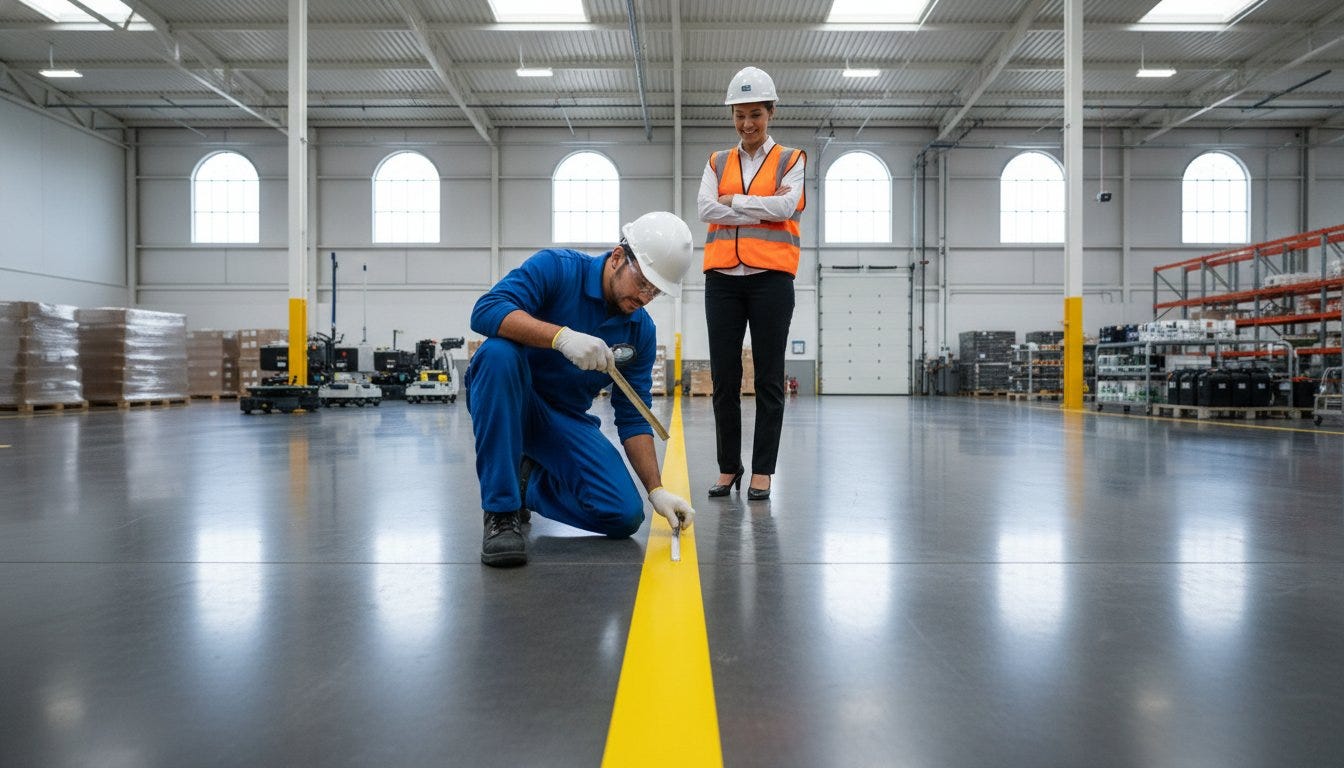
With OSHA penalties for serious violations reaching up to $16,550 in 2026, a single non-compliant aisle can quickly become a massive financial liability. You likely understand that floor markings are not just a janitorial task; they are a critical safety engineering project. However, distinguishing between a low-bid parking lot painter and a true industrial professional is difficult until the lines start peeling six months later. To protect your budget and your team, you need a specific list of questions to ask a warehouse striping contractor before signing any contract.
We know how frustrating it is to deal with extended facility downtime or markings that don’t stand up to heavy forklift traffic. This comprehensive checklist ensures you hire a partner who prioritizes OSHA compliance, surface durability, and minimal operational impact. We will examine the technical requirements for industrial markings, ranging from mechanical surface preparation like shot blasting to the selection of high-performance epoxy coatings that withstand the rigors of modern logistics.
Key Takeaways
- Distinguish between general painters and industrial specialists to avoid the high costs of non-compliant markings and frequent repainting.
- Identify why mechanical surface preparation, like shot blasting or diamond grinding, is the only way to ensure permanent adhesion for epoxy line painting.
- Discover the essential questions to ask a warehouse striping contractor regarding their moisture testing procedures and chemical compatibility standards.
- Protect your operational output by learning how to vet a contractor’s “return-to-service” timeline for heavy forklift traffic and automated machinery.
- Use our final checklist to verify a contractor’s safety record and historical tenure on large-scale industrial projects exceeding 50,000 linear feet.
Table of Contents
- Why Vetting Your Warehouse Striping Contractor Is a Safety Mandate
- The Technical Core: Questions About Surface Prep and Materials
- Operational Logistics: Questions to Protect Your Production Schedule
- Credibility and Compliance: Vetting the Contractor’s Background
- The Ultimate Warehouse Striping Contractor Checklist
Why Vetting Your Warehouse Striping Contractor Is a Safety Mandate
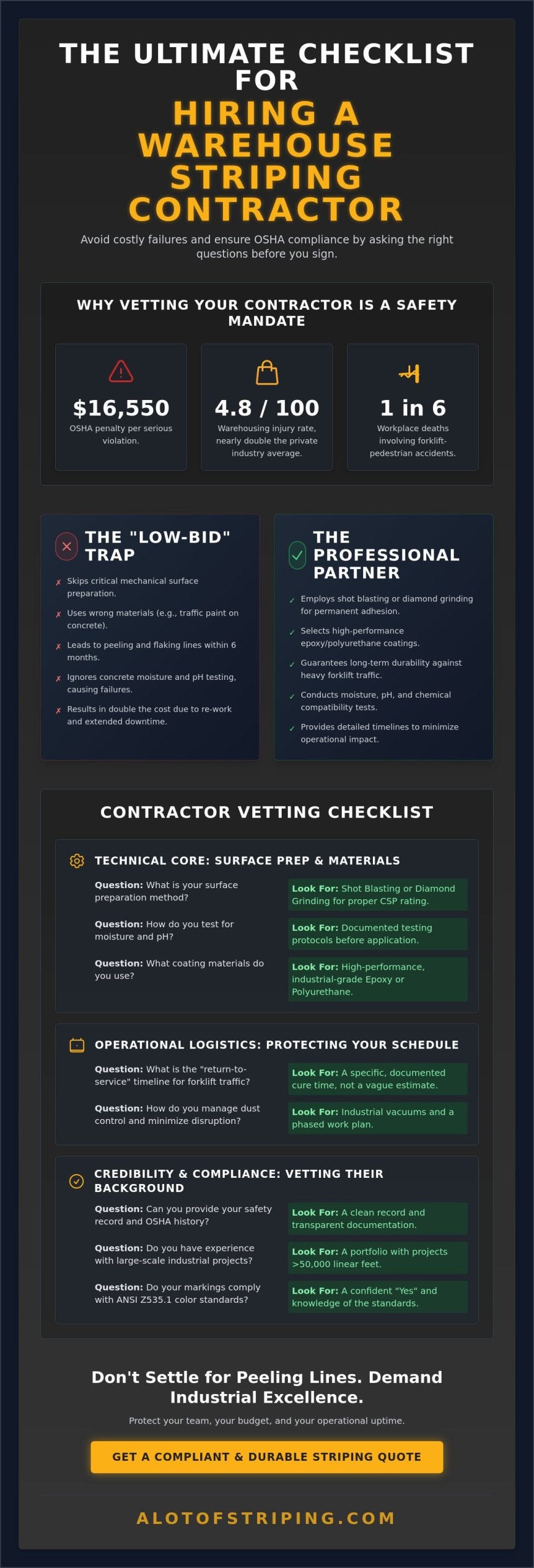
Safety in a high-velocity warehouse environment is a matter of precision, not just aesthetics. With the warehousing sector facing an injury rate of 4.8 cases per 100 workers, nearly double the private industry average, the clarity of your floor markings is a legal obligation. Hiring the wrong team leads to more than just peeling lines; it results in OSHA citations that can reach $16,550 per serious violation. This is why the specific questions to ask a warehouse striping contractor must focus on their understanding of industrial safety standards rather than just their price per foot.
As of 2026, OSHA is intensifying its focus on heat illness prevention and hazard communication. The May 2024 updates to the Hazard Communication Standard require updated labeling and employee training that must be reflected in your facility’s physical layout. A “fresh coat of paint” is no longer sufficient. You need a marking system that integrates with these evolving safety protocols. A general parking lot painter often lacks the equipment for deep mechanical surface preparation. They might use traffic paint designed for asphalt, which fails rapidly on polished or sealed concrete. In contrast, an industrial specialist treats warehouse floor striping as a technical installation that accounts for forklift traffic patterns and chemical exposure.
The Difference Between Paint and a Marking System
Industrial floors require a cohesive visual communication strategy. High-quality markings, whether they involve epoxy line painting or high-durability Floor marking tape, serve as the foundation for the 5S lean manufacturing methodology. When lines are crisp and logically placed, they reduce the risk of forklift-pedestrian accidents, which currently account for one out of every six workplace deaths. Effective markings improve facility throughput by removing the guesswork from navigation, directly impacting employee morale and the overall safety culture. A specialist understands these nuances, ensuring that your questions to ask a warehouse striping contractor cover ANSI Z535.1 color standards and pedestrian clearance requirements.
Avoiding the ‘Low-Bid’ Trap in Industrial Environments
The lowest estimate often hides the highest long-term costs. Cut-rate contractors frequently save money by skipping the cleaning and mechanical profiling steps, such as diamond grinding or shot blasting, that are essential for chemical adhesion. Without this preparation, even the best epoxy will flake off under the weight of a 10,000-pound forklift within months. Paying for a second installation six months later doubles your downtime and your total spend. Technical expertise justifies a higher initial investment because it provides a durable surface that withstands the 2026 operational demands of automated guided vehicles and heavy machinery. A professional partner will provide:
- Verification of concrete moisture and pH levels before application.
- Mechanical surface profiling to achieve the correct Concrete Surface Profile (CSP) rating.
- Detailed return-to-service timelines to protect your production schedule.
- Documentation of chemical compatibility between existing coatings and new materials. Choosing a contractor based on these technical capabilities ensures that your facility remains compliant and your workers stay safe.
The Technical Core: Questions About Surface Prep and Materials
The durability of your facility markings depends almost entirely on the chemical bond between the coating and the concrete substrate. While outdoor asphalt projects rely on heavy-bodied traffic paints, indoor concrete requires a more sophisticated approach. When evaluating potential partners, your questions to ask a warehouse striping contractor must prioritize their technical preparation process. Without the correct mechanical profile, even the most expensive industrial resins will eventually delaminate under the lateral shear forces of a turning forklift.
A professional contractor should provide a detailed plan for removing existing, failing lines before applying new materials. Using shot blasting line removal is often the most efficient way to clear old markings while simultaneously prepping the floor. You should also inquire about their moisture and pH testing protocols. High alkalinity or excessive moisture vapor transmission can cause osmotic blistering, leading to premature failure of epoxy line painting. If a contractor doesn’t mention testing the slab, they’re likely skipping a step that protects your long-term investment.
Mechanical Preparation: The Secret to Longevity
Mechanical preparation is the only reliable way to ensure long-term adhesion. Shot blasting is the gold standard because it fires steel shot at the floor to strip away contaminants and “open” the concrete pores. This is superior to diamond grinding in high-traffic zones because it creates a deeper texture for the resin to grip. You should avoid any contractor who suggests chemical etching or simple power washing for indoor environments; these methods introduce moisture and hazardous fumes without providing the necessary physical bond. An adhesion profile refers to the specific texture or “tooth” created on a concrete surface through mechanical abrasion that allows liquid resins to form a permanent mechanical bond. Ensuring a dust-free environment is also critical, so confirm that their equipment uses HEPA-filtered vacuum systems to maintain air quality during the process.
Material Science: Beyond Standard Traffic Paint
Standard traffic paint is designed for the flexible surface of asphalt and rarely lasts more than a few months on a warehouse floor. For industrial settings, you need high-solids epoxies or polyaspartics that offer superior chemical resistance and UV stability. These materials are formulated to withstand the heat generated by forklift tires and the harsh detergents used in industrial floor scrubbers. When selecting colors, ensure the materials align with OSHA’s safety color code to maintain total regulatory compliance. To achieve razor-sharp edges on porous concrete, ask if they use a “seal coat” or “bleed-blocking” primer. This technique prevents the pigment from wicking into the concrete grain, ensuring the clean lines necessary for high-visibility safety zones.
Operational Logistics: Questions to Protect Your Production Schedule
Executing a large-scale project in a live industrial environment requires more than just technical skill; it demands logistical precision. Your list of questions to ask a warehouse striping contractor must prioritize their ability to work around your production schedule without compromising throughput. A professional team should offer flexible scheduling, including off-shift hours or holiday shutdowns, to ensure your operations remain uninterrupted. If a contractor cannot provide a clear timeline for each phase of the project, they likely lack the experience necessary for complex distribution centers.
Compliance with OSHA regulations for warehouse safety mandates that permanent aisles and passageways be kept clear and appropriately marked. This requirement becomes a logistical challenge when striping new lines. You should ask potential partners about their ‘return-to-service’ times for forklift traffic. While some standard resins take 24 hours to cure, advanced polyaspartics or rapid-cure epoxies can handle heavy machinery in as little as four to six hours. Understanding these variables helps you plan for temporary marking solutions if a multi-phase rollout is the only way to keep your facility operational.
Minimizing Downtime and Disruption
High-velocity distribution centers cannot afford extended closures for floor maintenance. Professional contractors coordinate directly with your logistics team to phase the work, often striping one aisle while others remain open for picking and packing. They utilize rapid-cure materials that minimize the window of vulnerability where wet lines could be damaged. Ask how they handle the transition zones between completed sections and active work areas. A seasoned veteran will have a proven strategy for maintaining safety boundaries without halting the flow of goods through your facility.
Indoor Air Quality and Safety Protocols
When finalizing your questions to ask a warehouse striping contractor, clarify their protocols for managing dust and fumes. Indoor environments require the use of Low-VOC (volatile organic compound) or Zero-VOC materials to protect the health of your staff and prevent product contamination. This is especially critical in food-grade or pharmaceutical warehouses where sensitive inventory is at risk. Your contractor must have a written ventilation plan and provide OSHA-mandated respiratory protection for their crew. They should also demonstrate how they manage ‘overspray’ and concrete dust from mechanical preparation to keep your equipment and inventory pristine.
Credibility and Compliance: Vetting the Contractor’s Background
Ensuring a contractor has the technical skill is only half the battle. You must also verify their administrative and safety credentials to protect your organization from third-party liability. When finalizing your questions to ask a warehouse striping contractor, start with their safety record. A company’s Experience Modification Rate (EMR) is a reliable indicator of their safety performance; an EMR below 1.0 suggests a safer-than-average workplace. If a contractor cannot provide this number or lacks a formal safety program, they represent a significant risk to your facility’s operational continuity.
Scale matters in industrial environments. A local parking lot painter might struggle with the sheer volume of a 500,000-square-foot distribution center. Ask for references specifically for projects exceeding 50,000 linear feet to ensure they have the equipment and manpower to handle large-scale applications. Additionally, clarify whether the crew on your floor will be factory-trained employees or local day-labor sub-contractors. Professional Warehouse Floor Striping requires specialized knowledge of chemical ratios and machine calibration that temporary workers often lack.
The Value of National Industrial Experience
Contractors with a multi-decade history (specifically those with 29 or more years in the field) possess the seasoned expertise to handle site-specific surprises like unexpected slab moisture or old adhesive residue. Choosing a single-source contractor for a nationwide portfolio ensures that your safety markings remain consistent across every geographic location. This uniformity is vital for training employees who may move between facilities, as it ensures that “danger” and “clearance” zones look identical in every warehouse you own.
Insurance, Bonding, and Liability Protection
Standard residential or light commercial insurance is insufficient for the high-stakes environment of a modern warehouse. You should require at least $5M in general liability and umbrella insurance to cover potential damage to high-value inventory or automated systems. Workers’ compensation coverage for every person on-site is a non-negotiable requirement to shield your company from injury claims. Finally, verify that the contractor is properly bonded (a financial guarantee of project completion) to protect against project abandonment or substandard workmanship that requires costly remediation.
The Ultimate Warehouse Striping Contractor Checklist
Finalizing your choice requires an objective comparison of operational capabilities. When refining your questions to ask a warehouse striping contractor, the most important verification is whether they own their own shot blasting and grinding equipment. Relying on rental houses introduces unnecessary risk; if a rental machine fails or isn’t available, your production schedule suffers. A contractor with an in-house fleet demonstrates a permanent commitment to the trade and ensures the right tools are always on-site. This final checklist serves as your roadmap for the last set of questions to ask a warehouse striping contractor before the work begins.
Your written estimate should be transparent and detailed. Demand a linear-foot-based breakdown rather than a vague lump-sum figure. This level of detail allows you to audit the work and ensures you only pay for the material actually applied to your floor. Additionally, confirm that a dedicated project manager will be assigned to your facility. This individual acts as your single point of contact (SPOC), coordinating with your shift leads to manage the ‘return-to-service’ windows discussed earlier. Finally, a reputable industrial veteran will offer a multi-year warranty against peeling and delamination, standing behind the integrity of the chemical bond they create.
Final Red Flags to Watch For
Industrial environments are too high-stakes for vague promises. A major red flag is a contractor who refuses to discuss surface preparation in specific, technical detail. If they can’t explain the Concrete Surface Profile (CSP), which is the standardized measure of surface roughness required for adhesion, the lines won’t last. Watch out for vague timelines that don’t provide hard deadlines for when forklift traffic can resume. Most importantly, never hire a team that lacks a formal safety plan or OSHA-certified supervisors. Without these, your company assumes the liability for every person on your floor.
Next Steps: Securing Your Professional Bid
To get the most accurate quote, prepare your facility for a professional walkthrough. Ensure that key aisles are accessible and provide a detailed site map that highlights high-traffic zones and pedestrian walkways. You’ll need to provide data on your average daily forklift volume and any specific chemical exposures your floor faces, such as oil leaks or harsh cleaning agents. Having this information ready allows the specialist to recommend the correct high-solids epoxy or polyaspartic coating for your needs. This preparation ensures that your investment in Warehouse Floor Striping yields a durable, compliant result.
If you’re ready to improve your facility’s safety and efficiency, Contact StripeGuys today for a professional warehouse striping consultation.
Secure Your Facility with Industrial Precision
Selecting the right partner for your facility marking project is a decision that impacts both your safety record and your bottom line. You now have the essential questions to ask a warehouse striping contractor to ensure they prioritize mechanical surface preparation and high-performance, rapid-cure materials. By vetting for technical expertise and administrative credibility, you avoid the recurring risks of peeling lines and expensive OSHA citations.
At StripeGuys, we bring 29+ years of industrial expertise to every project, providing seasoned guidance for complex facility layouts. We offer nationwide coverage for large facilities and specialize in creating durable, OSHA-compliant safety markings that withstand the heaviest forklift traffic. Our team understands the logistical complexity of high-velocity distribution centers and prioritizes functional outcomes that protect your production schedule from unnecessary downtime.
Take the next step in optimizing your facility’s organization and safety culture. Get a Professional Warehouse Striping Quote from StripeGuys today. We look forward to helping you maintain a safe, efficient, and compliant industrial workspace that meets the highest operational standards.
Frequently Asked Questions
What is the best paint for warehouse floor striping in 2026?
High-performance epoxy and polyaspartic resins are the superior choice for industrial environments in 2026. Standard water-based traffic paints lack the chemical bond necessary to survive heavy forklift traffic on concrete. You should choose 100% solids epoxy for its extreme durability and resistance to lateral shear forces.
메타데이터
- post_id
- bc373b579f33
- slug
- 25-critical-questions-to-ask-a-warehouse-striping-contractor-before-hiring-bc373b579f33
- url
- https://medium.com/@eric_58247/25-critical-questions-to-ask-a-warehouse-striping-contractor-before-hiring-bc373b579f33
- canonical_url
- https://medium.com/@eric_58247/25-critical-questions-to-ask-a-warehouse-striping-contractor-before-hiring-bc373b579f33
- author_url
- https://medium.com/@eric_58247
- status
- ok
- fetched_at
- 2026-07-21 12:21:33