Demystifying Loan Against Mutual Funds: Preserve Your Compounding, Don’t Break It
Introduction
Demystifying Loan Against Mutual Funds: Preserve Your Compounding, Don’t Break It
Introduction
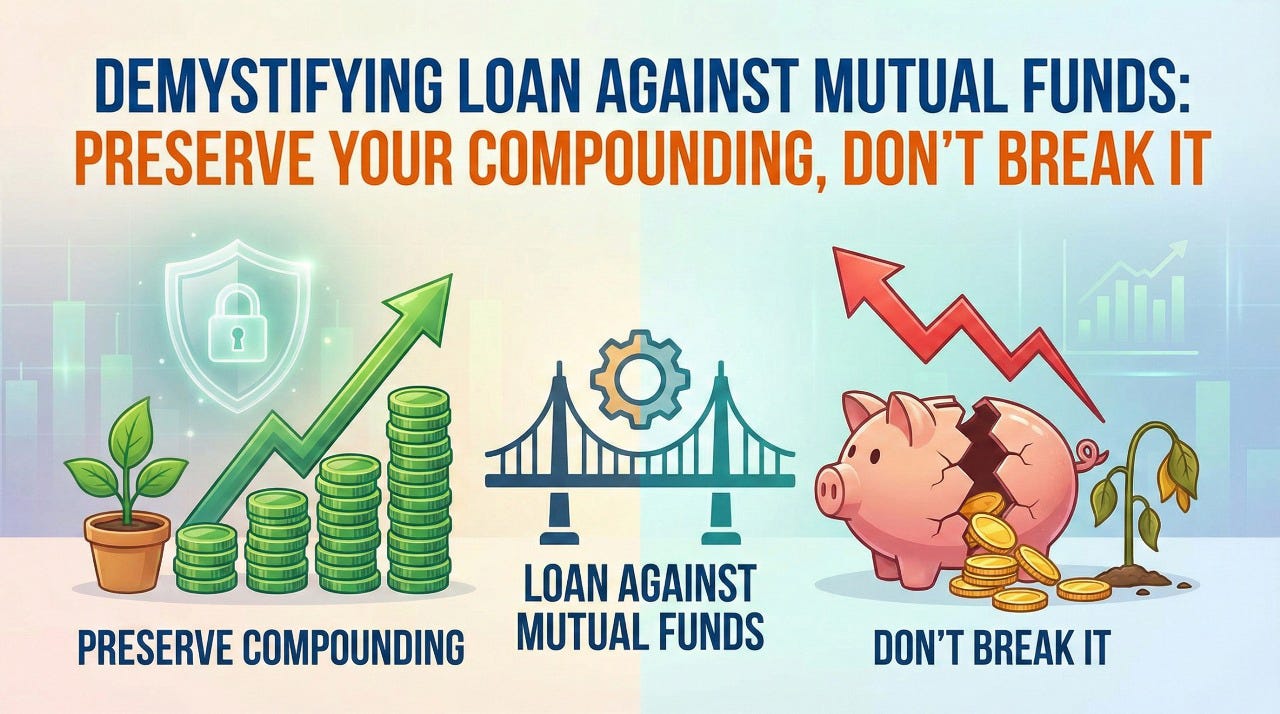
Imagine this scenario: you have built a sizable mutual fund portfolio over years of disciplined investing — SIPs, lumpsum, the whole compounding magic. Then life throws a curveball: a medical emergency, a business opportunity, or simply a cash crunch. Your instinct says, “redeem some units,” but if you do that, you break the compounding chain you’ve so carefully nurtured.
Here’s where a Loan Against Mutual Funds (LAMF) comes in — a smart liquidity solution that lets you unlock cash without surrendering your long-term investing gains.
Demystifying Loan Against Mutual Funds: Preserve Your Compounding, Don’t Break It
As a wealth manager and a veteran writer, I’ve seen both sides of this: the temptation to liquidate and the power of pledging. In this post, I’ll demystify LAMF — highlight when it’s a good loan, when it’s a bad loan, and why it deserves a place in modern wealth planning.
What Is a Loan Against Mutual Funds (LAMF)?
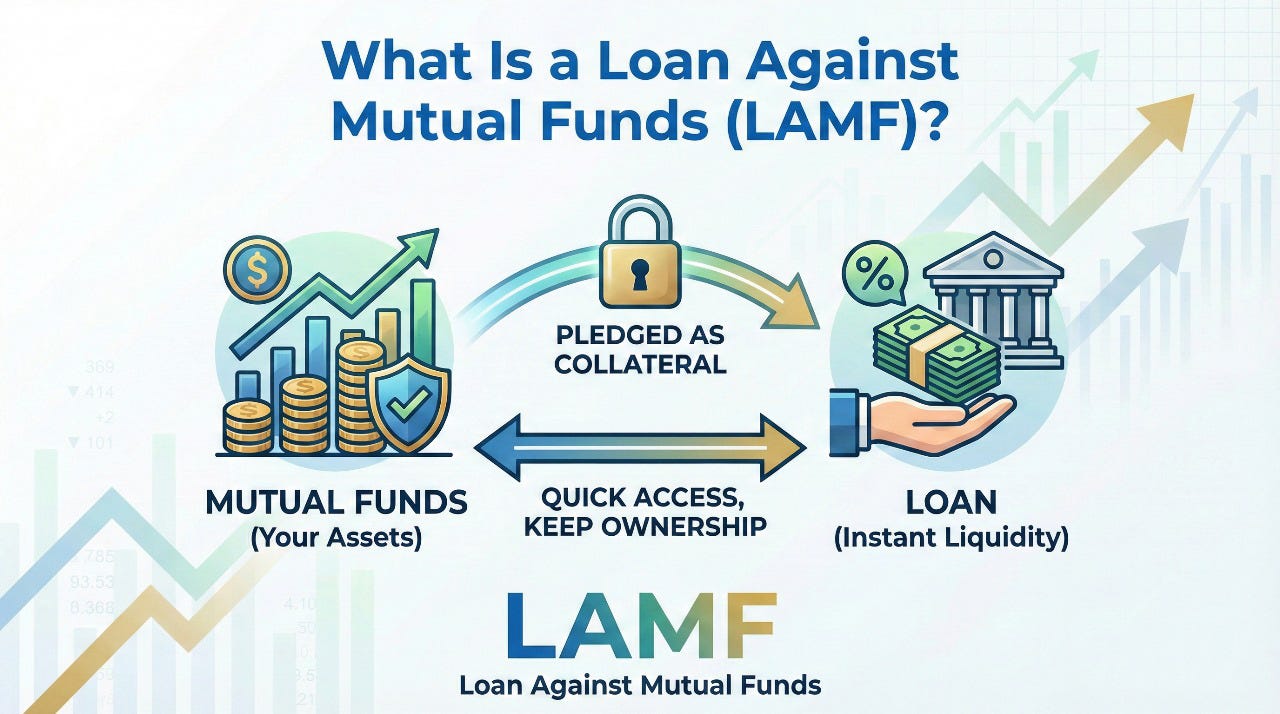
At its core, a LAMF allows you to pledge your mutual fund units as collateral and borrow against them. The units stay in your name; you retain beneficial ownership, including appreciation potential and dividends. You’re not selling — you’re borrowing.
What Is a Loan Against Mutual Funds (LAMF)?
- Lenders (banks, NBFCs, fintech’s) assess the value of your pledged units (based on NAV) and sanction a credit limit.
- The percentage of NAV you can borrow is called the Loan-to-Value (LTV) ratio. For equity funds, LTV typically ranges from ~ 50–70%.
- For debt funds, LTV can be higher (some lenders go up to ~ 80–90%).
- The application and pledge-marking process is often digital and fast, using RTA platforms (e.g., CAMS, K-Fintech).
Why Use LAMF Instead of Redeeming Mutual Funds?
Investors often pause their SIPs the moment a cash crunch appears. But as we explain in our other blog “Pausing SIP is the Worst Move an Investor Can Make,” stopping contributions — even briefly — can permanently dent future outcomes. You lose units, you lose compounding velocity, and you lose the advantage of disciplined accumulation.
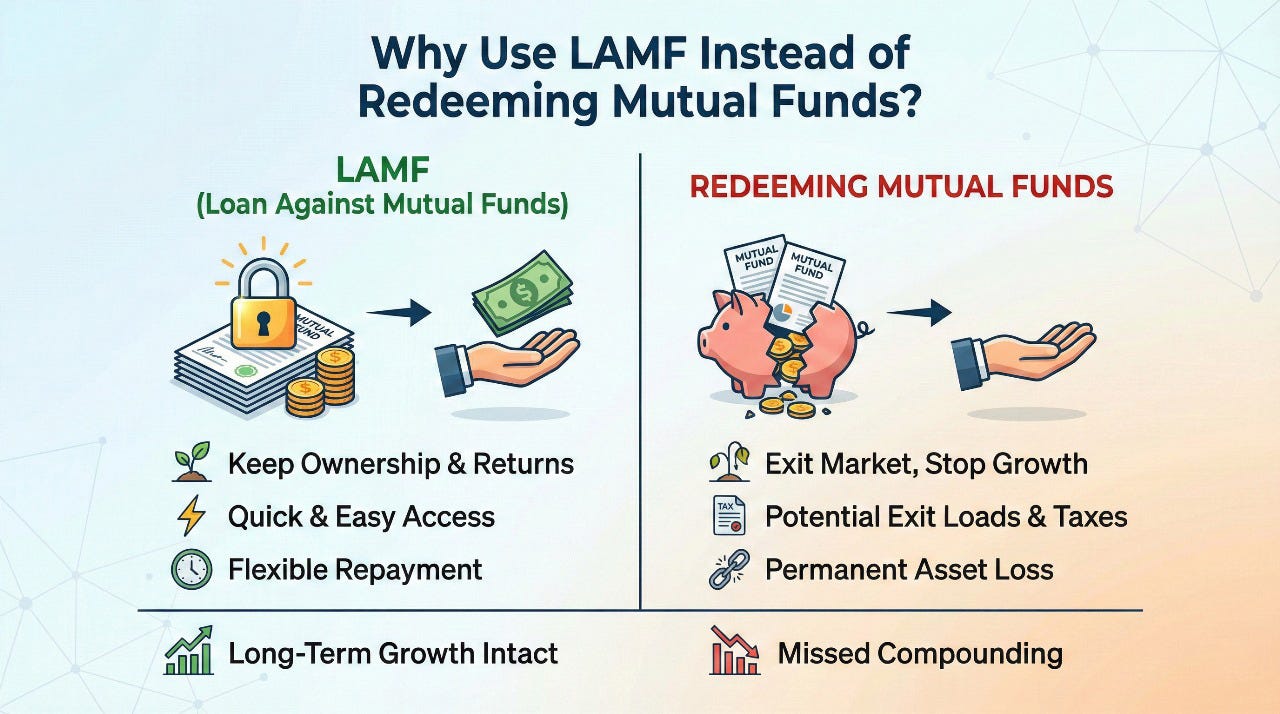
Why Use LAMF Instead of Redeeming Mutual Funds?
LAMF is ideal for bridging short-term liquidity gaps without stopping SIPs or redeeming long-term units. It keeps your portfolio and compounding intact, avoiding the sacrifice of a decade of future growth.
Here are the key benefits — why in many cases, LAMF is a good loan strategy:
- Preserve compounding
- When you redeem, you crystallize gains (or losses) and interrupt the compounding engine of your portfolio.
- With LAMF, your units continue to remain invested; you benefit from potential NAV appreciation, dividends, or bonus units (depending on the scheme). Some lenders explicitly state you continue to earn returns.
2. Lower interest versus unsecured debt
- Because the loan is secured (backed by MF units), interest rates are typically much more favourable than personal loans or credit cards.
- For example, platforms like Mirae Asset charge ~10.5% p.a., with interest only on the utilized amount.
3. Flexible repayment
- Many LAMF facilities are structured like an overdraft: you draw what you need and repay when you can, rather than fixed EMIs.
- There’s often no prepayment or foreclosure penalty.
- If you do a partial payment, interest is recalculated on the remaining outstanding principal — so you don’t keep paying interest on amounts you’ve paid off.
4. Speed & minimal paperwork
- Since mutual fund statements are digitized and RTAs are integrated, the process is largely paperless.
- Disbursal can happen very quickly once the lien is confirmed.
5. Maintain ownership rights
- You remain the beneficial owner, so you still get dividends, bonus units, etc.
- The lien restricts redemption until the loan is repaid, but once the obligation is met, the lien is released.
Key Terms Demystified: When LAMF is a Good Loan vs Bad Loan
To decide whether LAMF is a good loan or a bad loan for you, it’s helpful to frame it in terms of risk, cost, and behaviour.
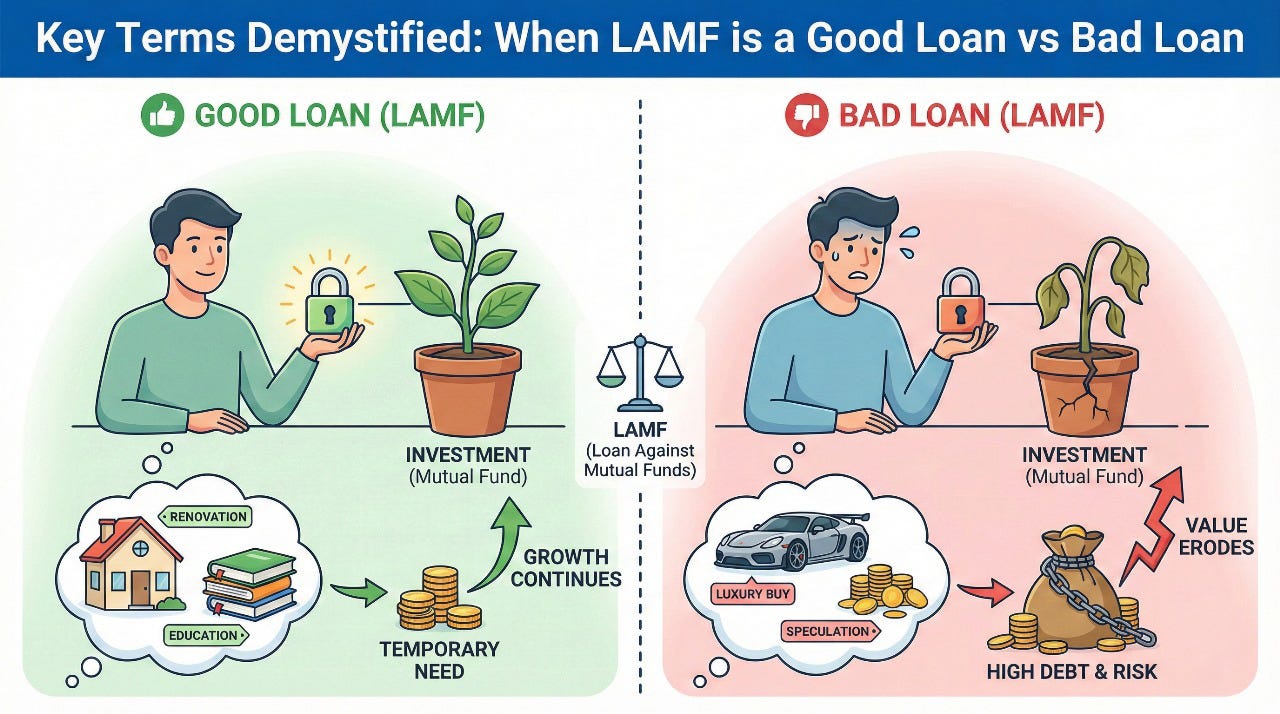
Key Terms Demystified: When LAMF is a Good Loan vs Bad Loan
When LAMF Is a Good Loan
- You have liquid mutual fund holdings (especially in equity or hybrid) that have a possibility to grow more than the interest paid for loan.
- Your cash need is short- to medium-term, not a permanent drain — e.g., emergency fund, opportunity funding, business cash flow gap.
- You plan to repay the loan quickly when cash is available.
- The cost of borrowing (interest rate) is lower than the expected risk-adjusted return on your mutual fund investments.
- You want to avoid capital gains tax (or defer it) that would come with redemption.
- You want to stay invested and benefit from potential dividend or NAV growth.
When LAMF Might Be a Bad Loan
- You’re pledging very volatile equity funds and the market tanks, risking a margin call (lender may ask for more collateral or partial repayment).
- Your cash needs are very long-term, and interest costs over time may outweigh the benefit of staying invested.
- You’re using the loan for speculative or high-risk investments, which can compound risk.
- You’re not disciplined in repayment — interest-only structure may lead to never paying down principal.
- If your lender’s fees (processing, pledge, renewal) are very high, they may erode the advantage.
Misconceptions & Myths
Here are a few myths that investors often believe — and the reality (backed by how lenders actually work):

Misconceptions & Myths
- “I’ll pay EMI like a regular loan”
- Not necessarily. Many LAMFs are structured as a credit line / overdraft. You may pay only interest monthly, not a fixed EMI.
2. “My mutual funds get sold when I take the loan”
- No — units are pledged (lien-marked), not redeemed, so you retain ownership.
3. “I pay interest on entire sanctioned limit”
- False. You pay interest only on what you draw.
- Even more, once you repay some principal, interest is charged only on the outstanding amount.
4. “Prepayment penalties will kill me”
- Many providers do not charge prepayment / foreclosure fees.
5. “Pledging means I lose control of my funds”
- No. While pledged, you cannot redeem, but you continue to earn returns; the lien is released when you repay.
Real-World Examples & Case Scenarios
Let me illustrate with a couple of realistic (but simplified) case studies — this helps make the abstract concept concrete.
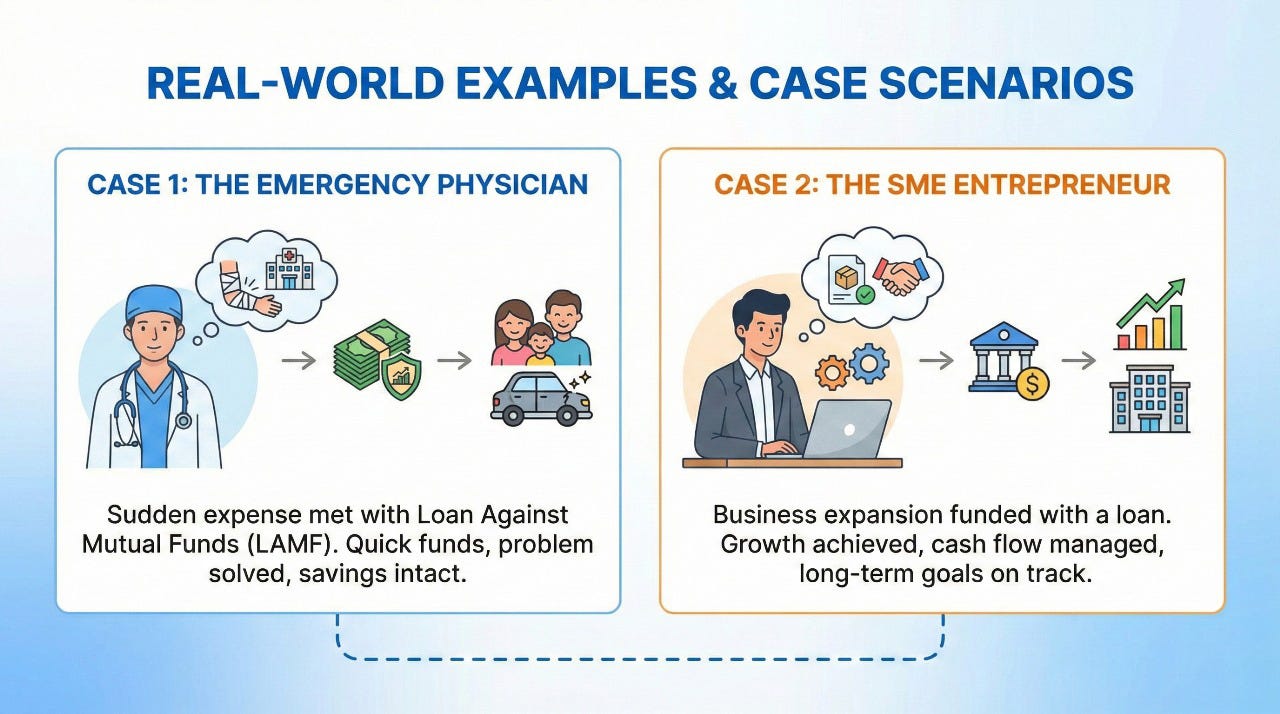
Real-World Examples & Case Scenarios
Case 1: The Emergency Physician
Profile: Dr. Meera, 40-year-old doctor, has ₹20 lakh in equity mutual funds (long-term SIPs).
Situation: Her child needs surgery costing ₹4 lakh on short notice. She does not want to redeem her MFs, because her portfolio has been compounding at ~12% annualized.
LAMF Option:
- LTV offered by a lender: 50% → She can borrow up to ₹10 lakh.
- She withdraws ₹4 lakh from her LAMF line.
- Interest rate: 10.5% p.a. (hypothetical).
Cost & Impact:
- She pays interest daily. Suppose she keeps the ₹4 lakh outstanding for 4 months (≈ 120 days).
- Daily interest rate = 10.5% / 365 ≈ 0.0288% → Interest per day = 0.000288 × ₹4,00,000 = ~₹115.
- Over 120 days, interest = ~₹13,800.
- She pays interest every month (auto-debit from her bank). She doesn’t touch the principal (since she wants to preserve her capital), but she has the option to repay the ₹4 lakh when she receives insurance reimbursement / other funds.
Benefit:
- Her ₹20 lakh stays invested — continues to earn NAV growth, dividends, etc.
- She avoids capital gains tax (if she had redeemed).
- The cost (₹13,800) is relatively small vs the value of keeping her long-term compounding intact.
Case 2: The SME Entrepreneur
Profile: Mr. Rajiv runs a small business. He has ₹50 lakh in debt + hybrid mutual funds.
Situation: He identified a short-term business opportunity: raw materials with a special discount if he pays in advance. He needs ₹15 lakh for 3 months.
LAMF Option:
- LTV on his debt/hybrid MFs: say 80%. → He can borrow up to ₹40 lakh.
- He draws ₹15 lakh for the opportunity.
Repayment Plan:
- He decides to repay ₹10 lakh at the end of month 2 (using expected revenues) and clears the remaining ₹5 lakh in month 3.
- Interest rate: 11% p.a. (hypothetical).
Cost Computation:
- Months 1–2 (60 days): ₹15 lakh outstanding → daily interest = (11%/365) × ₹15,00,000 ≈ ₹452/day → ~₹27,120 for 60 days.
- After partial repayment: ₹5 lakh outstanding for remaining ~30 days → daily interest = (11%/365) × ₹5,00,000 ≈ ₹151/day → ~₹4,530 for 30 days.
- Total interest cost ≈ ₹31,650 for 3 months.
Benefit:
- He uses LAMF to seize a working-capital opportunity without liquidating his investments, letting his MF portfolio keep growing.
- He pays interest, but repays the principal relatively quickly, minimizing cost.
- Once the loan is fully repaid, the lien is removed, and his MF units become unencumbered again.
Risks, Mitigations & Best Practices
LAMF is not risk-free. As a seasoned wealth manager, you know that any secured borrowing comes with caveats. Here are the main risks — and how to mitigate them.
- Market Risk / Margin Calls
- If NAV of pledged units falls significantly, the LTV ceiling may be breached → lender may ask to top up collateral or repay part of the loan.
- Mitigation: Pledge a diversified, less volatile MF portfolio; keep a buffer; monitor NAV; be ready for collateral calls.
2. Liquidity Risk
- If you don’t generate the cash to repay, the lender may liquidate pledged units (sell them) to recover dues.
- Mitigation: Use LAMF for planned short-term needs; maintain a repayment plan; restrict the use of LAMF for recurring or long-term recurring deficits.
3. Cost Risk (Interest + Fees)
- Processing fees, pledge-creation or lien fees, renewal fees may add up. For example, some lenders charge a renewal fee.
- Mitigation: Compare multiple lenders; negotiate terms; assess total cost (interest + fees) before pledging.
4. Behavioural Risk
- The temptation to just pay monthly interest and never repay principal can lead to a perpetually outstanding loan.
- Mitigation: Set personal repayment discipline; automate part-principal payback; create a trigger to unwind the loan.
5. Counterparty Risk
- If lending institution faces stress, or if the processes for lien-marking / releasing are flawed, you could face operational challenges.
- Mitigation: Choose well-regulated, reputed lenders; verify RTA integrations; ensure proper lien documentation.
Strategic Use Cases: When LAMF Is Part of Wealth Planning
Here are a few strategic ways wealth managers (and high-net-worth investors) can use LAMF prudently:
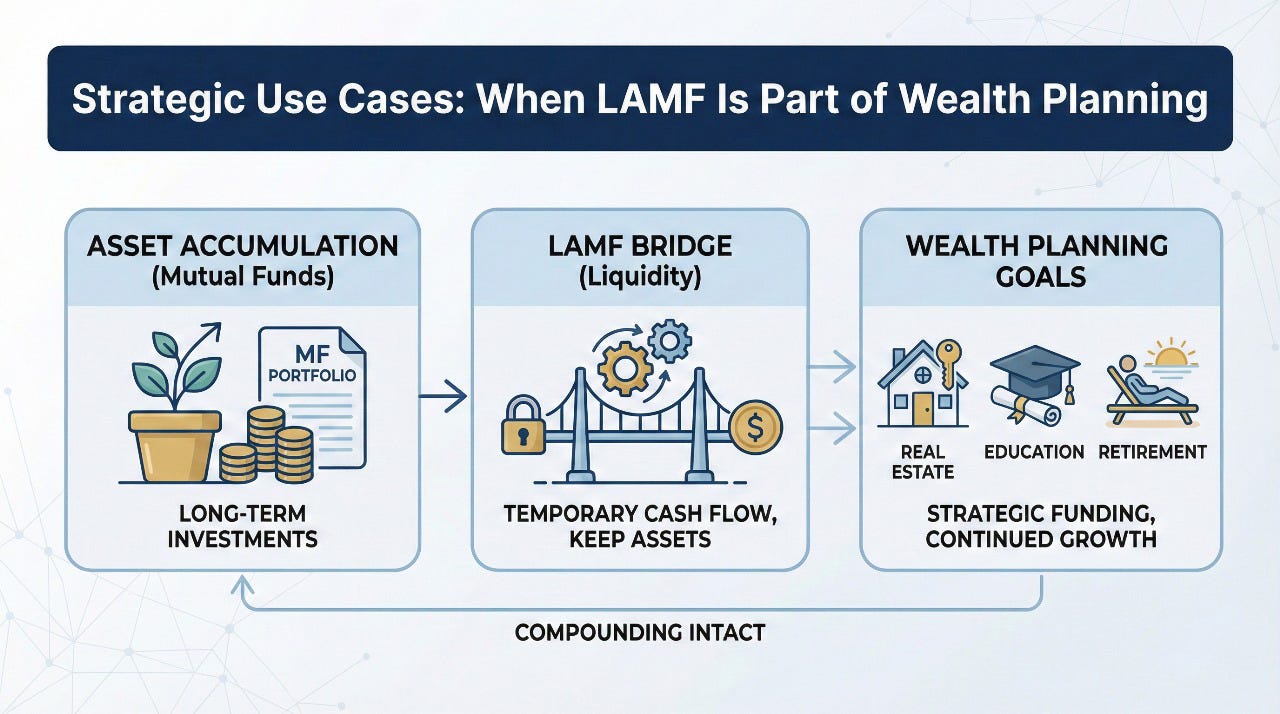
Strategic Use Cases: When LAMF Is Part of Wealth Planning
- Bridge Loans: Use LAMF as a bridge between liquidity needs and future inflows (e.g., expected sale, business proceeds, bonus).
- Capital Efficiency: Rather than keeping large cash reserves (which may underperform), you can maintain your core MF portfolio, pledge some for flexible credit, and only draw when needed.
- Crisis Fund: As part of an emergency liquidity strategy — LAMF offers a cushion without breaking your compounding engine.
- Tax-efficient Borrowing: If you have long-term equity gains, redeeming might trigger capital gains. LAMF helps avoid or delay that.
- Leveraging for Growth: In rare but well-managed cases, LAMF can be used to fund growth projects if the expected ROI exceeds the cost of borrowing — but this involves risk and should be part of a detailed cash-flow and risk assessment.
Drawbacks & When to Avoid LAMF
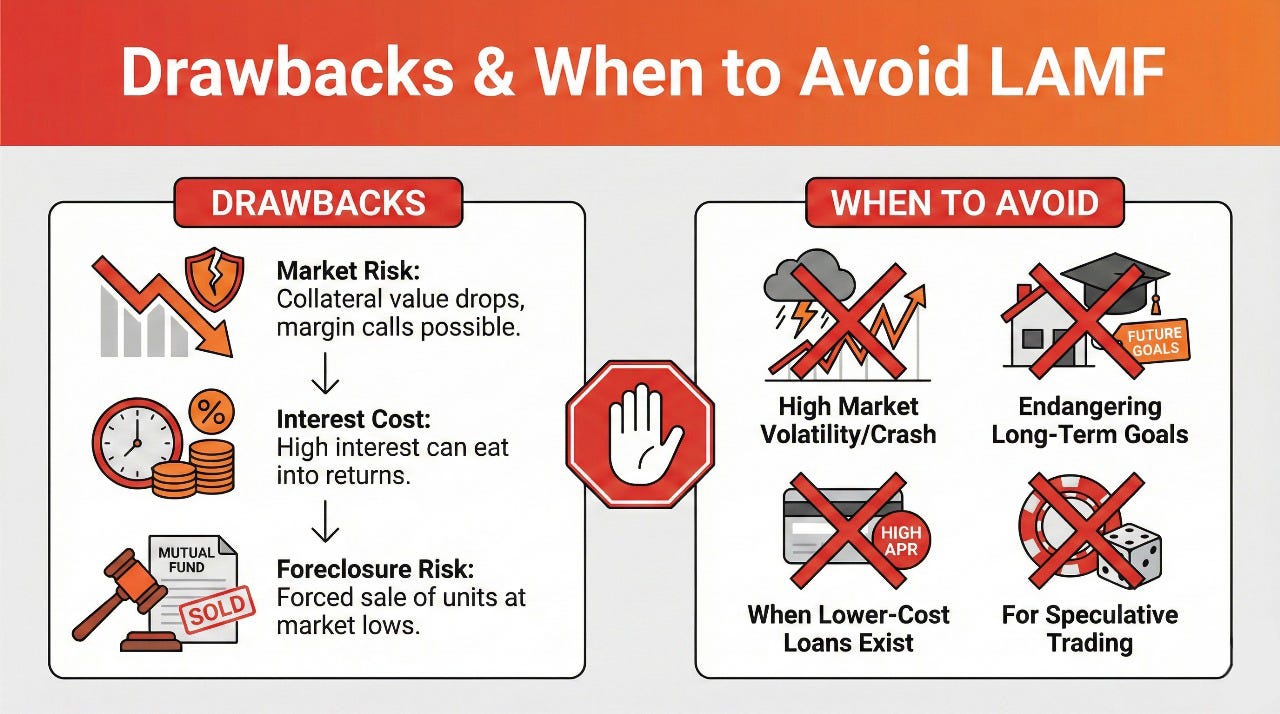
Even with its advantages, LAMF is not a panacea. Here are situations where it may not make sense:
Drawbacks & When to Avoid LAMF
- You need very long-term capital: Using LAMF for a 5-year or 10-year need may be inefficient if interest cumulatively outweighs expected MF returns.
- Your portfolio is very volatile or concentrated in high-risk thematic funds: Margin calls could become an issue.
- You’re using LAMF as a crutch for chronic overspending: If liquidity crises are recurring due to poor cash-flow management, pledging investments may mask deeper financial issues.
- The interest rate offered is comparable to personal loan rates: If the LAMF rate + fees is too high, you may as well consider alternate financing.
- Lenders’ terms are opaque or punitive: High renewal fees, hidden pledge costs, or lack of clarity about lien release should be red flags.
The Future of LAMF: Trends and Outlook
The Future of LAMF: Trends and Outlook
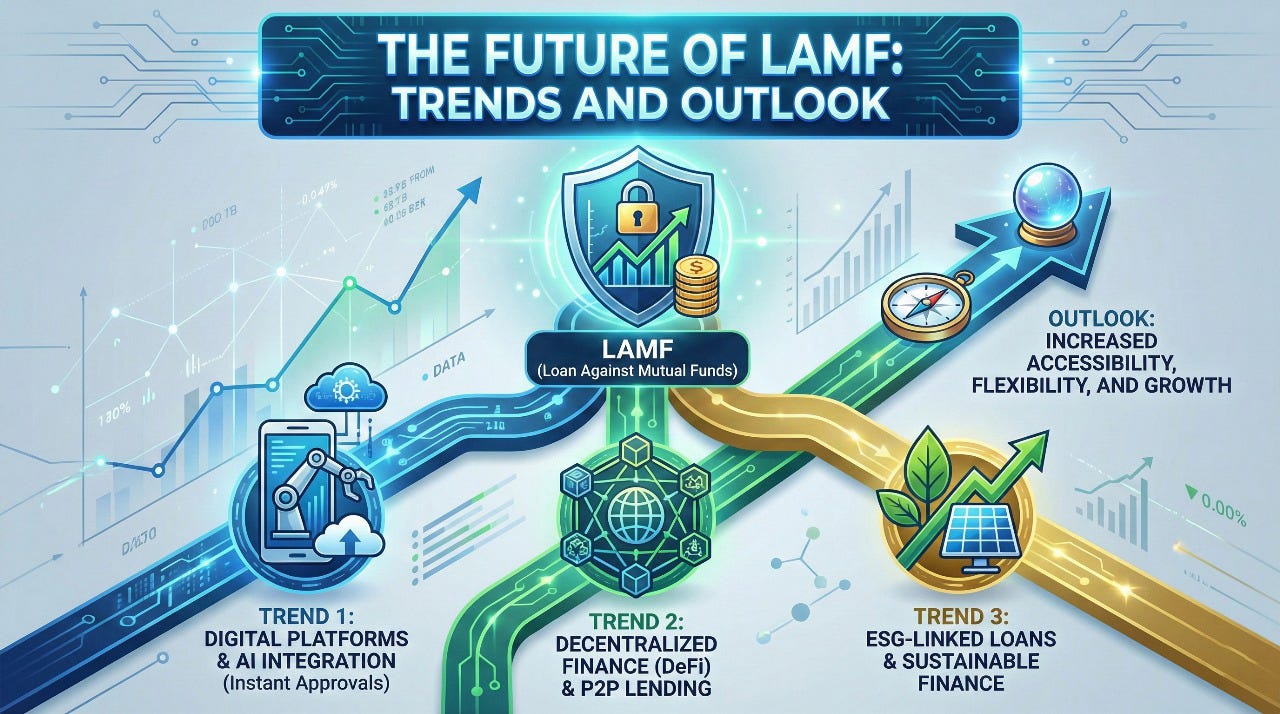
- Rising popularity: As digital lending platforms scale, LAMF is becoming more accessible, with faster turnaround times and minimal paperwork.
- Better technology integration: RTAs, depositories, and lenders are increasingly integrating, streamlining pledge and lien processes.
- Regulatory clarity: While AMFI provides best-practice guidelines, much of the product design is lender-driven. In the coming years, we may see standardized frameworks, driven by investor demand and regulatory maturity.
- Competitive credit rates: Given the secured nature of LAMF, interest rates may become more competitive as lenders optimize risk models.
- Education gap: Many investors are still unaware of LAMF or misunderstand its mechanics. As wealth managers, educating clients can unlock immense value.
How SubhShanti Wealth Assists in Using LAMF to Your Advantage
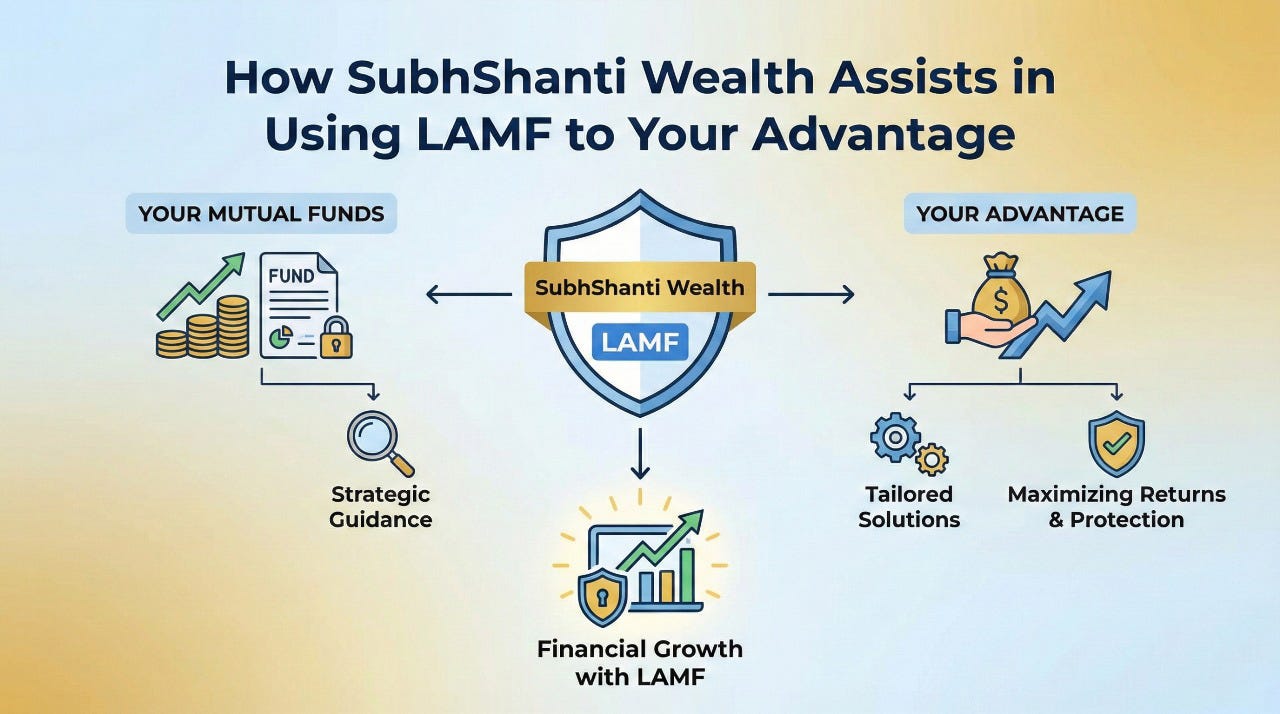
SubhShanti Wealth ensures LAMF becomes an efficient liquidity tool & not a drag on your portfolio. We assist you:
How SubhShanti Wealth Assists in Using LAMF to Your Advantage
- Evaluate whether LAMF truly fits your needs and avoid using it where it doesn’t.
- Identify which mutual funds are safest to pledge and reduce margin-call risk.
- Compare lenders, interest rates, and hidden fees to choose the most efficient option.
- Build a repayment plan so the loan stays short-term and doesn’t erode returns.
- Monitor your LTV and NAV movements to flag risks early.
- Coordinate a smooth lien release once the loan is closed.
The goal is simple: access liquidity without breaking your compounding — and SubhShanti guides you through every step to make that possible.
The Final Say
“Demystifying Loan Against Mutual Funds” isn’t just a catchy phrase — it represents a powerful concept in modern wealth planning. When used wisely, LAMF enables you to access liquidity without interrupting your compounding trajectory, pay lower interest, and maintain ownership of your investment.
The Final Say
However, like any financial tool, it must be treated with respect. It can be a good loan — flexible, cost-effective, strategic — but it can also turn into a bad loan if misused or left unmanaged.
For investors, the takeaway is clear: before you redeem your mutual funds in a hurry, pause and consider whether a LAMF can bridge your need — preserving your long-term compounding while solving your short-term cash flow.
As a seasoned wealth manager, you are well placed to guide your clients: model scenarios, compare lenders, stress-test margin-call risk, and integrate LAMF into a holistic wealth plan. For many, this is not just an alternative to redemption — it’s a smarter lever in the toolbox of disciplined investing.
For more information and expert insights on similar topics like these, we invite you to check out www.subhshantiwealth.com. Empower your financial decisions with trusted guidance.

메타데이터
- post_id
- c1914b80dc43
- slug
- demystifying-loan-against-mutual-funds-preserve-your-compounding-dont-break-it-c1914b80dc43
- url
- https://medium.com/@SubhShantiWealth/demystifying-loan-against-mutual-funds-preserve-your-compounding-dont-break-it-c1914b80dc43
- canonical_url
- https://medium.com/@SubhShantiWealth/demystifying-loan-against-mutual-funds-preserve-your-compounding-dont-break-it-c1914b80dc43
- author_url
- https://medium.com/@SubhShantiWealth
- status
- ok
- fetched_at
- 2026-07-13 18:24:43