Cheap Security Is Over
The death of the Franco-German fighter jet, Rasmussen’s warning of NATO’s disintegration, and the quiet return of nuclear deterrence to…
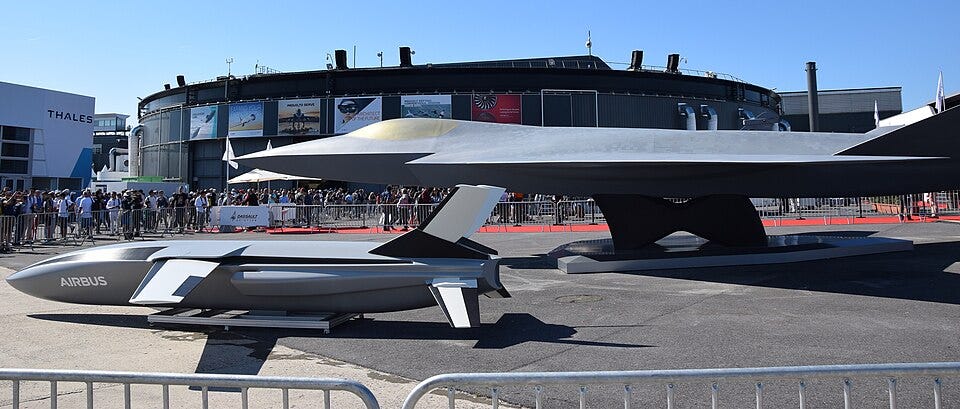
FCAS NGF mock-up at Paris Air Show 2019
Cheap Security Is Over
The death of the Franco-German fighter jet, Rasmussen’s warning of NATO’s disintegration, and the quiet return of nuclear deterrence to European politics signal that the continent’s long free ride on American power has finally ended
The fracture lines running through European security have never been more visible — or more consequential.
Within the span of a few weeks in the summer of 2026, a cascade of developments has forced the continent to confront a reckoning long deferred: the collapse of a flagship joint fighter jet program, a former NATO chief calling for the alliance’s replacement, the resurgence of nuclear weapons as instruments of national policy, a war in Ukraine that continues to grind on without resolution, and a small Caucasian republic quietly pivoting West against Moscow’s wishes.
Taken individually, each story might be absorbed as a setback or a curiosity. Taken together, they constitute a portrait of a continent in the midst of a profound, and still unresolved, transformation.
For decades, the architecture of European security rested on a set of assumptions so durable they had become invisible: that the United States would underwrite the continent’s defense, that NATO’s collective guarantee was reliable, that European nations could integrate their industrial and military capacities through patient multilateral cooperation, and that arms control frameworks would prevent the most dangerous forms of escalation. Each of those assumptions is now under serious strain, and some have been demolished entirely.
The clearest symbol of Europe’s predicament came on June 8, 2026, when Germany and France formally announced the end of the Future Combat Air System — FCAS — the most ambitious defense program the continent had ever attempted.
The project had been conceived in 2017, launched with ceremony by French President Emmanuel Macron and German Chancellor Angela Merkel, and presented as the embodiment of European strategic ambition: a sixth-generation fighter jet, supported by drones and linked by a classified “combat cloud,” that would replace both France’s Rafale jets and Germany’s Eurofighters by roughly 2040. The price tag was estimated at over a hundred billion euros. The symbolism was meant to be priceless.
What actually unfolded over the following nine years was a slow-motion collision between two industrial giants — France’s Dassault Aviation and the European aerospace consortium Airbus — whose disagreements grew so deep and so public that they eventually overwhelmed the political will of two governments. The companies clashed over control of the project’s next development phase, over access to intellectual property, and, most fundamentally, over what kind of airplane they were actually trying to build. France needed a jet capable of carrying nuclear weapons and landing on aircraft carriers; Germany had no such requirements. Dassault insisted on leading the program, claiming that only its engineers had the experience necessary to build a combat aircraft; Airbus, representing German and Spanish industrial interests, pushed for an equal partnership. Neither side yielded, and neither government proved willing or able to force a resolution.
The announcement came after Chancellor Friedrich Merz and President Macron met on the sidelines of an EU-Western Balkans summit in Montenegro and concluded, in the words of a German official, that there was simply no prospect of breaking the deadlock. Merz had in fact been signaling his skepticism for some time, openly questioning whether a manned sixth-generation fighter jet remained the right priority for Germany’s air force at all. His office framed the decision as difficult but necessary, and he called on German industry to prove its capabilities through new partnerships. Germany’s IG Metall union, representing aerospace workers, welcomed the move, with its deputy chairman explicitly thanking Merz for a decision he called in the interests of Germany as an aviation hub. In Paris, the mood was more defensive. Macron’s office expressed regret and pointed blame at the industrial partners’ inability to agree. The French Senate’s defense committee chief was blunter, saying Macron had been “the only one who still believed in the survival of FCAS.”
The political fallout spread quickly. Germany would now look to purchase American F-35s and pursue a new fighter partnership, potentially with Sweden’s Saab, which had signaled openness to collaboration. Spain, which had invested nearly two billion euros in FCAS and led two of its nine technological pillars through Indra and Airbus España, found itself in an acute state of uncertainty. Spanish defense officials confirmed they were exploring a Plan B — potentially joining Germany and Sweden in a new program — while acknowledging that the collapse had placed the country’s air combat capabilities for the next two decades at risk. The Siagen program, a 540-million-euro bridging contract signed in late 2025 to protect Spanish industry during the FCAS crisis, was suddenly looking less like a contingency and more like a lifeline.
Commentators across Europe were unsparing in their assessment. The failure, wrote one Swiss analyst, was not for want of money, not for want of threat awareness, and not for want of geopolitical urgency. It had come undone through what he called “the old European disease of vanity, industrial egotism, and political cowardice.” The breakdown echoed France’s earlier withdrawal from the Eurofighter program in the 1980s — a historical rhyme that offered little comfort. A British defense analyst observed that the outcome sent a signal that was hardly ideal to either Washington or Moscow. The collapse of FCAS did not simply mean that Europe would buy its fighter jets elsewhere. It meant that Europe had, at the precise moment of maximum strategic pressure, demonstrated an inability to build together what it could not afford to build alone.
Against this backdrop, the warnings of Anders Fogh Rasmussen carry a particular weight. The former Danish prime minister who supported the American-led invasion of Iraq, the former NATO Secretary General who spent years defending the alliance’s cohesion and the indispensability of American leadership — this is not a man given to alarmism or cheap rhetoric about European independence. His recent statements represent something genuinely significant: a considered, painful revision of everything he had stood for throughout his political career.
“What we are witnessing right now is the disintegration of NATO, and that is dangerous,” Rasmussen said in an interview published in May. The core of his argument was stark: President Trump had raised so many doubts about the credibility of Article 5, the collective defense commitment at NATO’s heart, that Europeans could no longer rationally depend on it. The only available conclusion, he said, was that Europe must learn to stand on its own feet and defend its own continent.
What Rasmussen proposed was a formalized new structure — a “coalition of the willing” among European nations ready to organize continental defense independently. The coalition would be open only to countries meeting strict conditions, including a defense spending target of five percent of GDP, a commitment to an Article 5-equivalent mutual defense guarantee, and a veto-proof decision-making mechanism. Any member failing to meet these conditions could be excluded. NATO, he acknowledged, would remain the nominal cornerstone of European security and the American nuclear umbrella would remain the ultimate deterrent. But conventional defense, he argued, was something Europeans would simply have to provide for themselves.
Crucially, Rasmussen called for Ukraine to be included as a full member of any such European security framework, describing the country as a necessary bulwark against Russia and noting the extraordinary pace at which Ukraine had developed new weapons and ammunition systems through years of existential combat. He appealed to Germany’s Friedrich Merz, France’s Emmanuel Macron, Britain’s Keir Starmer, and Italy’s Giorgia Meloni to provide leadership. He acknowledged he had received no firm commitments. “Someone,” he said simply, “has to get the issue moving.”
The emotional weight behind Rasmussen’s pivot was palpable. He described the rethinking as “very painful,” and said that since childhood he had admired the United States and regarded it as the natural leader of the free world. The intellectual journey he was describing — from reliable transatlanticism to a call for European strategic self-sufficiency — was not the product of ideology but of experience. For too long, he said, Europeans had relied on cheap energy from Russia, cheap goods from China, and cheap security from the United States. That model, he concluded, no longer works.
The same logic permeates the recent writings of Rasmussen on Ukraine specifically. In a June 2026 essay, he made the case that Europe should not rush toward a peace negotiation that is not anchored in genuine strength. He wrote from experience: having met both Vladimir Putin and Dmitry Medvedev, he asserted that they respect only power. The debate about appointing a European peace envoy, he warned, risked becoming a distraction if it was not preceded by the hard work of actually constraining Russia’s capacity to fight and demonstrating Europe’s commitment to Ukraine’s future.
His prescription involved three pillars. The first was to further constrain Russia’s war economy — specifically targeting the supply chains for Russian ballistic missiles, which depend on chemical precursors from China and Uzbekistan and Western microelectronics that reach Russia through intermediaries. He argued that Russia’s missile production capacity was an Achilles heel that European legal and diplomatic tools were already equipped to strike. He also pointed to Russia’s shadow fleet, nearly half of whose seaborne oil exports pass through the Baltic Sea, often through chokepoints controlled by European Union and NATO members. Closing those gaps, he argued, was both feasible and essential.
The second pillar was rebuilding Ukraine’s critical infrastructure before the next winter. Russia’s assault on the Ukrainian power grid, Rasmussen wrote, was a deliberate strategy to break Ukrainian society before any negotiating table was set. He called for European governments to treat the shipment and reinstallation of decommissioned power plants from across the EU with the same urgency they had applied to gas storage targets in 2022. Every megawatt of generation restored in Kyiv or Kharkiv, he argued, was leverage in any future peace negotiation.
The third and most structurally important pillar was Ukraine’s EU membership. Accession, Rasmussen argued, was the one security guarantee that Moscow could not veto — a game-changer in its own right, a form of defeat for Russia, and a lasting reward for Ukrainian sacrifice. He called for moving away from the unanimity requirement in EU foreign and defense policy toward qualified-majority voting, clearing the path around any Hungary-style obstruction. He addressed the EU’s democratic institutions directly, arguing that leaving Ukraine in a grey zone of half-promises would be a betrayal of the hundreds of thousands who had died defending values recognizably European: democracy, the rule of law, the right of a free people to choose their own alliances.
Ukraine’s situation in this period was further illuminated by an interview in which President Volodymyr Zelenskyy reflected on his country’s relationship with the United Kingdom. Zelenskyy spoke of the depth and importance of bilateral ties forged since the beginning of the war, describing the two countries as genuinely needing each other in what remained an existential struggle. He was careful not to take British support for granted, flagging with evident concern the decision by some Reform UK-controlled local councils to remove the Ukrainian flag from their buildings. The gesture, he suggested, was the kind of small mistake that could break a big friendship. His language conveyed both gratitude and vigilance — the posture of a leader who has learned that alliances must be tended constantly, and that symbolic slippage can presage something larger.
The strategic stakes of that friendship — and of European solidarity more broadly — were rendered vivid by the findings of the Stockholm International Peace Research Institute’s annual report, published in 2026. According to SIPRI, every one of the world’s nine nuclear-armed states had modernized and expanded their arsenals in 2025. The total number of nuclear warheads in the world stood at approximately 12,200 — slightly lower than the year before, but not as a result of genuine disarmament. Older warheads were being retired somewhat faster than new ones were being deployed, but researchers warned that the trend was likely to reverse in the coming years as dismantlement slowed and new deployments accelerated.
The geopolitical landscape behind these numbers was bleak. The New START treaty, the last surviving international agreement limiting the number of nuclear weapons between the United States and Russia, expired in February 2026 without a successor. In its place was not negotiation but exhibition: SIPRI’s nuclear weapons expert warned that nuclear states were increasingly displaying their nuclear strength rather than fulfilling their disarmament obligations. Russia and the United States together hold roughly 83 percent of all operational nuclear warheads in the world. China is expanding its arsenal faster than any other country, currently possessing around 620 warheads and, according to SIPRI projections, potentially matching either Russia or the United States in intercontinental ballistic missiles by the end of the decade. North Korea continues to grow its capability and conducted tests of a new solid-fuel ICBM in 2025. France, with approximately 290 warheads deliverable by nuclear submarine or Rafale aircraft, has actively offered neighboring European countries access to a French nuclear umbrella — a proposal that has gained new resonance as doubts about the American commitment have deepened.
Germany’s position in this nuclear landscape was particularly delicate. The country is constitutionally prohibited from possessing nuclear weapons of its own, a constraint embedded in the Two-Plus-Four Treaty governing German reunification. It has historically relied on the deployment of approximately twenty American nuclear bombs on German soil as its contribution to NATO’s nuclear sharing arrangements. As Trump’s reliability as a guarantor became increasingly questionable, Berlin began preliminary discussions with Paris about closer cooperation on nuclear deterrence — a conversation that would have been unthinkable, and perhaps unutterable, just a decade ago. Sweden and Finland, historically among the strongest advocates of nuclear disarmament, have both shifted their positions since joining NATO, now participating actively in alliance nuclear exercises. The normalization of nuclear thinking across European security policy represented one of the more profound, if least visible, shifts of the era.
Not every story from this period was one of failure or danger. The reelection of Armenian Prime Minister Nikol Pashinyan in parliamentary elections in June 2026 offered a counterpoint — proof that the gravitational pull of Western democratic values could still outweigh the coercive pressure of an authoritarian great power. Pashinyan had led Armenia through two military defeats, the loss of Nagorno-Karabakh, and an increasingly explicit break with Russia. Moscow had pulled out every lever available to it: threatening Armenia’s membership in the Russia-dominated Eurasian Economic Union, blocking Armenian exports at the border under spurious health grounds, and backing the country’s most pro-Russian political factions. None of it worked. Pashinyan’s party won convincingly on a platform built around a single, deeply unfashionable idea: the promise of peace.
The geopolitical dimensions of his victory were considerable. His rapprochement with Azerbaijan, consummated in a White House-brokered peace framework in August 2025, had redrawn the Caucasus’s strategic map. An EU summit held in Yerevan in May 2026 had put Armenian membership in the European Union on the table for the first time. Pashinyan had placed his country’s future on a westward bet, and his people had ratified that bet at the ballot box despite Russian warnings that doing so threatened Armenia’s very existence.
The path ahead was not clear. His parliamentary majority was insufficient for the constitutional amendments required to advance the peace process with Azerbaijan, and the demands from Baku — including the removal of indirect references to Nagorno-Karabakh from the Armenian constitution — remained politically sensitive enough to require a national referendum. Pashinyan’s own governing style attracted criticism: his rhetoric in the campaign had at times been divisive, his treatment of political opponents drew scrutiny, and his dismissiveness toward the Armenian refugees from Karabakh raised serious moral concerns. But his reelection demonstrated something important nonetheless: that Russia’s capacity to determine the political futures of its neighbors through intimidation had limits, and that those limits could be reached by leaders willing to offer their populations a genuine alternative.
The thread that ties all of these developments together is a single, disorienting recognition: Europe is being asked to become something it has not been in living memory. For three-quarters of a century, the continent organized its security around American power, its prosperity around global trade, and its identity around multilateral institutions whose durability seemed guaranteed by the weight of the history that had made them necessary. The logic was self-reinforcing: the more successful the institutions became, the more invested their members grew in their continuation. The result was a long peace that, whatever its flaws and inequalities, was genuinely unprecedented in European history.
That system is now under stress from every direction simultaneously. The American security guarantee has become conditional and, under the current administration, openly instrumentalized. Russia has demonstrated both the will and the capacity — however limited — to challenge the territorial order by force. Nuclear weapons are proliferating in fact if not in law. Europe’s most ambitious attempt to build a shared military capability in the air domain has ended in industrial squabbling and political embarrassment. And the continent is being asked, with some urgency, to spend more, build more, and integrate more deeply in ways that its political economies and institutional arrangements were not designed to support.
What is striking, in surveying all of this, is not despair but a kind of improvised determination. Rasmussen, who spent his career inside the old architecture, is now designing a new one from the outside. Germany, which spent decades using its history as a reason to limit its military ambition, is now the country whose leadership is being called upon to anchor European defense. Ukraine, which before 2022 most Europeans would not have placed at the center of the continent’s security equation, has become — through sacrifice and ingenuity — arguably the most experienced military force in the world against a major state adversary, and is now being proposed as a full member of whatever security architecture Europe builds next.
The collapse of FCAS was a failure. But Germany’s stated intention to find new partners and prove its industrial capabilities could become the foundation of a different kind of success. The unraveling of easy American guarantees was a shock. But the shock has produced what years of exhortation could not: a serious, sustained European conversation about self-reliance in defense. The return of nuclear weapons to European strategic thinking was alarming. But it also reflects a Europe that is finally thinking seriously about deterrence rather than assuming it.
None of these developments resolves the underlying uncertainty. The question of whether Europe can, in practice, organize its own defense — whether the political will exists to override national industrial interests, whether spending commitments will translate into actual capability, whether EU institutions can be reformed quickly enough to matter, whether Ukraine can be anchored to the West before Russia extracts an unacceptable price — remains entirely open. Rasmussen himself admits he has no firm commitments. The Spanish defense industry is waiting to see which program it will be allowed to join. The nuclear sharing conversations between France and Germany are preliminary.
What is no longer open is the premise. The old model, as Rasmussen put it, no longer works. Cheap energy, cheap goods, cheap security — that triangle has collapsed. What replaces it will be more expensive, more complicated, and more uncertain. But building it is no longer a theoretical exercise in strategic planning. It is the actual work that Europe’s governments, industries, and publics are now, haltingly, beginning to do.
The pace at which they do it, the coherence with which they coordinate, and the courage with which they make the necessary choices will determine not only the shape of European security for a generation but the fate of Ukraine, the credibility of the rules-based international order, and the signal sent to every revisionist power watching from the outside.
History, as Zelenskyy and countless Ukrainians have learned at devastating cost, does not wait for institutions to catch up with events. Europe is learning the same lesson — slowly, painfully, and, at last, seriously.
Sources and Further Readings
https://www.ft.com/content/ad600574-64c9-421d-b3a3-4ea24f73e440
메타데이터
- post_id
- c5ced678b063
- slug
- cheap-security-is-over-c5ced678b063
- url
- https://medium.com/the-geopolitics-report/cheap-security-is-over-c5ced678b063
- canonical_url
- https://medium.com/the-geopolitics-report/cheap-security-is-over-c5ced678b063
- author_url
- https://medium.com/@jens_sorensen_geopol.
- status
- ok
- fetched_at
- 2026-06-15 20:49:13