Wow and Hau: Culinary. Crocodile. Adventure.
Croc shisanyama. Feta, strawberries and grilled crocodile salad. Croc strips marinated for 24 hours in buttermilk and spices. Crocodile as…
Wow and Hau: Culinary. Crocodile. Adventure.
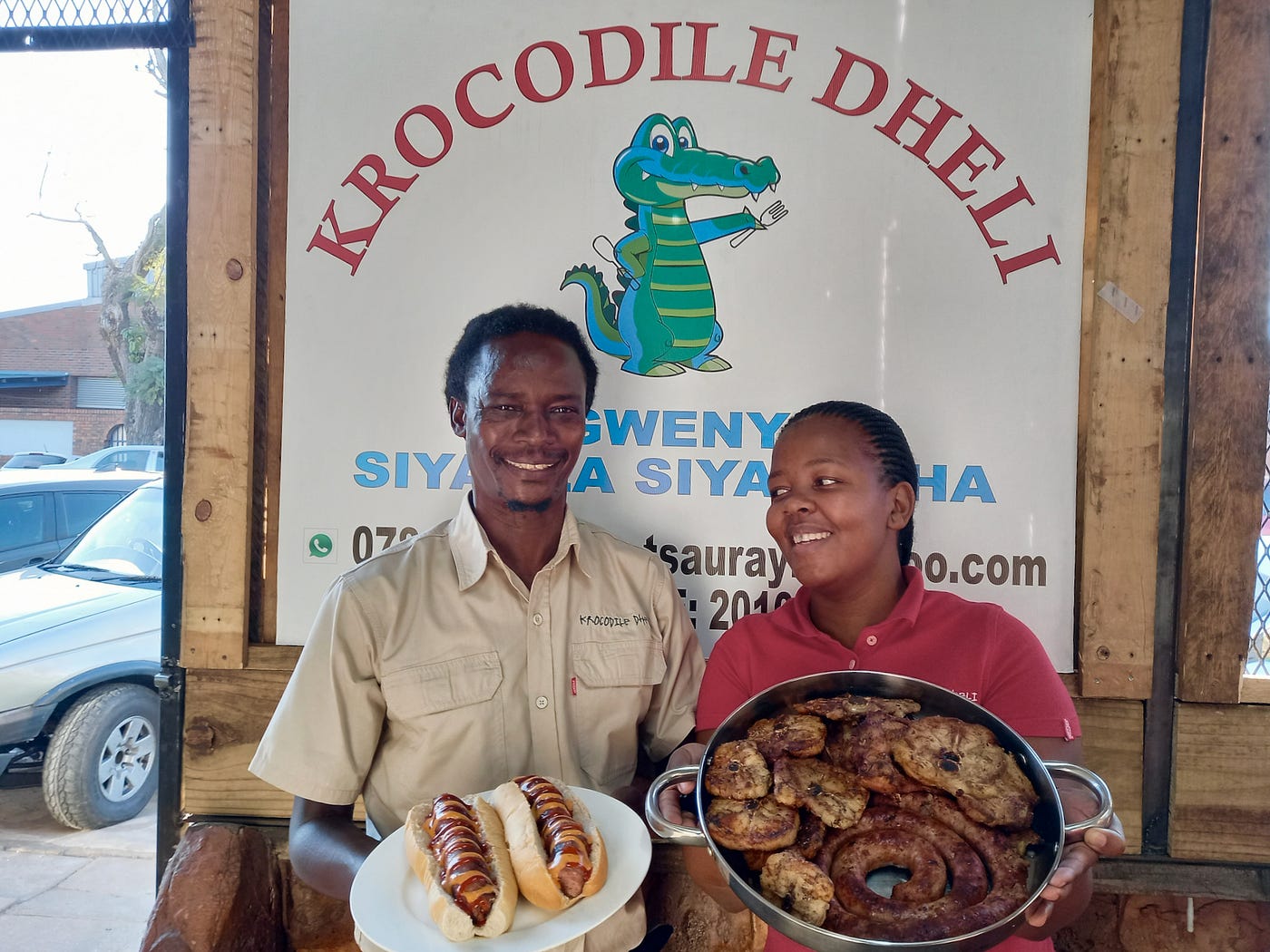
Raphael Tsaurayi and Nomthandazo Mkhize with assorted crocodile delights at his small-house ‘krok’ shisanyama cum butchery. (Photo: Wanda Hennig)
Croc shisanyama. Feta, strawberries and grilled crocodile salad. Croc strips marinated for 24 hours in buttermilk and spices. Crocodile as a superfood. Crocodile wors — or how about crocodile curry?
Having survived to eat another crocodile, instead of being eaten by one, an unexpected brave new world of croc cuisine opens up.
Shed no crocodile tears here.
So there I was on a mildly sweaty Tuesday morning in Pietermaritzburg, the down-at-heels capital of the province of KwaZulu-Natal, South Africa. Not having thought of crocodile for quite a considerable time. Indeed, not since sprinting from one. At the Mlilwane Wildlife Sanctuary in eSwatini, formerly Swaziland. While attending a “rhino survival function” focused on ending the rhino horn trade ban.
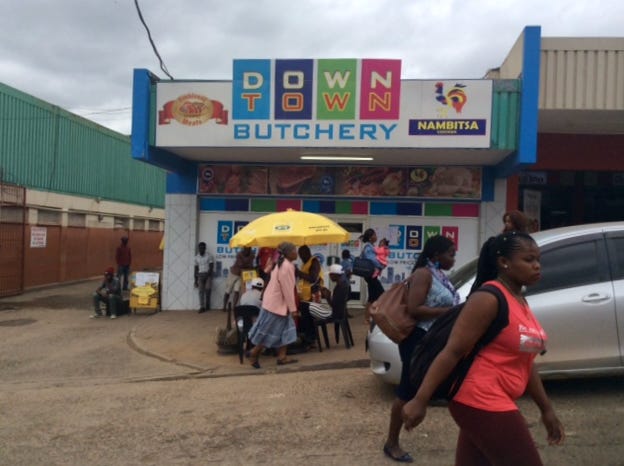
On the road in eSwatini. Photo: Wanda Hennig
There were no rhino around when our host, conference convener Ted Reilly, chief executive of the conservation and tourism entity Big Game Parks and eSwatini’s “father of conservation”, took us — pretty close — to observe a mama croc paying attention to her eggs. She was too busy being broody to concern herself with us, was the general idea.
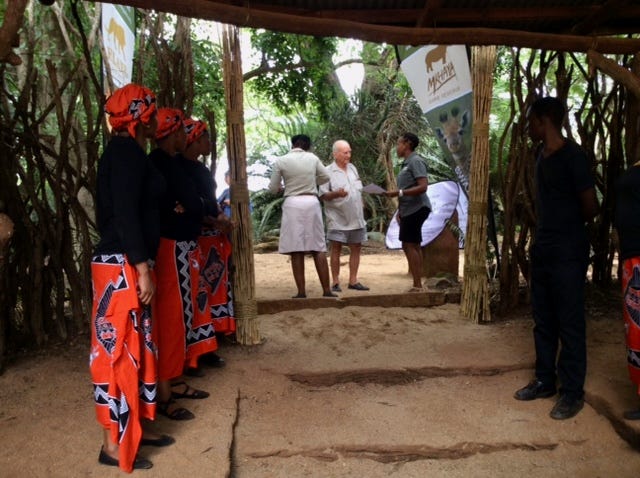
Ted Reilly’s welcome at the Mlilwane Wildlife Sanctuary in eSwatini. Before our Ma Croc encounter. Photo: Wanda Hennig
But suddenly Ma Croc spotted Reilly along with the rest of us, journos all, who had taken various long-and-winding-road journeys from cities around South Africa to this small land-locked kingdom. And Ma Croc sprang forth in a great lumbering flash, so sudden that one of our party jumped in the air and fell back down like a nine-pin bowling skittle before we grabbed him, luckily a short man, and yanked him to safety. Luckily she was not as speedy as she might have, one imagines, had she not been tied by maternal protective instinct elastic to her soon-to-hatch little snappers.
And so she lost interest and we survived to eat another crocodile instead of being eaten by one.
But back to the more recent Tuesday.
“Anything interesting of a culinary nature going on around here?” I ask my farmer friends, Mike and Lynn, who live about 90 minutes by road from Durban in the rural forested and farm mist-belt area known as Karkloof near Albert Falls Dam, which is rated as one of the best bass fishing dams in the world. Lynn had just had a luscious high tea to celebrate a significant birthday. To indulge and to celebrate with her is the reason I am there.
Mike ponders my question, for not too long. Then tells me about this woman who, most days, lights a fire in a little rusty braai (barbecue ) unit she sets up on a verge near the turnoff to their farm leading from the narrow Greytown road. People place orders, on their way to work, for the crocodile meat she sells, Mike tells me. She has it cooked and waiting for them to pick up on their way home.
And there is a crocodile meat café in Pietermaritzburg, Lynn chimes in before giving me detailed directions. Not difficult to find.
By morning, when I am set to leave, they have made a plan.
Thinking our rural Zulu roadside croc meat purveyor may not speak English or want to talk to a camera-wielding stranger — and to make sure I find the Pietermarizburg café (O ye of little faith) — Mike has asked the farm induna (headman), Vusi Zuma, to accompany me (then taxi home).
And the day might have flopped like a disappointing soufflé without Zuma. Because the crocodile woman was not in her spot. Alone I would likely have given up then and there. And missed out on my midweek crocodile adventure.
“Do you know where the crocodile farm is?” I ask Zuma when we come upon her empty spot, Mike having said she got her crocodile meat from a farm. Croc meat generally being a by-product of the crocodile skin export market, which he had noted is in decline.
This decline I confirmed online: that luxury brands are cutting back on exotic skin products in light of rather gruesome ethical and animal welfare concerns.
Turns out Zuma is game and adventurous.
He points me along the highway in the direction of Pietermaritzburg. “There,” he says, indicating a dirt-road track, which leads to a locked gate.
After a couple of false starts, we bump along in my little old townie Honda through some fields of veggies till we come upon a clearing with a shed, a small house and a man in a van.
A long conversation, in isiZulu, ensues between this man and Zuma. Interjected with my, in English, “Is the crocodile farm here?”
No.
“Is there a farm?”
Yes.
Zuma’s gesticulations. Lots of pointing and head-nodding. Indicates he is checking and confirming directions.
Our new route doubles us back past Lynn and Mike’s farm and after not too long, leads us to another dirt road, which ends at a No Entry, Crocodile Abattoir, By Appointment Only sign.
I tell the gate man, in English, that I’m a food writer interested in crocodile meat. What Zuma tells him, in isiZulu, is likely of more relevance to him. Because, friendly and welcoming, he signs us in. So we can drive a few yards towards the building down the drive-way that we’ve been pointed to. Then simultaneously glance to the left.
“Wow!” I say. “Hau”, Zuma says. In unison.
A couple of hundred crocodiles (they have 400 on the property pending their removal to a croc farm in Limpopo, we will hear) are swimming, climbing over each other, mainly sleeping under the African sun in and around a large concrete pool. One of several.
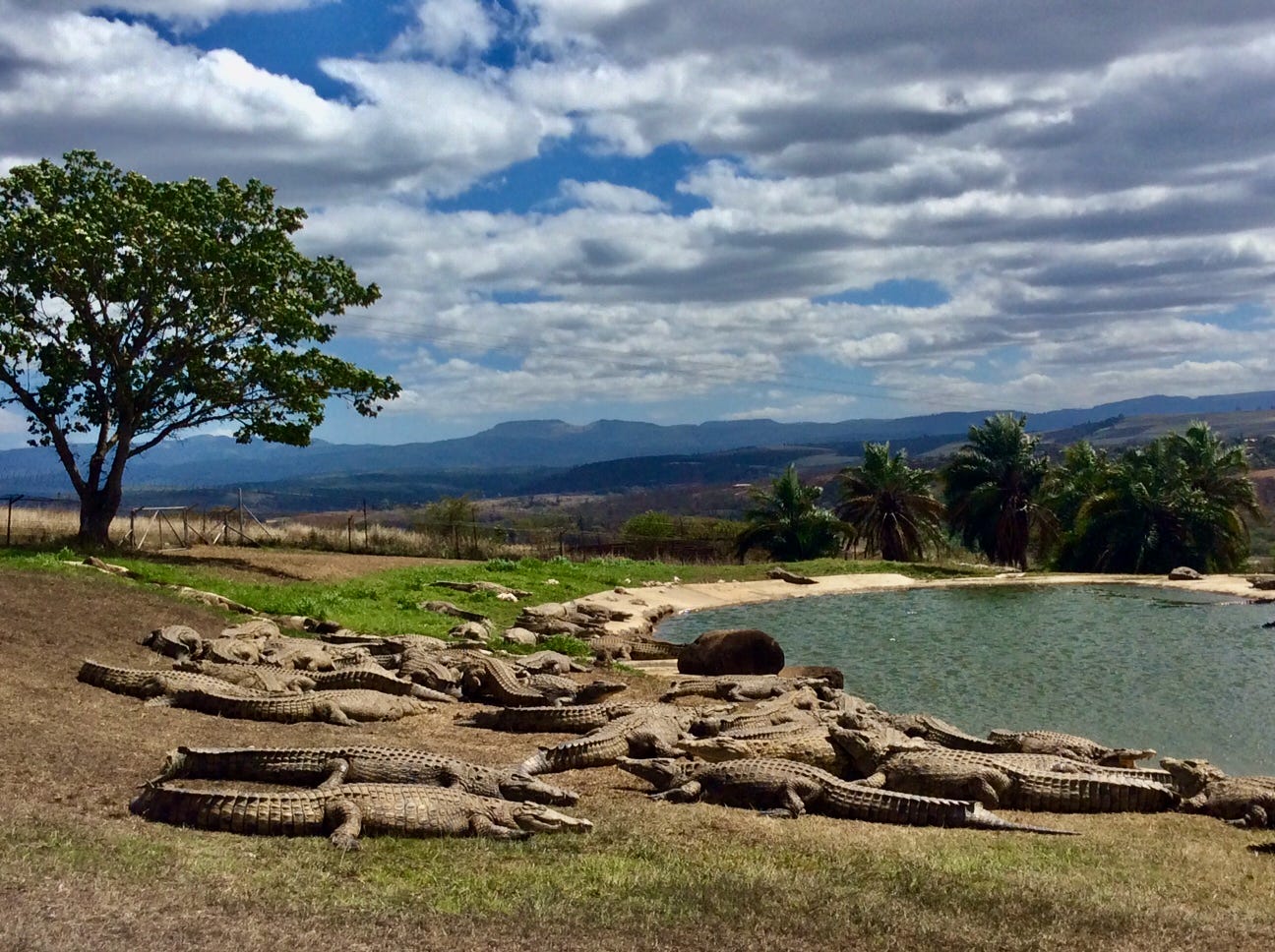
In a while, crocodile: these crocs will be moved to Limpopo. Photo: Wanda Hennig
Some crocodile facts: Only the Nile crocodile (Crocodylus niloticus) occurs naturally in South Africa and eSwatini, and they are formidable predators. A large adult is capable of preying on the largest buffalo or wildebeest. Big males can weigh up to 700kg and have up to 68 teeth. They are capable of staying submerged for more than an hour. They are opportunistic hunters, cannot chew, so typically kill by drowning, tear their prey apart and a large one is physically capable of swallowing a human whole.
We thought better than to stroll among them for an up-close-and-personal experience.
Just continued to the end of the driveway, noted the crocodile abattoir sign and tracked down supervisor Joram Ntlemo, a friendly and knowledgable Shangaan man, originally from Limpopo province near the Zimbabwe border, who told us he had worked with crocs since 2004.
It’s true, he confirmed. The bottom has pretty much fallen out of the international croc skin export market. The croc abattoir is no longer functioning as one. But there is croc meat for sale.
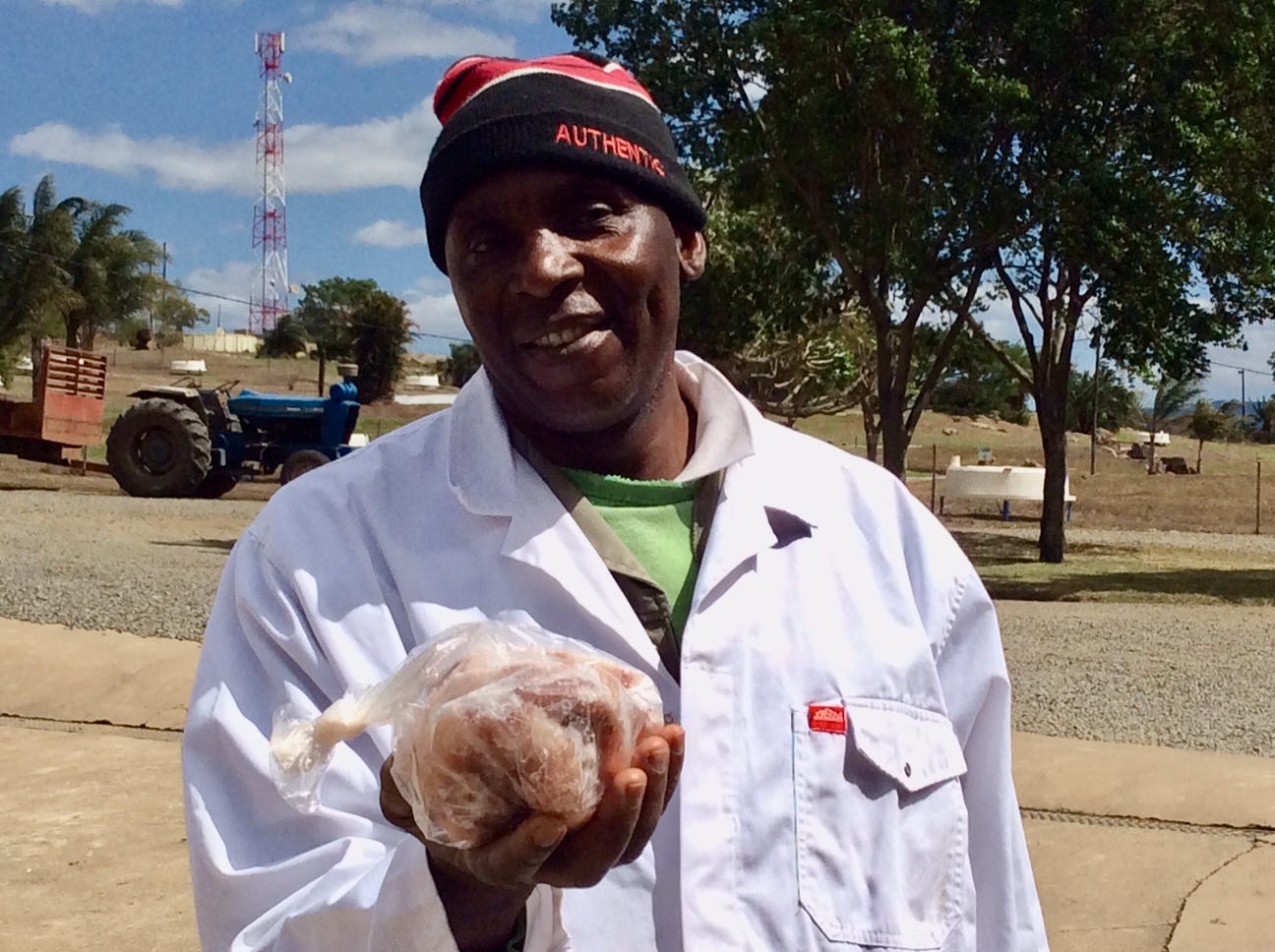
Joram Ntlemo with a kilo of frozen croc meat that made it home to my fridge and — much later — into a casserole for an unsuspecting friend. Photo: Wanda Hennig
With the demand for the meat, if anything, growing, the crocs are being relocated to a farm in Limpopo province. The abattoir is being turned over to chickens. And going forward, they’ll be bringing the farmed croc meat to KwaZulu-Natal from Limpopo.
And yes. I can buy a kg. of croc meat. Frozen. They still have some stock. He will wrap it in newspaper to survive the journey back to my deep freeze in Durban.
From the croc farm we head for Pietermaritzburg. We have an address: 390 Boom Street. We pass auto shops and taxis and congestion. Then up jumps an inviting little culinary oasis in a rough and tumble low-tech industrial stretch of road. Primary colors and a welcoming sign.
This is “Krocodile Dheli” Raphael Tsaurayi’s butchery cum shisanyama and café, located in a small house in an industrial part of the city.
Tsaurayi, a delightful friendly man who loves crocodiles, has been working with them for 25-plus years, which he calls “all my life” having started from school in admin at a crocodile farm. He grew with the company — farm manager then abattoir manager, initially in Zimbabwe; then at the crocodile farm we just left, before spotted a gap.
Having decided to go on his own, via his contacts and flexing his entrepreneurial muscles, he established the butchery we’ve come upon. Which also operates as a shisanyama (which translates from the isiZulu as “hot meat”) for those who want to buy and braai right there (he produces a plate and tells Zuma and me to tuck in while we chat). Or customers can pick up ready-made croc curry to take home.
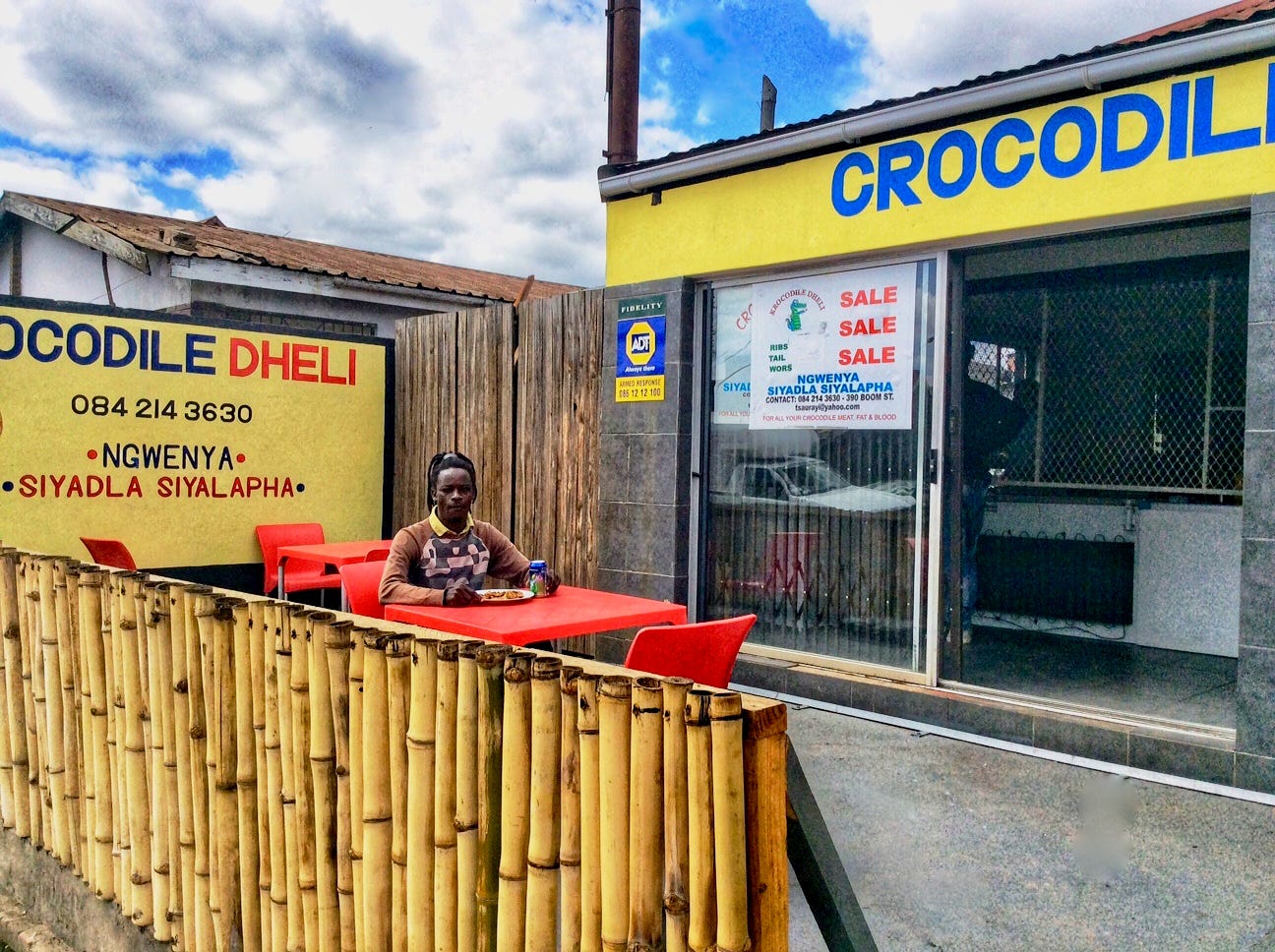
Tsaurayi and his butchery cum shisanyama in Pietermaritzburg. Photo: Wanda Hennig
Initially back in 2010 Tsaurayi sold croc meat door-to-door. It was unfamiliar to many. Now it’s acceptable and the demand continues to grow. It has become, he says, something of a Zulu and Sotho delicacy. Definitely African food.
The enterprising and congenial Tsaurayi makes crocodile wors (sausage) and has ready-to-go packages of different fleshy bits from the carnivorous reptiles. He is also supplying a growing list of clients.
There’s quite a lot about croc meat online, I discover. I see it called a superfood because it has more lean muscle tissue and much higher lower saturated fat content than even the leanest cut of beef.
Laminated sheets in Tsaurayi’s butchery push the health benefits of crocodile meat including the tail, the best and priciest cut. There’s a belief, he says, that rubbing on crocodile fat, for example mixed into a cream, can cleanse one of bewitching spells and bad magic. Health benefits, he tells me, are both physical and psychological. Men can drink the soup boiled from the meat for potency, many of his customers believe.
Conversely, if a spell is cast on ones manhood, the oil, which he sells in small containers, can counter the spell.
But most of his customers buy it for the flavour.
“I love it. It tastes like a combination of chicken and fish,” a woman shares as she leaves with her ready-cooked dinner.
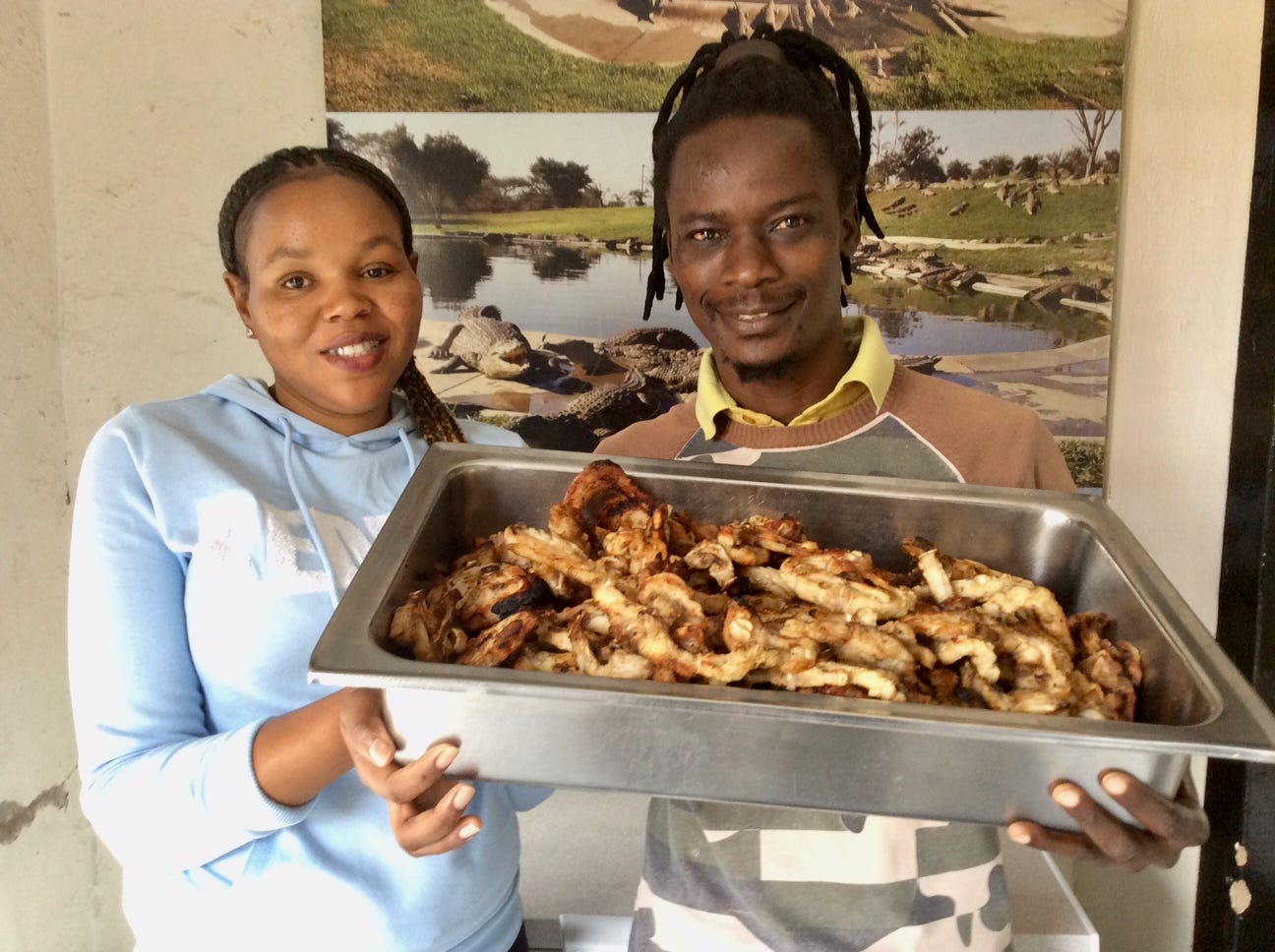
Croc man Raphael Tsaurayi with assistant Zanele Nzuza, bearing choice croc bites. Photo: Wanda Hennig
My first culinary croc experience was, years ago, at the erstwhile Carnivore Club in Nairobi. I was playing at being vegetarian at the time so denied myself the warthog and various venison offerings brought to the table on long skewers. But I’m glad to say I rationalized a bit of crocodile could be fish, fowl? And tried what seems, intermittently, to have been treated as a delicacy on menus at upscale restaurants in cities around the world.
At the Big Easy in Durban’s Hilton Hotel, prior to Covid, a favorite was crocodile marinated overnight in thyme and mustard, wrapped in bacon then pan fried and served on a bed of crushed carrots, sweet potatoes and mussels in brandy.
It was pretty refreshing to see it “back to basics” and available. And Tsaurayi assures me the abattoir experience of crocs in South Africa is well-monitored and humane.
See you later alligator. In a while crocodile.
When passing through Pietermaritzburg some months after that first visit, I popped in to say Hi, to see how things were going. Tsaurayi’s marketing assistant, Nomthandazo Mkhize, immediately got busy producing a little mound of freshly grilled tail meat, body meat and wors, which she set on a platter under cling wrap. Also, two robust croc-dogs. When I said I couldn’t stay, Tsaurayi graciously transfers these to a container, which he thrust into my hands before I left. “You have to try or how will you know?” he insisted.
The kilo of crocodile meat I bought, meanwhile, sat in my freezer for many months…
I considered marinating the meat then grilling it and serving it up appropriately spiced in a salad with strawberries, feta and beets. I read about a buttermilk marinade with cumin, coriander, paprika, black pepper, thyme and parsley, which recipe recommended coating the crocodile strips in cornflake crumbs, then baking. As time went (further) by, I considered throwing it away…
But finally, I slow-cooked it using a casserole recipe found via a Google search. And served it to an unsuspecting guest. A cautious nosher.
Only after he deemed it delicious did I tell him what he’d just eaten. A second bottle of wine helped quench the shock.
A version of this article was previously published in The Daily Maverick TGIFood section.
메타데이터
- post_id
- c67655e2d39e
- slug
- wow-and-hau-culinary-crocodile-adventure-c67655e2d39e
- url
- https://medium.com/@wanda_hennig/wow-and-hau-culinary-crocodile-adventure-c67655e2d39e
- canonical_url
- https://medium.com/@wanda_hennig/wow-and-hau-culinary-crocodile-adventure-c67655e2d39e
- author_url
- https://medium.com/@wanda_hennig
- status
- ok
- fetched_at
- 2026-07-18 09:10:59