The Surprising Value of Vagueness in Product Management
Premature certainty is dangerous
The Surprising Value of Vagueness in Product Management
Premature certainty is dangerous
If you’re a Product Leader whose organization is on a journey to become Product-led, this article is for you.
My goal is to “put the Productivity into Product” by helping your organization turn theory into practice while defining your Product Process in a way that makes it effective and repeatable.
One of the more unexpected lessons I’ve learned recently came not from a product team, but from AI.
Like many product managers, I’ve spent time experimenting with vibe coding platforms. The experience has been fascinating. When I provide highly detailed instructions, the AI generally produces exactly what I asked for. Sometimes that’s useful. Often it’s limiting.
The most interesting results tend to emerge when I provide a clear objective but leave room for interpretation.
Instead of specifying every screen element, workflow, and interaction, I describe the problem I’m trying to solve. The AI then proposes designs, interactions, and approaches I would never have considered. Some ideas miss the mark. Others are surprisingly creative and occasionally better than my original thinking.
The experience reminded me of something I’ve observed repeatedly with development teams throughout my career.
The Hidden Cost of Detailed Requirements
Many product organizations equate detailed requirements with good product management. The PM is expected to arrive with a fully formed solution, complete with epics, user stories, acceptance criteria, workflows, edge cases, and implementation guidance.
There are certainly situations where this level of detail is necessary. As initiatives mature, ambiguity becomes expensive. Teams need clarity to execute efficiently.
The problem is that many organizations apply execution-stage thinking during discovery-stage work.
…as AI makes execution easier, process becomes more valuable…
When product managers prescribe every detail too early, they unintentionally narrow the solution space. Developers stop thinking about the problem and start implementing instructions. Designers stop exploring alternatives and start refining predetermined concepts.
The result is often a solution that reflects the creativity of one person rather than the collective intelligence of the team.
Vagueness Creates Room for Discovery
Consider two different ways of framing the same problem.
The first approach might sound like this:
“We need a dashboard with these five widgets, arranged in this order, with filters in the upper-right corner and a notification panel on the left side.”
The second approach might sound like this:
“Customers are struggling to understand the status of their projects. We need a way for them to quickly assess progress, identify risks, and determine what action they should take next.”
The first statement contains a solution.
The second statement contains a problem.
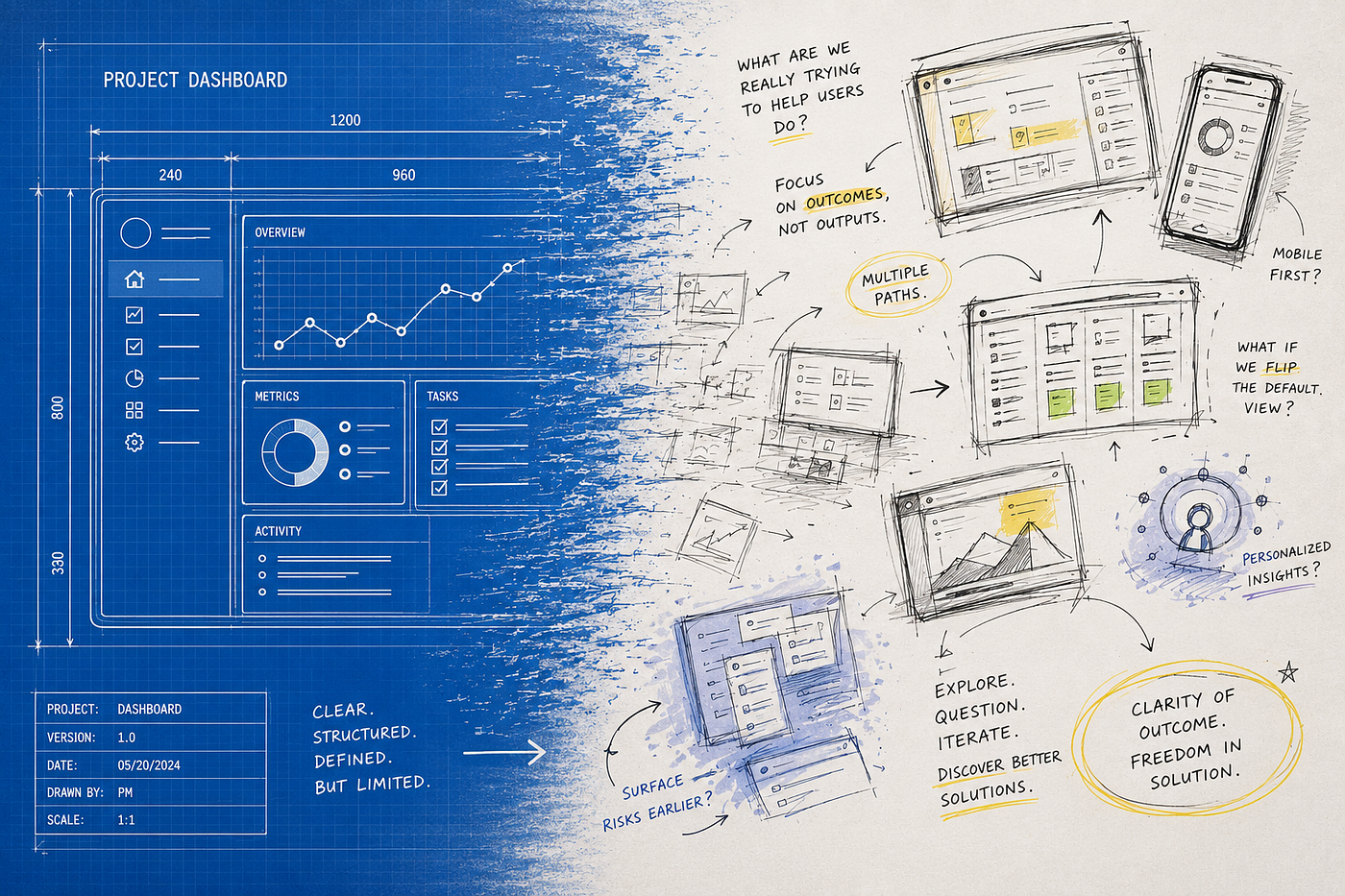
When teams are given problems instead of solutions, they are forced to think. They bring their own expertise, experiences, and perspectives into the conversation. Developers may identify technical opportunities that the PM never considered. Designers may discover interaction patterns that better serve users. Architects may uncover entirely different approaches that simplify the system.
The team becomes a source of innovation rather than a delivery mechanism.
Why This Works So Well Early
The earlier a team is in the product development process, the less certainty exists.
At the beginning of an initiative, we typically know the least about customer behavior, technical constraints, market reactions, and implementation tradeoffs. Ironically, this is often the stage when organizations expect the most detailed requirements.
Detailed requirements create the illusion of certainty. They make us feel like we understand the solution before we’ve fully understood the problem.
Vagueness, when used intentionally, acknowledges reality. It recognizes that discovery is still occurring and that the best ideas may not have emerged yet.
This doesn’t mean teams should receive vague objectives forever. Ambiguity becomes increasingly costly as work moves closer to implementation. The goal is not to eliminate specificity. The goal is to introduce specificity at the right time.
Early exploration benefits from flexibility.
Execution benefits from clarity.
Strong product teams know when to transition between the two.
AI Is Teaching Us an Old Lesson
What’s interesting about modern AI tools is that they are exposing this principle in a highly visible way.
Many people approach AI the same way organizations approach product development. They attempt to specify every detail upfront. Then they wonder why the output feels predictable.
The most effective users often provide goals, constraints, and context while leaving room for interpretation. They collaborate with the AI rather than dictating every step.
In many ways, the relationship mirrors the best product teams.
The PM defines the outcome.
The team explores how to achieve it.
The final solution emerges through collaboration.
AI simply makes this dynamic impossible to ignore.
The Role of Process in an AI-Driven World
This trend has implications far beyond requirement writing.
As AI continues to blur traditional role boundaries, the distinction between product management, design, engineering, and analysis becomes less rigid. Developers can generate mockups. Designers can create prototypes. Product managers can build working applications.
The question becomes less about who performs a task and more about how decisions are made.
This is where process becomes increasingly important.
When everyone can contribute across traditional boundaries, teams need shared frameworks for discovery, prioritization, experimentation, validation, and decision-making. Without those processes, organizations risk generating large amounts of activity without maintaining alignment.
Ironically, as AI makes execution easier, process becomes more valuable.
Not because it controls people.
Because it helps people coordinate.
Vagueness Is a Tool, Not a Philosophy
The lesson is not that requirements are bad.
The lesson is that premature certainty is dangerous.
Good product managers know when to be precise and when to be intentionally vague. They understand that detailed instructions are useful once a direction has been chosen. Before that point, excessive detail can prevent better ideas from surfacing.
Sometimes the most valuable thing a product manager can provide is not an answer.
It’s a well-defined problem and enough space for the team to solve it.
The irony is that by saying less, we occasionally learn far more.
If you’re looking for guidance in building effective product processes, I’d love to chat. Feel free to connect with me on LinkedIn.
메타데이터
- post_id
- cc00a1b03fe7
- slug
- the-surprising-value-of-vagueness-in-product-management-cc00a1b03fe7
- url
- https://medium.com/@willtivity/the-surprising-value-of-vagueness-in-product-management-cc00a1b03fe7
- canonical_url
- https://medium.com/@willtivity/the-surprising-value-of-vagueness-in-product-management-cc00a1b03fe7
- author_url
- https://medium.com/@willtivity
- status
- ok
- fetched_at
- 2026-07-19 09:08:32