🖤 Dark Social Psychology: 7 Uncomfortable Truths About Human Nature
Human beings like to think they make decisions rationally.
🖤 Dark Social Psychology: 7 Uncomfortable Truths About Human Nature
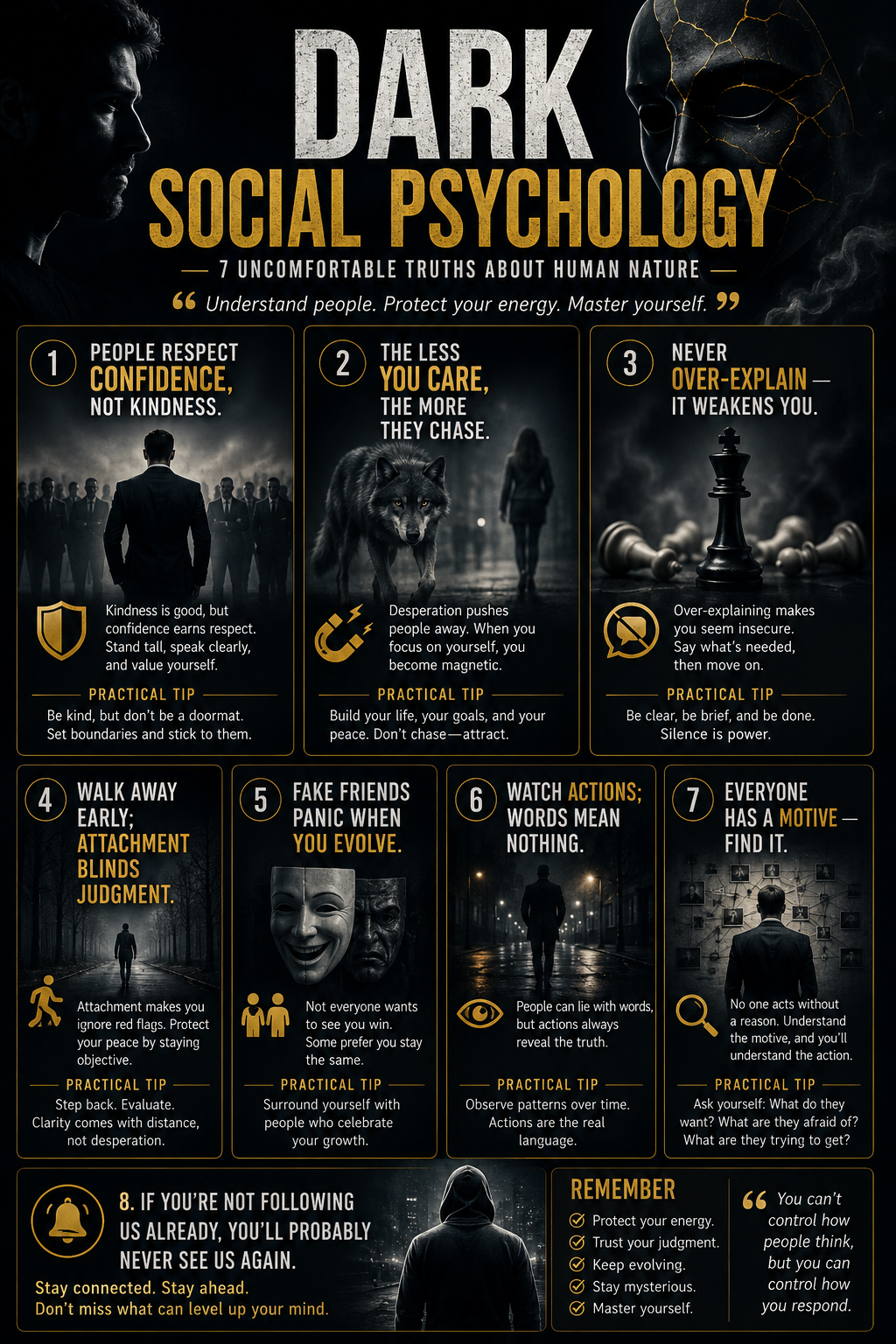
Human beings like to think they make decisions rationally.
We tell ourselves that we judge people fairly, form relationships logically, and make choices based on facts.
But beneath the surface lies a deeper reality.
Our emotions, insecurities, desires, fears, and unconscious biases often influence our behavior far more than we realize.
Understanding these hidden forces isn’t about becoming manipulative.
It’s about becoming aware.
Because once you understand how people truly think and behave, you can navigate life with greater confidence, stronger boundaries, and clearer judgment.
Here are seven uncomfortable truths about human nature that many people discover only after years of experience.
1. Confidence Often Commands More Respect Than Kindness
Kindness is a beautiful quality.
But kindness alone is not enough.
Many people mistakenly believe that if they are always nice, accommodating, and agreeable, others will naturally respect them.
Unfortunately, that’s not always how human psychology works.
People tend to respect those who value themselves.
Confidence signals:
- Self-belief
- Competence
- Leadership
- Emotional stability
Kindness without confidence can sometimes be mistaken for weakness.
Confidence without kindness can become arrogance.
The most powerful combination is both.
The people who earn the deepest respect are often those who are:
- Kind but not naïve
- Compassionate but not easily exploited
- Helpful but capable of saying no
Practical Tip
Speak clearly.
Maintain eye contact.
Express your opinions respectfully.
Don’t apologize for taking up space in the world.
Remember:
Confidence gets attention. Character earns trust.
2. Desperation Pushes People Away
Many people have noticed a curious pattern.
The harder they chase approval, affection, or validation, the more elusive it becomes.
Why?
Because desperation creates pressure.
People are naturally drawn to those who appear emotionally secure and comfortable with themselves.
This doesn’t mean pretending not to care.
It means not making your happiness dependent upon someone else’s response.
Whether in relationships, friendships, business, or social situations, emotional independence is attractive because it signals strength.
Practical Tip
Focus on building a life you genuinely enjoy.
Ironically, when your happiness doesn’t depend on others, your relationships often improve.
3. Over-Explaining Often Reveals Insecurity
Many people feel compelled to justify every decision they make.
They explain.
Defend.
Clarify.
Reassure.
Then explain again.
Often this comes from a fear of being misunderstood or judged.
But confident people understand a simple truth:
Not everyone needs an explanation.
Sometimes a simple answer is enough.
Instead of saying:
“I can’t attend because I’m extremely busy, and I have several commitments, and I feel bad because…”
Try:
“I won’t be able to make it. Thank you for understanding.”
The difference is subtle but powerful.
Practical Tip
When making decisions, communicate clearly and respectfully.
Then allow others to manage their own reactions.
4. Attachment Can Cloud Judgment
One of the greatest challenges in life is seeing situations clearly when emotions are involved.
When we become deeply attached to:
- A relationship
- A job
- A business opportunity
- A friendship
- An idea
we often stop seeing reality objectively.
We ignore warning signs.
We justify poor treatment.
We rationalize bad decisions.
Attachment can create emotional blind spots.
The ability to step back and evaluate situations honestly is one of the most valuable life skills you can develop.
Practical Tip
Whenever facing an important decision, ask:
“What advice would I give a close friend in this exact situation?”
The answer is often surprisingly clear.
5. Not Everyone Celebrates Your Growth
Growth changes relationships.
Sometimes for the better.
Sometimes not.
When you become more disciplined, successful, confident, healthy, or ambitious, you may discover that some people become uncomfortable.
Why?
Because your growth can unintentionally challenge their view of themselves.
Your progress may remind them of goals they abandoned.
Your discipline may highlight their excuses.
Your success may expose their lack of effort.
True friends feel inspired by your growth.
False friends feel threatened by it.
Practical Tip
Pay attention to who:
- Supports your goals
- Celebrates your victories
- Encourages your progress
Those people deserve a place in your life.
6. Actions Reveal Character More Than Words
People can say almost anything.
Promises are easy.
Intentions are easy.
Words cost nothing.
Actions require commitment.
When evaluating someone, don’t focus solely on what they say.
Observe what they consistently do.
Do they keep their promises?
Do they show up when needed?
Do their actions match their values?
Over time, behavior becomes the most reliable source of truth.
Practical Tip
If someone’s words and actions repeatedly conflict, believe the actions.
Patterns rarely lie.
7. Understanding Motives Helps You Understand People
Every human action is driven by some combination of:
- Desire
- Fear
- Security
- Status
- Love
- Recognition
- Belonging
- Survival
This doesn’t mean everyone has hidden malicious intentions.
It simply means people act for reasons.
The better you understand those reasons, the better you understand human behavior.
Great leaders, negotiators, entrepreneurs, psychologists, and communicators all share one skill:
They look beyond behavior and ask:
“What need is driving this person?”
That question often reveals more than anything else.
Practical Tip
When someone behaves unexpectedly, pause before reacting.
Ask yourself:
- What might they be afraid of?
- What might they want?
- What problem are they trying to solve?
Empathy often reveals answers that judgment cannot.
Final Thought: Awareness Is Power
The goal of understanding social psychology is not manipulation.
It is awareness.
The more clearly you understand human nature, the more effectively you can:
- Build healthy relationships
- Protect your boundaries
- Make better decisions
- Avoid unnecessary conflict
- Lead with wisdom rather than emotion
The strongest people are not those who control others.
They are those who understand themselves.
Because once you master your own emotions, insecurities, and motivations, the behavior of others becomes much easier to understand.
And that may be the most powerful psychological advantage of all.
🖤 Be kind. Be confident. Stay aware.
If you found this post helpful, please consider:
- 👏 Giving it all 50 of your claps!
- 💬 Leaving a comment to share your thoughts.
- 🔍 Highlighting important text for easy reference.
- 🔔 Don’t forget to **subscribe** for more valuable insights!
메타데이터
- post_id
- d0d9458137e8
- slug
- dark-social-psychology-7-uncomfortable-truths-about-human-nature-d0d9458137e8
- url
- https://medium.com/empowerment-odyssey-essays-on-growth-success/dark-social-psychology-7-uncomfortable-truths-about-human-nature-d0d9458137e8
- canonical_url
- https://medium.com/empowerment-odyssey-essays-on-growth-success/dark-social-psychology-7-uncomfortable-truths-about-human-nature-d0d9458137e8
- author_url
- https://medium.com/@complexitybeauty
- status
- ok
- fetched_at
- 2026-07-08 23:38:59