Profile in Courage Challenging and Defeating Authoritarianism in the Philippines and the United…
Maria Angelita Ressa — A Case Study in Courage, Nerve, Leadership and Action
Profile in Courage Challenging and Defeating Authoritarianism in the Philippines and the United States
Maria Angelita Ressa — A Case Study in Courage, Nerve, Leadership and Action
Introduction
Maria Angelita Ressa is a Filipino and American journalist and a 2021 Nobel Peace Prize laureate. In 2012, she co-founded and is CEO of Rappler, a Philippine based news service. She previously spent two decades working as a lead investigative reporter in Southeast Asia for CNN.
She is a Professor of Professional Practice in the School of International and Public Affairs at Columbia University and has been a Distinguished Fellow at Columbia’s new Institute of Global Politics since the fall of 2023.
In addition to her many awards for journalism and “her courage and work on disinformation and ‘fake news,’ Ressa was named one of Time Magazine’s 2018 Person of the Year, was among its 100 Most Influential People of 2019, and has also been named one of Time’s Most Influential Women of the Century. She was also part of the BBC’s 100 most inspiring and influential women of 2019 and Prospect magazine’s world’s top 50 thinkers.”
She recently founded Nerve, a data forensics company that enables changemakers to navigate real-world trends & issues through narrative & network investigations.

Maria A. Ressa
Ressa’s work since 2016
Since 2016, Ressa has written and spoken out on the authoritarian threats to democracy in the Philippines and now the United States. Many of her public speeches and interviews are included in the reference section.
Ressa represents the type of courage, nerve and leadership that is missing yet urgently needed today in the United States to soundly defeat and hold accountable the authoritarian capture of the government and key institutions of the United States of America by President Donald J. Trump and his MAGA regime of enablers and complicit perpetrators.
Ressa is qualified as a role model because she lived through the rise and now fall of former Philippine President Rodrigo Duterte, who was also democratically elected President in 2016 and served until 2022. Duterte served as a dictator and committed crimes against humanity with his extra-judicial killings of thousands of Filipinos, and has subsequently been arrested by the International Criminal Court. His co-perpetrators within his Administration are also at risk of arrest by the ICC.
For her reporting on Duterte’s crimes against humanity, Ressa has been arrested by the Philippine government with eleven arrest warrants issued against her. She showed courage in standing up for the Philippine Constitution, their bill of rights, and particularly the American 1st amendment principle of freedom of speech and the press, which was intended as a mechanism for independent journalists to speak truth to power and hold it accountable to the people in a Democracy.
Ressa won the Nobel Prize for Peace in 2021 because of her “efforts to safeguard freedom of expression, which is a precondition for democracy and lasting peace.” Her organization Rappler is a mission-driven news and reporting organization, not one driven by profit and the interests of media ownership. Ressa was the first journalist to receive the Nobel prize since 1935.
Ressa has also repeatedly sounded the alarm for democracies around the world, and particularly the United States, noting that the same authoritarian rise that captured the Philippine government is happening in other democracies, including the United States. In 2023, she published a book and template on how to stand up to dictators and defeat rising authoritarianism within democratic systems.
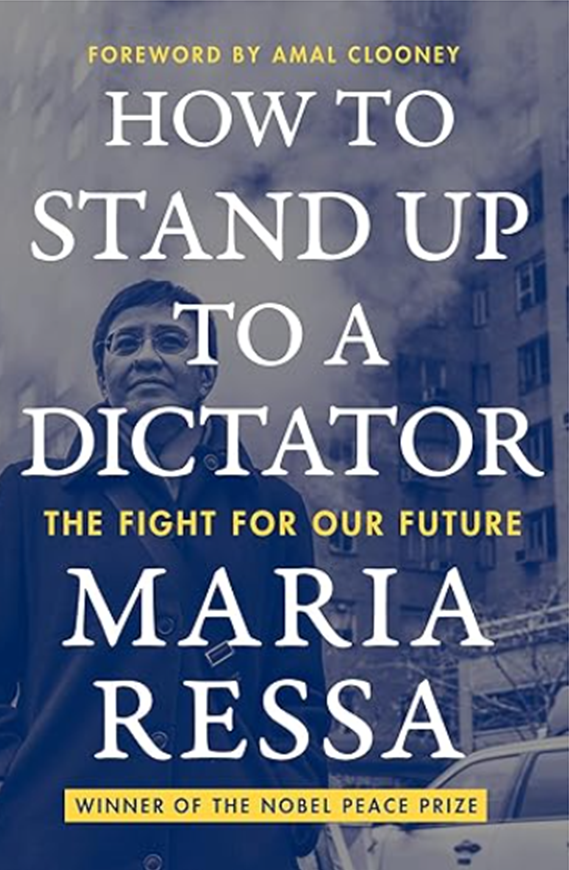
Ressa’s 2023 Book
Ressa emphasizes that Facts, Truth and Trust are required for a functioning Democracy. Without those three things, we have no shared reality and we have no Democracy. The playbook of Authoritarians like Duterte and Trump are to eliminate all three so that only the great leader “alone can fix things.”
With the ability of Facebook to significantly enable Duterte’s rise to power in 2016, Ressa began warning Americans that this technology (social media algorithms from all platforms) was going to impact America’s society and elections and they have.
The public information ecosystem, which is crucial to a healthy and functioning democracy, is now governed by plutocrats that own the major media and information systems, particularly social media. Social media is quite different than the media of old in its ability to psychologically, neuro-chemically, and emotionally hijack people’s attention for the profit of platform owners, and to manipulate them to develop beliefs and practices, including voting or not voting in ways that were never possible before these algorithms and platforms were developed.
Lies, fear, and anger keep people’s attention focused and this affects people’s beliefs and actions including how they vote in a Democracy. Lies and false information spread faster than truth and this has been measured and validated in multiple studies including an MIT 2018 study.
The authoritarian playbook depends on creating lies and confusion in a way that people no longer know what to believe so the only belief offered is the “truth” of the great leader when they state that “they alone can fix it.” The rule of law is impossible to uphold if there are no longer any shared facts.
In 2016, Cambridge Analytica tested the algorithms of mass manipulation in the Philippine 2016 election and once seeing it worked there, they and other platforms exported the approach to other democracies including the United States in 2016, 2020 and 2024.
The end result of this pollution of the information ecosystem is Fear, anger and hate or “toxic sludge” as Ressa referred to it in her Nobel Prize lecture.
Key Principles to Fight and Challenge Authoritarian Capture of Democracy
In Ressa’s 2023 book, she covers three key themes and principles that every citizen must comprehend, heed and embrace so that they may best take action to stop an authoritarian capture of Democracy.
-
Value what you have. Democracies, rights, and institutions are fragile. You must see them clearly before you can defend them.
-
Hold the Line. When truth is under attack, you must stand firm — personally, institutionally, collectively — even when the cost is high.
-
The Present Moment of the Past. The struggle is not only about today. It is about the long arc of history repeating itself unless we consciously break the cycle of authoritarian capture.
Ressa’s third point — “The Present Moment of the Past” — is her most philosophical and, in many ways, the key to understanding why democracies today feel so fragile. It names the deep temporal structure of the crisis she is describing: the way old, unresolved histories (Colonialism, Racism, Misogyny, Nativism, Religious Tribalism, Capitalist Owners suppressing labor) reassert themselves in the present through new technologies, new political actors, and new vulnerabilities.
What she means by “The Present Moment of the Past”
The essence is that the past is not past. It is continually re‑activated, re‑weaponized, and re‑lived in the present — especially in the digital age, where narratives can be rewritten, amplified, or erased at scale.
Ressa is pointing to three intertwined dynamics:
- Historical amnesia becomes a political weapon When societies fail to confront or integrate their own histories — authoritarianism, corruption, disinformation, colonial trauma — those unresolved patterns return. In the Philippines, the Marcos family’s return to power was made possible by decades of unaddressed historical wounds and a digitally accelerated rewriting of the past.
The Trump Administration has been hard at work in not only eliminating Science and scientific institutions, it is mandating a re-writing of American history in public schools, with sycophant Governors like Florida’s DeSantis following along with this. The most recent example is Trump’s order to remove a figure from Philadelphia’s National Historic Park showing 1st President George Washington with slaves, which is historically accurate and factual. A Judge just ordered that this be restored.
Historian Jon Meacham discusses the significance of the illiberalism of the Trump administration and how he has introduced a “virus into American democracy” and that with this Trump-MAGA regime, America once again is in the midst of a “ferocious struggle.”
- Digital platforms collapse time Social media creates a world where old propaganda, old lies, and old grievances can be revived instantly and made to feel newly urgent. The past becomes a reservoir of emotional triggers that can be deployed in the present.
- Authoritarian playbooks repeat themselves The tactics used by dictators in the 20th century — control information, attack truth-tellers, manufacture enemies — reappear today but are supercharged by algorithmic amplification. The “present moment” is simply the past running on new infrastructure.
Americans are living inside the consequences of histories we never resolved, now accelerated by technologies we never learned to govern.
Her three themes form a progression. The third point fits with the first two such that together, they form a call to historical consciousness, moral courage, and collective responsibility.
Why this matters for the meta‑crisis
Ressa’s insight resonates strongly with integrative metatheory regarding the meta‑crisis:
· The meta‑crisis is partly a crisis of time — we are overwhelmed by accelerating futures and haunted by unintegrated pasts.
· Disinformation exploits temporal fractures: nostalgia, grievance, mythic memory, and unresolved trauma.
· Collective sensemaking requires temporal integration: remembering accurately, grieving honestly, and choosing consciously what to carry forward.
In this sense, “The Present Moment of the Past” is not just a warning — it is an invitation to heal historical loops so that new futures become possible.
Trump 2.0 — Narrative Warfare, Breaking Down Reality, and Weaponizing Power
In Ressa’s just published work from Nerve, she documents the systematic importation of the authoritarian playbook and how the ‘Deconstruction Model’ turned narrative warfare into kinetic reality in the United States.
The Deconstruction Model of Project 2025 vs a Persuasion Model of democratic governance has been undertaken, and it has succeeded. See the figure below. “It fragmented shared reality so completely that majority opposition could not prevent — nor hold anyone accountable — for these actions.” Institutional gatekeepers of the press, Congress, think tanks, have been completely bypassed. Content triggers of Executive Order actions create narrative events which are amplified by influencers and algorithms that rewards this dysfunctional and unconstitutional political and governing behavior.
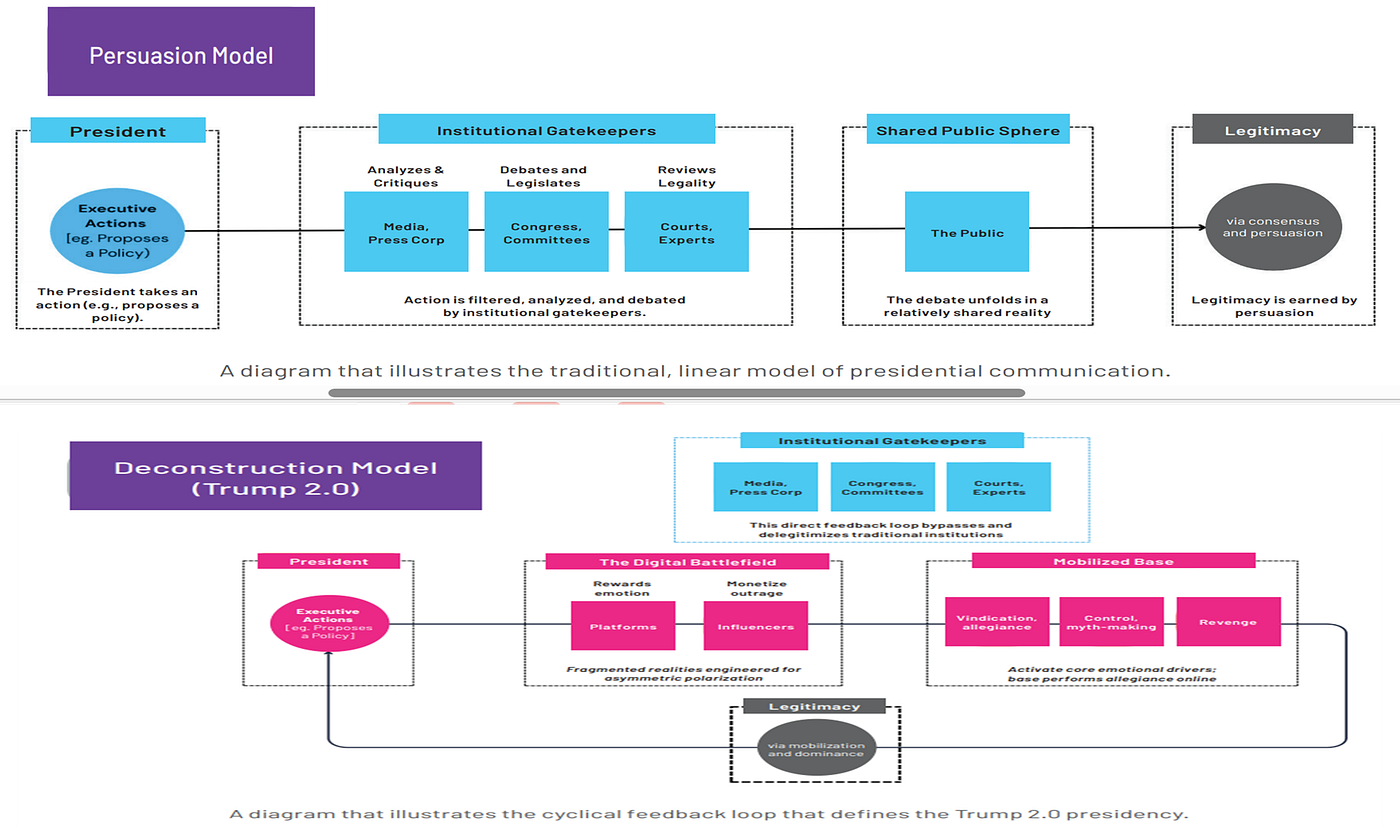
Persuasion vs Trump 2.0 Deconstruction Model of Governance (Nerve, 2026)
The Deconstruction Model’s “primary purpose is not to persuade institutions but to dismantle their authority. As this diagram shows, it operates as a cyclical, self-perpetuating feedback loop.” The first 100 days of the second Trump Administration “formed the blueprint. Venezuela is the proof. Minneapolis is the warning. Greenland is the pattern.
This report is the evidence of how narrative warfare laid the groundwork — and what becomes possible when the battle for information integrity is lost.” The technological architecture and economic model of the current information ecosystem and attention economy reinforce the focus from the content of policies and their impact and instead focuses on the personalities of the players.
This results in the authoritarian regime acting with impunity and without consequences (so far). The commodification of news means there are no longer institutional gatekeepers that are respected and that may be a check on authoritarian power.
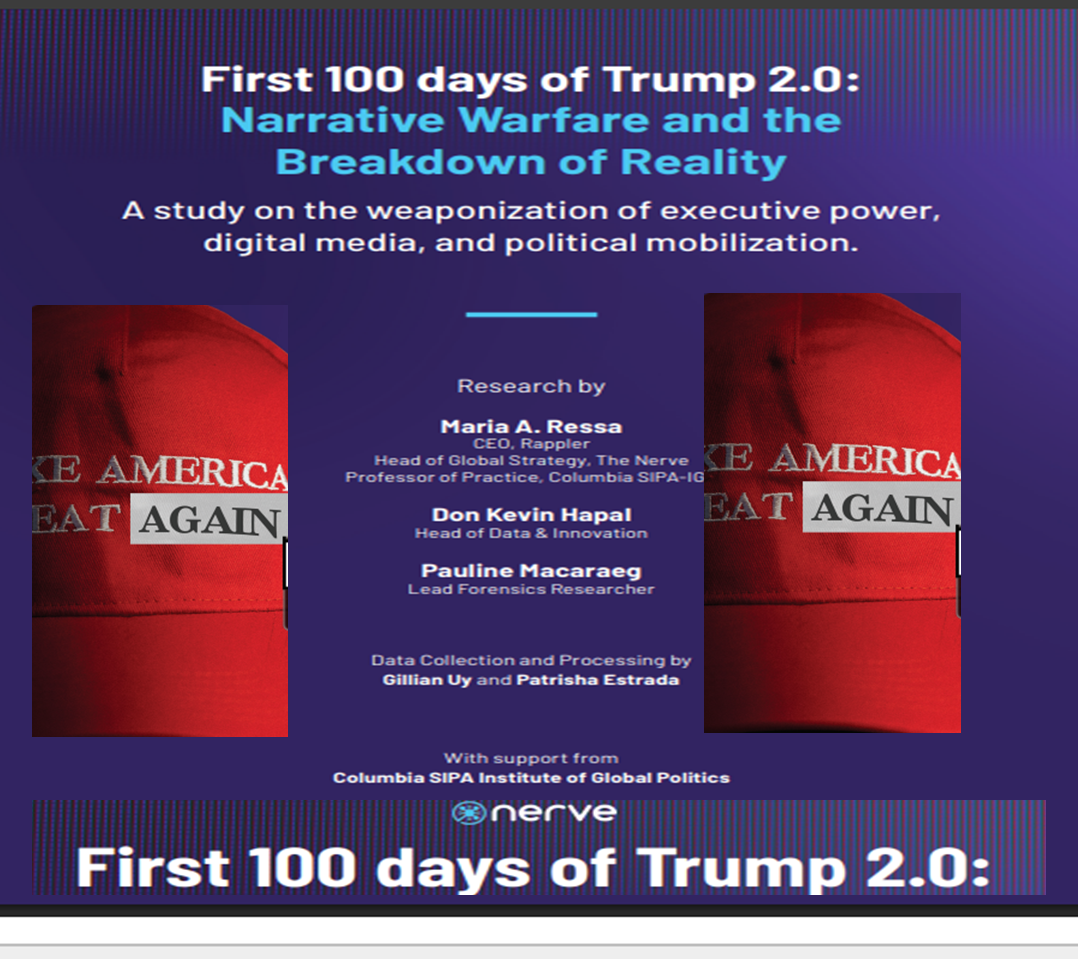
Ressa’s 2026 Report
Outline of the Report — First 100 Days: Trump 2.0 Narrative Warfare and Breakdown of Reality
1- Trump’s executive orders as narrative engines
- Policy as symbolic action
- Narrative splits across communities
- Platform amplification patterns
- Case Example: The DEI ban as a moral symbol
- From policy to propaganda cycle
2- Fragmented platforms, fragmented realities
- Facebook: Narrative insularity and group reinforcement
- X: Elite framing and ideological siloing
- TikTok: Spectacle and “celebritification”
- YouTube: Long-form narrative and symbolic mythology
- Platform fragmentation and the collapse of shared reality
3- Tactical camps within Trump’s base
- Populist-Nationalists: Anti-globalism and the deep state
- Religious Right: Trump as divine instrument
- Tech-Libertarians and Free Speech Absolutists
- Coordinated diversity, not uniform messaging
4- Narrative dynamics and emotional drivers
- Vindication
- Control
- Revenge
5- Weaponization of information
- Facts as narrative triggers
- Narrative reframing as an influence tactic
6- Trump as symbol: myth, media, and allegiance
- Mythologizing Trump: From candidate to chosen one
- The president as performer
- Allegiance over argument
7- The New Gatekeepers: Influencers and the creator economy
8- Conclusion and recommendation
This report focuses on how the Trump playbook is less about all the Executive Orders that have been issued or the defunding of key scientific research and agencies, or the destruction and defaming of key symbolic and artistic institutions, or the symbolic chainsaws held by plutocrat Musk with the failed DOGE effort, etc., it is about psychology. It is about how stories are used to shape what we believe is real.
“The Trump administration functions as a symbolic engine to consolidate power by systematically dismantling the institutional checks that require a shared reality. By funneling policies and provocations into a digital ecosystem architected to amplify emotion over substance, this model replaces institutional debate with a performance of allegiance. In this landscape, political legitimacy is no longer determined by law or democratic consensus, but is forged through loyalty within competing, algorithmically-curated worlds, effectively rendering traditional accountability obsolete.”
It has been first about imposing a narrative in the country. It has not been about governing in the traditional sense, it has been more about dominating attention. Flooding the zone with shit in Steve Bannon’s turn of phrase, and in the process, triggering emotion is the point.
All authoritarians are about imposing their will and power. They know that fear and anger travel faster than facts. The algorithms of social media amplify this fear, anger and rage. Rather than attempting to tamp this down, the authoritarian uses this as a tool of control.
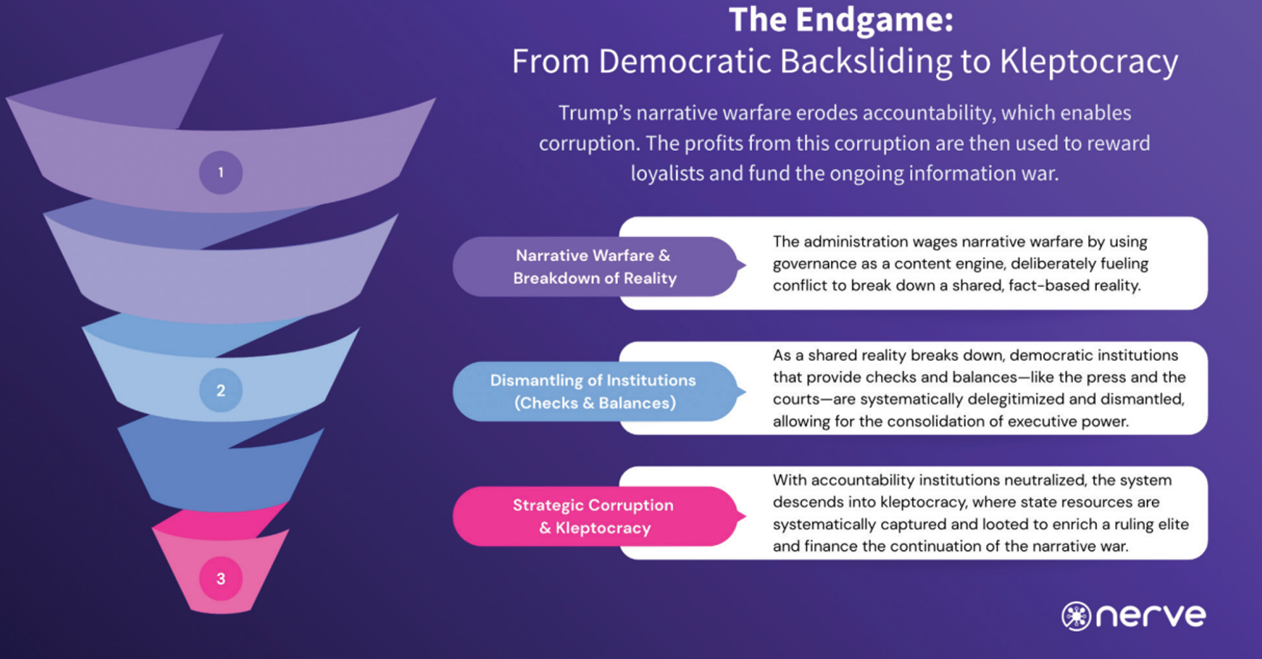
The Trump-MAGA Endgame, Nerve Report, January 2026
Trump and his communications strategy use digital systems to push emotional content relentlessly with people losing their grip on a shared sense of reality. Once an authoritarian breaks reality, other things become much easier to break and destroy. While it is true that the United States is politically polarized, this MAGA strategy intends to amplify this and achieve psychological fragmentation.
Democracies collapse when the authoritarian successfully erodes all institutions which are framed by the authoritarian as corrupt or fake, when the reality is that the Trump MAGA authoritarian regime is running the most corrupt operation in American history. Once people stop defending the institutions of American democracy, the “power over” held by the authoritarian enables them to do whatever they want, to the point where Trump has said (with backing by the Supreme Court) that the only thing stopping him from doing anything is his own morality.
Let that sink in. Where are the moral and courageous leaders that state clearly and plainly that the corrupt leader has no morals, no ethics and does not govern within the constraints of the Constitution and rule of law?
Ressa, having lived through Duterte and now Trump, has noted she is experiencing both Déjà vu and PTSD, which can be the cumulative effect of behavior change since this narrative warfare has begun. The narrative goes viral, and the lies are amplified — e.g. the 2020 election results and the reality of the insurrection that Trump instigated and was impeached for in January of 2021 are continuously pushed by the authoritarian as truth. The authoritarian uses the levers of his power — the Justice department, the national police agencies, the military, the pressuring of all media, including sympathetic mouthpieces like Fox News to amplify these untruths.
Narrative warfare is a type of “Information Armageddon” or a battle for discerning reality and truth. The authoritarian knows that once the public cannot tell facts from fiction, civic engagement disappears. Once civic engagement disappears, Institutions are then dismantled such that there are no longer checks and balances against the authoritarian capture. Once Institutions are dismantled, the fusion of the state with complicit and enabling Big Tech Corporations and Plutocrats has also occurred and taken control.
Without shared facts, there are no shared truths.
Without shared truths, you cannot have trust.
Without these you cannot have a functioning democracy, particularly with the collapse of journalism that accurately reports the facts that are unfolding.
From a Public Policy perspective, the Congress must address these issues once the authoritarian regime is removed. As noted in the conclusion of the report, “Addressing a crisis of this magnitude requires more than reactive fact-checking. It demands a proactive, multi-layered strategy focused on rebuilding the foundational pillars of a healthy democratic society.”
The report concludes with the following recommendations:
1- Civic Engagement: Cultivate Community-Level Resilience
We must pivot from top-down corrections to bottom-up resilience. Because disinformation spreads organically through trusted peer networks, external fact-checks often fail to penetrate insular communities.
• Support Independent Journalism: Direct funding and support must be channeled to independent and local journalism to restore a shared factual basis for community debates.
• Train “Trusted Messengers”: We must fund independent and local organizations to train community leaders — clergy, educators, and local organizers — on media literacy. These figures possess the established trust networks necessary to counter manipulation.
• Adopt a Hybrid Organizing Model: Resilience requires a model that empowers physical, on-the-ground community organizing while equipping it with scalable virtual distribution of resources and training.
2- Regulation: Promote Platform Accountability and Redesign
We must reframe the legislative debate from “content moderation” (which traps us in free speech arguments) to “product safety” (which focuses on design flaws). (The Congress must revisit Section 230 of the Telecommunications Act of 1996.)
• Reframe as Public Safety: Regulating platforms that algorithmically amplify disinformation is not a censorship issue but a public health and safety imperative.
• Redesign for Civic Health: Policymakers must pressure platforms to redesign algorithms to prioritize civic health over raw engagement. This includes strictly de-prioritizing content that fuels affective polarization.
• Monitor Influence Operations: Legislation must strictly monitor and regulate anonymous funding, fake think tanks, and covert media operations that fuel the “Deconstruction Model.”
3- Technology: Reinvest in the Infrastructure of Trust
We must build a structural alternative to the current ecosystem of surveillance capitalism. This involves securing sustainable funding for a “Public Tech Stack” — deliberative technology that serves the public good rather than profit.
These recommendations are about addressing the issue of free speech and societal harm — e.g. screaming fire in a theater when there is no fire is not allowed. Some guardrails and regulations for social media platforms are in order and must be constructed intentionally and thoughtfully.
We need to address Surveillance Capitalism and must Stop Surveillance for Profit. This is rampant since 9/11 and has only accelerated with cell phones, pervasive computing, the Internet of Things, and financial incentives to collect massive amounts of information about individuals which may be acted upon by corporations and the state.
We need to stop coded bias against ethnic minorities and women imbedded in algorithms of social media and Artificial Intelligence.
Journalism is an antidote to tyranny. It is protected and called out in the 1st Amendment to the Constitution for a reason. Congress must act to enable journalistic platforms without inherent conflicts of interest. Funding and support and tax policy for non-profit media institutions with journalistic standards may be implemented. Separate the publisher function and its ownership from the journalist and inclusion of editors with journalistic standards- E.g. a self-serving Plutocrat like Jeff Bezos should in no way be the owner of the Washington Post.
Focusing on these issues will support the enablement of building civic communities which are necessary for a well-functioning and healthy democracy.
Summary
The United States is now an autocracy practicing competitive authoritarianism.
If all goes well and right in the United States, justice will prevail and a similar fait will befall President Donald J. Trump as well as the key leaders and enablers from his Administration as has befallen Duterte and his leadership. For convenience, I have listed these key leaders and enablers in the reference section that will need to face varying degrees of justice for their high crimes and misdemeanors, complicity, sycophancy, and enablement. This can range from naming, shaming and shunning to trials and imprisonment.
Those enablers outside government that have both supported or been cowed by this reign of democratic destruction should also be held accountable now and after this regime has been removed from power. This naming, shaming and shunning of the complicit will be required in a way that was not done at all during Reconstruction after the Civil War but should have been. The US must learn from its history.
Before they are removed from power, Scott Galloway has offered one way now for people to withdraw financial support for these enablers by resisting and unsubscribing to economic enablers of MAGA. Stronger measures such as a national strike may eventually be required. The people of Minneapolis are leading and showing the way to resist this now. Governors like Maryland’s Wes Moore are also demonstrating leadership. There is need for others to show up in a bigger way now.
More leaders with the courage that Maria Ressa has demonstrated for ten years must now show up and lead the way. It is past time for others within the United State to take up the charge to bring an end to this authoritarian regime that has captured power within the United States and restore a democratic republic that protects and defends the Constitution of the United States against all enemies, foreign and domestic, and upholds the rule of law.
References
Rodrigo Duterte: The Rise and Fall of the Philippines’ Controversial Leader, 3/11/2025, Asian Journal Press.
Justice will catch up with Duterte allies — De Lima amid ICC update, 2/14/2026, Krixia Subingsubin, Cebu Daily News.
The human rights situation: From Duterte until today, Shay Cullen, 2/15/2026, The Manilla Times.
How to Stand Up to a Dictator: A Nobel Laureate’s Fight Against Authoritarianism, 11/28/2023, Maria A, Ressa.
The Meta-Crisis and Underlying Worldviews — Mapping a way forward, 7/25/2025, Jim Loving, Medium.
Jon Meacham: Trump Introduced a Virus Into Democracy, 2/18/2026, Amanpour and Company, YouTube.
First 100 days of Trump 2.0: Narrative Warfare and the Breakdown of Reality — A study on the weaponization of executive power, digital media, and political mobilization, 1/20/2026, Maria A, Ressa, Don Kevin Hapal, and Pauline Macaraeg, Nerve.
Bad Faith Communication — The Broken Media and Information Ecosystem and the Consequences for Democracy and Society, 12/30/2024, Jim Loving, Medium.
Concentrated Corporate Power Corrupts, Absolutely, 10/2/2024, Jim Loving, Medium.
Study: False news spreads faster than the truth, 3/8/2018, MIT Sloan School of Management.
The spread of true and false news online, 3/9/2018, Soroush Vosoughi Deb Roy, and Sinan Aral, Science Journal.
When Reality Becomes a Weapon: First Hundred Days of TRUMP 2.0, 2/12/2026, Adam Coleman, Substack.
America Has Never Seen Corruption Like This, 7/10/2025, Casey Michel, The Atlantic.
Trump Said His Global Power Was Limited Only by His ‘Own Morality’, 1/6/2026, Matthew Cullen, The New York Times.
As Jeff Bezos dismantles The Washington Post, five regional papers chart a course for survival, 2/10/2026, Dan Kennedy, The Conversation.
Concerns over autocracy in the U.S. continue to grow, 2/16/2026, Frank Langfitt, NPR All Things Considered.
Sen. Ruben Gallego would call for national strike if Trump tried to mess with November election, 2/11/2026, KTAR.com, Arizona News.
The Three Lessons of Minneapolis, 1/29/2026, Peter Wehner, The Atlantic.
Maria Ressa Public lectures and Interviews
Nobel Prize lecture: Maria Ressa, Nobel Peace Prize 2021, Nobel Prize, YouTube. Maria Ressa on Trump 2nd Term: “Narrative Warfare & the Breakdown of Reality”, 2/11/2026, Amanpour and Company, YouTube.
Maria Ressa: How Social Media Uses Free Speech To Stifle Free Speech, January 2023, Steven Colbert Show, YouTube. Maria Ressa — Fighting Back Against Trump’s Authoritarian Algorithm With Truth, October 2025, Jon Stewart and The Daily Show, YouTube.
Ressa Discussion at Washington Post Live, Futurist Summit, February 2025, YouTube.
Ressa Speech at One Young World, February 2025, YouTube.
Ressa Speech at the Vatican 2025, YouTube.
PBS Interview, March of 2025, YouTube.
United Nation’s 80th anniversary meeting, 9/22/2025, Ressa Talk, YouTube.
PBS Fresh Air Interview, 2023, YouTube.
Those Complicit and Enablers of the MAGA Authoritarian Movement
This is a partial list, but a good place to start.
Donald J. Trump, JD Vance, Jared Kushner, Donald Trump Jr.
Kristi Noem, Pam Bondi, Pete Hegseth, Kash Patel, Dan Bongino, Howard Lutnick, “Little Marco” Rubio, Steve Witkoff, Steven Miller, Russell Vogt, Brendan Carr.
Mike Johnson, John Thune, Mitch McConnel.
Steve Bannon, Elon Musk, Jeff Bezos, Mark Zuckerberg, Rupert Murdoch, David Ellison.
메타데이터
- post_id
- d0f414020e76
- slug
- profile-in-courage-challenging-and-defeating-authoritarianism-in-the-philippines-and-the-united-d0f414020e76
- url
- https://medium.com/@jylterps/profile-in-courage-challenging-and-defeating-authoritarianism-in-the-philippines-and-the-united-d0f414020e76
- canonical_url
- https://medium.com/@jylterps/profile-in-courage-challenging-and-defeating-authoritarianism-in-the-philippines-and-the-united-d0f414020e76
- author_url
- https://medium.com/@jylterps
- status
- ok
- fetched_at
- 2026-06-22 05:41:33