What Do Creators Owe Their Creations?
Mary Shelley on Prometheus and female creativity
What Do Creators Owe Their Creations?
Mary Shelley on Prometheus and female creativity
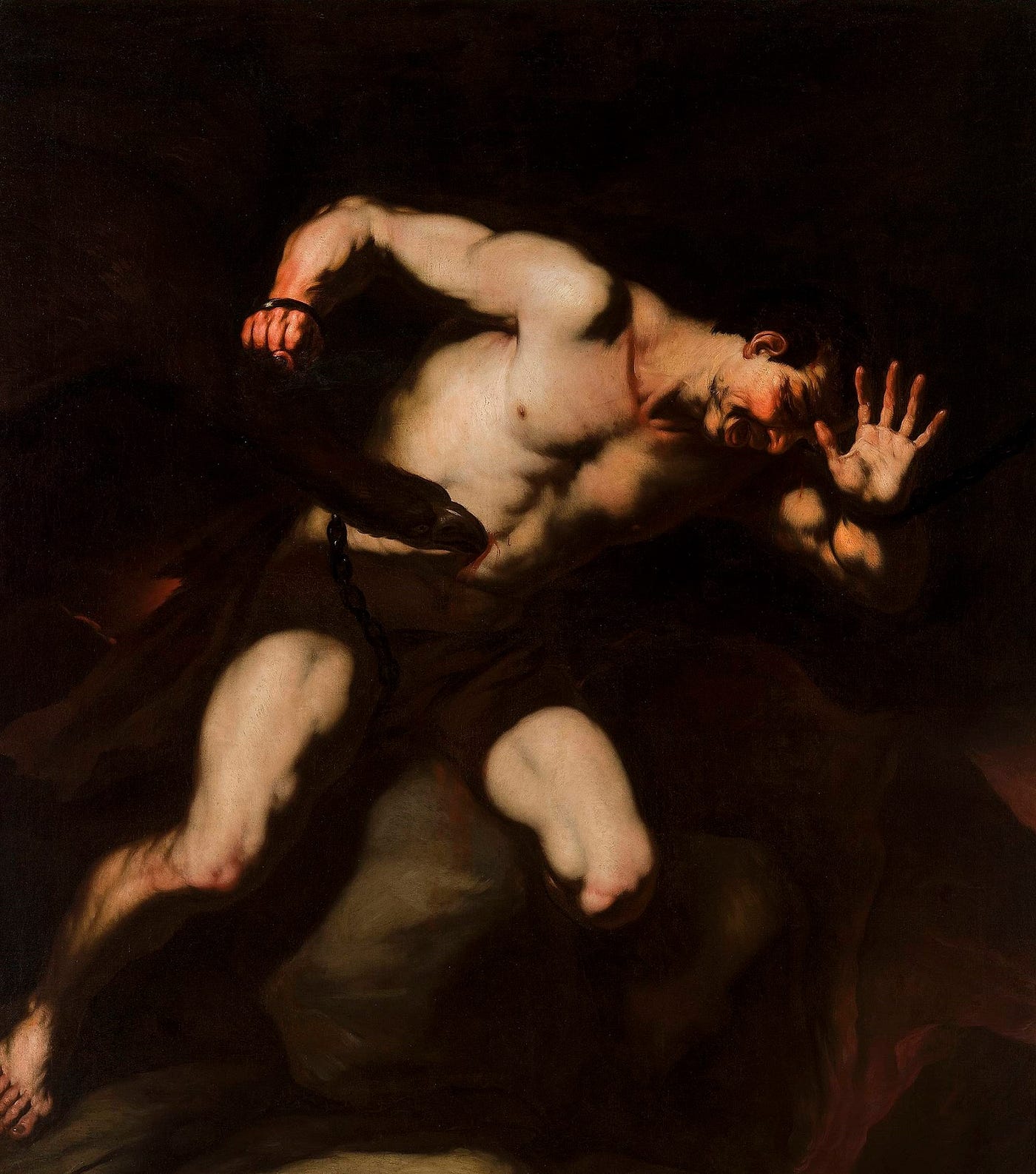
Luca Giordano, “Prometheus Bound.” Second half of 17th century. Museum of Fine Arts, Warsaw. Source: Wikimedia.
What do creators owe to what they bring into being? Few writers confronted that question more directly than Mary Wollstonecraft Shelley. After the untimely death of her husband Percy Bysshe Shelley in 1822, Mary Shelley made it her life’s work to present her husband’s writing to the world. It was through Mary’s labours that Percy’s “A Defence of Poetry” first appeared in print in 1840, in a volume that included his unpublished translations of Plato and numerous fragments.
Mary was a diligent and meticulous editor; her first priority was to present her deceased husband’s works in a format that would ensure their widest circulation. For translations such as Plato’s “Ion” that were left unfinished at the time of Percy’s death, she deemed it “better that it should appear as a whole” and therefore added in brackets translations of the parts he left untranslated.¹
The careful explanations she appended to every one of Percy’s extended works attest to Mary’s devotion to her husband’s legacy. In hindsight, Mary’s recreation of a posthumous Percy Bysshe Shelley appears as part of the process through which she developed her own creative license. Most of Percy’s writings, particularly his fragments and unfinished works, would never have seen the light of day without his wife’s editorial labours.
Mary also applied her critical faculties to the task of creating an audience receptive to Percy’s poetics, which turns out to have been quite distinct from her own. Indeed, both Mary’s editorial practice and her original writing show her driven by a single, urgent question: what do creators owe to what they bring into being?
Percy’s ideal of unbounded creation
Percy too was devoted to his spouse’s literary success. He arranged for the publication of what would become Mary’s best-known creation, Frankenstein; or, the Modern Prometheus (composed between 1816 and 1817) by the small publishing firm Lackington in a print run of 500 copies. Typically for the time, acknowledgement of Mary’s authorship was omitted.
To pre-empt harsh reviews, Percy composed a short essay about the book soon after its publication in 1817. In this work, published posthumously in 1832, Percy called the novel “one of the most original and complete productions of the day.”² And yet, he could not bring himself to offer unreserved praise. He found lacking in Mary’s creation the quality that he valued most in his own work: originality.
Percy had written in the preface to “The Revolt of Islam” (1817–8) that “I have sought to avoid the imitation of any style of language […] designing that even if what I have produced be worthless, it should still be properly my own.”³ In line with this aesthetic credo, Percy measures Mary’s Frankenstein entirely by the extent to which it bears the traces of other writers’ influence. In addition, he strikes a patronizing tone. “There are, perhaps, some points of subordinate importance,” in the novel, he states without offering further specifics, “which prove that it is the author’s first attempt.”
Two years after he authored this ambivalent assessment, Percy would compose what he called a “lyrical drama” on the same Promethean theme that occupied Frankenstein: “Prometheus Unbound.” It would be easy to link the two texts and to show how Mary’s refashioning of the ancient Greek hero Prometheus, who famously stole fire from Zeus to give it to humans, inspired her husband’s creation. Such an argument would need to acknowledge that, to the extent that Percy fashions a hero from Prometheus, he misses the critique of lawless creation that is found in Mary’s Frankenstein.
“Prometheus Unbound” was modelled on a lost play by Aeschylus, a disappearance that enabled Percy to replace tragic restraint with his own unbounded vision of Promethean liberation. Mary quotes a letter of Percy’s written from Rome: “It is a drama, with characters and mechanisms of a kind yet unattempted; and I think the execution is better than any of my former attempts.”⁴
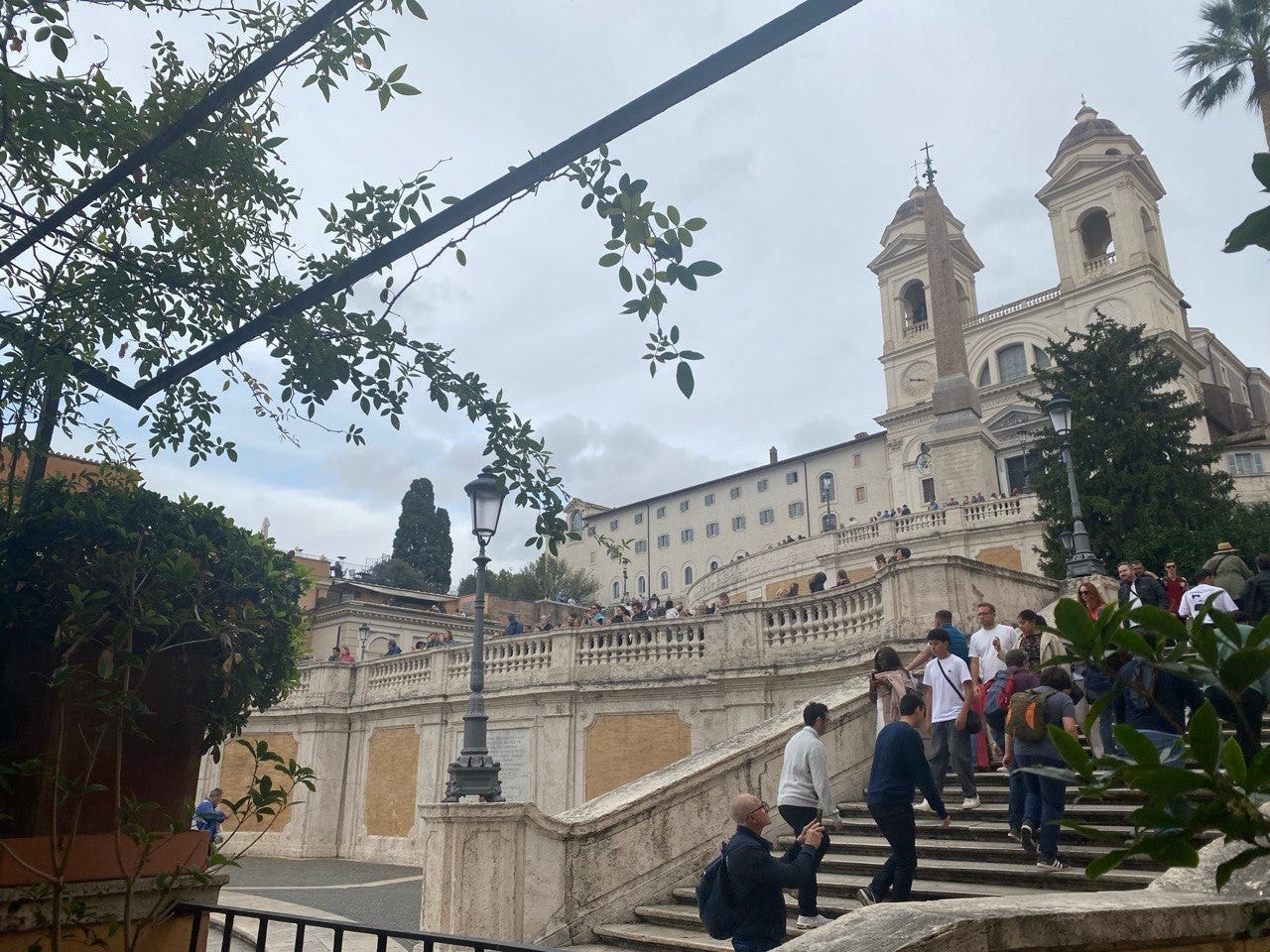
View of the Spanish Steps from the Keats-Shelley Home in Rome. Mary and Percy Shelley visited Keats many times here in 1821. Photo by Rebecca Ruth Gould (2025).
Romantic heroism and the ethics of rebellion
The Prometheus myth set in motion a subtle dialogue between husband and wife concerning the metaphysics of the creative act, the ethical status of creation, and the right of creatures to rebel against their creator. This Promethean exchange structured the intellectual dialogue — and, arguably, the rivalry — at the heart of their marriage. The divergence in their treatment of Prometheus is telling.
While Percy’s “Prometheus Unbound” chronicles the liberation of humanity through Prometheus’ theft of fire, Frankenstein deals with an equally blasphemous act: the creation of a quasi-human species. For this second act of hubris, the creator is punished. Whereas Prometheus is rewarded for breaking the laws instituted by the gods, Frankenstein is damned for breaking nature’s laws. These works’ opposing accounts of what we owe to our fellow creatures and to our creations tell us much about Percy’s and Mary’s divergent attitudes to the creative process.
With the subtitle for her first novel, Mary was the first to announce the Prometheus theme that would occupy the pair’s creative imaginations in subsequent years. Yet, it was Percy who drew out the implications of this myth in the greatest detail, thereby highlighting their respective differences. He insisted that “Didactic poetry is my abhorrence,” but he was also keen to provide an interpretive key to his work.⁵
In his preface to “Prometheus Unbound,” Percy develops an elaborate contrast between the figure of Satan, who, in his recreation in Milton’s Paradise Lost (1667), came to be seen as a Romantic hero for his refusal to bow down to God, and Prometheus, who more purely embodied the qualities of “courage, and majesty, and firm and patient opposition to omnipotent force.”⁶ Alongside these qualities, which he shared in common with Satan, Percy’s Prometheus is “susceptible of being described as exempt from the taints of ambition, envy, revenge, and a desire for personal aggrandisement.”
In equating Prometheus with the protagonist of her first novel, Mary had already cast a shadow over this tendency towards glorification. Her Prometheus would have been better off had he not violated Zeus’ mandate by stealing fire for the sake of humanity. Percy misses Mary’s warning concerning hubris, the dangers of which are also one of the major themes of the Greek tragic tradition. Instead, he celebrates an irresponsible hero who broke the law for the sake of a higher cause, and whose very oblivion to the consequences of his actions is part of his glory.
Whereas the Satan of Paradise Lost “engenders in the mind a pernicious casuistry,” Prometheus in Percy’s recreation represents “the highest perfection of moral and intellectual nature, impelled by the purest and the truest motives to the best and noblest ends.”
What, one wonders, did Mary make of this glorification of a figure whom she had already warned against in her first novel? We will never know in full. Percy did not comment directly on his wife’s subtitle, even in his brief pre-emptive review. The most we have by way of commentary from either spouse is an editorial aside by Mary in her “Editor’s Note on Prometheus Unbound,” which directly follows the presentation of the poem in the first volume of The poetical works of Percy Bysshe Shelley. Edited by Mrs. Shelley (1839).
In a rare moment of candor in a volume that contains few digressions from its focus on the poet and his works, Mary adds a note that seems out of place in a commentary on “Prometheus Unbound.” The comment pertains to Percy’s earlier poem, “The Revolt of Islam” (1817), also included in this same volume edited by Mary.
“The Revolt of Islam” is thematically linked to “Prometheus Unbound” through its celebration of the autonomous subject in revolt against everything and everyone who stands in the way of his will. When she was correcting the proofs of that poem, it occurred to Mary that Percy had “indulged in an exaggerated view of the evils of restored despotism, which, however injurious and degrading, were less openly sanguinary than the triumph of anarchy.”⁷
Although Mary is here reflecting on the general question of whether anarchy is better than bloodless tyranny, she grounds her own views within the bloody aftermath of the French Revolution that determined the political horizons of her generation.
The limits of revolutionary violence
Mary understood that something much bigger was at stake in her husband’s Promethean representations than a matter of historical interpretation. In her commentary appended to the end of “The Revolt of Islam,” Mary described Percy’s hero as “a youth nourished in dreams of liberty, some of whose actions are in direct opposition to the opinions of the world; but who is animated throughout by an ardent love of virtue.”⁸
Whether or not she agreed with Percy’s insistent celebration of the autonomous and irresponsible Promethean hero, Mary understood that Percy was staking a claim in his poetry on the poet’s right — indeed, his noble obligation — to act without considering the consequences.
For Percy, heedless action was the epitome of courage and freedom. Mary however had suffered intensely from Percy’s callousness and infidelity. She therefore had a different relationship to the Promethean myth than did her husband. Her incipient critique of “Prometheus Unbound” further complicates the poem, without depriving us of the ability to appreciate its beauty.
In her editorial notes, Mary tells of a book that she encountered which caused her to question her own discomfort with her husband’s political views. The book, entitled Scenes of Spanish Life (1837) by Victor Aimé Huber, recounts the French invasion of Spain in 1823. Mary was struck by the resemblances between this book’s account of the “triumph of the priests,” which is to say, of the restoration of a tyrannical monarchy after the failure of the French Revolution, and “the descriptions of the massacre of the patriots” in “The Revolt of Islam.”⁹
Mary leaves open the possibility that her husband’s celebration of anarchy over tyranny may have been justified in light of French despotism. Yet her subtle critique of Percy’s celebration of revolutionary bloodshed remains in force.
What emerges clearly throughout these oscillations is Mary’s subtlety as reader and critic. Although her disagreement with Percy’s take on the Promethean myth is clear, Mary’s ability to grasp Percy’s aims as a poet, and to appreciate their distance from her own no less articulated literary sensibilities, is striking.
Mary used her skill as a reader and critic to create a poetic persona of Percy Bysshe Shelley who was larger than life, more than a mere extension of herself, just as she had already done with Frankenstein. This type of authorship, animated by an ethical concern for the other, eluded her husband, who was more comfortable writing about himself in the first-person lyrical voice. Mary excelled in creating literary others; Percy excelled in celebrating himself.
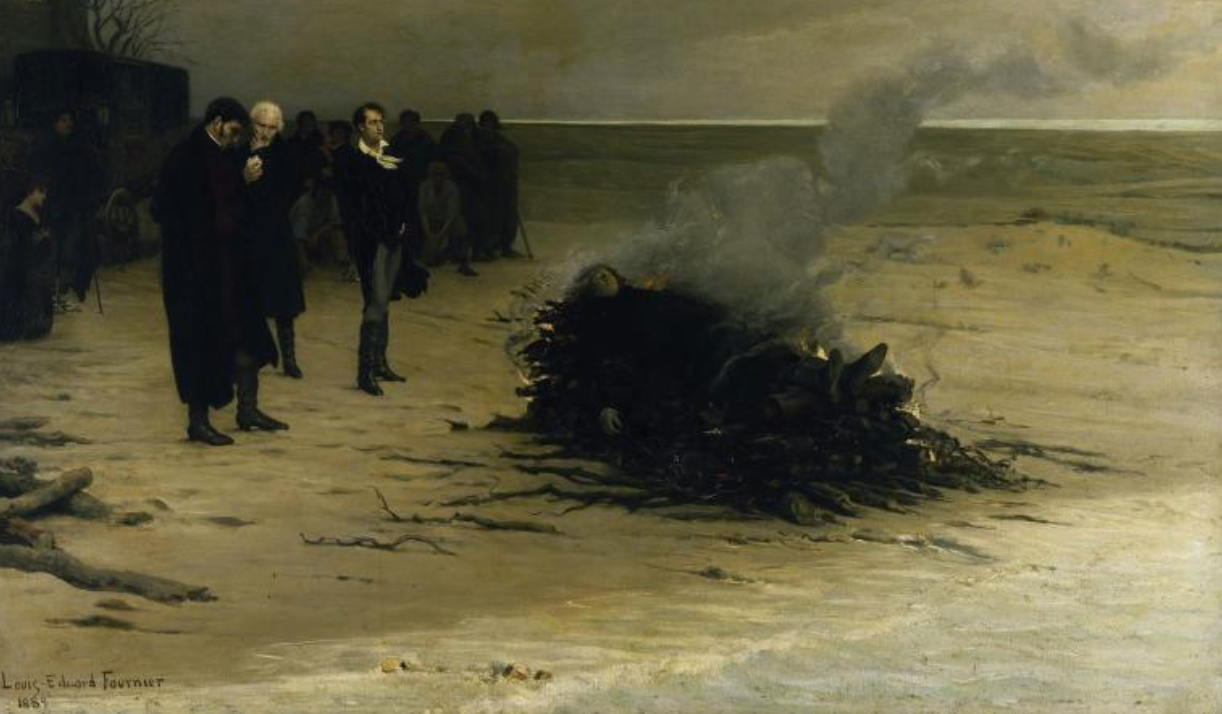
Louis Édouard Fournier, The Funeral of Shelley (1889), depicting Percy Bysshe Shelley’s cremation on the Viareggio shore. Source: Walker Art Gallery.
Perhaps, had he lived longer under Mary’s tutelage, Percy would have acquired the ability to create works that went beyond reproducing his narcissistic sensibilities. His poetic credo, “The Defence of Poetry,” appears however to disavow this possibility through its focus on the act of creation as a revelation of similitude rather than as an act of understanding. “Reason respects the differences,” Percy wrote in this work, contrasting it with imagination which reveals “the similitudes of things.”¹⁰
For Mary, by contrast, the literary imagination gives us access to alien points of view. Far from revealing a world in which everyone resembles us in inclination and views, the imagination reveals the incommensurability of the other and shows us worlds in which strangers demand our respect and even love precisely because they are not absorbed inside our ego.
Mary’s gift at articulating and defending positions — including her husband’s — that were not her own stood her in good stead as writer of fiction as well as in her capacity as the fashioner of Percy’s literary legacy and his most significant reader. Her objection to her husband’s hubris stands as a critique of Percy’s broadly masculine infatuation with a Promethean ideal.
This idealization of the rebel, who arrogates to himself the right to violate the natural order of things and to disregard all social norms that did not give him pleasure, was manifested among other domains in Percy’s careless treatment of the women in his life, including his wife. Mary was at various stages in her life Percy’s mistress, wife and widow; she and her children suffered greatly from his infidelities, including with her stepsister, Claire Clairmont. Indeed, Percy’s relationship with Mary began while he was still married to another woman, Harriet Westbrook.
Failed creation and the ethics of care
Mary’s and Percy’s differing views on the obligations of the creator to their creations help to account for their divergent representations of Prometheus. Mary understood that our ability to create — including our ability to bring other human beings into the world — gives us the capacity to do evil as well as good. Percy had a more optimistic — yet also arguably more naïve — view.
As Mary wrote simply, yet fairly: “Shelley believed that mankind had only to will that there should be no evil, and there would be none.”¹¹ Percy denied that humans were fundamentally evil; he believed that humanity could be perfected to the extent that all negative impulses would be obliterated. His faith in human perfectibility was infinite, and he conceived of sin and guilt as transitory.
Mary harboured no such sanguine hopes. The Promethean impulse is for Mary a potential source of evil, even when the acts committed in its name are done for the sake of the good, and especially when these choices are, to borrow from the title of Percy’s reimagining of Aeschylus, “unbound.” In terms of Mary’s aesthetic vision, the product of Promethean creation is an object of pity and scorn, rather than a target for emulation.
The process Mary chronicles in Frankenstein is a travesty of creation itself, and an allegory of what happens when men boldly elevate their will over that of all creation, and when they use their power to create merely to celebrate themselves. Mary began composing Frankenstein in 1816, while still grieving the earlier loss of her infant daughter Clara and other personal tragedies. As a mother who lost her own child, she understood the costs of the human ability to create in her own body.
In his literary writing, Percy readily implicated bloodshed in the masculine will to act, even at the cost of killing others. “The Revolt of Islam” explicitly links bloodshed with moral and political regeneration. Revolutionary violence is a painful but necessary stage on the path to human liberation. His imagery is saturated with blood, yet the poem insists that this violence is ultimately purifying. Phrases such as “slaughter’s sanguine hue” and the recurrent depiction of revolutionary struggle as drenched in blood are not framed as moral failure, but as part of a hopeful historical arc that coincides with the forward march of history. Ultimately, revolutionary killing is compatible with moral idealism.
Similarly, in “Prometheus Unbound,” violence is sublimated rather than repudiated, and the poem’s bright vision depends on that rupture. Percy displaces bloodshed into the mythic register, but its scarlet hues continue to color his vision.
By contrast, every death in Frankenstein exposes creation as an ethical mistake that cannot be redeemed by future outcomes. The creature’s existence is not treated as a regrettable cost of progress, but as an ethical catastrophe that invalidates the act itself. Later, when bloodshed does occur — William’s murder, Justine’s execution, Clerval’s death — Mary refuses any redemptive arc. Each death compounds responsibility rather than justifying it.
Unlike Percy’s revolutionary violence, these deaths do not move history forward; instead, they close moral space, generating silence, secrecy, and self-loathing. Across the full trajectory of her creative work, from the novels Valperga (1823) to The Last Man (1826) to her editorial prose, Mary consistently refuses the Romantic conversion of suffering into hope: violence in her writing never catalyzes moral progress, but instead exposes the ethical cost of action that mistakes power and ambition for greatness.
Mary’s counter-Romanticism
Creation, in her vision, demands not the triumph of the will but the discipline of care.
In Percy’s Romantic vision, the poet’s vocation licensed him to consider himself a god. Mary by contrast understands creation as discipline and sacrifice, not self-aggrandizement. Although no less creative than Percy, Mary was more profoundly haunted by the ways in which our creative capacities can destroy those we love. Frankenstein is a parable of what happens when the creative act is abused and unmoored from any ethical foundation.
The dangers of creation were as evident in life as in fiction, and Mary had more than enough evidence to support her fears. Her own mother, Mary Wollstonecraft, had died in childbirth. Her adult life supplied more than enough evidence of the dangers she dramatized, from maternal loss to the suffering caused by men who elevated their will above responsibility. The year that Mary began writing Frankenstein, Percy’s first wife Harriet would kill herself while pregnant with her husband’s child.
Against Percy’s faith in human perfectibility and his celebration of unbounded Promethean action, Mary articulated a counter-Romantic ethic grounded in vulnerability and relational obligation. Creation, in her vision, demands not the triumph of the will but the discipline of care.
Her vision of creation is accountable to what exceeds and resists the self. While her most famous creation, Frankenstein, is deliberately presented as a failed creation, the literary persona of Percy Bysshe Shelley is arguably her most successful creation. This feminist act of creation was governed not by hubris, but by love.
Notes
[1] Mary Shelley, “Preface,” Essays, letters from abroad, translations and fragments by Percy Bysshe Shelley. Ed. by Mrs. Shelley (London: Edward Moxon, 1840), xx.
[2] The Athenæum: Journal of Literature, Science and the Fine Arts (10 November 1832): 730.
[3] Percy Bysshe Shelley, “Preface [to ‘The Revolt of Islam’],” The poetical works of Percy Bysshe Shelley. Edited by Mrs. Shelley (London: Edward Moxon, 1847 [1839]), 67.
[4] Mary Shelley, “Editor’s Note on Prometheus Unbound,” 375.
[5] Percy Bysshe Shelley, “Preface [to ‘Prometheus Unbound’],” The poetical works of Percy Bysshe Shelley. Edited by Mrs. Shelley, 267.
[6] Shelley, “Preface [to ‘Prometheus Unbound’],” 264. Quotations in this paragraph all occur on this page.
[7] Mary Shelley, “Editor’s Note on Prometheus Unbound,” 374.
[8] Mary Shelley, “Editor’s Note on The Revolt of Islam,” 257.
[9] Quoted in Shelley, “Editor’s Note on Prometheus Unbound,” 374.
[10] Percy Shelley, “A Defence of Poetry,” Essays, letters from abroad, translations and fragments, 2.
[11] Shelley, “Editor’s Note on Prometheus Unbound,” 371.
I write about culture and politics in the Middle East and around the world. Browse my books and book recommendations here. To receive regular posts on literature and culture and join the community, subscribe to The Textual Materialist.
메타데이터
- post_id
- d4b43dbe0ee6
- slug
- what-do-creators-owe-their-creations-d4b43dbe0ee6
- url
- https://medium.com/global-literary-theory/what-do-creators-owe-their-creations-d4b43dbe0ee6
- canonical_url
- https://medium.com/global-literary-theory/what-do-creators-owe-their-creations-d4b43dbe0ee6
- author_url
- https://medium.com/@rrgould
- status
- ok
- fetched_at
- 2026-06-15 20:49:13