Gaming on Starknet Isn’t Failing — It’s Being Redefined by DeFi Execution
Part I — Why Starknet: The Question of Unifying Two Blockchains
Gaming on Starknet Isn’t Failing — It’s Being Redefined by DeFi Execution
Image source from https://btcfiseason.starknet.org/
Part I — Why Starknet: The Question of Unifying Two Blockchains
In the blockchain industry, Ethereum has become the center of smart contracts and applications, while Bitcoin has established itself as “digital gold,” a symbol of security and scarcity. Yet each has grown with clear structural limitations. Ethereum struggles with scalability and transaction costs; Bitcoin, by design, does not support native smart contracts.
Starknet does not attempt to “fix” these limitations. Instead, it seeks to redefine the role of blockchains by unifying both networks under a single execution framework.
Starknet is a ZK-rollup Layer 2 built on Ethereum. It inherits Ethereum’s security while executing large volumes of transactions off-chain and validating them through a single STARK proof. This architecture is not merely about cheaper fees or faster throughput — it is designed for structural scalability of financial execution
However, Starknet’s real ambition does not end with Ethereum. Its core vision lies in Bitcoin integration.
Bitcoin has historically been limited to value storage and transfer. This is not an ideological choice, but a consequence of its design. Without support for complex computation and state transitions, Bitcoin can be securely held — but not actively utilized. Starknet directly targets this constraint through ZK technology, aiming to enable “financial actions that Bitcoin itself has never been able to express” at the execution layer.
This vision is already supported by early signals. Through the integration with Xverse and the launch of BTCFi initiatives, more than 1,000 BTC have been bridged to Starknet, and over $100M in combined STRK and BTC has been staked, indicating tangible capital commitment rather than abstract intent
At this point, the question naturally evolves:
Is this vision actually working? And is the current Starknet ecosystem capable of sustaining it?
Part II — The Ecosystem Reality: What the Data Reveals
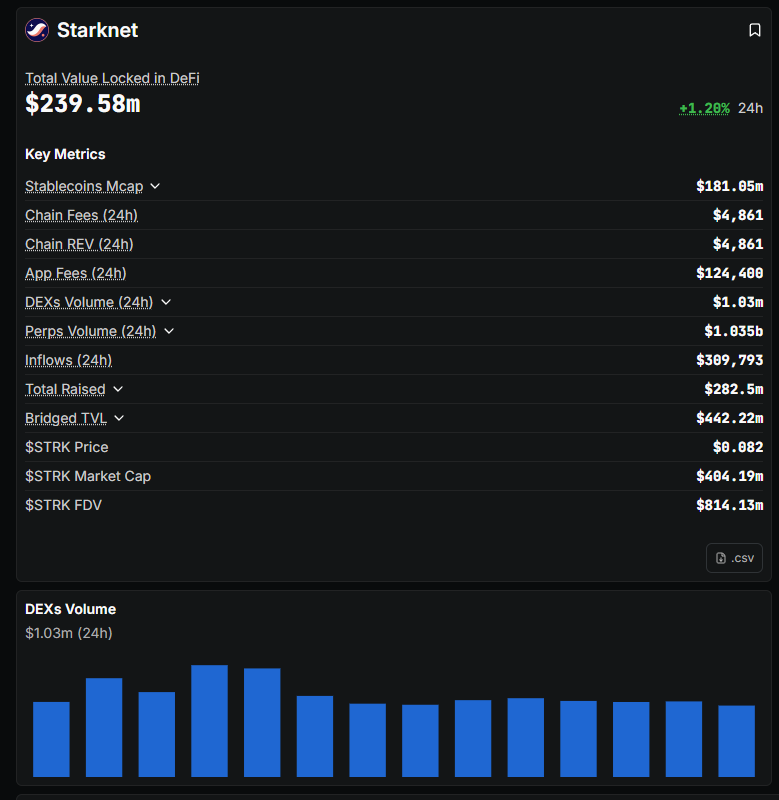
Image Source from https://defillama.com/chain/starknet
Vision alone is insufficient. Its credibility must be tested against data. To evaluate Starknet, the most relevant indicators are DeFi TVL, bridged asset volume, and ecosystem concentration.
1) DeFi TVL and Bridged Assets
Starknet’s current DeFi TVL stands at approximately $246M (DefiLlama).
Meanwhile, its bridged TVL — including Bitcoin and stablecoins — reaches roughly $678M (DefiLlama).
These figures confirm that Starknet is no longer a purely experimental network; it is a Layer 2 where real capital movement is already taking place. That said, the scale remains modest compared to major Ethereum L2s. Arbitrum, for instance, commands TVL in the multi-billion-dollar range and continues to dominate the L2 landscape (CoinLaw).
In other words, Starknet is not yet competing head-to-head in terms of deep liquidity.
2) Why DeFi Grows While Gaming Lags
Ecosystem growth on Starknet has been rapid — but uneven. The number of user-facing projects increased from 72 in 2023 to over 193 in 2024, representing 168% growth (starknet.io). Yet this expansion has been heavily concentrated.
DeFi clearly functions as the ecosystem’s central pillar. Protocols such as Nostra account for a significant portion of Starknet’s total TVL on their own (RootData).
Gaming and gamification projects, by contrast, have increased in number without achieving comparable ecosystem impact. According to DappRadar, the number of Starknet-based game projects grew from 4 to 51 in 2024, but the sector remains in an early stage (DappRadar).
This imbalance is not a matter of user demand or technical feasibility. It is the result of ecosystem direction set by the Starknet Foundation.
The sectors that grow on Starknet are those explicitly prioritized — DeFi, financial execution, and infrastructure. Categories outside this focus, while technically possible, struggle to gain sustained attention.
On Starknet, sector growth is not dictated by market trends, but by what the chain defines as “execution-critical.”
This reframes the discussion and leads to the next inevitable question:
What form must gaming take to become a category worth focusing on within Starknet?
Part III — Claw Machine: A Game That Obeys DeFi Gravity

Play Link: https://www.nebula3gamefi.com/sub/games-view.php?game_code=clwmc
One experimental answer to this question is Claw Machine.
Claw Machine is not an attempt to make gaming a new core category on Starknet. Quite the opposite — it is an experiment in embedding gaming as an interface within Starknet’s existing DeFi reward structure.
A portion of Claw Machine’s game revenue is deposited into DeFi staking pools, with the resulting yield distributed based on user activity.
- Paid users accelerate the speed at which they earn rewards.
- Non-paying users can still earn rewards purely through gameplay.
This dual-reward model goes beyond traditional Play-to-Earn. It aligns financial behavior (staking) with user experience (gameplay), demonstrating how DeFi and gaming can coexist rather than compete on Starknet.
The user acquisition strategy is equally deliberate. Rather than onboarding traditional gamers into Web3, Nebula3 targets existing Starknet DeFi users, who are already familiar with yield, rewards, and compounding.
To lower friction, Claw Machine adopts:
- hyper-casual gameplay
- an auto-play mode
This design allows DeFi users to transition into gamers with minimal cognitive or behavioral cost.
Here, gaming is no longer the end goal. It becomes a UX layer for accessing DeFi rewards.
Epilogue — An Execution-Led Chain Chooses People First
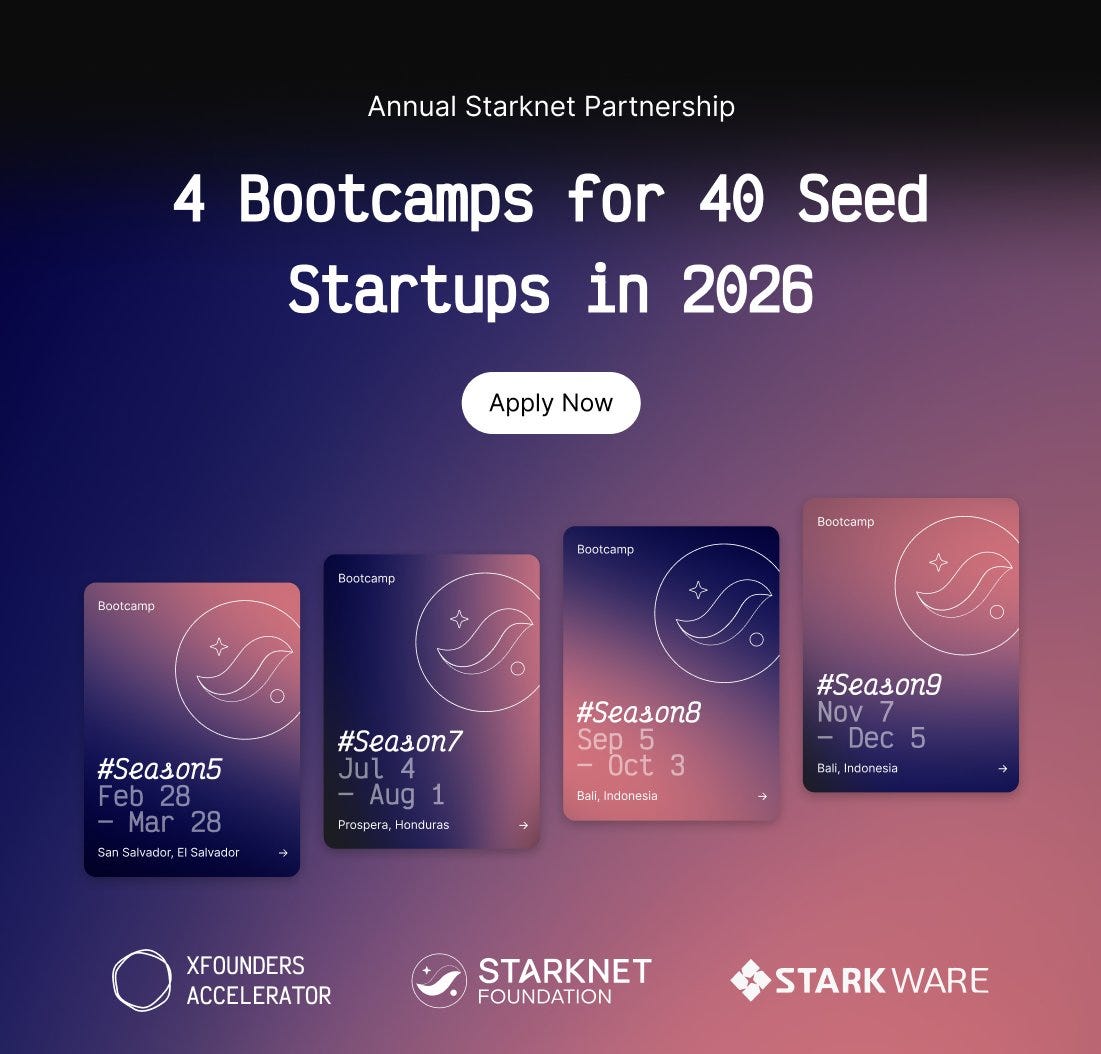
Starknet does not expand its ecosystem through code alone. In practice, Starknet has partnered with XFounders to run founder-focused IRL bootcamps in El Salvador and Bali in 2025, with four additional bootcamps planned in 2026 across El Salvador, Honduras, and Bali.
This is not a community marketing initiative. It is an execution-led talent strategy. Rather than pursuing random expansion, Starknet selects builders whose thinking aligns with its execution priorities — DeFi and financial infrastructure.
In this context, Jun Seo of Nebula3 GameFi was able, through the bootcamp process, to refine the idea of Claw Machine as a game model that operates coherently within Starknet’s DeFi-centric execution layer.
Starknet does not aim to grow fast. It chooses instead to avoid growing in the wrong direction.
About Nebula3
Nebula3 is a Web3 indie game hub with multi-chain support, focused on bringing Web2-native players into blockchain gaming through seamless UX and infrastructure abstraction. By working closely with ecosystem partners such as LINE NEXT and the Kaia Foundation, Nebula3 publishes and operates Kaia-powered Mini Dapps that prioritize participation first.
More information: https://www.nebula3gamefi.com
메타데이터
- post_id
- dc9132f2c5e7
- slug
- gaming-on-starknet-isnt-failing-it-s-being-redefined-by-defi-execution-dc9132f2c5e7
- url
- https://medium.com/nebula3-gamefi/gaming-on-starknet-isnt-failing-it-s-being-redefined-by-defi-execution-dc9132f2c5e7
- canonical_url
- https://medium.com/nebula3-gamefi/gaming-on-starknet-isnt-failing-it-s-being-redefined-by-defi-execution-dc9132f2c5e7
- author_url
- https://medium.com/@nebula3gamefi
- status
- ok
- fetched_at
- 2026-06-09 15:37:30