Venus Callipyge
The example of the importance of restorations and the danger of modern interpretations
Venus Callipyge
The example of the importance of restorations and the danger of modern interpretations
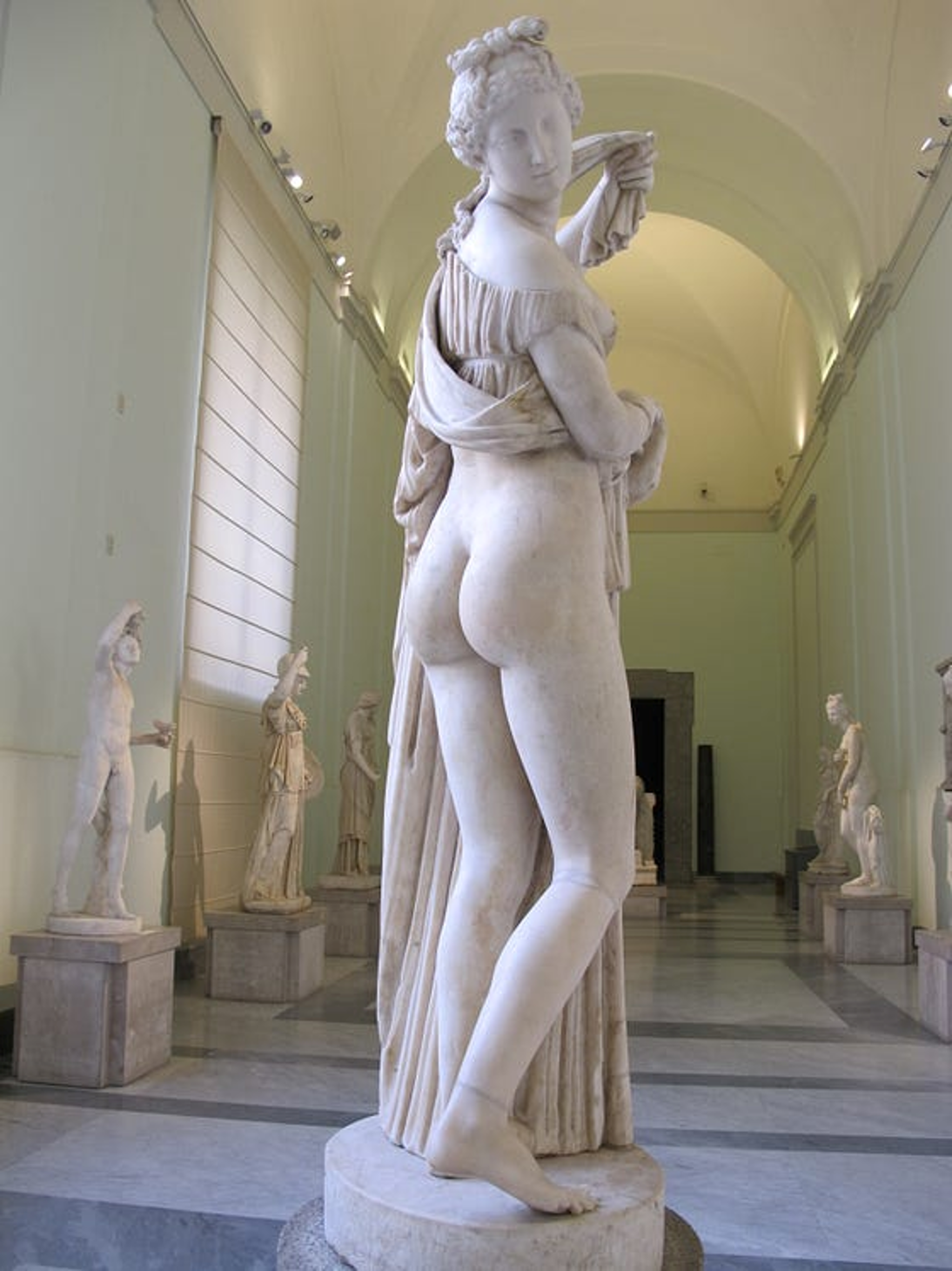
‘Venus Callipyge’ (1st-2nd century BC) by Anonymous. White marble. National Archaeological Museum, Naples. Image source Wikipedia
We all have a little visual idea of a classical art sculpture.
Without being experts or amateurs of that art, we know that the prevailing standard of statuary in Antiquity has such representative conventions and canons that are part of the collective imagination.
Let’s delve deeper into its visual aspect since Antiquity. In that case, we have received an iconography in sculpture that constantly moves between a very sophisticated idealization of beauty and an evident lustful tendency, so much so that it cannot be ignored.
Although no specific consensus has been reached, since the interpretations are both valid (a particular ideal of beauty or a game of eroticism, even both at the same time), what is unmistakable and unquestionable is the influence that classical sculpture had during many subsequent periods, particularly from the Renaissance onwards.
The most enduring characteristic of these sculptures, model, and inspiration for artists and critics of both art and history, has been the nude.
It is undoubtedly the plastic and visual paradigm of all classical culture, above other disciplines such as literature or philosophy. The image of a torso of both male and female nude with precise proportions has been and remains today the model to follow.
However, to be honest, the icons of that classic era in terms of sculpture ended up being female nudes. And within these nudes, the most outstanding are those starring Aphrodite or Venus, the Greek and Roman goddesses of love.
They, their representation during Antiquity, became the most used examples when talking about the classical arts, which during the Renaissance and later became the preserve of the cultural elite in the West.
Also, about their figures, what they represented, and that ideal that came from Antiquity, the classical female statues were the subject of a critical debate about their role as the definitive source of the model of Western beauty, perpetuated to the present day; in that same debate, the terms artistic nude and erotic nude have been confronted.
For all these reasons, time has placed the statues of Venus in a predominant position within the Greco-Roman legacy.
It is interesting to note that in some cases, sensuality has been appropriated as an unmistakable sign of classical artistic expression, which has led to an a posteriori interpretation that has not been contrasted and has caused a modification of the initial objective of work.
This process, which we could call intentional rectification, can be recognized with ample evidence in a statue dedicated to the goddess Venus, and it is not that of Milo: we are talking about the Venus Callipyge.
Named after the Greek word kallipygos, which means “the one with the beautiful ass”, it makes perfect sense when looking at the statue and noticing that the goddess is depicted looking over her shoulder to admire her buttocks, beautifully sculpted and on which the entire focus of the figure falls.
Undoubtedly, this is an erotic attitude that does not fit in with any kind of mythological or religious interpretation. There is no interpretation beyond the mere sensual contemplation of a female body, specifically her backside.
At this point, we must remember that a work of art is always a mixture of its narrative, the creator (which, in this case, we do not know), and a historical context both in its socio-political environment and in the internal history of the process of creation.
In the case of the Venus Callipyge, a curious circumstance greatly changes how we should look at the statue: when it was discovered, the head had been lost.
This variable is essential because the sculpture that can be visited today in Naples results from a restoration in which filters and canons were applied to explain those naked buttocks.
Thus, the process of invention of the head was based, it seems, on two dubious indications that are presupposed in classical times:
- The denomination Kallipygos was intimately linked to the figure of Venus, one of its characteristics when represented in sculptures. An indication undoubtedly lacking solid bases or contrastable testimonies.
- The statue could be an allusion to the prostitutes, who, when they went out to party and were drunk, argued among themselves about who had the best ass.
At this point, we can conclude that it is not of vital importance to know if this statue is a representation of Venus or an allegory of prostitutes (unlikely), or even an idealization of Greek peasant women.
None of this is relevant since it is a work with a modern interpretation that has completely changed its initial meaning.
Since no thread connects us with the period in which it was sculpted, nor previous restorations that could have preserved that initial symbolic idea, we could be looking at a goddess, a dancer, a peasant, or a prostitute. Or none of them.
Guess!
Thanks for reading!
Love this story? Buy Alejandro a coffee and show your appreciation for his writings.
I will be eternally grateful to you.
And don’t forget to subscribe to Counter Arts, an essential publication for art lovers in all its expressions!
메타데이터
- post_id
- e5194741150a
- slug
- venus-callipyge-e5194741150a
- url
- https://medium.com/counterarts/venus-callipyge-e5194741150a
- canonical_url
- https://medium.com/counterarts/venus-callipyge-e5194741150a
- author_url
- https://medium.com/@alejandro.orradre
- status
- ok
- fetched_at
- 2026-07-15 14:03:45