Blame by Refraction: How Covert Narcissists Bend Reality So You Wear Their Guilt
How to Recognize When a Narcissist Is Refraction-Blaming You
Blame by Refraction: How Covert Narcissists Bend Reality So You Wear Their Guilt
How to Recognize When a Narcissist Is Refraction-Blaming You
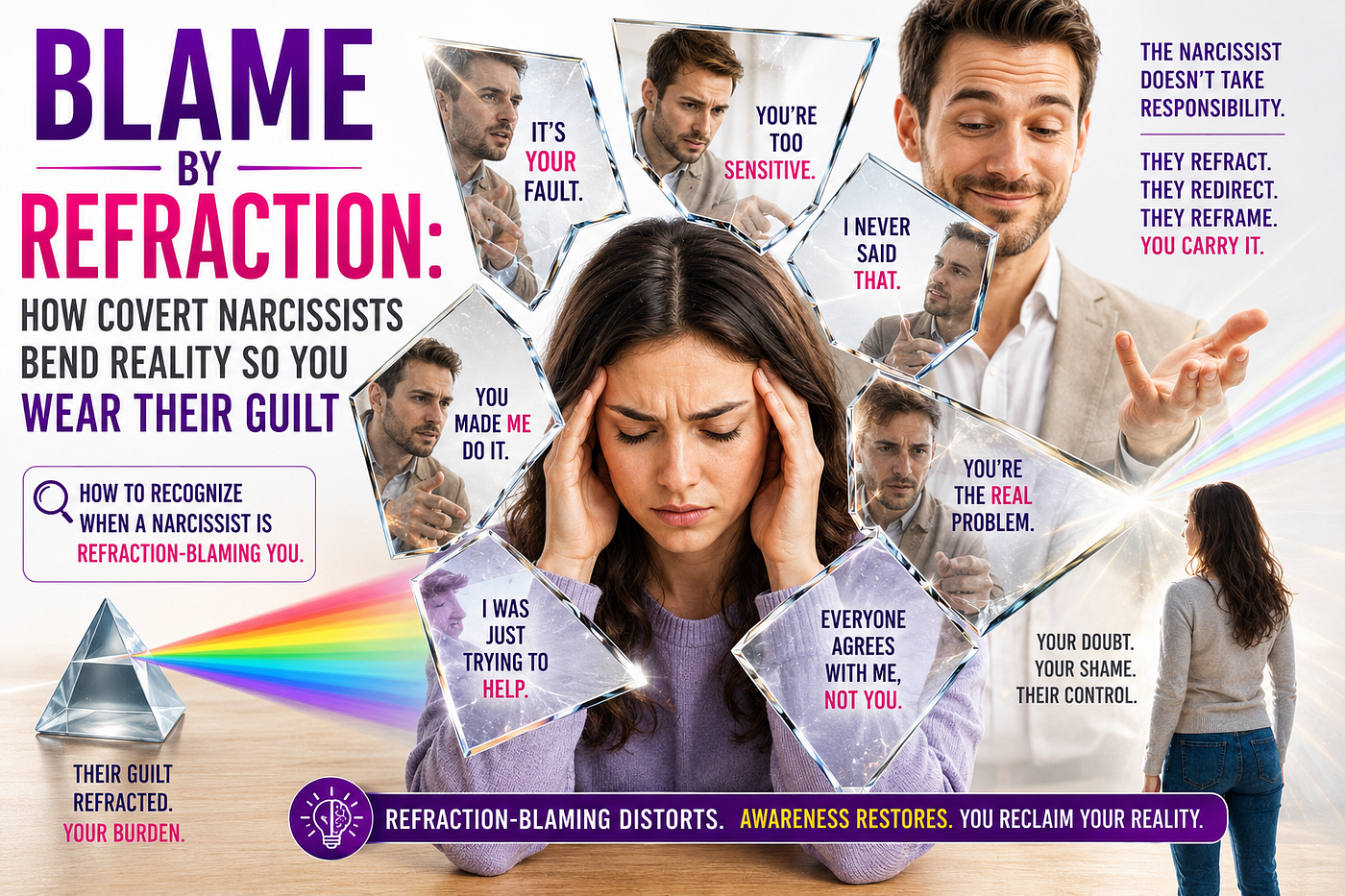
Image is generated via Chat Gpt 2.0 Model.
There is a specific kind of tired you only know if you’ve loved a covert narcissist.
It is not the tired of a long day. It is not the tired of grief, or work, or worry. It is the tired of waking up next to someone and not knowing whose version of last night actually happened. You remember saying something soft. They remember you screaming. You remember asking a question. They remember an attack. You remember tears in your eyes. They remember cruelty in your voice.
And the strangest part — the part that takes years to name — is this:
By breakfast, you are the one apologizing.
You don’t even know what you’re apologizing for. You just feel the shape of guilt in your chest, heavy and familiar, like a coat someone slipped onto your shoulders while you were sleeping. They are quiet. Wounded. Generous, even, in their willingness to “move past it.” And somewhere inside, a tiny voice — the voice you used to trust — whispers:
Wait. I don’t think I was the one who did anything wrong.
But the voice is faint. The coat is heavy. And the day must go on.
This is what I have come to call blame by refraction.
It is not gaslighting in the loud, cinematic sense. It is not the dictator-husband screaming “that never happened” until the wife shatters. Covert narcissists almost never do that. They are too sophisticated, too image-conscious, too allergic to looking like the villain.
Instead, they refract — the way a glass of water bends a pencil so the straight thing inside it looks crooked. They don’t deny reality. They angle it. They tilt the prism just so, until your behavior comes out the other side looking like the problem, and theirs comes out looking like a reasonable response to a difficult partner.
You don’t walk out of those conversations confused about facts. You walk out convinced you are the one with the dimmer soul.
This article is about how that refraction works. The exact mechanics. The exact phrases. The neuroscience of why it sticks. Why people who would never tolerate being hit can spend a decade tolerating this. And — most importantly — how the spell breaks, and what life looks like once the prism is gone.
If any of the first paragraphs already felt like someone reading from your diary, I am not going to pretend that’s a coincidence. Keep reading. We have a lot to unpack, and you deserve a name for what happened to you.
The Refraction Effect
Why “blame-shifting” is too small a word
The standard vocabulary fails us here.
We say blame-shifting, and the picture in your head is a kid in a kitchen pointing at his sister: “She did it.” Simple. Visible. Refutable.
We say gaslighting, and the picture is the 1944 film — a husband dimming the lights and insisting his wife is imagining things. Cinematic. Cruel. Obvious.
But what the covert narcissist does is neither of those, and that is exactly why it almost broke you.
Refraction is not denial. Refraction is reinterpretation.
The narcissist doesn’t argue with the event. They argue with the meaning of the event. They concede the facts and then quietly rewrite the moral of the story while you’re still standing in it.
You: “You forgot my birthday.” Them: “I didn’t forget. I was giving you space because you’ve seemed overwhelmed lately. But this is what I get for trying.”
Notice the architecture. The fact is preserved — they did not call, did not show up, did not acknowledge the day. But the meaning has been quietly inverted. Their inaction is now sensitivity. Your hurt is now ingratitude. Your sadness is now the thing they have to recover from.
You came into the conversation a person whose birthday was forgotten. You leave the conversation a person who has just hurt someone who was only trying to help.
Same facts. Different prism. New guilt — yours.
That is the engine. Every covert narcissist on the planet uses some version of it. The talented ones run it so smoothly you don’t even feel the bend.
Refraction is the art of changing your reflection without changing the facts. They don’t tell you the room is on fire. They convince you the smoke is coming from your lungs.
Why the covert kind is so much harder to escape
There is a reason psychologists have started taking covert (or “vulnerable”) narcissism more seriously over the last decade. The grandiose, swaggering, mirror-loving narcissist of the stereotype is comparatively easy. He announces himself. He humiliates you in public. He drains your accounts. People watching can name what they see.
The covert narcissist does none of that.
He brings you soup when you have the flu — and then never lets you forget it. She volunteers at the church — and then weaponizes that volunteer schedule to make you feel selfish. They cry in arguments. They apologize so well it sounds like a prayer. They are, by every external measure, the good one in the relationship. People love them. Your friends like them more than they like you. Your own mother is on their side.
Researchers describe the covert subtype as marked less by arrogance and more by hypersensitivity, suppressed grandiosity, deep envy, chronic victimhood, and a paralyzing inability to tolerate ordinary criticism. Outwardly, they look fragile. Inwardly, the entitlement is just as ferocious as the loudest narcissist you’ve ever met — it has simply learned to wear a softer mask.
Which means when they wound you, they do not look like someone who would wound you. They look like someone you have wounded.
That is what makes the refraction work. The persona itself is part of the prism.
If a man punches you in the face, no one in the courtroom asks whether you provoked his fist. If a man sighs deeply, says “It really hurts me when you talk to me like this,” and walks out of the room before you can finish your sentence — every courtroom in the world will eventually ask what you did to him.
That courtroom, by the way, includes the one inside your own head. Especially that one.
The Seven Mechanics of Refraction
Once you know what to look for, you can name it in real time. These are the seven moves I see again and again in survivor accounts, in therapy transcripts, in my own life, in the case files of every researcher writing on this. I have stripped them down to their bones so you can recognize them under whatever soft, well-spoken paint your particular narcissist uses to decorate them.
1. The Pre-emptive Wound
Before any real conflict can begin, the covert narcissist will discover that they are already hurting.
You come home ready to talk about the credit card statement. They are already on the couch with red eyes, telling you they had a hard day, that no one understands them, that they almost cried at work. The conversation you needed to have is now impossible. You cannot bring up the $2,300 charge. Only a monster would bring up the $2,300 charge to someone this fragile.
The wound came first. The wound is always first. The wound is the prism.
You learn, over time, to read the temperature of their day before you decide whether you are allowed to have a feeling of your own.
A covert narcissist’s pain always shows up just in time to make your pain feel rude.
2. The Concern Wrapper
This is the velvet glove over the iron point.
“I’m only telling you this because I love you.” “I’m worried about you. I don’t think you’re handling things well.” “You’ve been so anxious lately. Maybe that’s why you’re seeing it that way.” “I just want you to be the best version of yourself.”
Each of these is, on its surface, a sentence a loving partner might say. That is what makes them devastating. Real love does, occasionally, deliver hard truths in soft wrapping. The covert narcissist mimics this exact tone — but underneath the wrapper is a knife.
The function of the concern wrapper is not to communicate concern. It is to pre-emptively pathologize your response. Anything you say next — anger, hurt, defense, even a calm rebuttal — will now look like the symptom of the thing they just diagnosed you with. They are not attacking you. They are worried about you. And if you push back, you are proving them right.
Listen for this one carefully. Not at the words. At the function. Does this sentence make it harder for me to disagree without seeming sick? If yes, that is not concern. That is a leash.
3. The Plausible Alternative
The covert narcissist rarely denies what you saw. They offer a parallel story so reasonable, so charitable, so well-formed, that doubting it makes you feel paranoid.
You: “You were flirting with her.” Them: “She was going through a breakup. I was trying to be a kind person. I’m sorry that being kind to someone in pain is now something I have to apologize for.”
The plausible alternative is the most intellectually exhausting of all the moves, because it asks you to relitigate not just the event but your interpretation of human behavior, generosity, kindness, friendship, and your own jealousy. By the time you’ve finished arguing whether they were flirting, you have entirely lost the original thread — which was that something about the encounter hurt you and you wanted them to care.
You will leave that conversation having debated semantics. You will not leave it having been comforted.
That is the point.
4. The Tone Pivot
You raise something. They go quiet. You raise something else. They sigh.
You raise it a third time, slightly louder because you cannot tell if they’re listening, and suddenly:
“Why are you yelling at me?” “I can’t talk to you when you’re like this.” “This is exactly what I was talking about.”
The conversation is now about your tone. Not the thing. The tone.
It does not matter that you weren’t yelling. It does not matter that they are the reason you raised your voice — they had gone unresponsive in a moment that demanded a response. The pivot does not need to be true. It only needs to be introduced. Once “your tone” is on the table, the original issue is no longer reachable. Every attempt to drag the conversation back to the thing that actually happened will now look like proof of how aggressive you are.
This is the technique by which an entire decade of legitimate complaints — every one of them — gets archived under the file labeled “You always come at me angry.”
5. Reactive Provocation (and the Camera)
This is the cruelest of the seven, and one of the least talked about. Therapists call it reactive abuse, and it is precisely engineered.
Here is how it works. The covert narcissist applies pressure — small, plausible, deniable. A jab here. A withholding there. A late reply. A pointed silence. A “joke” that lands wrong. A look. Then another jab. Then another silence. For weeks. Sometimes months.
You absorb. You absorb. You absorb. You absorb past the point any reasonable nervous system can absorb.
And then — finally, on a Tuesday over something almost trivial — you snap.
You raise your voice. You slam a cabinet. You cry too loudly. You say something cutting you’ve been swallowing for half a year.
This is the moment they have been waiting for. This is the receipt. This is what they show their mother, their therapist, their friends, the courtroom in your shared imagination. Not the months of provocation. Not the silence. Not the jab. Just the snap.
“See? Look at how she talks to me.”
Your reaction — the natural, predictable response of a human being being slowly degraded — is now the only thing on the public record. Their behavior, which was diffused into hundreds of small unrecordable moments, has vanished. You have just become the abuser in your own story.
It is impossible to overstate how psychologically destabilizing this is. Reactive abuse is the move that, more than any other, plants the seed of self-loathing that grows for years afterward. I really did say that. I really did slam the door. Maybe I’m the problem after all.
You are not the problem. You were poked at, by a steady patient hand, until you bled. The hand is the problem.
6. The Soft Reversal (DARVO in a Cardigan)
Psychologists have a name for the classic narcissistic reversal: DARVO — Deny, Attack, Reverse Victim and Offender. The overt narcissist does this brutally: “I didn’t do it. How dare you accuse me. You are the real abuser here.”
The covert version is identical in function, but the cardigan is on. The voice is small. The eyes are wet.
“Maybe I did, I don’t know, I just — I try so hard, and nothing I do is ever enough for you. I don’t know what you want from me anymore.”
Everything is on the floor. The accusation. The defense. The reversal. Their pain, suddenly, larger than yours. By the end of the sentence, you are reaching out to comfort them. You came in with a grievance. You leave having apologized for raising it.
The soft reversal works because it doesn’t trigger your fight reflex. The overt DARVO sets off alarms. The covert version sets off your caregiving. It hijacks the part of you that loves them, the part that doesn’t want them to hurt, the part that — let’s be honest — was probably trained early in life to manage other people’s emotions before your own.
That part of you is not weak. That part of you is decent. The narcissist has simply learned to feed on decency.
7. The Rewritten Past
Months later — sometimes years later — you will hear them describe an event you were both present for, and you will not recognize it.
You did not say that. You did not do that. You did not feel that way at the time. The fight didn’t start the way they’re saying it started. You weren’t drunk. You weren’t crazy. You weren’t trying to humiliate them in front of their sister. That isn’t what happened.
But everyone around you nods. Because they are such a good storyteller. Because they tell it with such soft sadness. Because their version makes psychological sense — they’ve been polishing it the whole time, and yours, frankly, is rough because you are still trying to figure it out.
This is the final, generational move. The covert narcissist is not just rewriting the present. They are rewriting the historical record. The story your children will inherit. The story their family already believes. The story you yourself, on a bad night, will start to wonder if you should believe too.
Refraction in the moment is gaslighting. Refraction across time is myth-making. They are quietly building a version of your shared history in which they are the wounded saint and you are the difficult one. By the time you notice the museum, every wall is already painted.
Why Your Brain Believes Them
You are not weak. You are not stupid. You are not, as you have probably worried in the dark, also a narcissist for not being able to leave.
You are biologically vulnerable to this. Everyone is.
In late 2025, researchers at McGill University and the University of Toronto published work that reframed gaslighting from a “manipulation tactic” into something much more fundamental — an exploit on the way the human brain constructs reality in the first place.
We do not experience reality alone. We never have. From infancy, humans calibrate their perception of the world against the perceptions of trusted others — first parents, then peers, then partners. We literally outsource part of our reality-testing to the people closest to us. This is not a flaw. It is one of the most efficient cognitive systems evolution ever built. You don’t have to verify every fact yourself if you trust the tribe.
Covert narcissists do not break this system. They hijack it.
When the person whose nervous system you have synced with for years — the person you sleep next to, plan your future with, trust to remember things you’ve forgotten — consistently and gently insists that your interpretation of events is slightly off, your brain has only two options:
- Conclude that this person, the most trusted node in your reality network, is systematically misleading you.
- Conclude that your own perception is the unreliable instrument.
Option one is catastrophically expensive. It implies the foundation of your daily life is rotten. It threatens your home, your finances, your identity, your children, your future. Your brain, doing exactly what it evolved to do, will choose option two for a very long time before it will choose option one.
This is why intelligent, perceptive, high-functioning people — the kind who can spot a lie at work in half a sentence — will spend years failing to spot the lie in their own kitchen. It is not a failure of intelligence. It is a feature of attachment.
The longer you stay, the deeper the rewiring goes. fMRI studies on chronic interpersonal stress show measurable changes in the prefrontal cortex, the amygdala, and the hippocampus — the same regions involved in memory, threat assessment, and decision-making. Your ability to remember events correctly actually degrades. Your ability to assess danger actually shifts. Your sense of self, which is partly a story the brain tells itself using these systems, actually thins.
By the time you finally start to wonder if you might be the sane one, your instrument has been recalibrated to distrust itself.
This is not your fault. This is what the move is for.
A gaslit brain is not a broken brain. It is a brain that worked exactly as it was designed to — in an environment that turned its trust into a weapon.
Why You End Up Apologizing — Even When You Were Right
If you have lived this, you already know that the strangest part is not what they do.
It is what you do.
You apologize. You apologize fast, fluently, with a kind of practiced eloquence that even your own mother would not recognize from your childhood. You write long messages explaining yourself. You buy little gifts. You initiate making up. You absorb the blame for things you know — somewhere underneath everything — were not yours.
Years later, this is the part survivors are most ashamed of. Not the relationship. The apologies. I knew. On some level, I knew. And I still apologized.
Here is the kindest, truest thing I can tell you about that:
You apologized because the apology bought you the only safety available in the room.
That is not weakness. That is your nervous system doing math.
In a relationship with a covert narcissist, conflict is not a temporary state. It is a climate. The atmosphere is permanently tilted toward your wrongness. The only way to lower the temperature, to get a moment of warmth, to be allowed back into the emotional house — is to perform the ritual of being the one who messed up. So you do.
This is not denial. This is survival.
The cost, however, accumulates. Every apology you didn’t mean is a small deposit in an account labeled Maybe I really am the problem. Over years, the account grows. Over a decade, it becomes the dominant story you tell about yourself. By the end, even without them in the room, you find yourself apologizing — to friends, to bosses, to strangers — for taking up too much space, for having needs, for existing in a way that someone might find inconvenient.
The relationship ended a long time ago, but the apology habit is still paying interest.
The first sign of real healing is not anger at them. It is the day you catch yourself apologizing for something that isn’t your fault — and you stop, mid-sentence, and say nothing instead.
The Trauma Bond — Why You Stayed, and Why Leaving Felt Like Drowning
People who have never lived this will ask the question that ruins everything:
Why didn’t you just leave?
If you have lived it, you know that question is not a question. It is an accusation dressed as curiosity, and it carries the unstated assumption that staying was a choice you made freely with full information.
You did not. You couldn’t have.
What kept you wasn’t love, not by the end. It was something neurologically older, stranger, and much harder to fight: a trauma bond. Researchers describe it as the chemical and behavioral attachment that forms when the same person is, in turn, the source of your distress and the source of your relief. The brain, faced with an unsolvable signal, eventually concludes that the only escape from this person is more of this person. This is the same mechanism that creates loyalty in hostage situations, in cults, in abusive childhoods. It is not a personality flaw. It is a survival reflex with the steering wheel.
The arc of a trauma bond with a covert narcissist usually moves through recognizable stages, even if the specific shapes differ:
Love-bombing. At the start, you were seen. Fully, completely, electrically. They knew you better than anyone had ever known you, faster than anyone had ever known you. It felt like coming home. (You will, much later, learn that this kind of speed is itself a red flag. Real intimacy takes time. What love-bombing actually does is bypass the time during which your nervous system would have noticed something was off.)
Trust and Dependency. Your worlds merged. Friends merged. Money merged. Future merged. Their needs began to define the shape of your days. You did not notice the shape narrowing because the narrowing felt like closeness.
The Subtle Devaluation. The compliments thinned. The criticisms began — gently, always gently, always wrapped in concern. Small things at first. Then larger. Then constant. The you they had once “seen” began to disappear from their language.
Gaslighting and Refraction. This is where the techniques in Part Two come in. Reality begins to bend. The version of you in their mouth no longer matches the version of you in your mirror.
Resignation. You stop fighting. Not because you agree. Because fighting costs more than surrender. The household calms. You tell yourself this is maturity. It is not. It is the silence of an animal that has learned the fence is electric.
The Loss of Self. You can no longer remember who you were before. Your friends notice. Your family notices. You don’t. Because you are inside it.
The Bond. Even now — even after all of that — the thought of leaving makes your chest seize. Because they are the only person who knows the geography of who you have become. Leaving them feels like leaving the only witness to your own life.
This is why the question “why didn’t you just leave” is so brutal. By the time leaving was an option, you didn’t quite have a self to leave with.
You did not stay because you were weak. You stayed because the part of you strong enough to leave had been borrowed, one apology at a time, until the bank was empty.
The Moment the Spell Breaks
For almost everyone I have ever known who has come out of this, there is a moment.
It is not the climax of an argument. It is not, usually, anything they did. Often it is something stupendously small — a thing said by a friend in passing, a single line in a book, a stranger’s face in a coffee shop. Something so quiet you would never have predicted it could break a decade-long enchantment.
For me it was a sentence in a podcast, half-heard over a kitchen sink:
“If you have to keep explaining yourself to the same person, you are not in a misunderstanding. You are in a system.”
That was it. That was the whole crack.
For other survivors, the crack arrives in different shapes:
- A child’s drawing of the family in which they are not in the picture.
- A friend, kindly, refusing for the third time to take their side.
- A medical scare in which your own partner manages, somehow, to make it about them.
- An old photograph of yourself, smiling, from before — and not recognizing the smile.
- A single moment in which they overplayed their hand, just slightly, and the mask slipped just enough.
Whatever the trigger, the experience is universal: a sudden lurch of reality, as if the room you have lived in for years has tilted thirty degrees and you can suddenly see the angle.
In that moment, an entire decade reorganizes itself. The forgotten birthday. The therapy session they showed up late to. The way your mother flinched. The friends who stopped calling. The conversations that always ended with you apologizing. The way you stopped writing. The way you stopped laughing. The way your dog became wary around them. The thousand things you had filed under me-being-difficult — they all, in a single instant, refile themselves under something-was-wrong-here.
This is what therapists call the anagnorisis — the recognition moment. It is, paradoxically, both the most painful and the most liberating moment of the entire arc.
Painful because every memory now contains a betrayal you didn’t know was in it.
Liberating because, for the first time in years, you can trust your own eyes again.
Hold on to that moment. Write it down. Tell someone you trust. Because there will be days afterward when the narcissist’s voice in your head — and they will live in your head for a while, even after they’re gone — tries to talk you out of it. You will need a witness, even if the witness is a journal entry from your own hand on the night the prism shattered.
Recovery — How to Get Your Reflection Back
Recovery from refraction is not the same as recovery from a “bad breakup.” It is not even the same as recovery from overt abuse, which at least has the cold mercy of being unmistakable. Refraction-survivors carry a more unusual wound: the loss of confidence in their own perception. Healing means restoring that confidence — not declaring war on the world, but rebuilding trust with the instrument inside you.
Here is what actually works. Not the Instagram version. The slow, awkward, real version.
1. Get the language
You needed a name for this before you could carry it. That is why this article exists. Words like covert narcissism, DARVO, reactive abuse, trauma bonding, and now blame by refraction are not just jargon. They are handles. They turn an undifferentiated cloud of shame into discrete objects you can examine, name, and put down.
Read the literature. Listen to the survivors. Find the books written by clinicians, not by influencers. The more precise your vocabulary becomes, the less ground the old story has to stand on.
2. Reduce contact, deliberately
You do not have to hate them. You do not have to declare them a monster. You do not even have to be sure. You only have to reduce the signal.
Every interaction with a covert narcissist — even friendly, even brief, even one in which they seem to have changed — re-tunes your nervous system to their frequency. This is not paranoia. This is calibration. The instrument cannot be repaired while the magnet is still in the room.
If full no-contact is possible, do it. If it is not — co-parenting, shared finances, family — practice gray rock: become so consistently neutral, so emotionally non-nutritive, so devoid of supply, that there is nothing in you for them to refract.
3. Find a therapist who knows this terrain
Not all therapists do. A surprising number, even good ones, will reach for couples-therapy language — communication breakdown, mismatched needs, both-of-you-have-work-to-do — that is precisely the language a covert narcissist wants the therapist to use. You need a clinician who specifically understands narcissistic abuse, complex trauma, and the specific neurology of long-term coercive control.
If you sit with a therapist three sessions in and you find yourself defending your ex more than you are defending yourself, find a different therapist.
4. Trust your body before you trust your mind
After refraction, your mind has been compromised — temporarily, but really. The instrument it makes decisions with has been miscalibrated. Your body, on the other hand, is incorruptible. The tightness in your chest when their name flashes on your phone. The flinch when you hear a door close a certain way. The way your shoulders drop two inches when you walk into a room they are not in. These are facts. Treat them as data.
When your body and your story disagree, believe your body first. It has never lied to you. Only the story they built around your body has.
5. Rebuild a sense of self in small, concrete, useless things
You don’t get your reflection back by doing a vision board. You get it back by remembering you used to like cinnamon in coffee. By buying a notebook the exact shade of green you would have chosen at 17. By watching a movie they hated. By spending a Saturday entirely on something with no productive value. By learning, slowly, what you actually want when no one is performing concern at you.
This is dignity work. It is the most important work you will do. It is unglamorous, untweetable, and it heals something nothing else heals.
6. Stop trying to explain it to people who weren’t in the room
You will be tempted to make your friends, your family, even strangers, understand. You will marshal evidence. You will replay arguments. You will quote text messages. You will be precise, and reasonable, and devastating — and some of them will still not get it. Some will still ask if maybe you misunderstood. Some will still tell you the narcissist seems so nice. Some will quietly assume both of you are to blame.
Let them. Their inability to see is not your problem to solve. The covert narcissist is engineered to be unrecognizable to people who haven’t lived inside them. Wasting your recovery on convincing the unconvinceable is just refraction by another route — your energy still going outward, still bent toward the prism, instead of inward, toward the reflection.
The only person whose belief you need is yours.
7. Let grief in. Especially the strange grief.
You will grieve. Of course you will. But the grief will not look the way you expect.
You will not just grieve the relationship that ended. You will grieve the relationship you thought you were in. You will grieve the years. You will grieve the version of you that loved them, because that version was, at least at first, beautiful and brave. You will grieve who you might have become if you had not spent that decade managing someone else’s fragility. You will, on some days, even grieve them — not the person who hurt you, but the imagined version they sold you in the beginning, the one you genuinely loved.
That grief is not a betrayal of your recovery. It is the recovery. Mourning what wasn’t real is how the brain finishes accepting that it wasn’t real.
The Mirror Test — How You’ll Know You’re Free
There is no graduation ceremony from this. No certificate. No clean line where you cross from victim to survivor to healed. It is unfortunately gradual, and there will be relapses — weeks where their voice in your head gets loud again, where you wonder if maybe you were the difficult one, where a song or a smell or a stranger at a bus stop puts you right back inside the refraction.
That is normal. That is not failure.
But there is a test I have come to trust, and I offer it to you now. I call it the mirror test.
Stand in front of a mirror.
Not a metaphor. A literal mirror.
Look at yourself. Not at your hair. Not at your skin. At your eyes. Hold the look for sixty seconds.
While you look, ask yourself one question, slowly, and listen for the answer your body gives, not the one your head supplies:
Do I currently believe that the person looking back at me is, on balance, a good person trying their best?
If the answer is yes — even quietly, even with caveats, even through tears — you are healing. You may not be healed. But the prism is gone. The refraction is broken. The reflection is yours.
If the answer is no, that’s not a defeat. It is information. It means the work is still in progress. It means there is still a voice inside you, borrowed, that is calling you guilty for things you never did. You can keep going. Many of us have.
Do the test every few months. The day you find yourself looking at your own eyes and silently agreeing — yes, I am a good person, and I was always a good person, even while they were telling me I wasn’t — is the day you cross from surviving to living. It is not a loud day. It is, in fact, almost always a quiet one. A Tuesday. A grocery store mirror. A reflection in a train window. But you will know it when it happens.
That day belongs to you. They cannot take it. They were never in the room.
The Last Thing You Need to Hear
If you are reading this still inside the relationship, I will not tell you to leave. People who have not lived it love to issue that command, and it almost never helps. You will leave when leaving becomes survivable, and not a moment before.
But I will tell you this: the fact that this article has not, at any point, sounded crazy to you, is itself information. A person who isn’t living what I’m describing reads this and finds it abstract. You found it specific. You found it almost embarrassingly specific. That recognition is the first crack in the prism. Don’t let anyone — including yourself — argue you out of it.
If you are reading this newly out, I want you to know that the strange, suspended feeling you are in right now — the dissociation, the second-guessing, the bouts of missing them at 3 a.m., the inability to remember the bad days clearly even though they happened — is not a sign that you were wrong about leaving. It is a withdrawal symptom. It is the trauma bond grieving. It will pass. Slowly. But it will pass.
If you are reading this years out, and you found this article because some Tuesday morning a feeling came up you couldn’t name — I want you to know that the residue can stay long after the person is gone. That doesn’t mean you are still owned. It means a wound this specific takes more than time to heal. It takes time plus understanding plus witness. You have, in reading this, given yourself one of those things. You can give yourself the others, too.
And if you are reading this and the description does not match your life — if you are someone they told this article about, hoping you’d see yourself in it and feel guilty — I want you to know something equally important. Real abusers do not, as a rule, worry about being abusers. They worry about being caught. The people who read articles like this and panic that they might be the narcissist are, in my experience, almost never the narcissist. They are usually the survivor. The narcissist is the one who sent them the link with a sad little caption about how it reminded them of you.
Look in the mirror anyway. Do the test. The answer will sort itself.
Closing: The Light Was Always Yours
The metaphor that gave this essay its name is, I want to admit at the end, slightly unfair to physics.
Light doesn’t get bent against its will. It is simply changed by what it passes through.
That is true for you, too. You were not destroyed by the covert narcissist. You were changed by passing through them — and most of the changes, with time, are reversible. The eye learns to focus again. The instrument re-tunes. The story, retold enough times to enough people who actually listen, slowly stops being a story you wear and becomes a story you carry. There is a difference. The wearing is heavy. The carrying is light.
One day — maybe years from now, maybe sooner than you think — you will be sitting somewhere ordinary. A bench. A kitchen. A train. And you will notice that you have not thought about them in three days. Then a week. Then a month. The thought, when it finally comes, will not arrive with a fist. It will arrive with mild curiosity, the way you’d think about a city you used to live in. Oh. Right. That happened to me.
And in that moment — without ceremony, without anyone watching, without anyone congratulating you — the refraction will end. The light will pass straight through you again. Your reflection will line up with your face. The guilt-coat will slip off your shoulders, and you will not even have to bend down to pick it up. It was never yours.
It belonged to the person who built the prism.
You were only ever standing in the light.
메타데이터
- post_id
- e6f20649e867
- slug
- blame-by-refraction-how-covert-narcissists-bend-reality-so-you-wear-their-guilt-e6f20649e867
- url
- https://medium.com/@waheedahmedofficial/blame-by-refraction-how-covert-narcissists-bend-reality-so-you-wear-their-guilt-e6f20649e867
- canonical_url
- https://medium.com/@waheedahmedofficial/blame-by-refraction-how-covert-narcissists-bend-reality-so-you-wear-their-guilt-e6f20649e867
- author_url
- https://medium.com/@waheedahmedofficial
- status
- ok
- fetched_at
- 2026-06-09 15:37:30