Confession Of A Board Director — How NotebookLM Makes Me Look Smart As A Learned Approver
How NotebookLM Exposed the Hidden Risks in Our Board Decision
Confession Of A Board Director — How NotebookLM Makes Me Look Smart As A Learned Approver
How NotebookLM Exposed the Hidden Risks in Our Board Decision
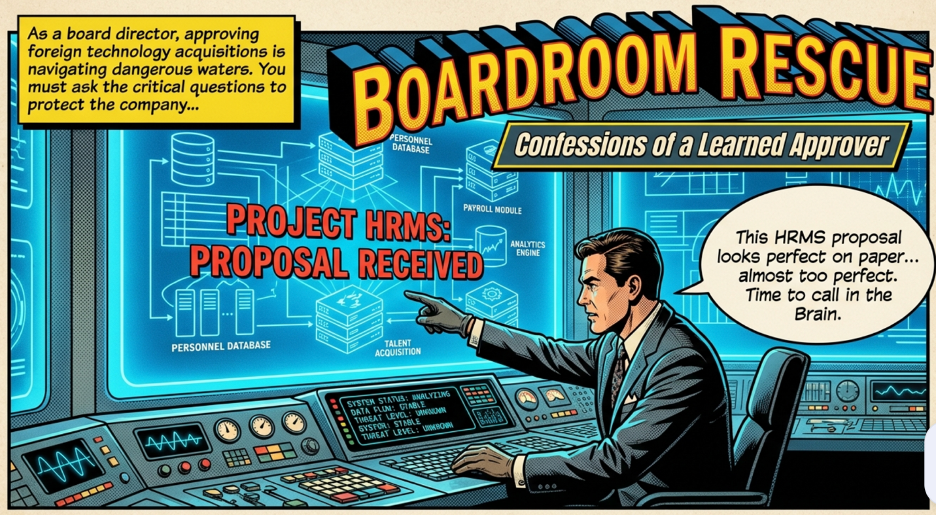
Board directors of a company are tasked with approvals of solution acquisition and project implementation. When landed in foreign water especially those involve technology installation, asking critical questions is key to ensuring capital outlays are invested with due care and applied diligence while discharging entrusted responsibility.
We shall perform a critical evaluation on project proposal backed by rigorous mathematical models like the Analytic Hierarchy Process (AHP) to demonstrate how NotebookLM could help directors in exposing hidden risks in “foreign territory,” particularly complex technology acquisitions.

AHP
The Proposal
In a hypothetical scenario board-level review of a Human Resource Management System (HRMS) acquisition. The selection process for the HRMS solution is technically sound and mathematically accurate according to AHP standards, though it raises minor questions regarding the “fairness” of its objective data handling. The process somewhat seemingly converts qualitative human judgments into ratio scales and verifies them through consistency checks.
“Learned approver” can utilize NotebookLM to critically audit a proposal that appeared technically flawless. The AI-driven inquiry exposes a sobering reality: mathematical perfection often masks catastrophic operational risks. Just because the math is “perfect” does not mean the decision is sound.
The Requirements
Data and information privacy must be preserved — first thing to do is to sanitize all documents of organization, suppliers and partners name and PII in the proposal. Our document in question is HRMS Selection(Sanitized).pdf, which is the actual paper detailing the selection process and calculation, after having removed/replaced all sensitive data and information.
To aid our audit, an article with a sample case using AHP model AHPTutorialTechnomo.pdf will be uploaded as source alongside the selection paper to aid NotebookLM as a guide for more effective assessment.

Upload Sources
The Bonuses
For a good start we could make use of the tools available in the studio to produce educational materials to enhance our understanding on the AHP model:

Tools

Mind Map
Infographic/Mind map, Video/Audio and reports are perfect starting point if one is new and foreign to the AHP concept.
The Audit Proper
Now go to the Chat section of NotebooLM and type in our prompt, click submit (arrow) and wait for the result:
As board member with deciding capability for the proposal, highlight all questionable points and put forth all queries required to arrive at final decision — include risk and compliance related matters

AI Assistant

Enter Prompt
Once the response is available, we could either copy the entire text content for subsequent processing or save as a note file in Studio section for future reference.

Options
This is the entire writeup from the result of the chat above:
To: The HRMS Selection Committee
From: Board of Directors
Subject: Critical Review of HRMS Vendor Selection (Analytic Hierarchy Process)
As a deciding member of the Board, I have reviewed the HRMS selection proposal which identifies Vendor 2 (XYZ) as the recommended finalist with a score of 0.4259. While the application of the Analytic Hierarchy Process (AHP) appears mathematically consistent, several points regarding the fairness, risk profile, and compliance of this selection require immediate clarification before a final vote.
1. Methodological Queries (AHP Integrity)
The provided tutorial warns that “too much consistency is undesirable” because it may indicate that the evaluators were not being critical or that the data was forced.
The Issue: Almost every matrix in the report has a Consistency Ratio (CR) of 0.0000 [64–67]. This level of “perfect” consistency is highly unusual in multi-criteria decision-making involving subjective human judgment.
Board Query: How was this data gathered? Was it a group consensus, or the input of a single individual? If it was a group, did the committee use the geometric mean to aggregate judgments as recommended by the AHP model, or a simple average?

2. The “Cost Dominance” Concern (Mathematical Fairness)
The most questionable aspect of this assessment is how the Cost criterion (weighted at 20%) has effectively dictated the entire outcome.
The Issue: Vendor 2’s cost ($278,504) is significantly lower than Vendor 3 ($804,035). Due to the “inverse of actual” formula used, Vendor 2 received a score of 0.9786, while Vendor 3 received 0.0052.
The Risk: This 188-fold disparity in cost scoring mathematically “zeros out” any technical or functional advantages held by other vendors. We must determine if this formula unfairly penalizes superior solutions or if the organization is prioritizing “cheapest” over “best fit.”
Board Query: Does the $525,000 savings with Vendor 2 represent a genuine value, or are we accepting a “bottom-tier” solution that will incur hidden costs later? Can the committee provide a sensitivity analysis showing the result if Cost weight is reduced to 10%?

3. Functional Gap and Compliance Risks
Vendor 3 is the clear technical leader in Functionality (0.4313) compared to Vendor 2 (0.3152).
The Issue: Vendor 2 is approximately 27% less capable in core functionality. Within the “User Requirements” sub-criterion, Vendor 3 leads significantly (0.4643 vs. 0.3214).
Compliance/Risk: HRMS systems are critical for legal compliance (taxation, labor laws, data privacy). A lower score in functionality often implies gaps in automated compliance reporting or security controls.
Board Query: Were there “must-have” compliance requirements that all vendors met before this AHP was conducted? Specifically, what functionality is the organization sacrificing by choosing the lower-scored Vendor 2?

4. Vendor Stability and Implementation Risk
The evaluation shows that Vendor 2 (XYZ) is the weakest in terms of Company (0.2443) and Contingency (0.2162).
The Issue: Vendor 3 is far more established (0.4020) and has a much stronger contingency “Plan” and “Backup” (0.4478).
The Risk: Choosing the cheapest vendor that also has the lowest establishment and financial scores presents a significant “Key Man” or “Business Continuity” risk. If Vendor 2 fails or lacks the staffing (where they also scored lowest at 0.3448), the implementation timeframe of 180 days may be an unrealistic “low-ball” estimate.
Board Query: Why are we comfortable selecting the vendor with the lowest score in “Finance,” “Staffing,” and “Backup Plan”? What is the mitigation strategy if Vendor 2 encounters financial distress during the 5-year maintenance period?

Required for Final Decision
To move forward, the Board requires the following:
Compliance Audit: A confirmation that Vendor 2 meets all statutory HR compliance requirements.
Reference Checks: Detailed reports from Vendor 2’s current clients regarding their “Support/Responsiveness,” where they scored lowest (0.2414).
Total Cost of Ownership (TCO): A risk-adjusted cost analysis that includes potential costs of implementation delays or functional workarounds needed for Vendor 2.
Final Remark: While the AHP math supports Vendor 2, the Board remains concerned that we are selecting the least stable and least capable vendor solely because of a pricing structure that the AHP model has amplified to an extreme degree.

The Conclusions
Board director/approver has great responsibility and accountability to steer management towards governance and practice beneficial to organization they serve and prevent corrupt and unfair practices, breach of trust. Use of NotebookLM can help approvers to ensure management duly comply with industry practice which makes sure all risks are managed, and relieves approvers of future legislative tussles and entanglement.

메타데이터
- post_id
- f1cb81669da8
- slug
- confession-of-a-board-director-how-notebooklm-makes-me-look-smart-as-a-learned-approver-f1cb81669da8
- url
- https://medium.com/@gescoach/confession-of-a-board-director-how-notebooklm-makes-me-look-smart-as-a-learned-approver-f1cb81669da8
- canonical_url
- https://medium.com/@gescoach/confession-of-a-board-director-how-notebooklm-makes-me-look-smart-as-a-learned-approver-f1cb81669da8
- author_url
- https://medium.com/@gescoach
- status
- ok
- fetched_at
- 2026-06-20 20:29:01






