Policy Changes in IVF and Other Assisted Reproductive Technologies (ART) in Singapore under…
Summary: In February 2026, Singapore reported a historic low Total Fertility Rate (TFR) of 0.87 for the year 2025. This unprecedented…
Policy Changes in IVF and Other Assisted Reproductive Technologies (ART) in Singapore under Consideration by the Marriage and Parenthood Reset Workgroup
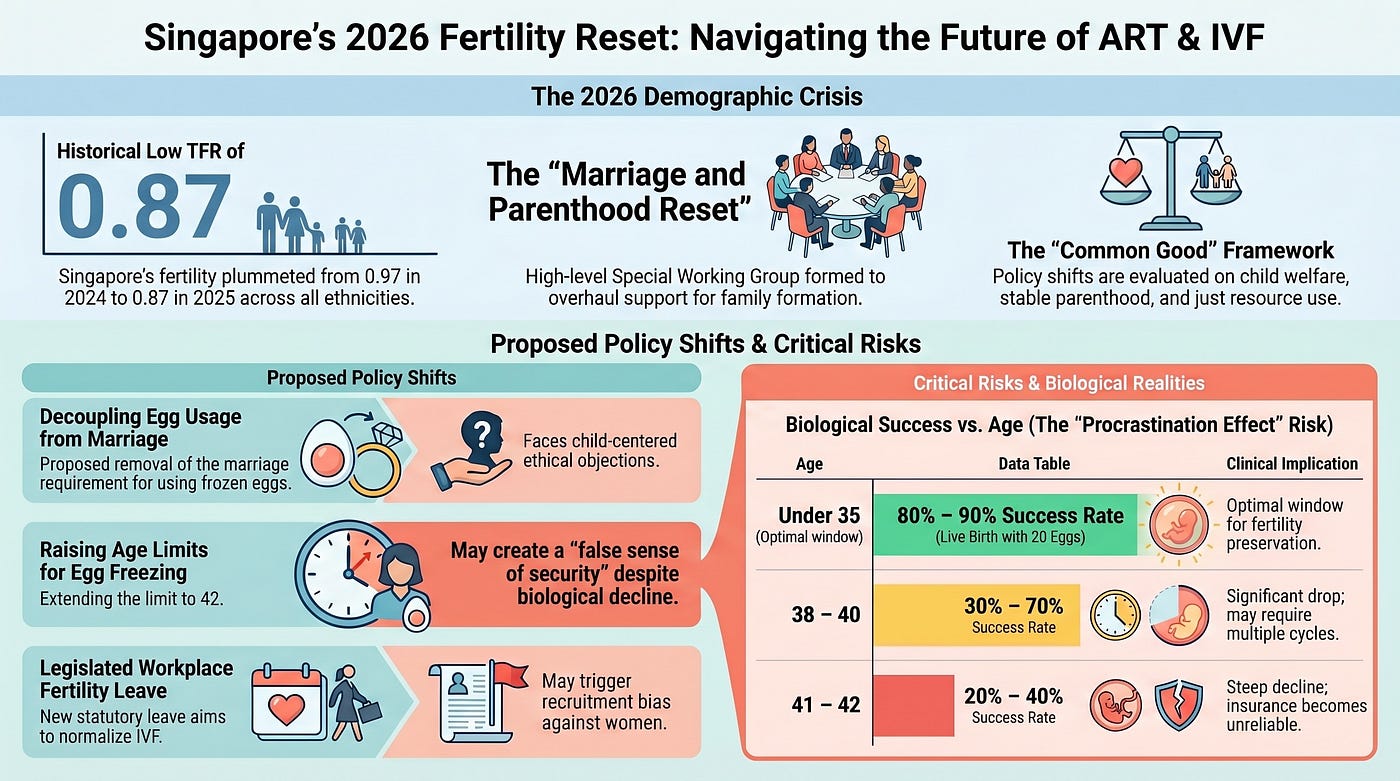
Summary: In February 2026, Singapore reported a historic low Total Fertility Rate (TFR) of 0.87 for the year 2025. This unprecedented demographic decline prompted the formation of a high-level Special Working Group, chaired by Minister Indranee Rajah, tasked with a “Marriage and Parenthood Reset.” Central to this reset is a comprehensive review of Assisted Reproductive Technologies (ART) and In-Vitro Fertilization (IVF) policies. This paper analyzes the anticipated policy and legal changes, focusing on the removal of marital requirements for elective egg freezing usage, the relaxation of age limits, and the enhancement of financial and workplace support for fertility treatments. Yet demographic urgency does not justify every expansion of assisted reproduction. A sound public policy response must ask whether proposed reforms truly promote the welfare of children, protect the integrity of family life, and use public resources justly, rather than merely expanding technical control over reproduction.
1. Introduction: The 2026 TFR Crisis
Singapore’s demographic landscape reached a critical juncture in early 2026. The announcement by Deputy Prime Minister Gan Kim Yong that the TFR had plummeted to 0.87 — down from 0.97 in 2024 — sent shockwaves through the policy community [1]. The decline was observed across all ethnic groups, exacerbated by a post-Dragon Year slump and long-standing structural issues such as high living costs and work-life imbalance. In response, the government signaled a “radical reset,” moving beyond incremental subsidies toward structural and legal reforms in how the state supports family formation. It must be noted that a fertility crisis, however grave, does not mean that every birth-increasing policy is ethically justified. The real question is whether the means proposed respect child welfare, stable parenthood, fairness in the use of public resources, and the proper limits of medicine.
2. The Special Working Group and the “Marriage and Parenthood Reset”
The Special Working Group (formally an inter-agency workgroup) was established to look holistically at marriage and parenthood issues. Its mandate includes:
• Enhancing government support for marriage and parenthood.
• Cultivating positive societal mindsets.
• Fostering family-friendly workplace cultures.
• Engaging the whole of society in fertility efforts [2].
A significant pillar of this group’s work is addressing the needs of couples and individuals facing fertility challenges, recognizing that later marriages (median age of first-time mothers at 32.3 in 2024) have made ART a necessity for a growing segment of the population.
A word of bioethical caution is apt here. That ART has become more relevant to later-forming families does not settle the ethical question of how far the law should facilitate its use. In public bioethics, the central issue is not simply what adults desire, but what future children are owed, what family structures best sustain human flourishing, and whether the state should treat reproduction primarily as a domain of technical choice. The question, therefore, is not whether ART can be expanded, but whether each proposed expansion is consistent with the common good. The “common good” here means the social conditions that help all persons and families flourish together, not merely the aggregation of individual choices.
3. Anticipated Policy and Legal Changes
Based on parliamentary debates, Ministry of Health (MOH) statements, and the “Marriage and Parenthood Reset” framework, several key changes to ART and IVF laws are anticipated.
3.1 Removal of Marital Requirements for Using Frozen Eggs
Since June 2023, elective egg freezing (EEF) has been legal for women aged 21 to 37 regardless of marital status. However, current regulations stipulate that these eggs can only be used for IVF within a legal marriage.
• Anticipated Change: The Working Group is under significant pressure to decouple the usage of frozen eggs from the marriage requirement. Proponents argue that allowing single women or those in stable de facto relationships to use their frozen eggs would directly address the “ticking biological clock” and provide a pathway to parenthood for those who have not found a spouse within their prime fertile years [3].
• Legal Hurdle: This change would require a significant shift in the “social norm” that children should be raised within a traditional family unit, a position the government has historically defended [3].
• Child-Centred and Social Concerns: The strongest objection to removing the marriage requirement is that the law should remain child-centred, not merely adult-centred. A child brought into existence through assisted reproduction is not simply the object of an adult reproductive plan; he or she is a future person with an interest in stable origins, durable parental commitment, and the care of both mother and father where possible. For that reason, the state may reasonably distinguish between responding compassionately to families already marked by absence or breakdown, and deliberately creating a legal pathway in which one parent is absent from the outset or parental commitment is structurally more fragile. In that light, the present rule is not mere moral conservatism. It reflects a defensible public judgment that procreation should ordinarily remain tied to a stable marital framework because the interests of children should not be subordinated to adult timing and preference.
• The Illusion of Choice and the Fertility Class Divide: The proposed reform also risks offering an illusion of choice rather than a reliable expansion of reproductive freedom. Elective egg freezing can create the impression that fertility has been safely deferred, when in reality later IVF success remains constrained by age, cost, and biology. [8] This may encourage some women to delay childbearing under the mistaken belief that egg freezing provides a dependable insurance policy. At the same time, the high financial cost of freezing and later using eggs means that any liberalisation would be most usable by the affluent, thereby deepening a fertility class divide. [9] A policy that appears to widen autonomy, but in practice chiefly benefits wealthier women while offering uncertain success, risks becoming less an instrument of justice than a technologically mediated privilege.
• Regulatory Complexity and the Social Meaning of Parenthood: Removing the marriage requirement would also trigger difficult legal and social questions that the current framework largely avoids. The law would need to confront issues such as parental responsibility in unstable de facto relationships, the legal status and inheritance position of children intentionally conceived outside marriage, and the disposition of unused eggs in cases of death, partnership breakdown, or disputed intentions. [10] More fundamentally, the reform would alter the social meaning of reproduction itself. Once the law treats frozen eggs as assets deployable independently of a stable marital union, fatherhood is subtly recast from a constitutive dimension of procreation into an optional social add-on. Even in secular terms, that is not a morally neutral shift. It signals a move from shared family formation toward the individualisation and technological management of parenthood.
• Law Shapes Societal Mores: Law does not merely permit conduct; it also teaches society what forms of conduct deserve recognition and support. If the state removes the marriage requirement, it will not simply be giving adults another option. It will be sending a public message that the link between procreation, fatherhood, and a stable marital home is desirable but no longer normatively important. That is a serious change in moral direction. A child-centred legal order should be wary of redefining fatherhood as optional at the very point where new life is deliberately brought into being.
3.2 Review and Potential Removal of Age Limits for EEF
Currently, the age limit for elective egg freezing is 37. The MOH has received numerous appeals from women above this age, with a 70% approval rate on a case-by-case basis as of April 2026 [4].
Anticipated Change: While the MOH remains cautious about “sending the wrong signal” regarding the decline in egg quality with age, the Working Group is expected to propose an upward revision of the age limit (potentially to 40 or 42) or a more formalized, transparent appeal process to accommodate the growing number of women who are only able to afford or consider the procedure in their late 30s.
While the Ministry of Health (MOH) reports a high approval rate of about 70% for appeals from women above the current age limit, a critical analysis reveals several systemic pitfalls and biological limitations that could undermine the effectiveness of this policy change. This discussion examines the ethical, socio-economic, and clinical implications of raising the age threshold for EEF.
The Paradox of the “Wrong Signal” and False Security: One of the primary concerns cited by the MOH is the risk of “sending the wrong signal” — the potential for women to misinterpret a higher age limit as a government endorsement of delayed childbearing. This concern is grounded in the biological reality of reproductive aging, where both egg quantity and quality decline precipitously after age 35.
Raising the limit to 40 or 42 may inadvertently create a false sense of security. Women who might have considered the procedure earlier may now delay it, assuming that a government-sanctioned limit implies a reasonable chance of success. This “procrastination effect” could lead to a cohort of women freezing eggs at an age where the probability of a future live birth is significantly diminished, thereby failing to achieve the policy’s underlying goal of fertility preservation.
Socio-Economic Disparities and Financial Burden: The high cost of EEF in Singapore — typically ranging from S$10,000 to S$15,000 per cycle — already poses a significant barrier. This financial burden is compounded for older women. Due to the decline in ovarian reserve, a woman in her late 30s or early 40s often requires multiple stimulation cycles to retrieve a sufficient number of viable eggs (the recommended 15–20 for a reasonable success rate).
“The financial burden of elective egg freezing is not just the initial procedure cost, but the cumulative expense of multiple cycles required to overcome age-related decline in egg yield.” [7]
Consequently, raising the age limit may primarily benefit high-income earners, exacerbating socio-economic inequities in reproductive access. For many women, the “ability to afford” the procedure only in their late 30s — as cited by the Working Group — means they are entering the process at a point of maximum cost and minimum efficiency.
Bureaucratic Hurdles in the Appeal Process: The proposal to formalize and make the appeal process more transparent is a double-edged sword. While transparency is generally positive, a formalized bureaucracy can introduce delays that are detrimental in a time-sensitive procedure like egg freezing. Every month matters in the late 30s; a protracted appeal process could push a woman from one success bracket into a lower one. Furthermore, a “case-by-case” approval process (currently at 70%) suggests a level of discretion that may still feel opaque or arbitrary to those denied. As the number of appeals grows, the administrative burden on the MOH may lead to longer wait times, further reducing the clinical window for applicants.
The “Success Trap” and Downstream Clinical Risks: The policy focus on the freezing stage often overlooks the usage stage. In Singapore, frozen eggs can currently only be used within a legal marriage [9]. If a woman freezes her eggs at 42, she may not attempt to use them until her mid-to-late 40s. This introduces additional clinical risks:
• Obstetric Complications: Pregnancies in the late 40s carry significantly higher risks of gestational diabetes, pre-eclampsia, and chromosomal abnormalities.
• Misleading Success Metrics: Clinics may report “survival rates” of thawed eggs, which are often high (90%+), rather than “live birth rates,” which are much lower for older eggs. This discrepancy can lead to emotional distress when the “insurance policy” fails to pay out.
Comparative International Context: Compared to other jurisdictions, Singapore’s policy remains relatively conservative. Countries like the United Kingdom and Australia have no statutory upper age limits for elective freezing, leaving the decision to clinical discretion and patient autonomy. Singapore’s cautious approach is better understood not as paternalism, but as a legitimate refusal to let law and marketing outrun biological reality. However, the complete removal of age limits — as some suggest — would require a robust public education campaign to ensure that “autonomy” is informed by a realistic understanding of biological limitations.
The anticipated policy changes may appear pragmatic, but they risk adapting law to delay rather than helping society confront the reasons for delay. Besides, without concurrent efforts to lower the costs for younger women or provide more comprehensive fertility education, raising the age limit may simply move the “fertility cliff” without providing a safer landing. The pitfalls of false security, financial inequity, and bureaucratic delay must be addressed to ensure that policy revisions translate into meaningful reproductive outcomes rather than just expanded procedural access.
Why the Age Limit Still Has Moral Value: There is also a deeper ethical reason for retaining a meaningful upper age limit. Age limits do more than regulate access; they communicate truthfully that medicine has limits and that not every technically possible intervention remains reasonable at every stage of life. In bioethical terms, this is a matter of proportionality: the burdens, costs, risks, and emotional investments associated with a procedure should remain in fair proportion to its likely benefit. A state that raises the age ceiling too far may appear compassionate, but in practice it risks licensing expensive hope where the chance of success has become too uncertain to justify routine policy endorsement.
3.3 Enhanced Financial Subsidies and Co-Funding
While IVF is already subsidized for Singaporean couples, the “Reset” is expected to deepen this support. The core anticipated changes include:
• Expanded Government Co-Funding Scheme: The co-funding scheme for ART is expected to cover a higher percentage of treatment costs and potentially extend to a greater number of treatment cycles. Currently, eligible Singaporean couples receive up to 75% co-funding for ART cycles in public hospitals, capped at three fresh and three frozen cycles [2]. The proposed expansion aims to further reduce the out-of-pocket expenses for couples.
• Flexible Use of MediSave: There are proposals to broaden the scope of MediSave usage to encompass a wider array of fertility-related diagnostics and treatments. This includes extending MediSave coverage to Pre-implantation Genetic Testing (PGT), which currently has specific limits and eligibility criteria [3]. The current MediSave limits are $6,000 for the first cycle, $5,000 for the second, and $4,000 for the third and subsequent cycles, with a lifetime cap of $15,000 [2].
• Enhanced Support for Elective Egg Freezing: Following its legalization in 2023 for women aged 21–35, enhanced support and subsidies for elective egg freezing are also anticipated. This aims to provide women with greater reproductive autonomy and potentially mitigate the impact of age-related fertility decline.
These changes are presented as making ART more accessible and affordable, but the deeper question is whether greater access to ART is the right response to the fertility crisis in the first place. Their effectiveness and equity are subject to various limitations and potential pitfalls.
Critical Discussion of Limitations and Pitfalls
Clinical Realities and Age Constraints: While financial support is crucial, it cannot circumvent the fundamental biological limitations of ART. The success rates of ART, particularly IVF, decline significantly with advancing maternal age, especially after 35 years. By potentially encouraging delayed childbearing through enhanced subsidies, there is a risk of creating a false sense of security among couples, leading them to postpone treatment until a point where the cumulative success rates are considerably lower, despite the financial aid. Furthermore, the existing age limit for co-funding, typically capped at 40 years at the start of treatment, creates a stark “cliff effect.” Couples above this age, who often face greater biological challenges and thus a higher need for ART, are excluded from this critical financial support, exacerbating their difficulties.
Socioeconomic Inequality: Despite the expansion of subsidies, socioeconomic disparities in access to ART may persist. The co-funding scheme is primarily restricted to public hospitals, which often experience longer waiting times due to high demand. For older women, where every month can impact success rates, these delays can be critical. Private fertility clinics, while offering potentially shorter waiting times and more personalized care, remain prohibitively expensive, effectively creating a two-tiered system where wealthier couples have a distinct advantage. Moreover, even with 75% co-funding, the remaining 25% of treatment costs, coupled with ancillary expenses such as medications, diagnostic tests not fully covered, and indirect costs like transportation and time off work, can still represent a substantial financial burden for lower-income families. This residual out-of-pocket expenditure can deter some eligible couples from pursuing or completing ART cycles.
Regulatory and Ethical Guardrails: Singapore’s ART framework has traditionally linked public support to a stable marital family structure. This is often criticised as restrictive, but there is a serious secular justification for such restraint. Public subsidy is not morally neutral; it signals what forms of reproduction and parenthood the state is prepared to endorse and finance. The state may reasonably conclude that where public money is involved, priority should be given to forms of parenthood most likely to secure stable caregiving, clear parental responsibility, and the presence of both mother and father where possible. Existing restrictions can therefore be understood not merely as conservative leftovers, but as an attempt — however imperfect — to align reproductive policy with child welfare and the common good.
Behavioral and Structural Pitfalls: Critics argue that an over-reliance on financial incentives and ART subsidies to boost the TFR is akin to “throwing money at the problem” without addressing deeper structural issues [7]. The persistently low fertility rate in Singapore is often attributed to broader societal pressures, including the high cost of living, housing affordability challenges, and demanding work cultures that make it difficult for couples to balance career aspirations with family life [8]. While ART can assist individuals with biological infertility, it does not resolve these systemic barriers that influence decisions about marriage and parenthood. Furthermore, an intense focus on the medicalization of infertility through ART might inadvertently divert attention and resources from preventive measures or policies that could encourage earlier natural conception, such as greater workplace flexibility, improved childcare support, and more affordable housing.
PGT-A and Diagnostic Limitations: The anticipated expansion of MediSave and co-funding for PGT, particularly PGT-A (Pre-implantation Genetic Testing for Aneuploidy), presents its own set of challenges. While PGT-M (for monogenic disorders) and PGT-SR (for structural rearrangements) are generally accepted, PGT-A remains controversial. Historically, PGT-A has been restricted or offered only through pilot programs due to concerns about its efficacy and the potential for false positives or negatives. Increased access through subsidies could lead to the disposal of potentially viable mosaic embryos, raising ethical dilemmas and potentially reducing the overall number of available embryos for transfer. The clinical criteria for PGT expansion will need to be carefully defined to ensure its appropriate and ethical application.
Risk of Introducing Problematic Societal Notion of Procreation: There is also a deeper social concern. Once public funding begins to support embryo testing and selection on an ever wider basis, the state risks encouraging the view that some possible children are more worth welcoming than others. Even if such testing begins with disease prevention, it can gradually normalise the idea that reproduction should involve screening, ranking, and discarding. A decent society should be careful not to drift from helping couples conceive to quietly teaching them to choose the “right” child.
Singapore’s anticipated policy changes to enhance financial subsidies and co-funding for ART represent a significant effort to address the nation’s declining fertility rate. By making ART more accessible and affordable, these measures aim to support couples in their parenthood journey. However, a critical discussion reveals that these policies, while well-intentioned, are not without limitations and potential pitfalls. These include the inherent biological constraints of ART, the persistence of socioeconomic inequalities in access, regulatory and ethical exclusions, and the risk of overlooking deeper structural and behavioral factors influencing fertility decisions. To achieve a more comprehensive and equitable solution, future policy refinements should consider a holistic approach that integrates financial support with broader societal reforms, addresses ethical concerns, and ensures that ART is utilized judiciously within its clinical and biological limits.
A further bioethical concern is that expanding subsidies can gradually transform infertility from a regrettable human difficulty into a publicly managed technological project. Once the state heavily funds repeated cycles, egg freezing, and increasingly selective embryo testing, it risks encouraging the view that parenthood is something to be engineered, optimised, and subsidised rather than ordinarily received within stable social institutions. This is especially troubling where the same public resources could instead strengthen the upstream conditions that make family life more possible in the first place: affordable housing, workable schedules, durable marriages, and meaningful support for raising children. The issue, then, is not whether infertility deserves compassion — it plainly does — but whether the state should answer a social crisis chiefly with laboratory solutions.
3.4 Legislated Workplace Support for Fertility Treatments
A major barrier cited by couples is the difficulty of balancing intensive IVF schedules with demanding careers. The difficulty of balancing intensive IVF schedules with demanding careers is a primary barrier for Singaporean couples. Current workplace support is largely discretionary, often requiring employees to use hospitalisation leave or annual leave for treatments. The anticipated change seeks to:
• Grant specific paid leave days for ART, similar to childcare or hospitalisation leave.
• Institutionalise support, moving it from a “perk” to a statutory right.
• Normalize fertility struggles, reducing the “shame” often associated with infertility.
While well-intentioned, legislating fertility leave may trigger several negative externalities:
Recruitment and Promotion Bias: The introduction of a new category of “fertility leave” may inadvertently heighten discrimination against women of childbearing age. Employers, particularly in Small and Medium Enterprises (SMEs), may perceive such employees as “high-risk” for frequent absences and subsequent long-term parental leave. This could lead to a “glass ceiling” where women are bypassed for critical projects or leadership roles during their peak reproductive years.
The “Stigma of Disclosure”: Legislated leave requires disclosure. For many employees, infertility is a deeply private medical and emotional struggle. Forcing employees to “claim” fertility leave requires them to reveal their private reproductive status to HR and managers. In a high-pressure corporate culture like Singapore’s, this disclosure may be perceived as a lack of commitment to the job, potentially leading to “quiet firing” or exclusion from the inner circles of influence.
Administrative Burden on SMEs: Unlike large Multinational Corporations (MNCs) with robust HR departments, SMEs may struggle with the administrative complexity and manpower scheduling required to accommodate the unpredictable nature of IVF cycles (e.g., sudden egg retrieval dates). This could strain employer-employee relations, especially if the government does not fully subsidize the leave costs.
Even if successfully legislated, fertility leave remains a “marginal” solution to a systemic problem. From a bioethical perspective, the deeper problem is one of misdirected policy attention. Fertility leave assumes that the central task of the state is to facilitate the medical management of delayed reproduction. But Singapore’s fertility crisis is not fundamentally a leave-management problem; it is a problem of social organisation, economic pressure, and the postponement of marriage and childbearing. A policy that normalises more time away for ART may appear compassionate, yet it leaves untouched the cultural and structural conditions that made ART necessary in the first place. Worse, it may deepen the medicalisation of family formation by treating technological intervention as the default route to parenthood rather than as a limited response to genuine infertility. Other relevant bioethical concerns include:
Insufficiency of “Time Off”: IVF is not merely a matter of taking days off; it is a grueling physical and emotional journey. A few days of legislated leave do not address the chronic stress, hormonal side effects, and potential mental health impacts (e.g., depression following a failed cycle). Without broader “Flexible Work Arrangements” (FWAs) and a culture of empathy, leave alone is a “band-aid” solution.
The “Success Rate” Paradox: ART has a significant failure rate. Legislated leave supports the process, but if the treatment fails, the employee returns to work with the same “fertility crisis” but now with the added burden of having disclosed their struggle. The policy does not address the post-treatment support needed for those who do not successfully conceive.
Gender Imbalance in Policy Focus: If fertility leave is framed primarily as a “women’s issue,” it reinforces the traditional gender roles that Singapore is trying to “reset.” For the policy to be truly effective, it must explicitly include and encourage male partners to take leave for support and their own treatments, yet workplace cultures often remain less supportive of men taking “family-related” leave.
Perhaps a better response would not be fertility-specific leave as such, but broader reforms that make marriage, family life, and child-rearing more workable for ordinary Singaporeans. These would include more flexible work arrangements, more predictable hours, stronger protection against workplace penalties for caregiving, and policies that reduce the economic pressures that lead couples to postpone marriage and children in the first place. In other words, the state should focus less on building special pathways for assisted reproduction and more on repairing the social conditions that make natural family formation difficult. The government should consider:
Broadening “Caregiving Leave”: Instead of a specific “Fertility Leave,” incorporating ART support into a broader, gender-neutral “Family Care/Medical Leave” could reduce targeted stigma.
Full Government Funding: To prevent employer resentment, the government should consider 100% reimbursement for fertility-related leave days, similar to the enhanced Shared Parental Leave.
Integration with FWAs: Legislation must be paired with the Right to Request Flexible Work, allowing employees to manage their own schedules without the need for formal “leave” for every appointment.
Legislated fertility leave represents a significant shift in Singapore’s pro-natalist policy, signaling that the state recognizes the workplace as a primary site of fertility barriers. However, without addressing the underlying corporate culture of “presenteeism” and the potential for gender-based discrimination, the policy risks becoming a “paper benefit” that employees are too fearful to use. A true “reset” requires not just new laws, but a fundamental shift in how Singaporean society values the balance between economic productivity and biological reproduction. Fertility leave may therefore be the wrong symbol as well as the wrong tool. It tells society that the path to parenthood is increasingly expected to run through clinics, procedures, and managed absence from work. A healthier public message would be that family formation should be supported earlier, more broadly, and less medically.
4. Comparative Analysis: International Context
Singapore’s anticipated moves mirror trends in other ultra-low TFR jurisdictions:
Recent Policy Reform (2024–2026) by Country:
South Korea
Subsidizes up to 2 million KRW for egg freezing and provides extensive IVF subsidies regardless of income [5].
Japan
Expanded public health insurance to cover 70% of IVF costs and removed income caps for subsidies [6].
Taiwan
Increased childbirth allowances and expanded ART funding to combat a TFR that fell to 0.70 in 2025 [7].
These international examples show that low-fertility societies often respond by expanding technical and financial support for assisted reproduction. But policy diffusion is not moral justification. The fact that other states are liberalising ART does not answer the more basic question of whether such liberalisation truly serves children, families, and the common good. Singapore’s strategy differs in that it still places greater normative weight on the traditional family unit, even as demographic pressure tempts policymakers toward broader ART liberalisation.
5. Conclusion
The 2026 TFR crisis has undeniably intensified pressure for a major reset in Singapore’s family and fertility policies. But demographic alarm should not be allowed to erode ethical judgment. The anticipated reforms discussed in this paper — removing the marriage requirement for the use of frozen eggs, raising age limits for elective egg freezing, expanding public subsidy for ART, and legislating fertility leave — may each appear compassionate or pragmatic when viewed in isolation. On closer inspection, however, they risk encouraging a model of reproduction that is more technologically expansive, more publicly financed, and less anchored in child-centred family formation.
A sound public bioethics must ask not only whether these reforms enlarge adult choice, but whether they serve the welfare of children, tell the truth about biological limits, use collective resources justly, and resist the reduction of parenthood to a technical project. Singapore’s fertility crisis is real, but it will not be solved well by treating ART liberalisation as the primary answer. The more responsible path is to strengthen the social foundations of marriage, family life, and child-rearing, while keeping assisted reproduction within principled ethical limits. A society may rightly desire more children, but it should not pursue that desire by weakening the moral, familial, and legal norms that make the begetting and raising of children a genuine human good.
References
[1] DPM Gan Kim Yong, “Speech at Committee of Supply Debate 2026,” Parliament of Singapore, Feb 26, 2026. [2] Minister Indranee Rajah, “Speech on Population at the Committee of Supply Debate 2026,” National Population and Talent Division, Feb 26, 2026. [3] Ministry of Health Singapore, “IVF Usage Rates and Consideration to Remove Marriage Requirement,” Parliamentary QA, April 8, 2026. [4] Ministry of Health Singapore, “Approval Rates for Egg Freezing Above Age 37,” Parliamentary QA, April 8, 2026. [5] “South Korea’s policy push springs to life as world’s lowest birthrate rises,” Reuters, Feb 26, 2025. [6] “Japan puts all its eggs in one basket to combat fertility crisis,” East Asia Forum, Aug 22, 2024. [7] “Ongoing policy drive to combat falling birthrate,” Taipei Times, April 6, 2026. [8] Annals.edu.sg. (2024, January 30). Freezing hope: Balancing realism and optimism in elective egg freezing. https://annals.edu.sg/freezing-hope-balancing-realism-and-optimism-in-elective-egg-freezing/ [9] Business Times. (2026, April 3). Could Singapore government consider providing financial assistance for egg freezing?. https://www.businesstimes.com.sg/opinion-features/could-singapore-government-consider-providing-financial-assistance-egg-freezing [10] Chin AHB. Singapore needs to update regulation of frozen egg donation after permitting social egg freezing. J Assist Reprod Genet. 2022 Jul;39(7):1497–1500. doi: 10.1007/s10815–022–02526–9.
메타데이터
- post_id
- f2000f0fd1fb
- slug
- anticipated-policy-changes-in-assisted-reproductive-technologies-arts-and-ivf-in-singapore-by-the-f2000f0fd1fb
- url
- https://medium.com/@alexisheng/anticipated-policy-changes-in-assisted-reproductive-technologies-arts-and-ivf-in-singapore-by-the-f2000f0fd1fb
- canonical_url
- https://medium.com/@alexisheng/anticipated-policy-changes-in-assisted-reproductive-technologies-arts-and-ivf-in-singapore-by-the-f2000f0fd1fb
- author_url
- https://medium.com/@alexisheng
- status
- ok
- fetched_at
- 2026-06-25 07:00:49