They Cannot Say We Were Not Warned
The question is no longer whether societies can ignore climate change, but how long they can pretend the current system can survive.
They Cannot Say We Were Not Warned
The question is no longer whether societies can ignore climate change, but how long they can pretend the current system can survive.
Photo by Breana Panaguiton on Unsplash
For decades, scientists, communities and environmental movements have repeated the same message: the material conditions of life are changing. Yes, that is a fact. But the atmosphere does not negotiate. Physics does not wait for elections, quarterly reports or political convenience. The warnings were always there. The only question was how long the response could be postponed.
A heatwave is a good place to start.
I’m writing this from a cooler Brussels compared to the previous week’s boiling pot. The temporary relief almost feels like an illusion. The heat is due to return, and with almost the same intensity.
Across Europe, the conversation is changing, but nowhere near the speed that is needed. And the conversation lacks useful content, miles away from any kind of organised effort to actually make a change. Because then we would have to at least touch the world’s financial structure, and forbid we do that. Right?
Unfortunately, we already know that private capital will never voluntarily abandon what generates profit. And the system, to our misfortune, is exceptionally good at reproducing itself through bailouts and safety nets for capital whenever it is threatened. So the question is: how long can we wait?
The answer is becoming depressingly clear: we appear able wait a very long time. Organised effort can speed it up but it needs a political expression vastly different from the status quo.
A worldwide organised effort to truly reshape power structures is needed, reforming them until they no longer reward destruction as a business model. Obviously, we are not there yet, but for the planet’s survival, we must get there soon. By studying history we see that organised struggle can speed up this process — the question is, what do we rally behind?
The younger generations seem to understand what needs to be done as future prospects are very limited (even if you are growing up in the wealthy nations), but the young are also deeply divided. There is the get rich quick crowd, the YOLO, enjoy life crowd, the serious activist group — the Gretas of the world — and then there are the bystanders. The ones who roll the dice and wait to see what happens. It is easier to observe than to actually do something, and they probably make up the majority (in any age group, young to old): benefit from whatever they can benefit from, then call it a day.
At least I saw a video from BreakThroughNews of a Parisian saying that we need a revolution. I am paraphrasing, but he said something along the lines of: that is the only thing that will make them listen — we need to stand up to them.
One thing we do know for sure is that the material conditions are getting worse. From a dialectical materialist standpoint, we could say that the contradictions of the current status quo are intensifying. They are maturing. But will political organisation mature quickly enough to meet them?
Extreme heat is no longer an abstraction. It is becoming a louder wake-up call every year. The threatening scenarios have long been discussed in climate reports — ignored, but discussed nonetheless — even though the scientific consensus is overwhelming.
It is increasingly becoming a daily question of whether homes, transport systems, energy grids and public services can continue functioning.
France is one example where the wake-up call is becoming louder. It saddens me that those of us living in the economic core seemingly need to feel the heat ourselves before people begin to react. But even when children die in cars because of the heat, the news barely travels far. It is reported and then quickly forgotten in our world of hyper-media consumption.
We are being fed so much information that it almost feels as though we are being buried alive without even realising it. We keep living our lives through our phones, and the simulation that everything is fine continues uninterrupted.
It makes me think of football fans during the World Cup filming themselves enjoying the moment instead of actually enjoying the moment.

Source: https://www.instagram.com/p/DZdqtZpkVls/
As people that are following european news are very well aware of. Many French buildings were simply not designed for the temperatures they now experience. Low-income housing estates are suffering the most, turning apartments into what residents describe as furnaces.
The consequences spread quickly. Extreme heat has increased air pollution, hospital admissions, school closures and transport disruptions. Train services have been cancelled. Power cuts have affected thousands of households, leaving people unable to cool their homes. French nuclear production has been reduced because high temperatures limit access to the water needed for cooling. This is often where the climate debate becomes uncomfortable: the costs are no longer theoretical. They arrive in budgets, infrastructure failures, public health systems and household insecurity.
Technology alone does not answer these questions. Even Europe’s wealthy societies are discovering that adaptation is expensive. A recent report from the Fondation pour le Logement found that half of French homes have insufficient protection from high temperatures. Around two-thirds of French residents report struggling with heat inside their homes. The climate crisis is therefore also a housing crisis. It is an inequality crisis. Those with resources can adapt faster: better insulation, cooling systems, greener neighbourhoods, private solutions. Those without them experience the crisis first.
And these costs arrive at exactly the moment when the global economic system is already struggling with multiple crises. Financial systems can absorb a lot — until they cannot. The contradiction is becoming harder to ignore: we are attempting to maintain a model of endless growth and consumption on a finite planet. The idea that wealthy societies can simply continue expanding their material footprint while eventually bringing everyone to the same standard of living is becoming increasingly difficult to defend.
Some respond by pointing to countries like China. And China deserves to be studied. It has achieved an extraordinary industrial transformation, particularly in renewable energy, electrification and infrastructure. But the question cannot only be whether a system can build quickly. The question is also: under what conditions? Who bears the costs? Who benefits? What forms of labour, extraction and inequality make such transformation possible? The structural critique is that, at the level of political economy, there is often less that differentiates China, the United States, Russia and the European Union than their political narratives suggest. Of course, the differences in institutions, governance and rights matter enormously in many respects, but the underlying economic imperative of continuous growth, resource extraction and capital accumulation remains remarkably similar.
Photo by Veer Shah on Unsplash
The same contradiction is emerging in another sector: the race to build data centres. The AI boom is often presented as the future. But every future requires physical foundations. Data centres consume enormous amounts of electricity and water. They are increasingly becoming the target of climate-related legal challenges around the world because of their energy sources, emissions and environmental impacts.
A review by the London School of Economics examining thousands of climate-related lawsuits since 2015 found growing litigation targeting data centres, particularly around electricity consumption, water use and pollution.
Chile offers an early example as depicted by *The Guardian*. Residents and local authorities challenged a planned Google data centre in Santiago, arguing that the project threatened already stressed water supplies. The legal challenge succeeded in stopping the project because climate impacts had not been properly considered.
Ireland has become another centre of conflict. The country encouraged the expansion of the data centre industry, even as the sector grew to consume a significant share of national electricity demand. Environmental groups have challenged government decisions arguing that they risk locking the country into fossil fuel dependency.
Similar conflicts are emerging in the United States. In California, local authorities have forced data centres to use renewable energy and recycled water. Elsewhere, communities are challenging fossil fuel infrastructure built to power the AI industry: Groups challenge air permit for massive methane gas and oil expansion at Plant Bowen; Elon Musk’s xAI faces second lawsuit over toxic pollutants from datacenter; Trump’s DoJ intervenes to back Elon Musk in datacenter pollution lawsuit; DOJ Defends Musk’s xAI in Data-Center Pollution Lawsuit.
Take a pause here and reflect. That the DoJ intervenes should not be surprising — one way or another private capital finds its way. It makes me think of a phrase I recently read:
“Musk is a master of regulatory arbitrage. He will no doubt leverage Starlink’s ability to cross borders via satellite and function before formal agreements are reached to muscle his way into recalcitrant markets.”
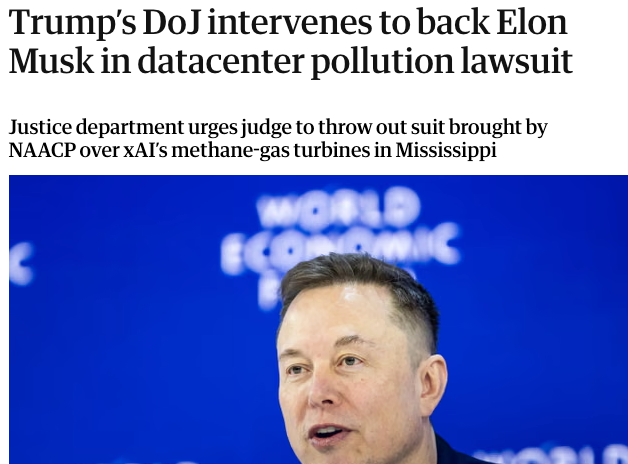
Source: https://www.theguardian.com/technology/2026/jun/16/elon-musk-xai-datacenters-trump-administration
The conflict is simple: A digital economy still depends on physical resources. ‘The cloud’ is not floating in the sky. It is built from electricity, minerals, land and water. Europe is not immune to this contradiction. Governments have often celebrated data centre investments as symbols of progress and economic opportunity. But short-term investment headlines can hide long-term costs. The question is not whether these technologies are valuable. The question is whether societies are planning for their consequences. In the reality of a competitive economy, the answer so far seem to be: no, we are not planning.
The contradiction is becoming increasingly difficult to ignore. Every attempt to preserve a model of endless accumulation runs into the same material limits: a warming atmosphere, growing inequality, finite resources and infrastructures that were never built for the conditions now emerging. Technology may change, industries may evolve and governments may change course, but none of them can repeal the laws of physics. The question is therefore no longer whether change will come, but whether it will be organised, or imposed upon us through ever deeper crises. The warnings have been with us for decades. Today, they have become lived reality. They cannot say we were not warned.
메타데이터
- post_id
- f3f35f9dc000
- slug
- they-cannot-say-we-were-not-warned-f3f35f9dc000
- url
- https://medium.com/the-new-climate/they-cannot-say-we-were-not-warned-f3f35f9dc000
- canonical_url
- https://medium.com/the-new-climate/they-cannot-say-we-were-not-warned-f3f35f9dc000
- author_url
- https://medium.com/@adamlantz
- status
- ok
- fetched_at
- 2026-07-09 05:53:33