AI DeepResearch APIs in 2026
The evaluation of deepresearch APIs according to DRACO benchmarks in 2026. Valyu leads, ahead of Parallel, Perplexity and Exa.
AI DeepResearch APIs in 2026
The evaluation of deepresearch APIs according to DRACO benchmarks in 2026. Valyu leads, ahead of Parallel, Perplexity and Exa.
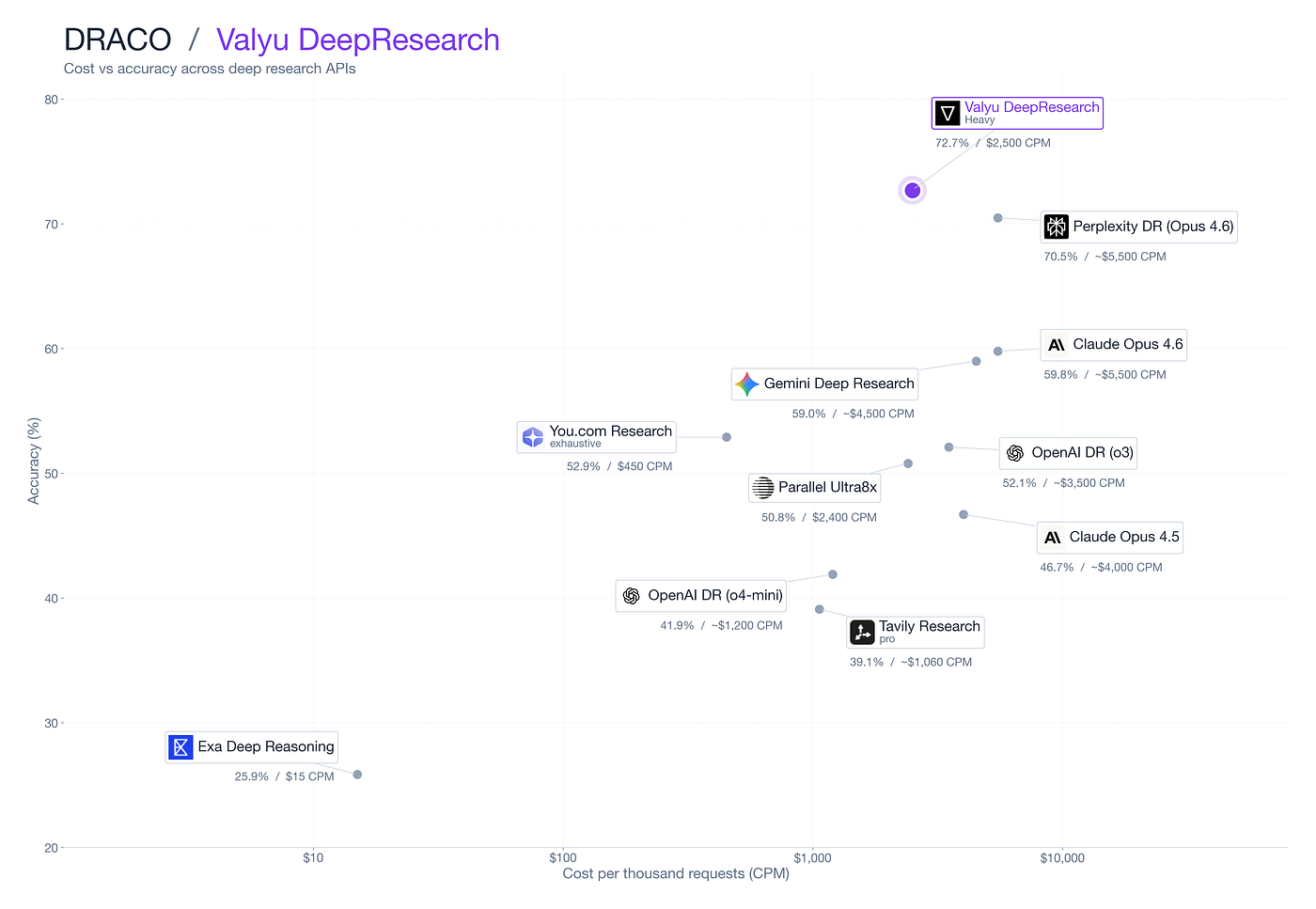
The deep research API category barely existed two years ago. Now every major AI company has one. The pitch is the same across all of them: give it a question, it breaks the question into sub-queries, runs searches, reads sources, and returns a structured report. The category has matured fast enough that we can now benchmark it properly and the results are worth paying attention to.
This is a survey of the independent deep research API providers in 2026. I’m not covering Gemini Deep Research, OpenAI Deep Research, or Claude’s research features here in this article. Those are consumer and enterprise products where API access, rate limits, and pricing work differently enough that direct comparison distorts more than it informs.
This covers the providers you’d actually evaluate when building an AI product that needs research capabilities.
What DRACO Measures
DRACO (Deep Research Accuracy, Completeness, and Objectivity) is a benchmark designed specifically for evaluating deep research APIs. It tests accuracy against factual queries that require multi-step reasoning. Questions that can’t be answered from a single source and where the answer is verifiably correct or incorrect.
Production decisions rarely come down to a single metric, but the two most directly comparable signals across providers are factual accuracy on verifiable queries and cost per query (reported here as $/1k requests). Both are necessary, neither is sufficient: latency, citation quality, data source coverage, output structure, and rate limits often decide whether an API actually fits a workflow. Treat the numbers below as a starting point for a shortlist, not a substitute for testing on your own queries.
A few things worth noting about how to interpret these numbers:
- Accuracy here means factual accuracy on verifiable questions, not “quality” in some subjective sense. A provider that writes well but gets facts wrong scores low. A provider that writes tersely but gets facts right scores high.
- CPM figures are approximate. Published pricing changes, volume discounts exist, and some providers don’t publish list prices at all. Treat these as ballpark figures for comparison, not quotes.
- This is a point-in-time benchmark (May 2026). The API landscape moves fast. Exa’s models improve quarterly. Perplexity shipped three major research updates in the past six months. Check current docs before making final decisions.
The Results (Benchmarks)
Understanding the Numbers
The accuracy gap is the real story
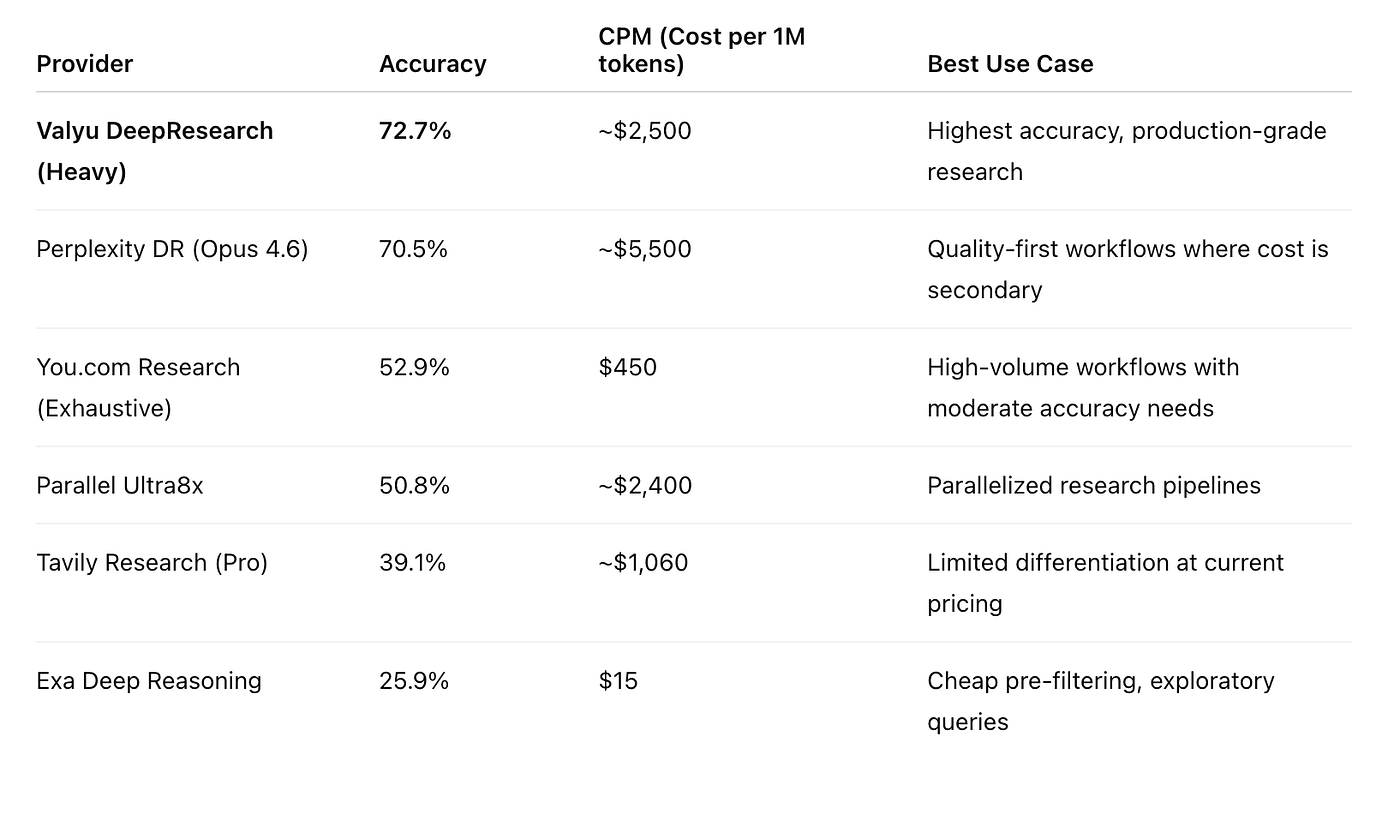
The single most important thing in this dataset is the 20-point gap between the top two providers (Valyu at 72.7%, Perplexity at 70.5%) and the next tier (You.com at 52.9%, Parallel at 50.8%). This is not a marginal difference in benchmark conditions, it represents a structural divide in what these products can do.
At 72-70% accuracy, a deep research API can handle questions that require cross-referencing multiple sources, resolving contradictions between them, and synthesizing a factually correct answer.
At 50-53% accuracy, the product is getting the right answer roughly half the time. That might be acceptable for some use cases. It is not acceptable for financial analysis, clinical research, legal summarization, or any application where a wrong answer has a real cost.
At 39% (Tavily) and 26% (Exa), the products are failing on the majority of queries. That’s not a research tool for production use, it’s a starting point for exploration.
Accuracy vs. Cost: three distinct tiers
Top tier. Accuracy-first ($2,500-$5,500 CPM): Valyu and Perplexity. If accuracy above 70% is a requirement, these are the only options. Valyu comes in at $2,500 CPM vs. Perplexity’s $5,500 CPM for 2.2 percentage points less accuracy. On a pure cost-per-accuracy-point basis, Valyu is significantly more efficient. At 1,000 requests per month, the difference is $3,000/month for marginally lower results.
Mid tier. Volume-friendly ($450-$2,400 CPM): You.com and Parallel both sit around 50-53% accuracy with very different pricing. You.com at $450 CPM is the standout value play in this tier, it’s the cheapest route to 50%+ accuracy by a wide margin. Parallel at $2,400 CPM delivers almost identical accuracy to You.com at 5x the cost. Unless you have specific reasons to use Parallel (their data coverage, latency profile, or integrations), You.com wins this tier on value.
Budget tier. Exploratory only ($15-$1,060 CPM): Exa at $15 CPM and Tavily at $1,060 CPM. The pricing spread here is enormous but the accuracy floor is low enough that neither belongs in a production research pipeline. Exa at $15 CPM is interesting purely because the price is low enough to make it viable as a first-pass filter or cheap exploration layer before routing to something more capable.
The Tavily Position
Tavily sits in a position that’s hard to justify: $1,060 CPM for 39.1% accuracy. That’s more expensive than You.com (which is 13 points more accurate) and far more expensive than Exa (which, granted, is 13 points less accurate). It’s not the budget option and it’s not the quality option. Following the Nebius acquisition in February 2026, the product roadmap has been opaque. The current pricing-to-accuracy ratio makes it a hard recommend against either alternative at its price point.
Where Exa fits
Exa at 25.9% accuracy is failing on nearly 3 in 4 queries. That sounds like a disqualification but at $15 CPM, it’s a different product for a different use case. If you’re processing thousands of queries and need a cheap way to filter obvious non-answers before routing to a more expensive tier, Exa’s price makes it viable as a pre-filter.
DeepResearch Provider Breakdown
1. Valyu DeepResearch (Heavy)
72.7% accuracy / ~$2,500 CPM
Top of the benchmark on accuracy and competitive on cost relative to the other premium option. The “Heavy” mode runs extended multi-step research. Valyu also offers faster, cheaper modes for different accuracy/cost tradeoffs.
One structural advantage: Valyu’s data access includes specialised sources (SEC filings, academic publishers, clinical databases). For queries that require data behind paywalls, the accuracy gap versus web-only competitors is likely wider than DRACO’s web-query baseline captures.
2. Perplexity DR (Opus 4.6)
70.5% accuracy / ~$5,500 CPM
Strong accuracy with the highest cost in the benchmark. Perplexity’s consumer product has significant brand recognition, and the API inherits that search infrastructure. The Opus 4.6 model driving this mode is among the strongest language models available, which explains the accuracy. The price reflects it.
If you’re choosing between Valyu and Perplexity on pure benchmark performance, Valyu wins on cost-efficiency. If you have specific reasons to prefer Perplexity’s data sources or citation format, that’s a reasonable basis for the premium.
3. You.com Research (exhaustive)
52.9% accuracy / $450 CPM
The clearest value play in this benchmark. $450 CPM for 53% accuracy is genuinely competitive. You.com has been quietly improving their research product and “exhaustive” mode runs a more thorough search process than their standard tier. If your use case can tolerate roughly 1-in-2 accuracy (content summarization, trend research, low-stakes Q&A), You.com undercuts the field significantly. Worth testing before defaulting to premium options.
4. Parallel Ultra8x
50.8% accuracy / ~$2,400 CPM
Parallel raised a total of $230M and built a premium positioning around speed and data coverage. Ultra8x is their high-end research mode. The accuracy result here (50.8%) is in the same tier as You.com despite costing 5x more. Parallel’s differentiated value has historically been latency (deep mode previously benchmarked at 13.6 seconds, which is fast for multi-step research) and specific data partnerships. If those factors matter for your use case, Parallel is worth evaluating. On accuracy and cost alone, it’s hard to justify over alternatives at this price.
5. Tavily Research (pro)
39.1% accuracy / ~$1,060 CPM
Post-Nebius acquisition, Tavily has strong developer distribution (1M+ developers have used Tavily in some form) but the research product hasn’t kept pace with the accuracy improvements seen elsewhere. 39.1% is a meaningful step down from the mid-tier providers, and the current pricing doesn’t reflect that gap. The core Tavily search product remains solid; the research layer is where the value case weakens.
6. Exa Deep Reasoning
25.9% accuracy / $15 CPM
Exa’s strength is neural indexing and high-quality web retrieval. Deep Reasoning is their attempt to add multi-step synthesis on top of that retrieval layer.
The accuracy result suggests the reasoning layer isn’t yet competitive with the providers above it. At $15 CPM, it’s the cheapest deep research option by a wide margin roughly 30x cheaper than the next cheapest option (You.com).
That price point creates specific use cases even at 26% accuracy: bulk classification, topic exploration, first-pass triage before escalating to other providers.
What I’m Shipping With…
I’m building this into a product, so I need something I can deploy today and trust on questions where the answer actually matters. I’m going with Valyu DeepResearch (Heavy) as the default.
The accuracy holds up on multi-step questions where the answer requires reconciling sources, and the specialised/proprietary data access (Finance, Healthcare, Economic indicators, Clinical trials, Technology, Life Sciences) covers most of what my queries actually hit. Pricing is predictable per task, which makes cost easy to forecast as the workload grows.
For high-volume, lower-stakes work like content summarization, trend research, exploratory Q&A, I’ll route to You.com Research in exhaustive mode. It’s the most cost-effective option in the tier where rough-cut accuracy is acceptable, and the latency is reasonable for batch work.
I’ll keep Exa in the toolbox as a pre-filter. It’s not a standalone research tool, but it’s fast and cheap enough to triage thousands of inputs before escalating the interesting ones to a more capable provider.
I’m not currently using Tavily or Parallel. Tavily’s research layer hasn’t kept pace since the Nebius acquisition, and Parallel’s premium positioning is hard to justify when the output quality lands in the same band as cheaper alternatives. Both are worth revisiting as their roadmaps evolve.
The right answer here for you depends solely on your use case and budget. Pick what works for you and ship with it!
메타데이터
- post_id
- f6d89ca0c17d
- slug
- ai-deepresearch-apis-in-2026-f6d89ca0c17d
- url
- https://medium.com/@unicodeveloper/ai-deepresearch-apis-in-2026-f6d89ca0c17d
- canonical_url
- https://medium.com/@unicodeveloper/ai-deepresearch-apis-in-2026-f6d89ca0c17d
- author_url
- https://medium.com/@unicodeveloper
- status
- ok
- fetched_at
- 2026-06-09 15:37:30