The reptile downstream of the server farm
Alabama’s state turtle survives in one delta. The water it needs is being claimed upstream, one data center at a time.
The reptile downstream of the server farm
Alabama’s state turtle survives in one delta. The water it needs is being claimed upstream, one data center at a time.
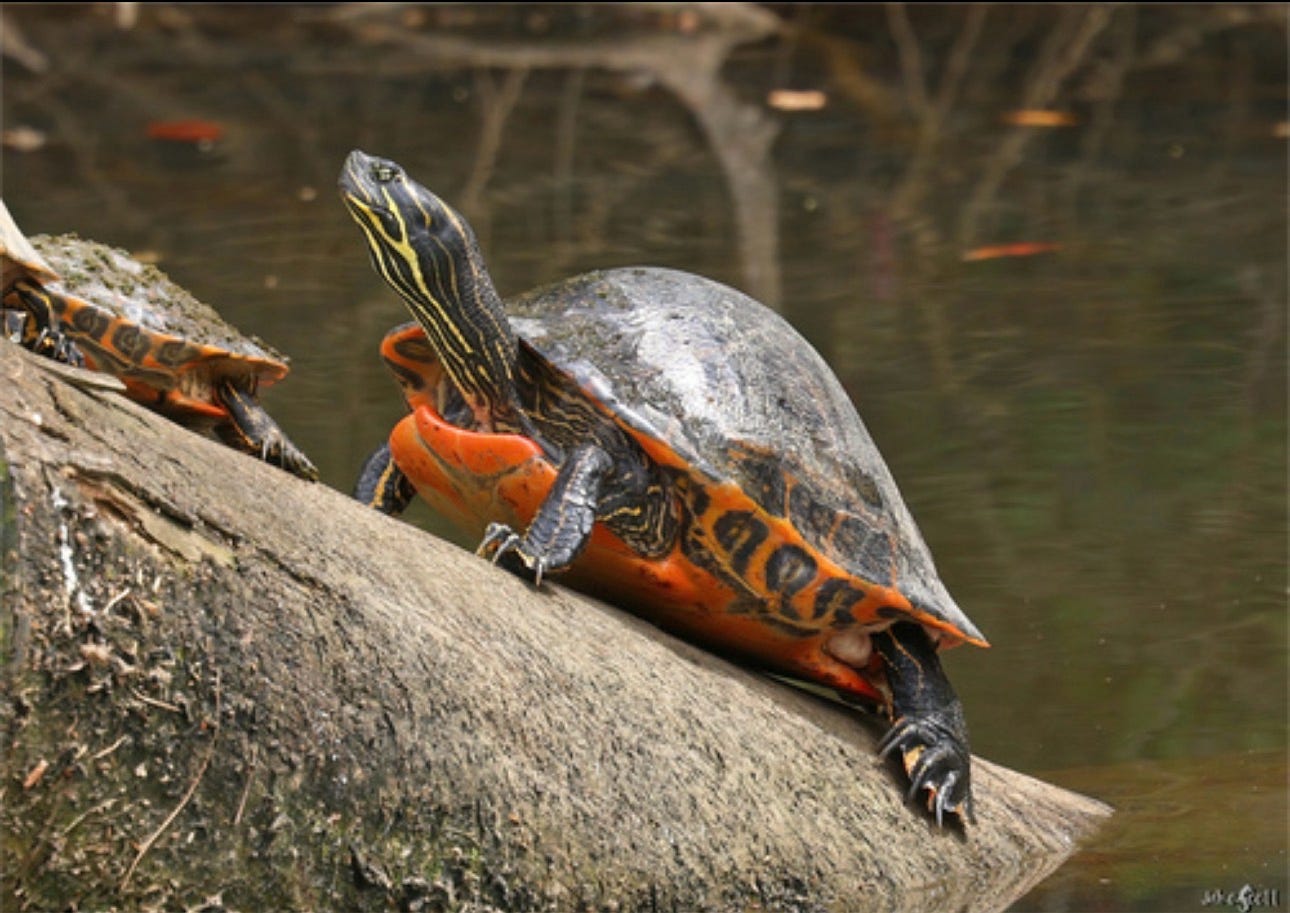
David Nelson has spent the better part of his career on his knees in the sand of the Mobile-Tensaw Delta, counting a turtle that most people in Alabama have never knowingly seen. The herpetologist from the University of South Alabama knows the Alabama red-bellied turtle the way a farmer knows a field, where the females haul out to nest in early summer, which logs the basking adults favor, how a hatchling the size of a silver dollar makes its run for the water. He has watched the species claw back from a roadkill crisis that once killed hundreds a year on a single causeway. Now he is watching a different kind of threat take shape, one that arrives without headlights.
“The habitat is changing,” Ylenia Chiari, a George Mason University biologist who has studied the turtle’s genetics, has said of the delta where it lives.
This time the change is coming from upstream, dissolved in the water itself, not chiefly from the road. Across Alabama, technology companies are racing to build data centers, vast warehouses of servers that train artificial intelligence and run the internet, and the largest of them are thirsty. The state counts 23 operating data centers and a wave of giant projects behind them, including a 1,600-acre complex near Bessemer called Project Marvel. These machines drink water to stay cool and return it warmer. In Alabama, the water runs downhill to one place. Two-thirds of the state drains into the Mobile River Basin and the delta below it, the only home the red-bellied turtle has.
A turtle that lives almost nowhere
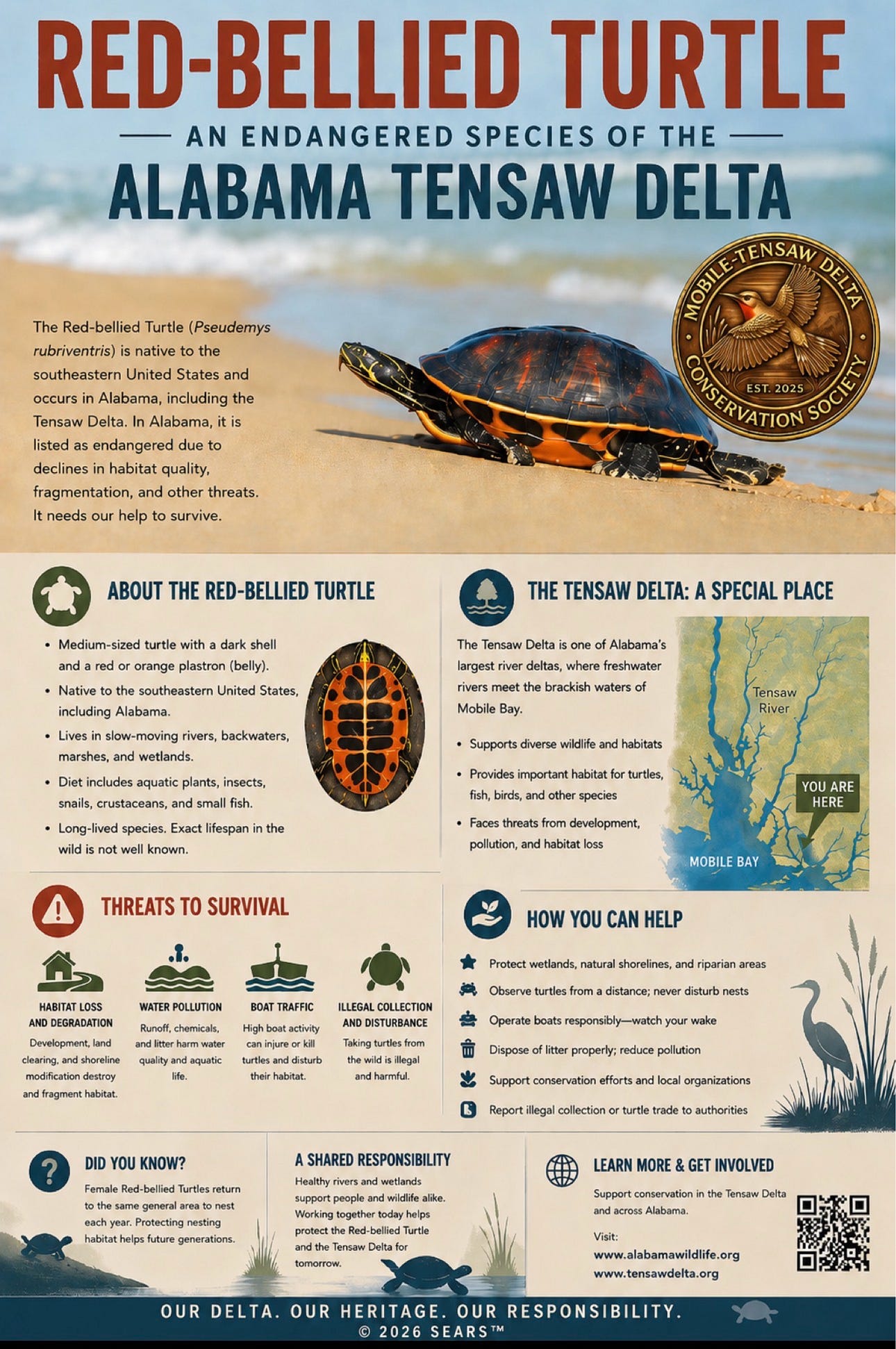
The Alabama red-bellied turtle is a creature of one address. It lives in the fresh to brackish waters of the Mobile-Tensaw Delta in Mobile and Baldwin counties, with a scattering of relatives across the line in the coastal drainages of Mississippi, and almost nowhere else on Earth. First described by the zoologist Georg Baur in 1893, it was placed on the federal endangered species list in 1987 and named the official state reptile by the Alabama Legislature in 1990. It remains a species of the highest conservation concern, and the International Union for Conservation of Nature also classifies it as endangered. A mature female can stretch to about 14 inches of shell, greenish to near-black on top with the reddish wash beneath that gives the animal its name. She will spend most of her life in the water, grazing on aquatic vegetation, basking on half-sunken logs in the sun, hauling out only to lay. The species belongs to the cooter family of freshwater turtles, its common name traced to kuta, a word for turtle from the Mande languages of West Africa, carried to the Southeast by enslaved people from the region of present-day Mali.
The turtle’s troubles are old and human in origin. Declines have been documented since the 1980s, driven by lost nesting ground, illegal trapping for the pet trade and for food, and drowning in fishing nets and crab pots. Adults have few natural predators beyond the occasional alligator; people have always been the larger danger. The delta it depends on is itself one of the most biologically dense places in North America, a sprawl of cypress swamp and marsh that shelters dozens of rare and imperiled species, and the red-belly is among the rarest of them. Alabama sits within one of only three regions worldwide identified as a global priority for turtle conservation.
How many remain is a question no one can answer with confidence. The population has never been firmly counted and is believed to number well below 10,000 animals, possibly as low as 1,000. For a turtle that matures slowly and breeds across a long life, those are not numbers that leave room for a new mistake. A female killed before she nests erases not one turtle but every clutch she would have laid over decades, and the species has already spent years absorbing exactly that kind of loss.
Nelson knows the arithmetic well. His roadkill counts on the Mobile Bay Causeway documented the toll that finally forced the state to act: in 2001, more than 580 turtles died on that stretch of highway, most of them spring hatchlings and nesting females. The 3.4-mile barrier fence that the Alabama Department of Transportation and the Alabama Department of Conservation and Natural Resources built in response, completed in 2008, sharply reduced recorded deaths. It was a rare clean win in endangered-species work, a problem the state could see, measure and engineer away with chain-link and warning banners.
The threat Nelson watches now offers no such target. You cannot fence the water.
The thirst upstream
A single large data center can consume as much water in a day as thousands of households, pulling from municipal systems, wells and rivers to feed evaporative cooling towers, then discharging the warmed water back into the watershed. Project Marvel, the $14.5 billion hyperscale complex approved for Bessemer, supplies the clearest numbers Alabama has yet seen. In filings with the local water authority, developers estimated the facility would need about 2 million gallons of water per day. That is roughly the daily use of 6,700 households, close to two-thirds of Bessemer’s population, requested from a rural utility that said it could not supply the demand without significant upgrades to its system. Independent estimates for a data center of that power class run higher, past 10 million gallons a day.
Where the water comes from, and where its heat goes, is only partly public. Developers have suggested the operator may use a closed-loop cooling system to reduce consumption, but the specifics, how much, drawn from surface or ground, and discharged where, have not been disclosed. Much of the project advanced under non-disclosure agreements, some signed by city officials before they voted. A claimed environmental review reportedly found no ecological problems at the site, but it has not been released; opponents ask why, if the study clears the project, it stays sealed. The Bessemer City Council approved the rezoning 5–2, changing the designation from agricultural to light industrial and clearing the final local hurdle for a project valued in the billions.
The completed complex would draw an estimated 1,200 megawatts of electricity, roughly the demand of a city of 760,000 people, from a grid that still leans heavily on fossil fuels. And Project Marvel is one project among many. Alabama’s 23 operating data centers are scattered across a dozen cities, with proposals stacking up behind them, an 800-acre site in Lowndes County, a planned 500-megawatt facility in Childersburg, others still taking shape. Each one needs water. Most of that water, somewhere along its path, has a relationship to the rivers that feed the delta.
“We have a lot of promises from these developers,” Charles Miller, policy director of the Alabama Rivers Alliance, told a reporter. “We’ve not been able to see any of them in writing.”
The legal landscape gives those promises little to push against. Under Alabama law, a landowner beside a river or stream can draw water without a permit. Businesses pulling more than 100,000 gallons a day must file a certificate declaring the use beneficial, but the reporting is largely self-policed, oversight is thin and penalties are effectively nonexistent. The state has no comprehensive water plan. Into that vacuum has come an industry that can earn its owners many millions of dollars per megawatt each year, drawn by cheap power and a 30-year tax abatement written into state law to attract these projects. The water the servers need has to come from somewhere, and in Alabama the rivers connect almost everything to the delta.
How it reaches the turtle
The Mobile-Tensaw Delta is a balance, not a fixed feature. It is a transition zone where freshwater pouring down from the rivers meets saltwater pushing up from Mobile Bay and the Gulf, and the line between the two is held in place by the volume of river flowing down. Lower that volume, and the salt advances upriver. Warm the water, and the chemistry shifts further. Researchers have wired the delta to watch the boundary move, installing nine continuous salinity and water-level monitoring stations and surveying 47 plots of tidal forest across the delta, a sprawl of more than 250,000 acres that ranks among the largest river deltas in the country, precisely because these tidal freshwater forested wetlands are understood to be vulnerable to saltwater intrusion and human disturbance.
For the red-bellied turtle, that boundary marks the difference between habitable water and water that can kill. Freshwater reptiles have little tolerance for salt. Studies of freshwater reptiles and amphibians have found that even modest increases in salinity can impair their physiology and, in some cases, prove lethal. A few freshwater turtles can ride out brackish spells for hours or months by moving between salty and fresh water and cutting back on how much they feed and drink, but those are survival tactics with limits, not a way of life. A turtle confined to one delta cannot simply migrate to a fresher river. There is no other river for this turtle. An isolated population once lived farther inland in southwestern Alabama, the genetic study notes, and has since been extirpated, which leaves the coastal rivers around Mobile Bay and the Mississippi Sound as the species’ last ground.
That is how a server farm near Bessemer reaches a turtle some 200 miles to the south. The data center need not touch the delta to change it; taking enough water from the rivers that feed it, and adding enough heat, can let the salt creep farther upriver than it otherwise would. No single withdrawal announces itself at the waterline. The effect is cumulative, invisible and, by the design of Alabama’s water law, largely unmeasured.
Ryan Anderson, a staff attorney with the Southern Environmental Law Center, has pressed the basic, unanswered questions about the Bessemer project. “They requested two million gallons a day from a fairly rural, under-resourced, drinking water utility,” he said, “and we have questions about whether that utility can upgrade its system without any cost to its customers in order to serve the data center.” Then the underlying question for the delta: “And there is another really basic question of whether they are going to use surface water or ground water.”
The answer determines where the loss lands. Surface withdrawals pull directly from the rivers that hold the salt line in place. Either way, the water leaves the watershed as vapor from a cooling tower or returns to it warmer than it left, and either way the delta downstream absorbs the difference.
Heat acts on the delta separately from salt. A turtle is cold-blooded, its body and its biology tuned to the temperature of the water around it. Warmer water holds less dissolved oxygen and stresses the cold-adapted life that depends on it, the same combination of rising temperature and falling oxygen that stresses the imperiled fish of these rivers. For turtles, temperature reaches into the next generation. Like many reptiles, the red-belly’s hatchlings take their sex from the warmth of the nest, warmer sand tilting a clutch one way and cooler sand the other. Females dig their nests in sandy soil from May through July, and hatchlings that emerge late may overwinter in the nest and surface the following spring. A watershed running consistently warmer stresses the adults in the channel and can also skew the sex ratio of the young in the bank, in a population already too small to absorb the loss.
A species with no margin
The data center draw adds to a turtle already pressed from several directions at once. On Gravine Island, the species’ main known nesting ground in the delta, crows and feral pigs raid the nests, and campers’ lights, trampling and noise have been observed to disrupt nesting and cause reproductive failure. The genetics are fraying, too. Chiari and her colleagues found Alabama red-bellied turtles increasingly hybridizing with river cooters and coastal plain cooters in the delta, eroding the species’ genetic distinctiveness, a problem they believe is driven in part by a simple shortage of mates of the turtle’s own kind. Some populations showed low genetic health. A species this rare cannot afford to be diluted out of existence on top of everything else.
The safeguards have not kept pace. The federal recovery plan for the turtle, first written in 1990, set out what recovery would require before the species could be considered for downlisting to threatened: long-term protection of at least three nesting habitats, protection of basking, feeding and overwintering areas, and 15 years of data showing the population climbing. More than three decades on, the plan remains in the early stages of being revised, and reviewers have noted there are no targeted survey or management actions currently in place to monitor and protect the species. The researchers who documented the hybridization called for habitat preservation, the maintenance of genetic diversity in both the Alabama and Mississippi populations, and routine monitoring such as nest surveillance and estimates of recruitment. The state reptile is protected in name and on paper. In the water, it is largely on its own.
What the fence couldn’t be
Nelson built much of his life’s work around a threat with an edge he could touch. The causeway killed turtles in a way he could photograph and count, and so it could be fenced, and the fence worked, and the deaths fell. The barrier worked because the danger had an edge; the new danger has none. There is no place to put a fence between a data center’s cooling tower and a turtle’s nesting bank. The water carries the threat, and the water goes everywhere the turtle goes, because the turtle has nowhere to be except in the water.
The delta will not announce the change with a body on a roadside. It will register, if it registers at all, as a salinity reading creeping upward on a sensor, a nesting bank gone slightly too salt for the eggs, a population estimate revised downward in a report few people read. There will be no single moment to point to, no photograph of the harm, no count of the dead to force a fence into being. Somewhere upstream, a server will be training a model, and the bill for its cooling will be paid in part by a turtle that was here before the state had a name to give it.
Nelson keeps counting. He has watched this animal survive the road, the trappers, the pigs and the crows, and he has seen what a clear-eyed fix can do when the state decides a problem is worth solving. Whether the rivers stay fresh enough, long enough, is a question no fence can answer.
He kneels in the sand, finds the disturbed patch where a female has laid, and marks it.
© 2026 Sears Publishing Company. All rights reserved.
메타데이터
- post_id
- f76cae60f269
- slug
- the-reptile-downstream-of-the-server-farm-f76cae60f269
- url
- https://medium.com/wilderness-medicine-guide/the-reptile-downstream-of-the-server-farm-f76cae60f269
- canonical_url
- https://medium.com/wilderness-medicine-guide/the-reptile-downstream-of-the-server-farm-f76cae60f269
- author_url
- https://medium.com/@caseycsears
- status
- ok
- fetched_at
- 2026-06-21 23:24:37