How an Independent Architect Becomes a Big Four
The Big Four monetise the scarcity of artefact production. ArcKit commoditises that layer, so the only things left to compete on are…
How an Independent Architect Becomes a Big Four
The Big Four monetise the scarcity of artefact production. ArcKit commoditises that layer, so the only things left to compete on are judgement and trust, and you already hold both.
What You Are Actually Competing With
The first mistake the independent architect makes is to assume the Big Four win on architecture. They don’t. The thinking inside a KPMG, Deloitte, PwC or EY engagement is frequently thinner than what a seasoned independent brings. The partner who shaped the strategy is rarely the person who shows up on Tuesdays. What the firm sells is four things stacked on top of the thinking:
- Bid throughput. The ability to turn a tender into a polished, compliant, voluminous response on a deadline, repeatedly, across dozens of opportunities at once.
- Methodology and reusable IP. The accelerators, reference models and templates that make junior labour productive and outputs consistent.
- Production capacity. A pyramid of junior consultants who convert a partner’s judgement into two hundred pages of deliverable.
- Brand and risk transfer. Nobody got fired for hiring The Big Four. The buyer is purchasing indemnity and political cover as much as advice.
Look closely and only the fourth is genuinely about trust. The first three are about manufacturing: the industrial conversion of expert intent into governed artefacts at volume. That is the machine you have never been able to match alone.
The Asymmetry That Kept You Out
You have always had parity, often superiority, on the judgement at the top of that stack. What locked you out of the work was items one to three. You could out-think the bid team and still lose the bid, because you could not out-produce them. A lone expert cannot write the response, build the target operating model, draft the business case, assemble the governance pack and keep five other opportunities warm at the same time. The pyramid could. That production asymmetry, not the quality of the advice, is what reserved the large mandates for the large firms.
What ArcKit Collapses
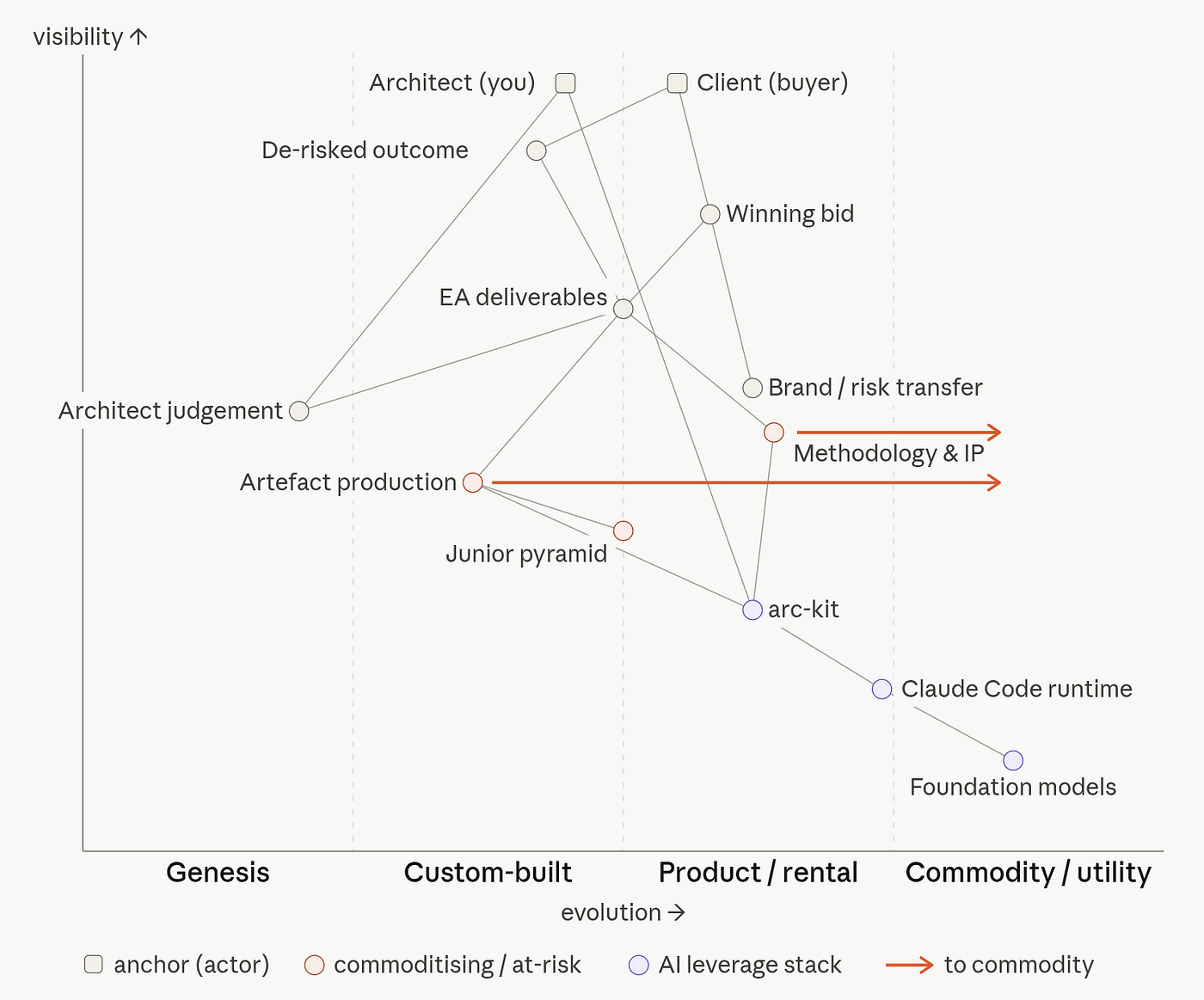
Put the value chain on a Wardley map and the shift becomes obvious. Artefact production has spent decades sitting in custom-built: labour-intensive, bespoke per engagement, the stage where scale wins. An AI-native enterprise architecture harness drags it rightward, toward commodity. The capability that used to require a pyramid of analysts, turning expert intent into consistent, voluminous, governed deliverables, becomes one expert operating a tool.
This is the part that matters strategically. When a previously scarce capability commoditises, the business model that monetised its scarcity is exposed. The junior pyramid is that monetised scarcity. It is labour arbitrage dressed as methodology. The moment a single architect can generate bid-grade and deliverable-grade artefacts at near-zero marginal cost, the economic logic of the pyramid stops working. Not because the juniors are bad, but because the scarcity they were sold against has evaporated.
ArcKit is a deliberate instrument of that commoditisation. It feeds off a leaf-node power source (foundation models, an agentic runtime, the toolkit on top) and it pushes the wave up the value chain into exactly the layers the Big Four charge for: production first, then methodology.
The Bundle Breaks
For thirty years the four things came bundled. You bought brand and methodology and production and bench in one purchase, because they were inseparable. You needed the pyramid to get the deliverables, and you needed the firm to get the pyramid. AI-native tooling unbundles that. It hands one credentialed person items one to three at the cost of a software licence, leaving only item four, trust, to be earned separately.
And item four is the one an experienced independent already owns a slice of. If your CV carries real programmes (chief architect roles, CTO mandates, authored policy, live clearances) then you arrive with BigFour-grade credibility already in hand. Combine that with BigFour-grade production via ArcKit, strip out the overhead, the bench cost and the partner margin, and you have the actual wedge: a credentialed individual who can now do, alone, the thing that used to require the firm.
That is what “becoming a BigFour” means in practice. Not hiring three hundred people. Unbundling the three hundred people.
What Stays Scarce, and Is Therefore the Whole Game
Here is the discipline the thesis demands of you, because it cuts both ways.
If ArcKit commoditises production for you, it commoditises it for everyone. The moment the whole market has the tool, production stops being a differentiator, including yours. A flawless deliverable is no longer a signal; it is table stakes. Competition reverts, hard and fast, to the two things that do not commoditise. Judgement, the calls only experience can make, the architecture decisions that don’t appear in any template. And trust, the track record, the relationships, the indemnity the buyer is really paying for.
So the tool is necessary and nowhere near sufficient. ArcKit gets you to parity on the machinery. It does nothing for the moat. The moat is you.
The Honest Part
Four things the deck won’t tell you.
Winning a bid is not delivering a programme. ArcKit lets you out-write a Big Four bid team on the design-and-bid phases. It does not give you two hundred bodies for a three-year delivery. The realistic model is the boutique that wins the thinking and the bid, then networks or partners for scale delivery, or that stays deliberately in high-value advisory and assurance and never pretends to be a systems integrator.
Trust is earned, not generated. The model produces a faultless-looking artefact. It cannot manufacture a track record. If you don’t already hold the credentials, the tool will not lend them to you.
Procurement is slow and rigged for incumbents. Frameworks lower the entry barrier and encode incumbency advantage in the same breath. Anyone who has worked inside public-sector buying knows this. Insurance thresholds, risk-aversion and panel structures are real friction, and they don’t care how good your deliverable is.
Commoditised production is a floor, not a ceiling. It stops you losing on capacity. It does not, by itself, win you anything.
The Play
Given all that, the move is not to out-produce the Big Four at their own game. It is to let the tool own the game they were winning, and climb above it.
Let ArcKit own production. You own judgement, assurance and the trust relationship, the parts that don’t commoditise and that the buyer was always really paying for. Then go one step further and productise the methodology itself. The reusable IP a firm keeps locked inside its walls is, in your hands, a thing you can package: a certified method, a hosted capability, an enterprise-support offer. That is how a boutique stops selling time and starts selling product, and it is the only route by which the going-concern value of a one-person practice climbs out of day-rate territory.
The Big Four’s moat was never the thinking. It was the manufacturing. The manufacturing just commoditised. What remains is judgement and trust, and if you have spent a career accumulating those, the firm’s last advantage over you has quietly disappeared.
Join the ArcKit Community
- Discord — real-time conversation, help with commands, and what people are building: discord.gg/UsfzrZmr
- LinkedIn Group — announcements, case studies, and longer-form discussion: linkedin.com/groups/17641034
- GitHub — code, issues, and contributions: github.com/tractorjuice/arc-kit
메타데이터
- post_id
- fb16ae21726a
- slug
- how-an-independent-architect-becomes-a-big-four-fb16ae21726a
- url
- https://medium.com/arckit/how-an-independent-architect-becomes-a-big-four-fb16ae21726a
- canonical_url
- https://medium.com/arckit/how-an-independent-architect-becomes-a-big-four-fb16ae21726a
- author_url
- https://medium.com/@mcraddock
- status
- ok
- fetched_at
- 2026-06-10 08:17:25