The Most Expensive Line of Code Is the One You Didn’t Delete
As software engineers, we’re often rewarded for building things.
The Most Expensive Line of Code Is the One You Didn’t Delete
As software engineers, we’re often rewarded for building things.
New features.
New services.
New abstractions.
New frameworks.
Writing code feels productive because it’s visible. Every commit adds something tangible to the project.
But after years of working on real-world systems, I’ve learned a different lesson:
Some of the most valuable engineering work comes from deleting code.
Not refactoring it.
Not optimizing it.
Not rewriting it.
Simply removing it.
The Hidden Cost of Every Line
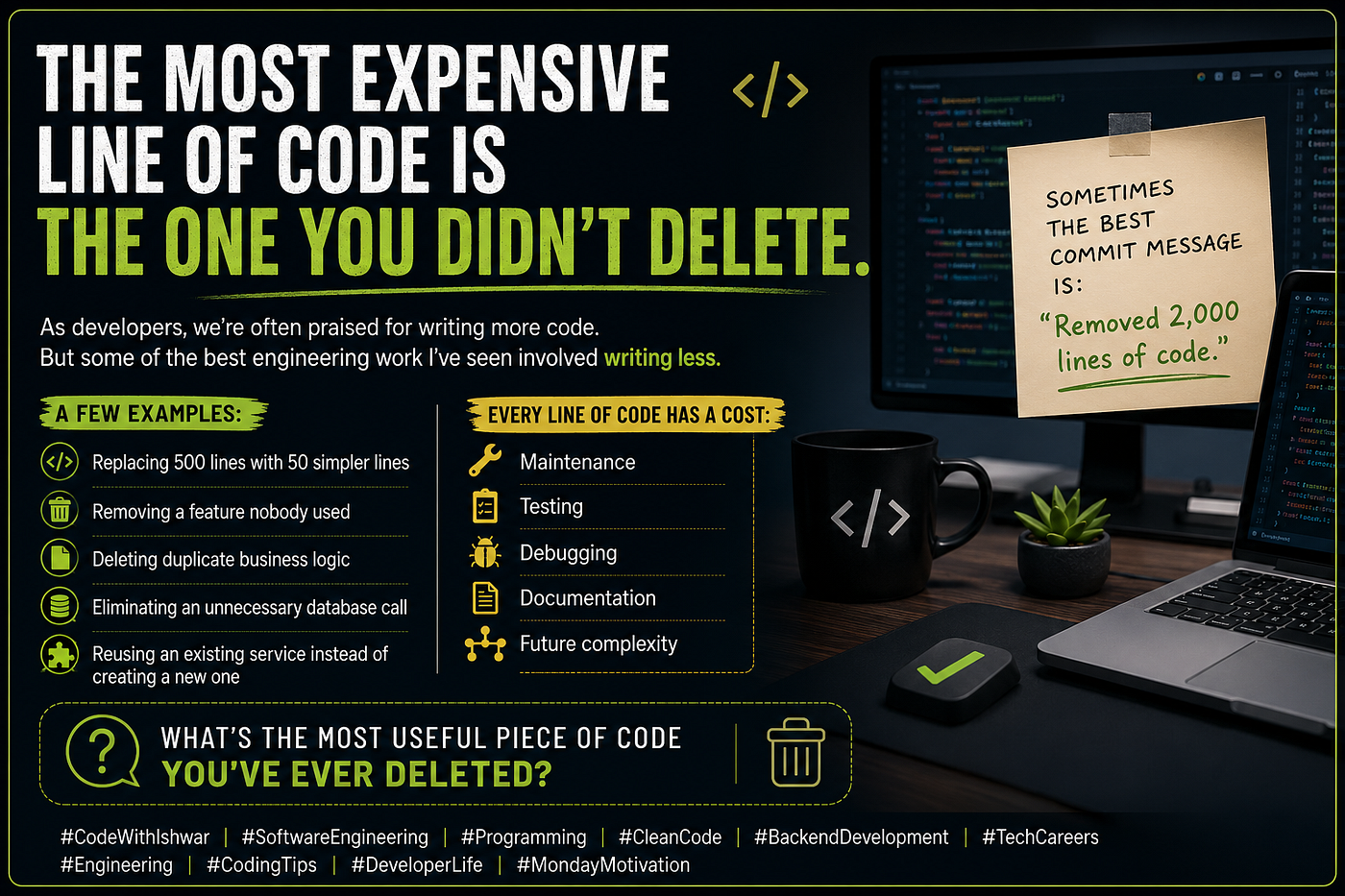
Every line of code we write comes with a long-term commitment.
Today, it solves a problem.
Tomorrow, it requires maintenance.
Eventually, it becomes something future developers must understand, test, debug, document, and modify.
The cost isn’t paid upfront.
It accumulates quietly over time.
Every additional line increases:
- Maintenance effort
- Testing complexity
- Debugging difficulty
- Documentation requirements
- Technical debt
This is why experienced engineers often think differently about code than beginners do.
Beginners see code as an asset.
Experienced engineers recognize that code is also a liability.
The goal isn’t to maximize the amount of code in a system.
The goal is to maximize the value delivered while minimizing unnecessary complexity.
Where Complexity Hides
Complexity rarely announces itself.
It grows slowly.
One helper function.
One extra abstraction.
One additional service.
One “temporary” workaround that becomes permanent.
Before long, a simple solution becomes difficult to understand and even harder to maintain.
I’ve repeatedly seen teams struggle with problems that weren’t caused by bad code.
They were caused by too much code.
Five Places Where Less Is More
1. Unused Features
Most mature applications contain features nobody uses anymore.
Yet teams continue maintaining them.
They fix bugs.
Update dependencies.
Handle edge cases.
Write regression tests.
All for functionality that provides little or no business value.
Removing unused features often creates immediate benefits:
- Smaller codebase
- Fewer bugs
- Reduced maintenance costs
- Faster development
Sometimes deleting a feature provides more value than building a new one.
2. Duplicate Business Logic
Duplicated code seems harmless at first.
Copy.
Paste.
Ship.
The problem appears months later.
One version gets updated.
Another doesn’t.
Now the same business rule behaves differently depending on where it’s executed.
The result is confusion, inconsistency, and difficult debugging sessions.
Removing duplication isn’t just about cleaner code.
It’s about preventing future problems before they happen.
3. Unnecessary Database Queries
Developers often focus on advanced optimization techniques:
- Caching
- Query tuning
- Index optimization
- Distributed architectures
Yet sometimes the biggest performance improvement comes from eliminating work entirely.
The fastest database query is often the one that never runs.
Removing unnecessary operations usually beats optimizing unnecessary operations.
4. Over-Engineering
Most developers have done it at some point.
Creating abstractions for future requirements that never arrive.
Introducing patterns where simple functions would work.
Building flexibility before it’s needed.
The intention is good.
The result is often complexity without value.
Software should be designed for today’s requirements while remaining adaptable for tomorrow — not built around hypothetical scenarios.
5. Excessive Layers of Abstraction
Abstractions are powerful tools.
Used correctly, they simplify systems.
Used excessively, they hide behavior behind multiple layers and make debugging frustrating.
If understanding a simple operation requires navigating through five services and three interfaces, the abstraction may be causing more harm than good.
The best abstractions reduce complexity.
The worst abstractions create it.
The Productivity Trap
One of the biggest misconceptions in software development is that productivity equals output.
More commits.
More pull requests.
More files.
More lines of code.
But software engineering isn’t a writing competition.
Nobody wins because they wrote the most code.
Users don’t care how many lines a feature required.
They care that it works.
They care that it’s reliable.
They care that it’s easy to evolve over time.
The best solution is rarely the one with the most code.
It’s the one that solves the problem with the least complexity.
My Favorite Commit Message
Over the years, I’ve seen countless impressive commits.
New architectures.
Major feature launches.
Complex performance optimizations.
But one of my favorite commit messages was incredibly simple:
Removed 2,000 lines of code.No new framework.
No revolutionary design.
No clever algorithm.
Just less complexity.
The application became easier to understand.
Easier to test.
Easier to maintain.
And ultimately, more reliable.
The Best Engineers Simplify
Great engineers don’t just build systems.
They simplify them.
They remove friction.
They reduce complexity.
They eliminate unnecessary work.
And they understand an important truth:
Every line of code should justify its existence.
The next time you’re working on a problem, pause before adding another abstraction, service, or helper class and ask yourself:
Can I remove something instead?
You may discover that the most valuable code you’ll ever write is the code you’ll never have to maintain.
Key Takeaways
- Every line of code has a long-term maintenance cost.
- Simpler solutions are often more reliable and easier to evolve.
- Removing unused features can create immediate value.
- Duplicate logic increases future bugs and inconsistencies.
- The fastest code is often the code that never executes.
- Great engineers focus on reducing complexity, not increasing it.
What’s the most useful piece of code you’ve ever deleted?
I’d love to hear your experience in the comments.
#CodeWithIshwar 🚀
메타데이터
- post_id
- fc2a8f4c4e8b
- slug
- the-most-expensive-line-of-code-is-the-one-you-didnt-delete-fc2a8f4c4e8b
- url
- https://medium.com/@codewithishwar/the-most-expensive-line-of-code-is-the-one-you-didnt-delete-fc2a8f4c4e8b
- canonical_url
- https://medium.com/@codewithishwar/the-most-expensive-line-of-code-is-the-one-you-didnt-delete-fc2a8f4c4e8b
- author_url
- https://medium.com/@codewithishwar
- status
- ok
- fetched_at
- 2026-06-09 14:34:10