Jungian Psychology & Music: Why Names Matter
Between the Darkness of Rap, Taylor Swift’s shiny Eras & Lady Gaga’s Chihiro-complex
Jungian Psychology & Music: Why Names Matter
Between the Darkness of Rap, Taylor Swift’s shiny Eras & Lady Gaga’s Chihiro-complex
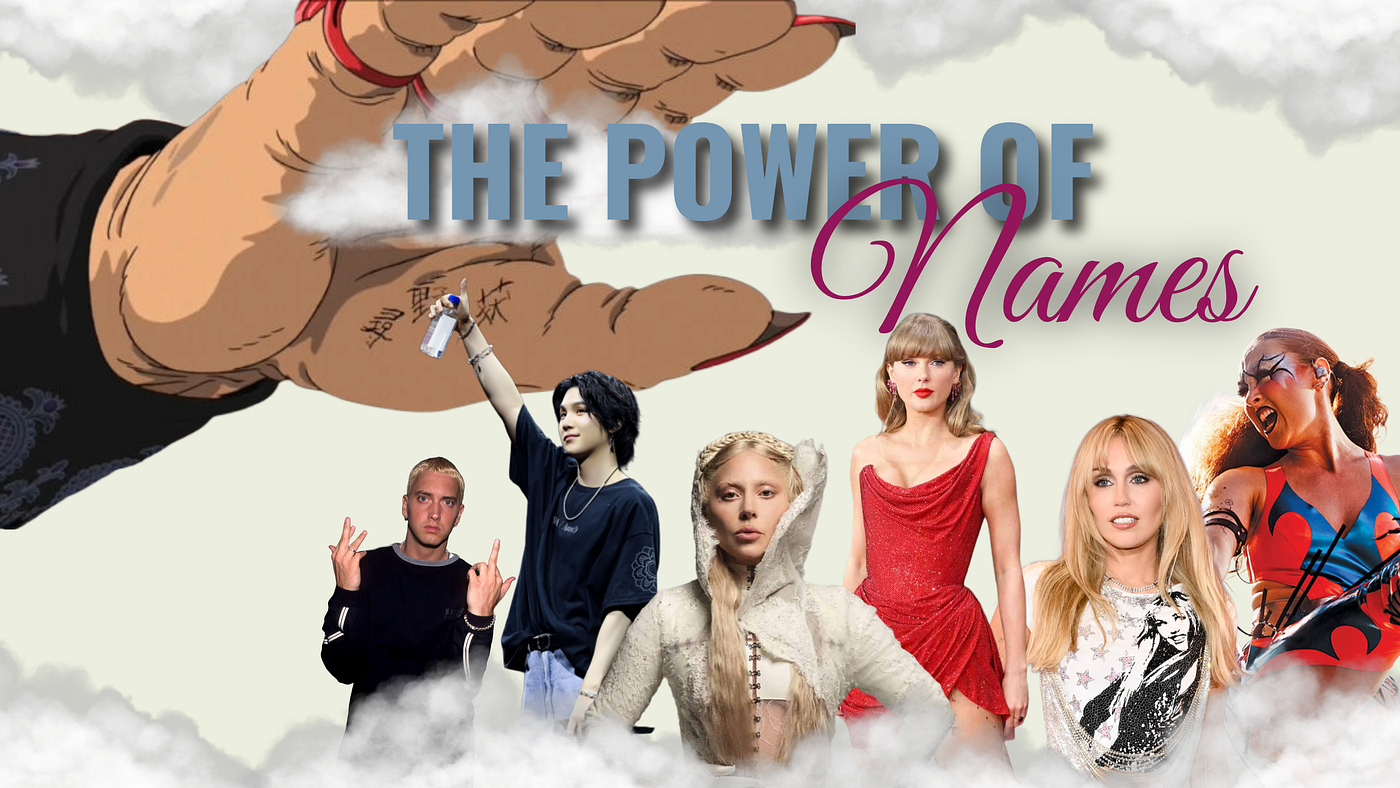
Thumbnail created by author
“Take good care of your name,” says Zeniba to Chihiro, as she sends her to slay her sister. In the world of “Spirited Away”, names are the only ticket out of the spirit’s realm, tucked away across a river in the Japanese countryside. Her name is Chihiro’s only way to return home and release her greedy parents from the spell that turned them into pigs.
What a fantastical story. So meaningful and symbolic, because no one truly forgets their name. That is a mere fairytale, it seems. It is, however, quite plausible for us to forget who you are.
Names are a manifestation of personality in letters and ink, and in our brains, they hold far more importance than a word. As a speech therapist and expat, I know the power of names quite well, especially since my own name is a puzzle of its own.
So let me take you on a ride into the Jungian psychology behind my favorite artist’s names, because they are far more than a simple marketing scheme.
My struggle with my names
Ironically, I share much of Chihiro’s journey.
When I moved to Taiwan three years ago, I got a new name, given to me by my university: Hannah Kao, or in Chinese 高漢娜. Truthfully, I felt reborn, which was partially due to the fact that, like an infant, I couldn’t write my own name for a little bit. It was an experience I didn’t expect to hold so much weight in my life.
I have had three names in my life so far: my mother’s maiden name (though only for a short while), my father’s family name (which is a whole other debate as a feminist) and finally a name in an unfamiliar language that I, yet again, didn’t choose for myself.
In a way that appears to be one of the plights of the female lived experience that Jung didn’t consider: Women are most frequently given names and traditionally are also the ones to be forced to change them. Oh, the irony.
Only a few months ago, when I moved to Korea, did I dare to give myself my own name, for the first time: Hannah Jung (or Jeong, depending on the Romanization) or 정한나 in Korean.
Why Jung?
Because I needed a Korean family name that would help me to fit in, yet be meaningful for my new documents, and I wanted to choose my own name for the first time. I am well aware now, not only as a feminist, of the importance names can hold, and I always strive to learn cultures by trying to integrate, as best as I can.
Jung was perfect, because while it is meaningful in Korean, it also traces back to my favorite psychologist in German, my mother tongue: Carl Jung, the man who mapped the subconscious.
With this new name, I am entering a new era of myself, much like Taylor Swift, and I cannot help but find that she, among other artists, is a true genius in how she applies personality. But let me begin my guided tour through the subconscious of names where all things start: In the dark.
Shadow-work and Eminem
Given the spikey nature, heavy lyrical critique, and heavy beats, it is no surprise that rap artists love to play with the idea of their alter ego through names. They often tend to emphasize “the shadow,” as Jung would call it, which is sometimes broken down to being “the evil part” inside us.
But that is far too simple.
“The shadow” in our personality really is the part we hide away, not because it is generally bad, but oftentimes simply because it makes us uncomfortable. It is either not aligned with the norm-culture surrounding us, which makes it uncomfortable in social settings, or it runs contrary to the narrative we tell about ourselves, which is even more uncomfortable.
As such, it has an important function: It is a barometer for alignment on one’s life-path, and following it means finding those parts of yourself that you or your surroundings are uncomfortable with. The shadow can sometimes rear its ugly head when we have strayed far from living a life that is healthy for us in search of comfort.
One person who found gold in their shadow is Eminem, in his shadow-personality “Slim Shady”.
[embed]“The Real Slim Shady” by Eminem via Spotify
As Slim Shady, Eminem likely didn’t rap “better” than before, but by letting the dark in, he became open and aggressive in a way that caught attention. Showing other parts of your personality often evokes strong reactions because it is a vulnerable and thus shocking thing to do.
Slim Shady is what made Eminem famous, as he became more confessional than ever, stopped caring about the rules, and became more and more aggressive in his rapping. This was good for the arts, but it did eventually touch on his personal life when Slim Shady started showing up in his real life, leading him to several cases of breaking the law.
This is the danger for artists who let their shadow roam publicly: At some point, the ego, the conscious part of our psyche, is overpowered by shadows, leading to a role-confusion of who really is in the driver's seat.
Eminem let his Shadow, Slim Shady, enter from the subconscious into the conscious, until it started taking up his ego. A long recovery process followed. But “shadow-work”, as dangerous as it might seem, can also be done safely, and the rapper Agust D shows how.
The Amygdala & Agust D
Agust D is the shadow persona of Suga, the rapper from BTS whose real name is Min Yoongi. His psychological worldbuilding is far more advanced than the invention of Slim Shady, though he certainly took inspiration from both Eminem and Jung.
Min Yoongi is known as one of the more introverted, dark characters in BTS, and millions of fans followed his healing process through his persona Agust D.
Literally, Agust D is the inversion of his stage name Suga, adding the letters “DT”, which is an acronym for his hometown, Daegu, often labelled “D-Town” in the rap underground scene, in which he grew up. This letter-joke is a first artefact of how seriously Min Yoongi takes his personas.
[embed]Link to “Haegum” by Agust D via Spotify
In his solo projects as Agust D, Min Yoongi is darker, more depressive, and more confessional than in his BTS appearances. As a producer who is very fond of his Korean heritage, his songs like Haegum play with the same mirrors in meaning and words as his name suggests.
The word 해금 (Haegeum) refers simultaneously to either a traditional Korean instrument or, written in traditional Chinese characters (解禁), it translates directly to “lifting a ban” or unblocking something that was previously forbidden.
Thus, he cleverly nudges to the past as he calls for liberation and freedom of expression in the future.
But my favorite Agust D psychology-nugget is the song Amygdala, which is named after an almond-shaped brain area in the limbic system that is connected to the control of emotions. At the same time, an “amygdala shock” is quite literally the opposite of emotional control. It is caused by an extreme emotional trigger that leads to the Amygdala bypassing the prefrontal cortex, which is associated with reasoning.
An amygdala shock thus floods your body with hormones and emotions that are irrational, often as a trauma response.
[embed]“Amygdala” by Agust D via Spotify
In the song *Amygdala*, Min Yoongi writes down his most traumatic experiences, like his mother’s heart surgery, his motorcycle accident, and his father’s liver cancer, as he curses his amygdala for setting him into shock mode. He sings “my amygdala, please save me, please let me out”, both calling for help and fighting himself.
And this is precisely where Agust D takes the idea of Slim Shady a step further: Not only does he allow his shadow to surface from the subconscious into his art, but he uses the necessary vocabulary to keep holding the reins.
Agust D is allowed to curse and swear and protest openly and bleed onto the lines of his lyrics in a way that Suga can’t, but he doesn’t externalise the problem into his real life. In other words, he doesn’t blame others for his pain in a hurtful way, but uses art as a canvas to express things he can’t keep hidden anymore. This prevents him from eventually turning into a criminal through his shadow, as Eminem did.
Actually, Suga has spoken openly about using Agust D as his healing journey. Agust D still exists on Spotify for all those fans who need him to give sounds to their pain, but Suga has announced that he is retiring his shadow, Agust D.
This was a beautiful signal to BTS ARMY, as it was a tangible artefact that Min Yoongi, the man behind the shadows and persona of Suga, was healing.
All in all, Min Yoongi is a true musical artist who wields public personas expertly by giving the public access to other parts of his self intermittently. But there is one woman who has been playing personas like a card game, and her name is Lady Gaga.
Lady Gaga & Sticky Masks
Jung describes the persona as part of the conscious human personality. It is also often referred to as “masks” we wear in society, or “roles” that we take on in different settings. As such, personas are a favorite tool of artists to reflect inner workings onto their audience in a sometimes eccentric way.
And at times, Lady Gaga is exactly the eccentric Mayhem she has titled her album after.
She is now known to be an activist for the LGBTQ+ movement, but she will always be burned into my visual cortex as the alien from *Born This Way* and the woman wearing a meat dress.
[embed]Video for “Born this Way” by Lady Gaga via YouTube
After her recent success with her album Mayhem, she did an interview with the New York Times, in which she openly admitted to having lost herself in her craft of impersonation.
As she strove to turn from an Alien, to a country singer, an Icon at the Paris Olympics, and a poker-faced superstar, she used the red carpet as her expressive canvas and herself as the brush that continued to be worn out. This is a story that, in many ways, parallels Eminem.
She said that now, she sees herself more as an artist again who crafts sounds with her partner and producer. She had lost herself in her self-expression until she eventually forgot who she really was. Instead of the subconscious shadow becoming too large, her conscious mask or persona got a bit too sticky.
The demons she invented to be expressive, earning her praise, eventually developed a taste for oxygen.
Which leads to one sad constant narrative that is perpetuated across visual and audible arts alike: The idea of the crazy artist. The genius gone mad.
It is often said that chaos, insanity and mayhem, if you will, breed creativity in a way that order can’t. Lady Gaga argues against this narrative in her interview because, as she says, her art in devastation wasn’t actually better than that made in a healthy state.
And I agree. All humans need whole and healthy brains to create the best art, be it music or visuals.
The kernel of truth is that chaos feeds creativity, and “crazy” is a word we use to describe novel things. Thus, a creative act, like music, runs on just enough chaos to be sorted by a crazy artist, who actually was just a person dealing with something perfectly normal in a novel way: Their own psychology.
Crafting Personas & Personality Art: Taylor Swift
And in this process of sorting the chaos into clarity, the best crazy person there is to understand the beauty of personas in music must be Taylor Swift.
She and her Eras are not just a perfect expression of variable personas and masks that she puts on for each of her albums, but she even managed to bring the term “era” into the public discourse.
Now, GenZ constantly talks about being in their “xy Era”, which is really just a way to state the current state, role, or obsession one is currently in pursuit of. I think if Jung heard of Taylor Swift’s eras, he would call them the individuation process. This is the psychological process of maturation that all of us are on, until our puzzle of conscious and subconscious parts is mostly overlapped.
Taylor is a special example of dealing with her personas, as she is one of the few artists who took ownership of their older eras early on, allowing her to reflect on her past selves in a way that few are able to.
Of course, I am referring to the “Taylor’s Versions” or re-recordings of her older albums, before she could buy back the masters of those albums. A specifically visual reclamation of these versions of Taylor happens in the last shot of the music video for Look What You Made Me Do on her Reputation album.

Final shot from the music video “Look what you made me do” by Taylor Swift via YouTube
Reputation could be called Taylor’s shadow work after she faced public backlash, yet again, and turned into a mummy and snake lady, alongside other horrifying images, that were so contrary to her earlier country-girl days.
In these last seconds of her music video from 8 years ago (thus quite a few Eras have been added since), all her personas are lined up and are engaging in a discussion. This showcases perfectly how aware Taylor is of all the versions of herself that are out there, and yet she has the grace and humor for all of these past versions not to get absorbed by any of them or curse them.
Rather, she acknowledges that they are all part of herself, which perpetuates an idea that many of us are challenged by: Humans are ever-changing and multifaceted, as much as we like to stick things into neat little boxes.
Miley & Chappell: Artist Names or Artists with Names?
In returning to the premise of this article, the psychology of names, there is one recent star on the “Walk of Fame” that is known to be the best of both worlds, while also having seen the worst of either: Miley Cyrus.
Recently, Hannah Montana, the old Disney Channel public persona of Miley Cyrus that transported her right from my TV screen into my heart, celebrated her 20th anniversary.
It is safe to say that Miley went through ebbs and flows with the character of “Hannah Montana”. Maybe because this was less an “era” she could revisit and more of an entire separate character that was not malleable, completely separate from Miley and superimposed upon her as a young girl.
In the early 2010s, Miley fought the image of Hannah Montana, first through simple defiance, then through revenge and causing public uproar. Her song *Can’t Be Tamed* was a first nudge at showing the public who was below the blonde wig, as she presented herself as a dark bird inside a cage at the museum under the name Avis Cyrus.
Again, this is a play at the idea of the shadow, in this case performed by an artist who felt her true self to be merely the dark shadow of the wig she wore publicly, which covered Miley and was called Hannah. She sings “I’m not a mistake, I’m not a fake, it’s set in my DNA. Don’t change me, I can’t be tamed.” as she dances a choreography somewhere between Lady Gaga’s Poker Face and Michael Jackson's Thriller.
[embed]Music video for “Can’t be Tamed” by Miley Cyrus via Spotify
But with her album Bangerz and especially Wrecking Ball, the image of life in 2 worlds finally shattered. And the public didn’t take that lightly on her.
In recent interviews, she tells that story very vulnerably, how she almost lost it all. People tried to ban her music, wrote complaints, and acted as if Miley showing herself beneath the wig was an insult to them personally.
It is almost like the inversion of Slim Shady taking over Eminem, because the mask of Hannah Montana was so insanely out of touch with Miley herself that her ego became the shadow. And in her struggle to prove who she really was, the public rejected her.
But there is hope, because the next generation seems a little more cautious of the power of names: On the 20th anniversary special of Hannah Montana, Miley Cyrus appears healed and sat down with Chappell Roan for a short talk.
Chappell thanked Miley for showing her how to live with a persona as a female artist, how to craft a personality on stage, and what the struggle between personal and public names can look like.
Chappell Roan’s own rise to fame is marked by her starting to perform as a drag performer on stage, which gave her the visual and audible audacity and individualism she needed to be recognizable.
Her real-life name, Kayleigh Rose Amstutz, would have likely never carried her to such heights. This is the main hinge that the psychology of names operates on: A name for artists is a great way to separate roles from one another, the shadow from the ego, and the persona from the real person. It is similar to how we like to keep work and life separate and embody different roles in different situations.
But there is always the risk that the new persona overpowers the real ego or that we start cosplaying other personalities rather than living more truly, inside our own minds.
Chappell Roan’s fans, for instance, draw a clear line between Chappell and Kayleigh, and she herself also makes this clear in interviews. She refers to Chappell as her stage persona, her drag identity, and frequently labels it as her “project”. In a way, stepping into “Chappel” for her is like taking a seat in her office chair at work, which is a very healthy dynamic.
It is important to be the agent of one’s names, labels, or personalities, and maybe Chappell can be the light at the end of the tunnel where even the public can no longer ignore that their artists have more than one side. And thus, more than one name.

메타데이터
- post_id
- fc943fe427c8
- slug
- jungian-psychology-music-why-names-matter-fc943fe427c8
- url
- https://medium.com/music-for-thought/jungian-psychology-music-why-names-matter-fc943fe427c8
- canonical_url
- https://medium.com/music-for-thought/jungian-psychology-music-why-names-matter-fc943fe427c8
- author_url
- https://medium.com/@hannahscafe
- status
- ok
- fetched_at
- 2026-07-16 12:44:52