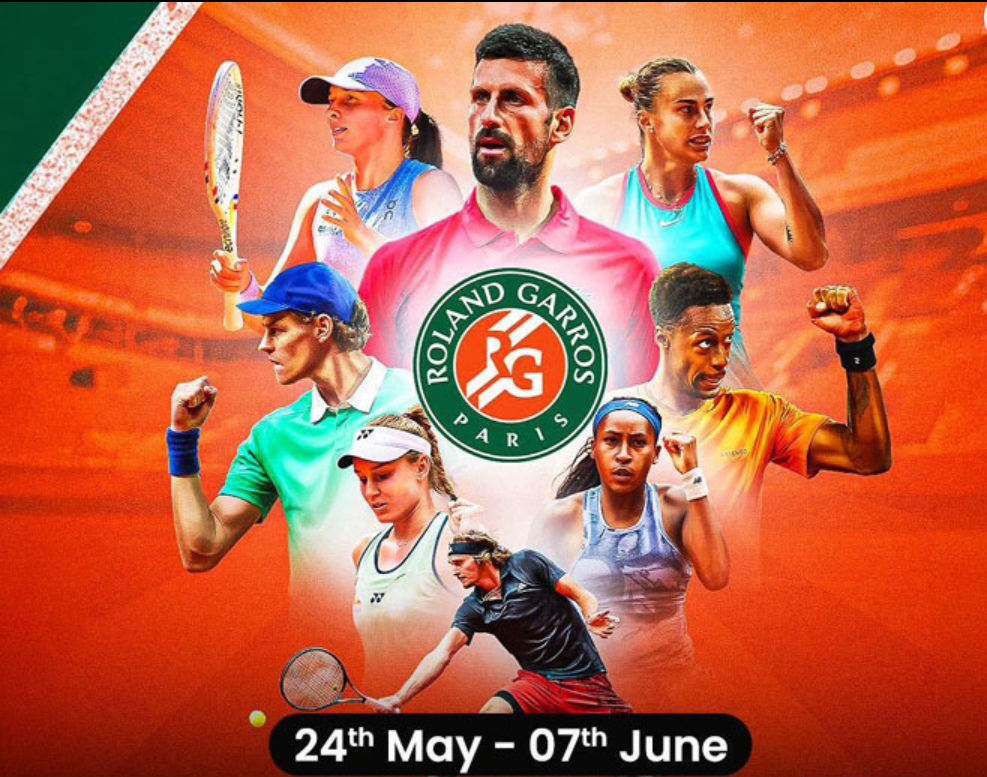
10 Storylines That Will Define Roland Garros 2026
French Open 2026 preview, Roland Garros storylines, Sinner career Grand Slam, Djokovic 25th Slam, Monfils farewell, Wawrinka final Roland…
10 Storylines That Will Define Roland Garros 2026
French Open 2026 preview, Roland Garros storylines, Sinner career Grand Slam, Djokovic 25th Slam, Monfils farewell, Wawrinka final Roland Garros, WTA French Open predictions.
I’ve been staring at this draw for two days. Flipping between the men’s and women’s brackets, circling matches, crossing them out, circling different ones. And the thing I keep coming back to is this: for the first time in years, nobody controls Roland Garros.
The defending men’s champion is home with a wrist brace. The women’s No 1 could barely move in Rome two weeks ago. Two of the greatest entertainers the sport has produced are playing their last matches in Paris. And the man everyone expects to win? He was three points from lifting this trophy 12 months ago and watched all three disappear.
Here are the 10 stories I’ll be watching. Some of them are obvious. A few of them aren’t. All of them matter.
1. Sinner and the Three Points That Won’t Leave Him Alone
I need to start here because everything else at this tournament orbits around it.
Last June, Jannik Sinner served at 5–4, 40–0 in the fourth set of the final. Three championship points. The career Grand Slam was one swing away. Carlos Alcaraz saved all three, won 13 of the next 14 points, and took the fifth-set tiebreak 10–2 after five hours and 29 minutes. The longest final in Roland Garros history. The most painful loss of Sinner’s career.
He’s back. Alcaraz isn’t. The draw has put him in the opposite half to Djokovic. He opens against a French wildcard. He’s 17–0 on clay this season, owns six consecutive Masters 1000 titles, and completed the Career Golden Masters three weeks ago in Rome. On paper, this is the most lopsided favourite Roland Garros has had since Nadal in 2010.
But paper doesn’t play tennis. And as someone who has competed at a professional level, I can tell you — three saved championship points don’t just leave your body. They live somewhere in your hands. In your breathing. In the way you hold the racquet at 40-all in the fifth set. Sinner will feel them on Chatrier. Whether they sharpen him or freeze him is the question that defines this tournament.
If he wins, he becomes the first Italian man to lift the Coupe des Mousquetaires since Adriano Panatta in 1976. Fifty years.
2. Djokovic. Because It’s Always Djokovic.
One match on clay this season. One. A first-round loss in Rome to Dino Prizmic. Three tournaments all year. He told the press his preparation is “not ideal” and he’s “not where I want to be.”
I’ve heard this before. We all have. And then he wins the tournament.
I’m not predicting that this time. His body is 38 years old and it shows. But Djokovic is in the opposite half from Sinner, which means a potential final, and he opens against Giovanni Mpetshi Perricard — a 6'8" French wild card with one of the biggest serves on tour. If he survives the first week, he could find a level that nobody else in his half can match over five sets. He’s done it at every stage of his career when people wrote him off.
The man practised tennis in a swimming pool during NATO bombings. Writing him off based on a few bad weeks has been the most reliably wrong prediction in the sport for 20 years.
3. Fils is Out — And French Tennis Just Lost Its Heartbeat
This one hurts. Arthur Fils withdrew on Saturday with a hip injury, and Roland Garros just lost the storyline it needed most.
He was supposed to face Stan Wawrinka in the first round. The 2015 champion playing his final Roland Garros against France’s best hope for a men’s title since Yannick Noah won it in 1983. One career ending, another one begging to begin. The kind of match that writes itself.
Instead, Fils sat in front of the press and said what nobody wanted to hear: the hip was bothering him since Rome, he hadn’t hit a single point in two weeks, and he wouldn’t be stupid about it the way he was last year, when a premature return cost him eight months with a stress fracture. He’s 21 and he’s already withdrawn or retired from six of his last eight Grand Slam appearances. That pattern is becoming a story of its own — and not the kind anyone wants to read.
Wawrinka now faces Dutch lucky loser Jesper de Jong, ranked 109th. The emotional texture of the match has completely changed. Instead of the generation-defining clash Paris was dreaming about, Wawrinka gets an opponent nobody in the stadium will recognise — which means the crowd’s entire energy will be pointed at one man. Court Philippe-Chatrier is the largest clay court in the world. Fifteen thousand seats. And on Monday, every single one of them will be watching a 41-year-old with a one-handed backhand try to win one more match before it’s over. If he does, he gets a second round on Chatrier with a crowd that isn’t ready to let him go. If he loses, to a lucky loser, in his final Roland Garros… I can’t even finish that sentence.
4. Monfils’ Last Dance
This one is personal for me, and if you’ve been following the Rome coverage on this blog, you’ll know why.
Gaël Monfils already had his farewell evening on Chatrier — “Gaël & Friends,” with music, guests, and 15,000 people watching the most electrifying showman in tennis say goodbye to his home court. But the real goodbye comes when he plays his final singles match, which the tournament has confirmed will be scheduled on Chatrier with a tribute ceremony afterwards.
His own words last month: “Roland-Garros… my last Roland-Garros. It’s strange to write, but it’s the reality.”
While Monfils says goodbye, his wife Elina Svitolina is in the women’s draw chasing the Grand Slam title she’s never won. Their daughter Skaï is at home, believing — as she always does — that every parent plays professional tennis. One career ending. Another one peaking. Same family. Same tournament.
5. Svitolina Wants This Slam. She’s Just Stopped Strangling Herself Over It.
I wrote about Svitolina extensively after Rome, so I won’t repeat everything. But here’s what matters for Paris. She’s 31, seeded 8th, 29–7 on the year, and 8–0 in clay-court finals. She just beat Rybakina, Świątek, and Gauff in consecutive matches. Of course she wants a Grand Slam title. Every professional tennis player does. Anyone who tells you otherwise is lying or retired.
But something has shifted in how she carries that desire. After her Australian Open semifinal loss earlier this year, she said the question of whether she’d ever win a Slam used to eat at her. Before motherhood, it was a sensitive topic — the gap on her resume that defined every conversation. Now, she said, she’s made peace with the possibility that it might not happen. Not because she doesn’t want it. Because she’s stopped letting the wanting consume her.
That distinction matters on clay. This surface punishes desperation. It punishes players who press, who force, who try to end points before they’re ready to be ended. And it rewards exactly what Svitolina does best: absorb, redirect, extend, and wait for the opponent to crack first. She doesn’t overpower you. She outlasts you. And at Roland Garros, where rallies stretch past 20 shots and the pressure builds like a slow tide, that game is built for this place.
Her husband Monfils is saying goodbye at this same tournament. Their daughter Skaï is at home. The emotional weight of this fortnight, for this family, is unlike anything else in the draw. And Svitolina has shown all year that emotional weight doesn’t slow her down anymore. It steadies her.
I’m not saying she’s the favourite. I am saying I wouldn’t want to face her in a quarterfinal.
6. The Sabalenka Question
Aryna Sabalenka is the №1 seed and nobody is picking her to win.
Think about how strange that is. Five Grand Slams. The most dominant hard-court player of the past three years. She reached this final last year, beating Zheng Qinwen and Iga Świątek before losing to Gauff. But she’s 4–2 on clay in 2026, battled back and hip problems through Madrid and Rome, and lost to Sorana Cîrstea in the third round in Rome — her quickest defeat of the season.
Chris Evert nailed it: clay resists the instincts that made Sabalenka great. She can’t end rallies short. She needs more ball tolerance. On hard courts, her pace rushes opponents into panic. On clay, they have an extra second to recover, reset, and redirect. Greg Rusedski pointed to something more specific — the Dunlop ball used in Rome and Madrid, which is heavier and slower and harder for power players to hit through.
She says she’s 100% now. Maybe she is. But here’s the thing about Roland Garros: it doesn’t reward players who arrive healthy. It rewards players who arrive patient. And patience has never been Sabalenka’s game.
7. Gauff’s Serve, Gauff’s Problem
Coco Gauff is the defending champion and she arrives with something she didn’t have a year ago: a serve.
That sounds reductive. It isn’t. In Rome, she committed only one double fault in two of her matches. One. For a player whose serve was once her most glaring weakness — the yips at the US Open, the double-fault spirals in big moments — that’s a transformation, not an adjustment.
But there’s a problem named Svitolina. Three losses this season. Three times Svitolina has found the same tactical blueprint: extend rallies, absorb pace, wait for the forehand to misfire. Gauff knows the pattern. She said in Rome her game is heading in the right direction but there are moments to fine-tune.
The question isn’t whether Gauff is good enough to win Roland Garros. She won it last year. The question is whether she’s solved the one opponent who keeps proving she hasn’t quite figured everything out yet.
8. Świątek’s Quiet Return
Four French Open titles. A 26-match winning streak at Roland Garros before Sabalenka ended it last year. Nobody has dominated this tournament in the modern era the way Iga Świątek has.
But 2026 has been rough. She changed coaches — hiring Francisco Roig, who used to work with Nadal — and the tactical adjustments are still settling. She’s admitted publicly that her confidence has taken a hit. In Rome, she lost to Svitolina in the semis after showing flashes of her best level.
Here’s what I keep reminding myself: Świątek on clay at Roland Garros is a different player than Świątek anywhere else. The topspin forehand that kicks up to shoulder height. The court coverage that makes opponents feel like they’re hitting into a wall. If she finds that level by the second week, nobody — and I mean nobody — will want to be across the net from her.
9. The Kids
Two teenagers. Both seeded. Both capable of blowing up a quarter.
Joao Fonseca is 19, Brazilian, seeded 28th, and plays tennis like he’s been at the top for a decade. Explosive off both wings, fearless shot selection, the kind of energy that makes a crowd pick sides immediately. He’s in a quarter with Daniil Medvedev and could genuinely produce the upset of the first week.
Mirra Andreeva is 19, Russian, seeded 5th, and reached the Roland Garros semifinals in 2024 when she was 17. She pushed Gauff to three sets in Rome. Her ceiling might be the highest in the entire women’s draw.
These two won’t win the tournament. Probably. But they’ll produce at least two matches that everyone’s talking about, and within three years, one of them will be the favourite at a Grand Slam. Write those names down.
10. Everything Else That Matters
The details that don’t fit neatly into a storyline but deserve your attention.
On May 26, Roland Garros will mark 70 years since Althea Gibson became the first woman of colour to win a Grand Slam singles title by winning the French Open in 1956. There will be a formal ceremony.
Caroline Garcia, who retired after the 2025 US Open, returns pregnant for a tribute between the women’s semifinals on June 4.
For the first time at any Grand Slam, players can wear connected performance devices — Whoop bands and the like — during matches. Roland Garros is also the only remaining major with human line judges, after Melbourne, London, and New York all switched to electronic line calling.
The prize fund is €61.7 million. First-round losers earn €87,000. And yet the biggest off-court story is the players’ protest: Sinner, Sabalenka, and Gauff are all limiting press conferences to 15 minutes in response to what they say is an unfair split of Grand Slam revenue. Even the arguments at Roland Garros are about endurance.
I’ve covered this sport for a long time. Played it even longer. And I can’t remember the last time I looked at a Grand Slam draw and genuinely didn’t know what was going to happen.
Sinner should win. Djokovic might refuse to lose. Wawrinka and Monfils will break our hearts on the way out. Svitolina might finally get her moment. Sabalenka might prove everyone wrong. Świątek might remind us who owns this place. And somewhere in the second week, a teenager will do something that makes the entire tennis world sit up straight.
The clay is ready. I don’t think any of us are.
Beyond The Baseline covers tennis match analysis, player stories, legends & legacy, rising stars, ATP/WTA coverage, and the game beyond the scoreboard. Follow for weekly insights.
메타데이터
- post_id
- fcdb5f74d2a8
- slug
- 10-storylines-that-will-define-roland-garros-2026-fcdb5f74d2a8
- url
- https://medium.com/@kartikib87/10-storylines-that-will-define-roland-garros-2026-fcdb5f74d2a8
- canonical_url
- https://medium.com/@kartikib87/10-storylines-that-will-define-roland-garros-2026-fcdb5f74d2a8
- author_url
- https://medium.com/@kartikib87
- status
- ok
- fetched_at
- 2026-06-09 15:37:30




