Can the Area of a Circle Ever Be π?
How Much Do You Really Know About Circles?
Can the Area of a Circle Ever Be π?
How Much Do You Really Know About Circles?
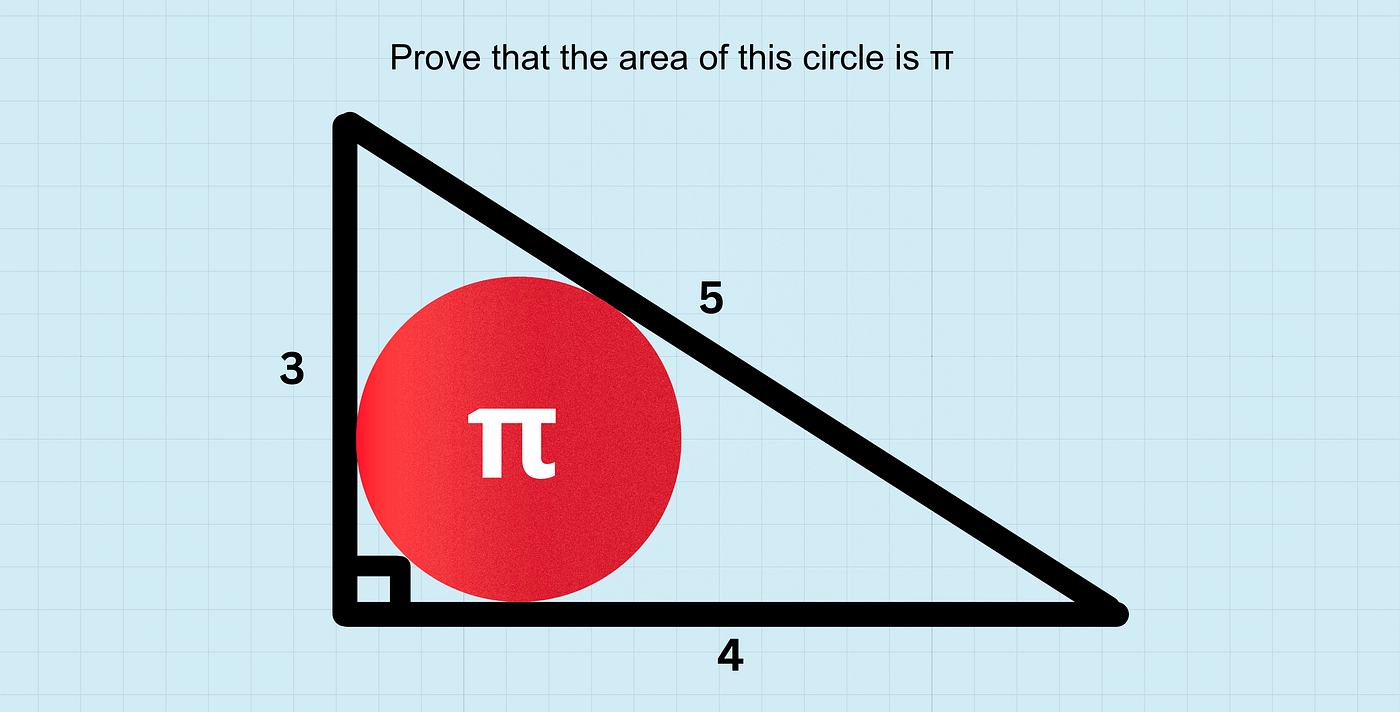
Image by the author
One thing you might immediately think of is that the area of a circle is πr².
That means if this circle really has an area of π, then its radius must be exactly 1.
So the real challenge isn’t finding the area — it’s proving that the radius is 1.
Fortunately, the diagram gives us an important clue. The circle touches all three sides of the triangle, making it the triangle’s incircle.
A useful property of circles is that the radius drawn to a point of tangency is always perpendicular to the tangent line. So, if we draw a radius from each point of tangency, all three radii meet at the center of the circle.
That gives us exactly what we need to begin the proof.
But before we begin, take a moment to study the diagram. How would you approach this problem?
Let me know your thoughts in the comments.
To begin, draw a radius from each point of tangency to the center of the circle.
Since a radius is perpendicular to the tangent at the point of contact, each of these three radii is perpendicular to one side of the triangle.
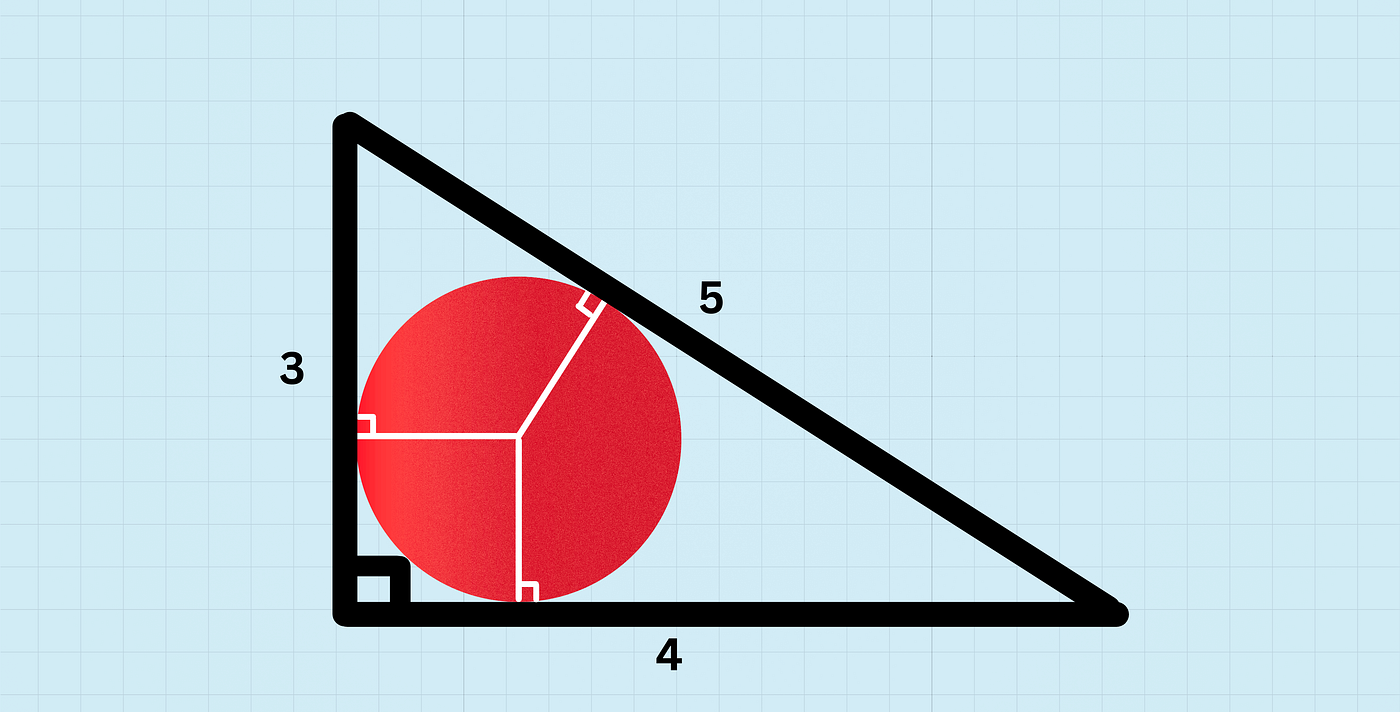
Image by the author
Now, notice the small square formed at the bottom-left corner of the triangle.
Each side of this square has length r because every segment from a point of tangency to the center of the circle is a radius.
This means the base is split into two segments of lengths r and 4−r, while the vertical side is split into segments of lengths r and 3−r.
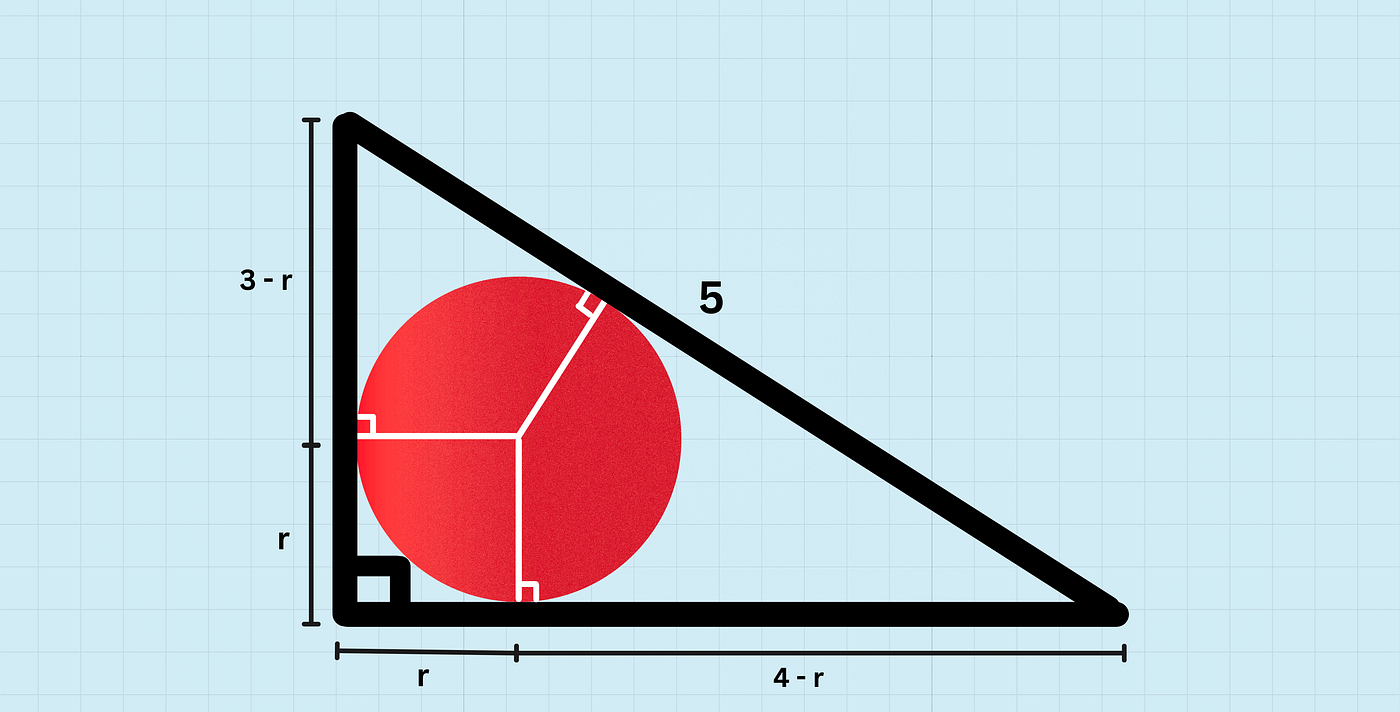
Image by the author
Cool!
Now, let’s apply an important theorem in circle geometry — the Equal Tangent Segments Theorem.
This theorem states that if two tangent segments are drawn from the same external point to a circle, then the two tangent segments are equal in length.
In our diagram, the top vertex is an external point from which two tangent segments are drawn: one along the vertical side of the triangle and the other along the hypotenuse.
Since these tangent segments are equal, the segment on the hypotenuse adjacent to the top vertex also has length 3−r.
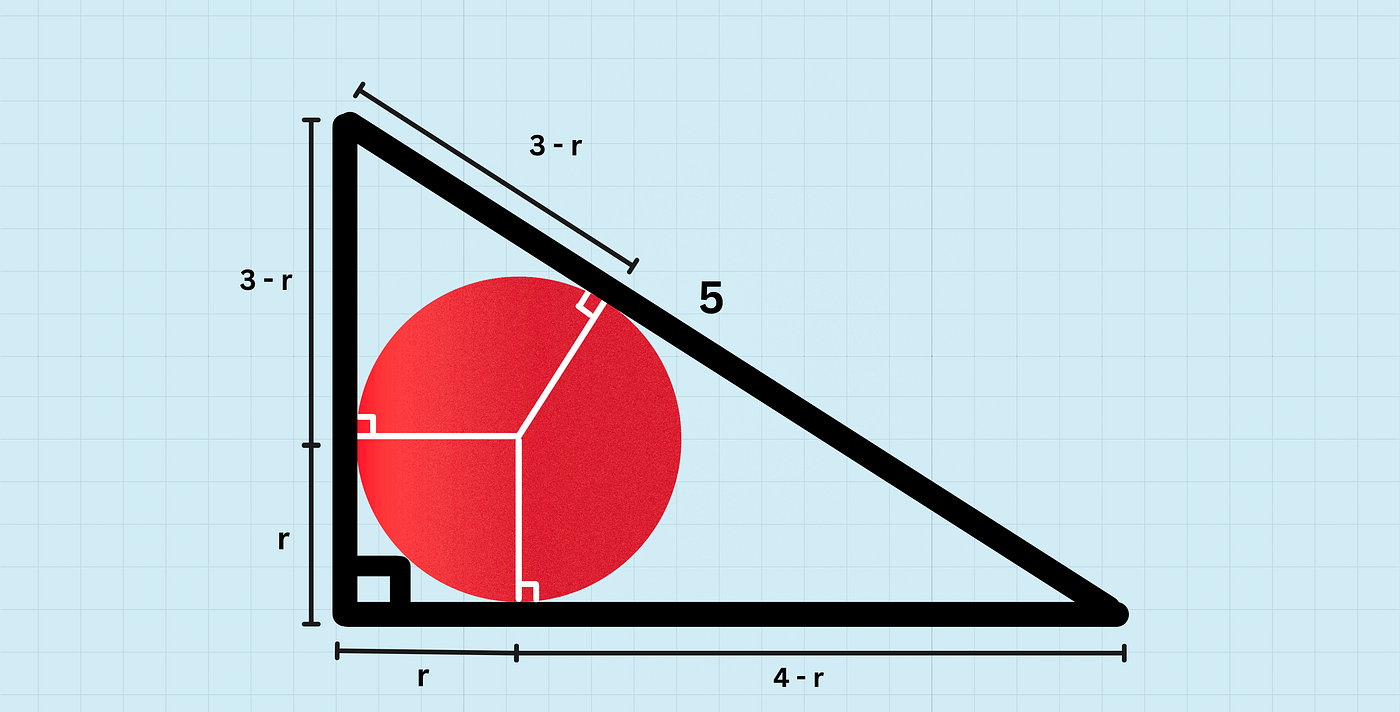
Image by the author
Likewise, the bottom-right vertex is also an external point. Therefore, the tangent segment on the hypotenuse adjacent to this vertex has length 4−r.
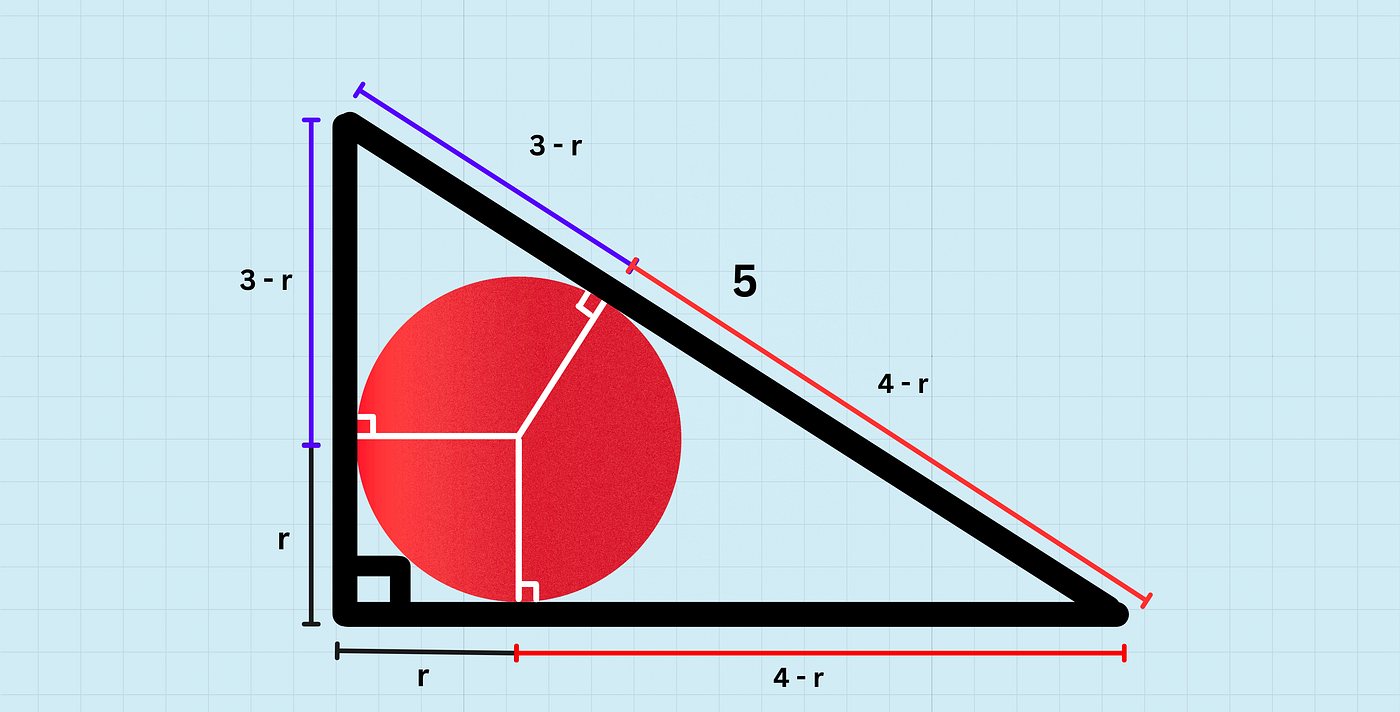
Image by the author
What do we do next?
We already know that the hypotenuse is 5 units long.
We also know that its two parts have lengths 3−r and 4−r.
So, let’s add them together and set the result equal to 5
(3−r) + (4−r) = 5
From here, finding r is straightforward.
Solving for r from the equation above gives us:
r = 1
There we have it!
If we fix this value of r in the formular for the area of this circle, we get π.
Thank you for reading! If you like this article, please give a few claps, follow me, and don’t forget to subscribe to stay updated with my latest articles.
Originally published at https://nnamdisammie01.substack.com.
메타데이터
- post_id
- fdce6045cdfd
- slug
- can-the-area-of-a-circle-ever-be-π-fdce6045cdfd
- url
- https://medium.com/think-art/can-the-area-of-a-circle-ever-be-%CF%80-fdce6045cdfd
- canonical_url
- https://medium.com/think-art/can-the-area-of-a-circle-ever-be-%CF%80-fdce6045cdfd
- author_url
- https://medium.com/@mathsammie
- status
- ok
- fetched_at
- 2026-07-09 09:01:30