5 Dystopian Memory Thrillers Every Sci-Fi Fan Should Read
There’s something uniquely unsettling about stories where memory itself becomes the battleground.
5 Dystopian Memory Thrillers Every Sci-Fi Fan Should Read
There’s something uniquely unsettling about stories where memory itself becomes the battleground.
Unlike the sweeping planetary invasions or AI uprisings that dominate so much science fiction, memory thrillers strike closer to home. They ask a simple, terrifying question:
If your memories can be altered, erased, or fabricated, who are you really?
This subgenre has quietly produced some of speculative fiction’s sharpest short-form work. Below are five stories — spanning cyberpunk classics to a newer indie release — that use memory as a weapon, a currency, and a prison.
1. We Can Remember It for You Wholesale — Philip K. Dick
No list of memory-driven science fiction is complete without this classic.
A clerk named Douglas Quail visits a company that implants false memories of an exciting life he can’t otherwise afford — a vacation to Mars complete with the thrill of secret-agent heroics. The implantation goes wrong in a way that suggests his “fake” memories might be uncomfortably close to something real.
What makes this story endure isn’t just the twist (though it’s an excellent one). It’s the way Philip K. Dick uses memory implantation to interrogate identity and desire.
If a false memory feels exactly like a true one, does the distinction even matter?
The story later inspired Total Recall, but the original is leaner, colder, and arguably even more disturbing.
2. Johnny Mnemonic — William Gibson
William Gibson approaches the memory-thriller concept from an entirely different angle.
Rather than implanted memories, Gibson imagines a courier who has surgically converted his own brain into digital storage, carrying dangerous corporate secrets inside his skull. The price? He’s deleted much of his own childhood simply to make room.
It’s vintage cyberpunk: dense, fast-paced, and deeply suspicious of corporate power.
Beneath the neon aesthetics, however, lies a genuinely tragic idea — a man who has literally sold pieces of his identity for profit and may not have anywhere left to store what’s left of himself.
3. The Truth of Fact, the Truth of Feeling — Ted Chiang
Ted Chiang rarely writes anything that isn’t quietly devastating, and this novella is no exception.
It interweaves two narratives:
- A near-future technology that allows people to perfectly record and replay every memory.
- The historical introduction of writing into an oral culture.
Both stories explore the same unsettling idea:
Once memory becomes perfectly verifiable, it stops being forgiving.
Chiang isn’t interested in cheap dystopia. There’s no authoritarian government wiping minds.
Instead, the horror is subtler.
Imagine a world where you can never soften your past, misremember an argument, or gradually reshape painful experiences. The gap between what happened and what you remember disappears — and that may cost more than it gives.
4. Paycheck — Philip K. Dick
Philip K. Dick appears twice on this list because, quite simply, he helped define the memory-thriller genre.
In Paycheck, an engineer agrees to have two years of his memories erased after completing a highly classified contract in exchange for an enormous payout.
When he wakes up, the money is gone.
Instead, he’s left with a collection of seemingly worthless trinkets that his forgotten self deliberately chose instead of the fortune.
The story becomes an ingenious mystery.
The protagonist must trust a version of himself he no longer remembers, following clues left behind by a stranger who happens to be… himself.
It’s memory as puzzle box, and it remains one of Dick’s most satisfying concepts.
5. Cleanslate — M. J. Jessimy
Rounding out this list is a newer entry that deserves a place alongside these genre staples:
Cleanslate by M. J. Jessimy
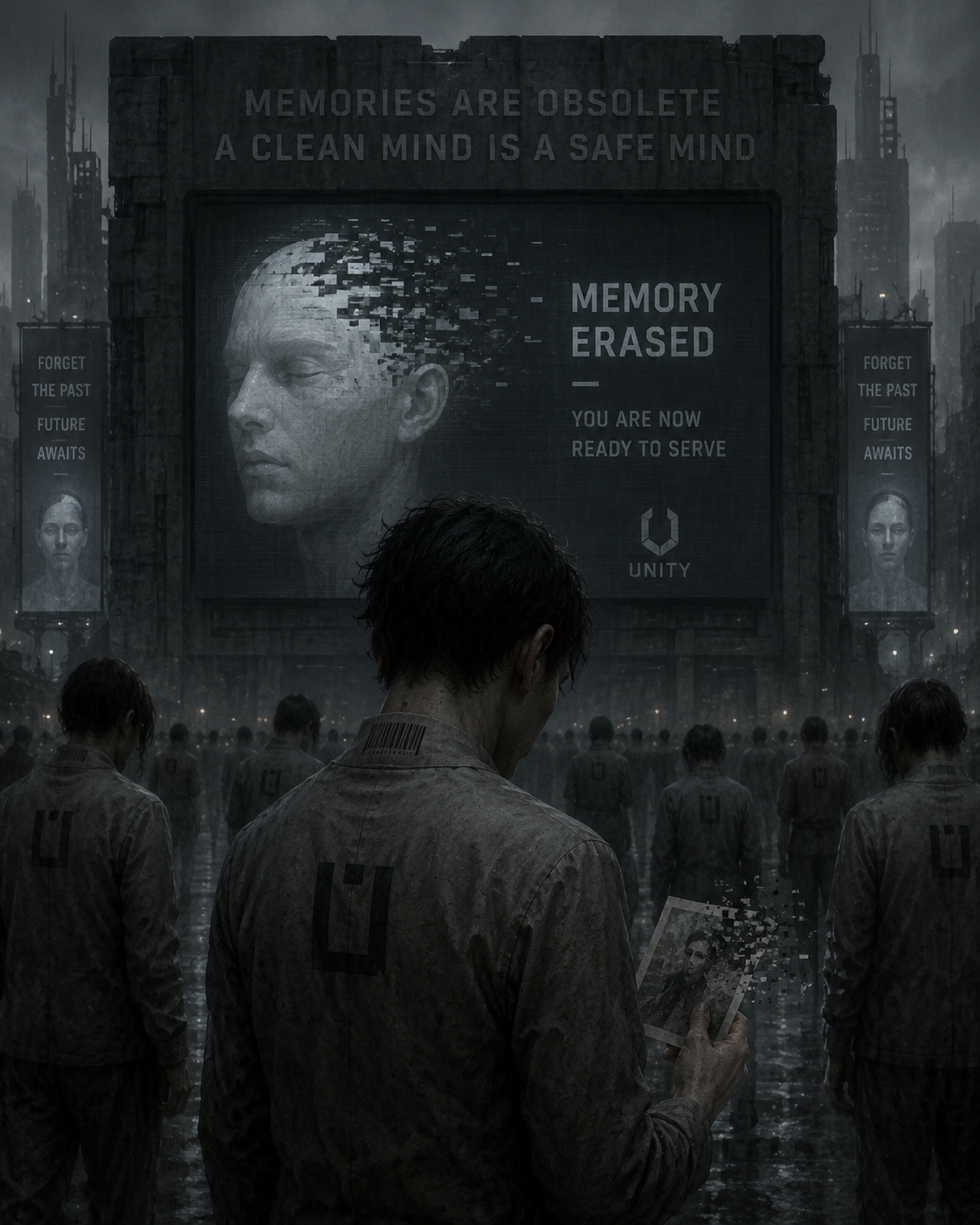
Where many classic memory thrillers focus on individuals losing pieces of themselves, Cleanslate expands the idea into an entire dystopian society.
Here, forgetting isn’t accidental.
It isn’t a side effect.
It’s policy.
Cleanslate is a dystopian sci-fi flash fiction piece: a story about a man who avoids prison by erasing the memory of the crime he committed, only to face the victim who remembers everything.
The core premise is a near-future justice system where guilt can be technologically deleted — raising the question of what accountability means once a crime can be surgically removed from someone’s mind. The emotional weight lands not on the perpetrator, but on the victim, who’s left carrying the full, unedited memory alone while the guilty party walks free of it. It uses that imbalance to explore identity, guilt, and fairness without needing much world-building beyond that one premise.
Cleanslate sits comfortably within the lineage of Philip K. Dick and William Gibson while exploring its own themes of consent, identity, and institutionalized forgetting.
If you’ve enjoyed the classics and want to see where the subgenre is heading, this is an excellent next read.
Read Cleanslate here: https://theutopiandystopia.gumroad.com/l/cleanslate
Why Memory Thrillers Hit Differently
What unites all five of these stories isn’t simply the plot device of altered memories.
It’s the deeper anxiety they all explore.
Most dystopian fiction threatens your freedom.
Memory dystopias threaten something even more fundamental:
The continuity of self.
If you can’t trust your own recollections, every relationship, every decision, and every belief about who you are becomes uncertain.
That’s why memory thrillers work especially well as short fiction.
They don’t require sprawling world-building or interstellar wars to unsettle readers.
Sometimes all it takes is one character questioning one memory.
Philip K. Dick, William Gibson, and Ted Chiang understood that instinctively.
It’s encouraging to see newer work like Cleanslate carrying that tradition forward.
If you’re new to the subgenre, begin with We Can Remember It for You Wholesale for the quintessential memory-twist, then work your way through the rest.
By the end, you’ll likely agree that some of science fiction’s most unsettling ideas don’t require galaxies, alien invasions, or killer AI.
Sometimes all they need is a mind that can no longer be certain of itself.
메타데이터
- post_id
- fefd3eb47f2f
- slug
- 5-dystopian-memory-thrillers-every-sci-fi-fan-should-read-fefd3eb47f2f
- url
- https://medium.com/@mjavier6/5-dystopian-memory-thrillers-every-sci-fi-fan-should-read-fefd3eb47f2f
- canonical_url
- https://medium.com/@mjavier6/5-dystopian-memory-thrillers-every-sci-fi-fan-should-read-fefd3eb47f2f
- author_url
- https://medium.com/@mjavier6
- status
- ok
- fetched_at
- 2026-07-09 03:40:04