How to Become a Claude Certified Architect (CCA-F): The Complete Playbook
Fees, payment, partner access, prep courses, practice tests, the proctoring experience and what is actually on the Claude Architect…
How to Become a Claude Certified Architect (CCA-F): The Complete Playbook
Fees, payment, partner access, prep courses, practice tests, the proctoring experience and what is actually on the Claude Architect Certification exam.
If you have been building anything serious with Claude — agents, MCP servers, Claude Code workflows, structured-extraction pipelines — you’ve probably already heard the buzz. Anthropic launched its first official technical credential, the Claude Certified Architect — Foundations (CCA-F), on 12 March 2026, alongside a $100 million Claude Partner Network investment.
It’s been roughly seven weeks since launch. The early rush has settled, the prep ecosystem has matured, and we now have enough community data to tell you exactly how to approach this credential without wasting time or money.
TL;DR — the exam at a glance
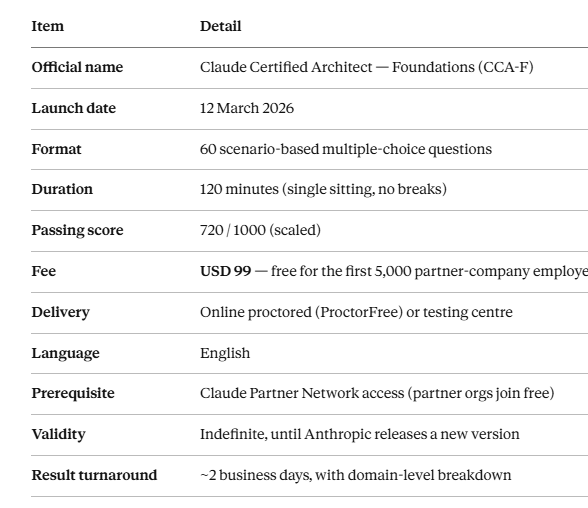
Item wise details on how to prepare and appear for Claude architects certification exam
Why this certification is different
Every cloud and AI vendor has a “foundations” badge. Most of them are completion certificates — watch the videos, click through the quiz, print the PDF. The CCA-F is not that.
It is a 301-level proctored architecture exam. Anthropic is explicit that the target candidate has at least 6 months of hands-on experience with the Claude API, the Claude Agent SDK, Claude Code, and the Model Context Protocol (MCP). The questions don’t ask whether you can recite features. They put you inside a production scenario and ask which architectural decision is correct — usually with three plausible distractors.
Three things make it stand out:
1. Scenario-anchored questions. The exam draws from a pool of six production scenarios — Customer Support Resolution Agent, Code Generation with Claude Code, Multi-Agent Research System, Developer Productivity with Claude, Claude Code for CI/CD, and Structured Data Extraction. Four of those six are randomly selected for your sitting. Every question is grounded in one of them.
2. Real proctoring. No Claude tab, no docs, no Stack Overflow. You face the camera and the mic for two hours.
3. Enterprise pull. Accenture is training ~30,000 professionals on Claude. Cognizant has opened Claude access to roughly 350,000 associates. Deloitte and Infosys are in. This credential is on the same trajectory AWS Solutions Architect was on in 2014 — optional today, preferred soon, expected by 2027.
Who should actually sit this exam
Be honest with yourself. The CCA-F is a good fit if you’ve done several of these things:
- Wired up a Claude agent that calls real external tools and handles ambiguous user requests
- Configured Claude Code across a team —
CLAUDE.mdhierarchies, custom slash commands, plan mode, hooks - Built an MCP server (or at least seriously consumed one) and dealt with tool-boundary issues
- Designed prompts that reliably emit structured JSON, with validation-retry loops
- Thought hard about what happens when an agent fails — escalation, retries, context overflow
If your Claude experience is mostly chatting in claude.ai and writing one-shot prompts, start with the free Anthropic Academy courses first. Sitting the exam without 6+ months of building is an expensive way to feel bad about yourself.
The five domains and their weights
This is what the exam tests, in the order Anthropic weights them:
Agentic Architecture & Orchestration — 27% The heaviest domain. Agentic loops (request → inspect stop_reason → branch on tool_use vs end_turn → loop), hub-and-spoke multi-agent patterns, task decomposition, lifecycle hooks vs prompt-level guardrails, session management. The exam loves to show you a subtly broken loop and ask you to find the bug.
Claude Code Configuration & Workflows — 20% The most configuration-specific domain. CLAUDE.md hierarchy, path-scoped rules in .claude/rules/, Agent Skills with frontmatter (including context: fork for isolated sub-agent execution), custom slash commands, the -p (or --print) flag for non-interactive CI/CD mode, --output-format json with --json-schema for structured PR comments.
Prompt Engineering & Structured Output — 20% JSON schema enforcement via tool_use, nullable fields, validation-retry feedback loops, few-shot prompting for ambiguous inputs, multi-pass review architectures.
Tool Design & MCP Integration — 18% MCP server design — tools, resources, prompts as the three primitives. Tool description clarity to prevent model misrouting, structured error responses with categories and retryable flags, server scoping. Knowing the difference between .mcp.json (project-level, version-controlled) and ~/.claude.json (user-level, personal) is a frequent question.
Context Management & Reliability — 15% Long-context preservation, multi-agent handoff patterns, error propagation, escalation logic, human-in-the-loop boundaries.
The top three domains together carry 67% of your score. If your prep time is short, that’s where you live.
Step-by-step: from zero to certified
Step 1 — Join the Claude Partner Network (free)
The CCA-F currently sits behind partner access. The good news: any organisation actively bringing Claude to market can apply, and membership is free.
- Apply at:
[claude.com/partners](https://www.claude.com/partners) (also reachable viaanthropic.com/news/claude-partner-network) - Review: Anthropic manually reviews applications based on delivery capability, technical depth, and fit. Community reports suggest 1–3 weeks turnaround.
- What you get: Anthropic Academy training materials, sales playbooks, dedicated Applied AI engineer support for live deals, listing in the Services Partner Directory, and priority access to certifications.
If you’re a freelancer or independent consultant, the cleanest path is to align with a partner organisation that already has access. If you’re at an IT services or BPO firm, push your leadership to apply — it costs nothing and the strategic value is significant.
Step 2 — Start the free Anthropic Academy courses (no partner status required)
Even before partner access lands, you can begin. All 13 Anthropic Academy courses on Skilljar are free and open to everyone. Go to [anthropic.skilljar.com](https://anthropic.skilljar.com) and start.
The courses I’d map directly to exam domains:
- Claude 101 — baseline Claude usage and capability awareness
- Building with the Claude API (~8 hours) — the flagship course; tool use, streaming, structured output, agentic patterns, RAG
- Introduction to Model Context Protocol — MCP primitives (tools, resources, prompts) — directly maps to Domain 4
- Model Context Protocol: Advanced Topics — sampling, notifications, transport — production-relevant
- Introduction to Subagents — multi-agent orchestration and context delegation, hits Domain 1 hard
- Introduction to Agent Skills —
SKILL.mdfrontmatter, thecontext: forkoption — exam-relevant - Claude Code in Action — Claude Code in your real dev workflow
- AI Capabilities and Limitations — feeds into reliability and escalation reasoning
Two non-essential but useful side courses: Claude with Amazon Bedrock and Claude with Google Cloud’s Vertex AI — not directly tested, but valuable if your customers deploy through those clouds.
Step 3 — Build something real
Reading is not enough. The exam tests architectural judgment, which only comes from making mistakes in production. Pick a small project that touches at least three of the five domains:
- Build an agentic loop using the Claude Agent SDK with tool calling and structured error handling
- Configure a real
CLAUDE.mdhierarchy with path-scoped rules and a forked-context skill - Write an MCP tool with deliberately differentiated descriptions and structured error responses
- Build a structured-extraction pipeline with JSON schemas and a validation-retry loop
- Wire Claude Code into a CI/CD pipeline using
-pand--output-format json
If you can’t honestly say you’ve done at least three of these, build them now. Two weekends of real work is worth more than two weeks of video watching.
Step 4 — Request exam access
Once your partner status is confirmed, register for the exam at:
[**anthropic.skilljar.com/claude-certified-architect-foundations-access-request](https://anthropic.skilljar.com/claude-certified-architect-foundations-access-request)**
Inside Skilljar you’ll find:
- The official Exam Guide PDF — read it cover to cover. It contains the scenario summaries and sample exercises.
- An official Practice Exam — 60 questions, same scenario format as the real one, with explanations after each answer. Do not skip this. Aim for 900+/1000 on the practice before scheduling the real test.
Step 5 — Pay the fee (or claim your free seat)
- First 5,000 partner-company employees: the $99 fee is waived. As of late April 2026, partner network sources suggest the free seats are still available but are filling steadily. If you’re partner-eligible, schedule sooner rather than later.
- Everyone else (after free seats run out): USD 99 per attempt, paid via the Skilljar checkout (credit/debit card). VAT/GST may apply depending on your country.
- Retakes are at full price — there is no built-in discount for a second attempt. Treat your first sitting like it counts.
Step 6 — Schedule your proctored session
Anthropic uses ProctorFree for online proctoring. You will need:
- A reasonably modern laptop or desktop (no tablets)
- A working webcam and microphone
- Stable broadband (community reports suggest at least 5 Mbps up/down)
- A government-issued photo ID for identity verification
- A quiet, well-lit room with no other people, no second monitor, no notes, no phone within reach
You can also opt for an in-person testing centre if proctored-from-home isn’t your style. The testing-centre option is useful in regions where home internet is unreliable.
Block 2.5 hours in your calendar — 30 minutes for room scan, ID check, and setup, plus the 120-minute exam. You cannot pause the exam once it starts.
Step 7 — Sit the exam
Practical tips that compound:
- Read the scenario header carefully. Every question on a scenario assumes the same context.
- Eliminate the obviously wrong distractor first. You’re usually choosing between two plausible answers.
- “Stakes-proportionate” decisions get rewarded. The exam consistently prefers deterministic enforcement (hooks, validators) for non-negotiable outcomes and prompt-level guidance for soft preferences.
- For multi-agent questions: subagents have no memory of the coordinator’s context. Anything they need must be passed explicitly.
- For Claude Code questions: when in doubt, prefer project-scoped (
.mcp.json, projectCLAUDE.md) over user-scoped configuration. - For parallel work: emit multiple
Tasktool calls in a single response — sequential when parallel was possible is consistently marked wrong.
Step 8 — Get your results
Score reports arrive in approximately two business days with a domain-level breakdown. If you pass, you receive a digital badge — Credly-style, shareable to LinkedIn — and the right to call yourself a Claude Certified Architect.
Add it to your LinkedIn headline within 48 hours. The early-mover advantage is real for the next 6–12 months.
How much real prep time do you need?
From community data and my own observations across consulting teams I work with:
- Already building Claude apps in production daily: 2–4 weeks of focused study, ~20–30 hours total
- Comfortable with the Claude API but new to Agent SDK / MCP: 6–10 weeks
- New to Claude entirely: 2–4 months, including time to build real projects before attempting
Most of the people I’ve seen fail did so because they over-indexed on prompt engineering (the comfortable, familiar bit) and under-invested in agentic architecture and Claude Code configuration — the two heaviest, most specific domains.
Practice resources worth using
Beyond Anthropic’s own free practice exam (which you absolutely should take), several community options have emerged. None are official, and quality varies, so treat them as supplements:
- Anthropic’s official practice exam — the only one that mirrors the real format exactly. Free inside Skilljar after access. Always do this one.
- Community Medium guides —
claudecertifications.com,machinemind.medium.com, anddynamicbalaji.medium.comhave all published detailed domain breakdowns and scenario walkthroughs. Free, and a good way to test whether you really understand the patterns. - Paid practice tests — Tutorials Dojo (Jon Bonso) and several Udemy courses have published 240–360-question banks. Useful for stamina and breadth, but quality of explanations is uneven and some questions don’t fully reflect the real exam’s nuance. Use them for drilling, not as your primary study source.
- Rick Hightower’s 8-part series on Towards AI — long-form, well-organised, free.
A reasonable plan: read the official Exam Guide, complete the 8 most relevant Skilljar courses, build one real project, take the official practice exam, fill gaps from community guides, take one paid practice set, then sit the real exam.
Will it actually help your career?
Honest answer: yes, right now, with caveats.
The credential is seven weeks old. There are still relatively few certified architects globally. Hiring managers in BPO, IT services, and consulting are starting to ask for it — especially in RFPs where Claude is named. For freelancers and boutique agencies, it’s pure differentiation. For people working inside an Anthropic partner organisation, it’s becoming a baseline expectation faster than most other AI credentials.
Two important caveats:
- It’s a Claude-specific credential. It signals nothing about your ability to work with GPT, Gemini, or open-weights models. If your career is multi-model, this is one of several credentials you’ll want.
- Foundations is the entry tier. Anthropic has confirmed seller, developer, and advanced architect certifications later in 2026. Foundations is the prerequisite-in-spirit for the advanced ones. Get it now while the field is uncrowded; it positions you for the higher tiers as they roll out.
If you’re already building with Claude in any serious way, the cost-benefit is straightforward: free or $99, two to four weeks of focused prep, indefinite validity, and a credential whose stock is rising. That is a very good trade.
A short note on the path for India-based practitioners
If you’re reading this from India — as many of my consulting clients are — three things worth knowing:
- The exam is delivered in English only, with online proctoring that works fine on standard Indian broadband from most metros.
- Payment in USD via international credit/debit card; most major Indian cards work directly on Skilljar.
- Many of the largest Indian IT services firms (TCS, Infosys, Wipro, HCL, Cognizant, LTIMindtree, Persistent, Infogain, and several mid-tier BPO and AI-services firms) are already in or applying to the Claude Partner Network. Check internally before paying out of pocket — your employer may already have free seats allocated.
Final word
The CCA-F is the first AI credential I’ve seen that genuinely tests whether you can ship Claude in production rather than whether you watched the right tutorials. The proctoring is real. The scenario design is sharp. The distractors are uncomfortably plausible if your knowledge is partial. And the credential is rising in the market faster than most certifications do in their first year.
If you’ve been building seriously with Claude, formalising it now is the obvious move. Apply to the Partner Network this week, start the Skilljar courses tonight, build something this weekend, and sit the exam within the month.
The first wave of certified architects will stand out the most. That window is still open. It will not stay open forever.
메타데이터
- post_id
- 000cdc4f46b8
- slug
- how-to-become-a-claude-certified-architect-cca-f-the-complete-playbook-000cdc4f46b8
- url
- https://medium.com/@ravisat/how-to-become-a-claude-certified-architect-cca-f-the-complete-playbook-000cdc4f46b8
- canonical_url
- https://medium.com/@ravisat/how-to-become-a-claude-certified-architect-cca-f-the-complete-playbook-000cdc4f46b8
- author_url
- https://medium.com/@ravisat
- status
- ok
- fetched_at
- 2026-06-15 20:49:13