Food Dyes: What They Are, Where They Hide & Why They’re Going Away
Pick up a box of Froot Loops in London and check the label. You’ll find natural colorings from carrots, blackcurrants and paprika. Now…
Food Dyes: What They Are, Where They Hide & Why They’re Going Away
Pick up a box of Froot Loops in London and check the label. You’ll find natural colorings from carrots, blackcurrants and paprika. Now, pick up the same box in Chicago. You’ll most likely see Red 40, Yellow 6 & Blue 1. The same brand and the same product name, but completely different ingredients.
This isn’t a rumor or a conspiracy theory. It’s printed right on the packaging. Kraft, Mars and Kellogg’s. Already know how to make their products, without petroleum based dyes. They’ve been doing it for years. Just not in the United States or Canada.
Key Takeaways
- The same products are made differently depending on where you live. Kraft, Mars and Kellogg’s. Already sell dye free versions of their products in Europe, using natural colorings. The US versions still contain petroleum based synthetic dyes.
- The FDA’s phase out is voluntary, not a ban. Red 3 is the only dye that’s been formally banned. The other six are part of a voluntary request with no enforcement mechanism. The real pressure is coming from state laws, consumer demand and companies reformulating on their own.
- Food dyes show up in far more than candy and cereal. Pickles, salad dressings, yogurt, medications and even packaged salmon, can contain synthetic dyes. Per capita, consumption in the US increased fivefold between 1950 and 2012.
What Are Food Dyes?
Most artificial food dyes are synthesized from petroleum byproducts. That alone surprises most people. The reds, oranges and yellows are typically azo dyes. The blues and greens are triarylmethane dyes. Both start with the same raw material, petroleum.
There are two categories you’re likely to encounter. Synthetic dyes, which are lab made and petroleum derived. Accompanied by natural dyes that come from plants, minerals or animals. Think beet juice for red, turmeric for yellow, spirulina for blue-green.
Manufacturers tend to prefer synthetic dyes for one reason. Cost. They’re cheaper, more stable under heat / light, and produce brighter colors than natural alternatives. They don’t add any nutritional value, they don’t preserve food and they definitely don’t improve taste. They pretty much exist, only to make processed food look more appealing.
The Seven Dyes in the US Food Supply
The FDA currently certifies seven synthetic dyes for use in food. That number used to be much higher. Over the past century, the FDA has pulled dozens from the approved list, as safety concerns emerged. These seven are essentially what survived.
Red 40 (Allura Red) is the most widely used. A 2025 study found it present in 14% of all products, from the top 25 US food manufacturers. Together with Yellow 5 (Tartrazine) and Yellow 6 (Sunset Yellow). These three dyes account for roughly 90% of all food dye use in the United States. The remaining four are Blue 1 (Brilliant Blue), Blue 2 (Indigo Carmine), Green 3 (Fast Green) and Red 3 (Erythrosine). Red 3 (Erythrosine) is the one you’ve probably heard about. The FDA banned it in January 2025. After the Delaney Clause required action on additives shown to cause cancer, in lab animals. Food manufacturers have until January 2027 to remove it. In Canada, all seven remain approved for use, including Red 3.
Where They Show Up
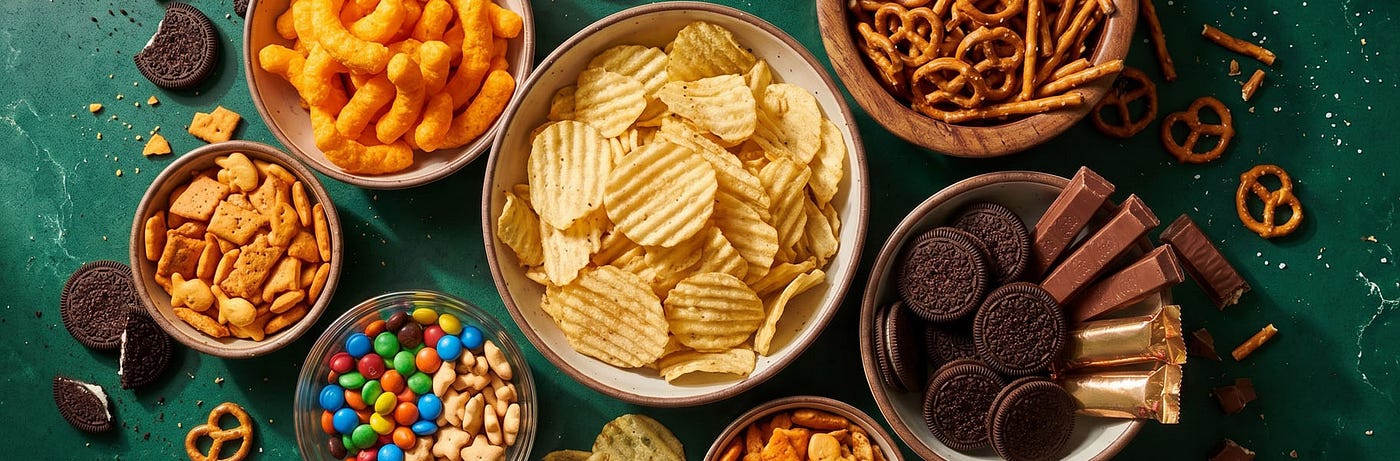
In most cases, you will identify these dyes in candy, cereal and soda. Although food dyes appear in places most people would never think to check.
Pickles. Salad dressings. Flavored yogurt. Canned fruit. Packaged salmon. Medications and vitamins. Some brands of mustard, relish and hot sauce. Even products marketed as “healthy” or “natural”, can contain synthetic dyes. Especially if they haven’t been reformulated.
The amount of synthetic dye in the American diet, has changed dramatically. In 1950, the FDA certified about 12 milligrams of artificial food color per person per day. By 2012, that number hit 68 milligrams. A fivefold (5x) increase. Researchers at Purdue University calculated. That a child who eats two cups of Kraft Mac & Cheese, a small bag of Skittles, and eight ounces of Crush Orange. Will consume roughly 102 milligrams in a single day. That’s more than the amounts used in clinical trials, which showed behavioral effects in children.
What the Research Says
The study that changed the conversation happened in 2007. Researchers at the University of Southampton. Handed out drinks containing mixtures of artificial food colors and sodium benzoate. This was given to 153 three year olds and 144 eight and nine year olds, from the general population. Not kids with behavioral diagnoses. Regular kids.
The results published in The Lancet. Showed significant increases in hyperactive behavior in both age groups. The study was double blinded and placebo controlled. The six dyes tested became known as the “Southampton Six.”
The European Union responded with mandatory warning labels starting in 2010. The United States reviewed the same evidence. In 2011, the FDA’s own Food Advisory Committee, voted 8 to 6 against recommending warning labels. Both the EFSA (European Food Safety Authority) and the FDA reviewed the same study. The European Parliament required warning labels anyway. Although, the EFSA and the FDA decided they weren’t necessary.
Researchers at Ohio State have since pointed to a possible genetic explanation. Three gene variants, two related to histamine and one to dopamine. This may explain why some children react more than others. Their recommendation didn’t hedge, saying; “It’s best to avoid all artificial food dyes.”
Why They’re Going Away
As of today, Red 3 is technically already gone. The other six however, are a different story. In April 2025, the FDA, the Department of Health and Human Services. Announced a voluntary phase out. The original target was the end of 2026. It has since been pushed to 2027.
However this is not a ban. No formal rulemaking was issued. No enforcement mechanism exists. The Center for Science in the Public Interest, called the announcement “disappointing.”
Some companies have committed. Kraft Heinz, General Mills, Mars, Walmart and Tyson Foods. Are all actively reformulating. Many others, including Coca-Cola, Unilever and Mondelez. Have made no commitments at all. Even though some of them already sell dye free versions, in other countries.
States within the USA aren’t waiting. Over 37 introduced food dye legislation in 2025. California, West Virginia, Texas and Louisiana. Have all passed laws targeting synthetic dyes. A Consumer Reports survey from March 2026. Found that 72% of US adults, are at least somewhat concerned about synthetic dyes in food.
How to Spot Them
Synthetic dyes are listed on ingredient labels, using the FD&C naming convention. Look for “Red 40,” “Yellow 5,” “Yellow 6,” “Blue 1,” “Blue 2,” “Green 3,” or “Red 3.” They may also appear as generic “artificial colors” or “color added.” Natural alternatives that brands are switching to include; turmeric, beet juice, paprika, annatto, spirulina extract and blackcurrant extract.
The simplest way to check what’s in a product before you buy, it is to scan the barcode with the AbuNai Labs app (coming soon). It flags synthetic dyes and other ingredients of concern instantly.
The Labels Tell the Story
The same companies selling you dyed products in the US, already know how to make them without synthetic colors. Kraft reformulated Mac & Cheese for the UK, using paprika and annatto. Mars Inc. sells M&M’s with plant based colorings overseas. Kellogg’s makes Froot Loops with natural dyes for European shelves. The formulations exist and the supply chains exist.
What changed in the US isn’t the science. The research has pointed in the same direction since 2007. What changed is that states started passing their own laws, consumers started reading labels, and the FDA finally told the industry it was time to move on. Even then, it was a request. Not really a requirement.
The industry is shifting. Not because anyone suddenly decided, petroleum based dyes don’t belong in food. It’s because the market is telling them so. When the companies making the products, start quietly pulling the ingredients out on their own. That tells you more than any headline ever could.
You don’t need to wait for federal legislation to finish working its way through. You don’t need a nutrition degree to read an ingredient list. The information is right there on the package. It always has been. The difference now is that more people are actually looking.
Full article with sources is linked below:
https://labs.abunai.app/food-dyes-what-they-are-where-they-hide/
Content is for informational purposes only and is not medical or dietary advice. Product formulations, cooking oils and restaurant practices can change without notice. Always verify current ingredients directly with manufacturers or restaurants.
메타데이터
- post_id
- 0022deb484de
- slug
- food-dyes-what-they-are-where-they-hide-why-theyre-going-away-0022deb484de
- url
- https://medium.com/@abunailabs/food-dyes-what-they-are-where-they-hide-why-theyre-going-away-0022deb484de
- canonical_url
- https://medium.com/@abunailabs/food-dyes-what-they-are-where-they-hide-why-theyre-going-away-0022deb484de
- author_url
- https://medium.com/@abunailabs
- status
- ok
- fetched_at
- 2026-08-04 01:39:09