Column 1 — The Success of the Band Theory
Band theory, built on Bloch’s theorem, is one of the great achievements of twentieth-century physics — it explains why some materials…
Column 1 — The Success of the Band Theory
Band theory, built on Bloch’s theorem, is one of the great achievements of twentieth-century physics — it explains why some materials conduct electricity and others do not, from a single quantum-mechanical principle. This column traces the success of band theory in explaining the electrical properties of materials.
Here is a question that should bother you more than it seems: why is aluminium a metal and boron an insulator? Both are elements you can find in the same chapter of a chemistry textbook, and both consist of atoms sitting in a regular crystalline lattice. Classical physics cannot answer this question. The Drude model — the 19th century picture of electrons bouncing through the array of ion cores — cannot tell you why some materials have essentially zero conductivity at low temperatures while others conduct freely. It cannot tell you why carbon is an insulator when it forms diamond and a conductor when it forms graphite. It cannot explain why iron, with its multiple chemical valences, behaves the way it does.
These were not idle curiosities. They were fundamental mysteries sitting at the center of solid-state physics, and answering the required a completely new framework. That framework is band theory, built on the foundation of Bloch’s theorem. In this column, we will uncover the profound insights that band theory provides.
What Quantum Mechanics Changed
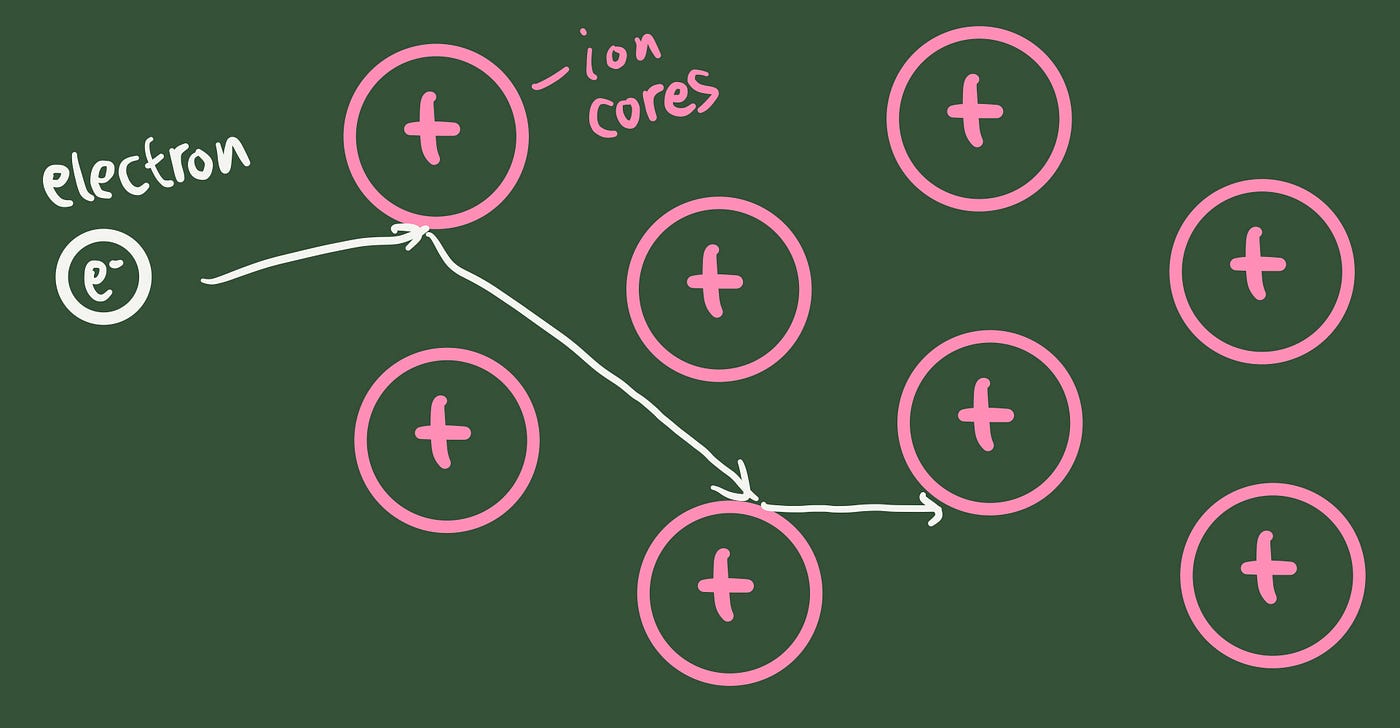
The Drude model got one thing catastrophically wrong. Electrons in a crystal are not particles bouncing off ion cores like billiard balls. They are quantum mechanical waves, and waves in a perfectly periodic potential do something remarkable: they pass through it without scattering at all.
This is what Bloch’s theorem tells us. The theorem states that the eigenstates of the one-electron Hamiltonian in a periodic potential
[embed]
where U has the full periodicity of the crystal lattice, take the form
[embed]
where u_{nk}(r) is a function that shares the periodicity of the lattice, and k is a quantum number called the crystal momentum. The n is the band index, labeling which of the possible energy bands the state belongs to. The exponential factor is a plane wave — the kind of state a free electron would have — and u_{nk} modulates it at the scale of the unit cell. Together they describe an electron that, in a certain sense, propagates as a wave through the entire crystal. Crystal momentum k plays the same organizational role that ordinary momentum plays in free-electron theory, though it is important to note that ħk is not a true momentum and it can only be defined modulo a reciprocal lattice vector.
So, the physical consequence is stunning: a Bloch electron in a perfect periodic lattice moves forever without losing any mean velocity. There is no scattering. Quantum coherence, once properly accounted for, makes the mean free path infinite. This is why room-temperature resistivity in metals comes not from the periodic potential from ion cores but from defects, impurities, and phonons — deviations from perfect periodicity. The ions themselves, in a perfect crystal, are transparent to electrons.
Three Types of Materials from One Principle

With Bloch’s theorem established, the classification of materials into metals, insulators, and semiconductors follows from a single physical criterion: where does the Fermi energy fall relative to the band structure?
If electrons fill some number of bands completely with other bands completely empty, then a gap separates the highest occupied state from the lowest unoccupied one. This is the band gap. With a band gap much larger than k_B T, no infinitesimal electric field can excite electrons across it — the Pauli exclusion principle ensures that there is simply no available state for an electron to scatter into without jumping all the way across the gap. The system cannot conduct. This is an insulator.
Instead, if the Fermi energy lies within a partially filled band, there is a surface in k-space — the Fermi surface — that separates occupied from unoccupied states. States just above the Fermi surface are accessible at vanishingly low energy. The material conducts. This is a metal.
Semiconductors are insulators with a gap small enough that thermal excitation at room temperature populates the conduction band at a detectable level, making conductivity sensitive to temperature and doping.
What determines which category a material falls into? Electron counting. In a primitive cell with one atom, each band holds exactly two electrons (degeneracy from spin). So an element with an odd number of valence electrons will half-fill a band and be a metal. An element with an even number might fill an integer number of bands and be an insulator- though band overlaps can muddy this, turning an expected insulator into a semimetal.
This is impressive. The alkali metals — Na, K, Li — are monovalent and all excellent metals. Si, Ge, and diamond-form carbon are all even-valence elements forming non-metallic lattices, and all are insulators or semiconductors. A single-particle quantum theory, requiring no information about electron-electron interactions, sorts materials into these categories with striking success.
Does the band theory always hold?
The cracks appear in materials where the key assumption of band theory — that electrons can be treated as independent, each moving in an average background potential created by all the others — breaks down badly. Consider a crystal in which each atom contributes exactly one electron to the conduction band, so the band is half-filled. Band theory says this must be a metal — half-filed band, Fermi surface present, done. But there exist materials — most famously certain transition metal oxides — that satisfy exactly this criterion and are nontheless insulators. They are not insulators because of disorder or impurities. Something intrinsic was driving the insulating behaviour. We will discuss this phenomenon in the next column.
References
- Girvin & Yang, Modern Condensed Matter Physics (2019)
- Ashcroft & Mermin, Solid State Physics (1976)
메타데이터
- post_id
- 003a779c6cbf
- slug
- column-1-the-success-of-the-band-theory-003a779c6cbf
- url
- https://medium.com/@grhncgzsvb/column-1-the-success-of-the-band-theory-003a779c6cbf
- canonical_url
- https://medium.com/@grhncgzsvb/column-1-the-success-of-the-band-theory-003a779c6cbf
- author_url
- https://medium.com/@grhncgzsvb
- status
- ok
- fetched_at
- 2026-07-18 11:12:31