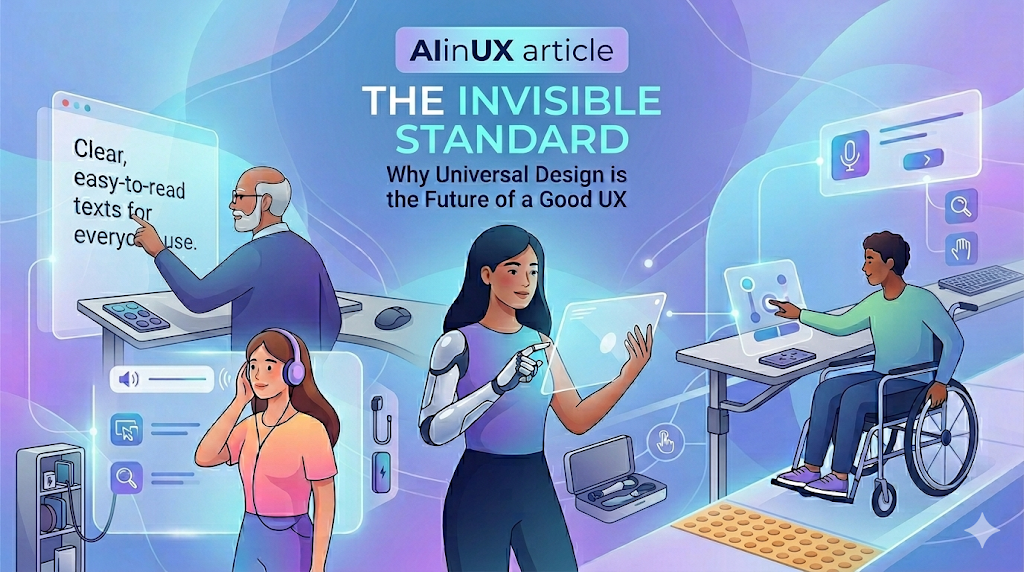
The Invisible Standard: Why Universal Design is the Future of a Good UX
Beyond the Checklist: Mastering the 7 Principles to Create Experiences That Work for Everyone, Everywhere.
The Invisible Standard: Why Universal Design is the Future of a Good UX
Beyond the Checklist: Mastering the 7 Principles to Create Experiences That Work for Everyone, Everywhere.
Universal Design is not a niche requirement for compliance; it is the ultimate heuristic for human-centric excellence. By integrating these seven timeless principles with modern AI reasoning, we move from “patching” interfaces to building inherently inclusive digital worlds. Truly great design should be so seamless that its accessibility remains entirely invisible to those who don’t need it, yet indispensable to those who do.
by Krystian M. Frahn. Research workflow created with a skill on Claude 4.6 Sonnet and article writing augmented by Google Gemini 3.
Custom mede Gem in Gemini AI by Google used by Krystian M. Frahn
What’s Inside:
- The Architect’s Legacy: How Ronald Mace shifted the paradigm from “special needs” to “universal use.”
- The 7 Pillars of AIinUX: A strategic translation of timeless principles, from equitable use to AI-powered intent recognition.
- The Human Heuristic: Why Universal Design is the ultimate “gut check” for any designer, comparable to Nielsen’s rules.
- Proactive vs. Reactive: Why AI reasoning is making the dream of default inclusion a reality by eliminating the “error” state.
Imagine you are standing in the middle of a bustling international airport. You are exhausted from a ten-hour flight, juggling two heavy suitcases, and trying to soothe a crying toddler. You don’t speak the local language, and the signage is a blur of unfamiliar characters. Suddenly, you see a high-contrast, glowing pictogram: a minimalist silhouette of a person going toward an open door. You follow it toward a wide, automatic sliding door. You don’t have to drop your bags to turn a handle; you don’t have to struggle with a narrow turnstile. The environment simply “opens up” for you.
This is the magic of Universal Design (UD). For a person in a wheelchair, that wide door is a necessity. For you — the tired traveler — it is a luxury. But for the designer, it is a single solution that served both without discrimination. In the digital world of AIinUX, we are facing our own “busy airport” moment. As interfaces become more complex, the need for design that works for everyone by default has never been more critical.
The Architect of “Everyone”
Universal Design wasn’t born in a software lab; it began with Ronald L. Mace, an architect and wheelchair user who realized that the world was built for a “standard” body that rarely exists in reality. In 1997, Mace and his team codified the 7 Principles of Universal Design (Centre for Universal Design, 1997).
As I often emphasize in my research, UD is not “design for the disabled.” It is a proactive philosophy. It’s about moving away from retrofitting — the expensive and clunky process of adding accessibility features after a product is finished — and toward a model where barriers are eliminated before the first line of code is even written.
The Seven Pillars of Strategic UX
When we translate Mace’s principles into the AIinUX workflow, we see they are universal strategic standards that define high-end experiences:
- Equitable Use: Design is useful to everyone without stigma. Like bold architectural signage aiding both low-vision and distracted travelers, high-contrast buttons and “bigger fonts” are strategic standards benefiting all.
- Flexibility in Use: Accommodating different preferences and abilities. Strategically, this means providing choices in methods — allowing a user to choose between gestures, shortcuts, or voice — to fit their current context. AI may augment this ease of use by dynamically adapting the interface based on real-time user behavior or environmental needs.
- Simple and Intuitive Use: Eliminating complexity. Whether it’s a door handle with no affordance or signifier, or a landing page with no clear CTA, the design should “feel” right regardless of the user’s experience level. A multimodal AI assistant may help here by providing real-time, context-aware guidance when traditional signifiers are missing or unclear.
- Perceptible Information: Communicating regardless of sensory abilities. Haptic feedback — a “nice-to-have” for many — is a critical lifeline for someone with poor sight or in a high-noise environment.
- Tolerance for Error: Minimizing hazards. AI helps here by shifting from reactive “Undo” buttons to proactive intent recognition. AI can interpret a messy command or predict a high-risk mistake before it happens, widening the lane for user success.
- Low Physical Effort: Reducing friction by using voice commands instead of buttons. AI reasoning makes this seamless; the system understands natural intent rather than requiring the “exact right phrase,” saving the user both physical and cognitive effort.
- Size and Space for Approach: Ensuring comfortable interaction regardless of mobility or posture. In digital strategy, this manifests as responsive design — adaptive layouts that function perfectly across any device or physical orientation.
The Human Heuristic: Getting the “Feel”
There is a tendency to treat Universal Design like a technical checklist, similar to the 94.8% of homepages that fail WCAG compliance (WebAIM, 2024). But UD is closer to Nielsen’s Heuristics or Shneiderman’s Eight Golden Rules. It’s a philosophy you have to “get the feel of.”
“Simply think about the user, the human,” is the mantra I share with the UX community. When we use AI to check for WCAG compliance, we aren’t just looking for green checkmarks; we are ensuring that the human on the other side of the screen isn’t being excluded by our own “creative” ego. Designers will be lazy with or without AI — it’s human nature — but the 7 principles provide the structural discipline to overcome that.
The Resolution: The Traveler’s Return
Back in our airport, the traveler finds their gate with ease. The “invisible” design has reduced their stress, saved their time, and made a difficult journey manageable. When we apply Universal Design to our digital products, our users — whether they are “power users” or someone using a screen reader — feel that same sense of relief.
Universal Design is the future of any good UX because it recognizes that “average” is a myth. By designing for the margins, we create a better center for everyone.
Author’s Note: Krystian M. Frahn is a UX/AI design researcher and the creator of AIinUX. He explores the intersection of human-centric design and machine intelligence. https://linktr.ee/aiinuxdesign
Process Note: This article was developed using a “Human-In-The-Loop” (HITL) process. Initial research and structural logic were drafted via Claude 4.6 Sonnet, while the creative expansion and narrative synthesis were performed by Google Gemini 3, with final verification by the author.
Glossary
- Universal Design (UD): The design of products and environments to be usable by all people, to the greatest extent possible, without the need for adaptation.
- Retrofitting: The practice of adding accessibility features to a product after the initial design and development phase is complete.
- Affordance/Signifier (Don Norman’s concept): Visual cues (like a handle or button shape) that tell a user how an object can be used.
- AI Reasoning: The ability of an AI to understand context and intent, allowing it to handle “imperfect” user inputs.
- WCAG: Web Content Accessibility Guidelines; the global standard for digital accessibility.
Sources
- Burgstahler, S. (2021). Universal design: Process, principles, and applications. DO-IT (Disabilities, Opportunities, Internetworking, and Technology). https://www.washington.edu/doit/universal-design-process-principles-and-applications
- Centre for Universal Design. (1997). The principles of universal design. North Carolina State University. https://projects.ncsu.edu/ncsu/design/cud/about_ud/
- Mace, R. L., Hardie, G. J., & Place, J. P. (1991). Accessible environments: Toward universal design. In W. E. Preiser, J. C. Vischer, & E. T. White (Eds.), Design intervention: Toward a more humane architecture (pp. 155–175). Van Nostrand Reinhold. https://archive.org/details/
- Shneiderman, B., Plaisant, C., Cohen, M., Jacobs, S., Elmqvist, N., & Diakopoulos, N. (2016). Designing the user interface: Strategies for effective human-computer interaction (6th ed.). Pearson. https://www.pearson.com/en-us/subject-catalog/p/designing-the-user-interface-strategies-for-effective-human-computer-interaction/P200000003290
- W3C. (2021). Web Content Accessibility Guidelines (WCAG) 2.1. World Wide Web Consortium. https://www.w3.org/TR/WCAG21/
- WebAIM. (2024, May 22). The WebAIM Million: An annual accessibility analysis of the top 1,000,000 home pages. https://webaim.org/projects/million/
AIinUXdesign #UniversalDesign #UXResearch #Accessibility #InclusiveDesign #AIinUX #HumanCentricDesign #DesignHeuristics #StrategicUX #FutureOfUX #WCAG
메타데이터
- post_id
- 00477804e03c
- slug
- the-invisible-standard-why-universal-design-is-the-future-of-a-good-ux-00477804e03c
- url
- https://medium.com/@aiinuxdesign/the-invisible-standard-why-universal-design-is-the-future-of-a-good-ux-00477804e03c
- canonical_url
- https://medium.com/@aiinuxdesign/the-invisible-standard-why-universal-design-is-the-future-of-a-good-ux-00477804e03c
- author_url
- https://medium.com/@aiinuxdesign
- status
- ok
- fetched_at
- 2026-07-09 13:13:48