The Order Of Things — Foucault’s Abstract Masterpiece Questions Our Epistemological Presuppositions
The role of Philosophy in shaping discourse and dialogue
The Order Of Things — Foucault’s Abstract Masterpiece Questions Our Epistemological Presuppositions
The role of Philosophy in shaping discourse and dialogue
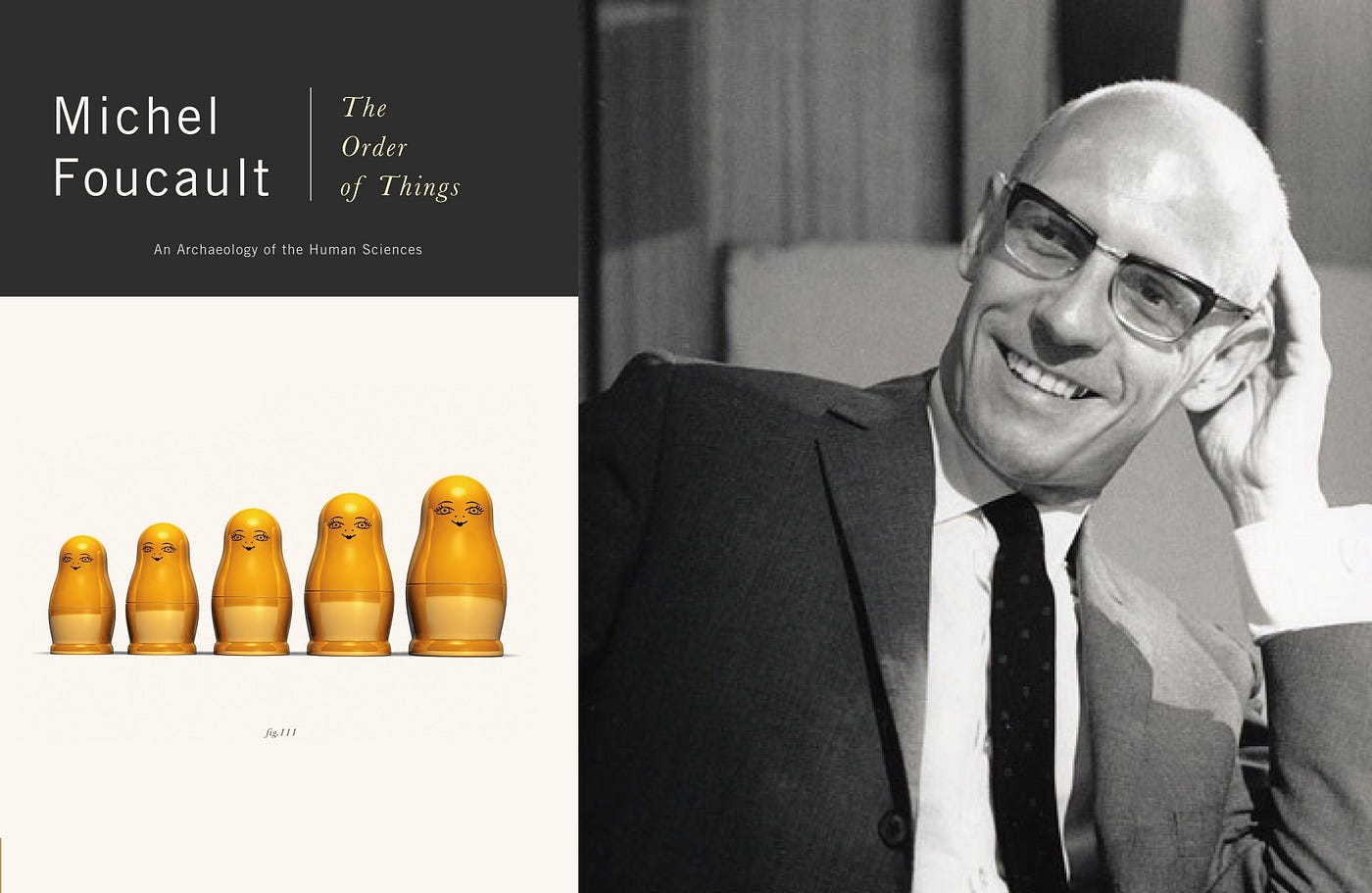
“The visible order, with its permanent grid of distinctions, is now a superficial glitter above an abyss”. — Michel Foucault
Foucault was criticised for a number of views that he held and on many of these issues I agree with his critics, since ultimately his world view leads to a form of moral relativism and nihilism. However, when we confront his work directly, there are definitely many thoughts and ideas that are relevant to our current times and can shed a lot of light on why Western civilization is in a crisis.
After reading his book The Order of Things, the first of his works that I have read so far, my appreciation for his analysis has increased and I understand why he has made such an impact on philosophy and thought. This book deals with episteme, and the underlying assumptions and presuppositions that characterise any era or mode of thought. At times, the level of abstraction Foucault displayed was bewildering, and I had to read certain sections twice in order to come to a more accurate understanding.
The first passage in the book I found to be significant is Foucault’s analysis of the Classical painting Las Meninas by Velazquez, in which he reveals a representation within a representation and how they reflect, displace or conceal something. According to Foucault’s perception, in the end the double is revealed when man faces the mirror. When I read this, the mirror stage in Lacan’s psychoanalytic work came to mind and Foucault’s other thought about imagination being the suture of body and soul.
In the preface we are presented with the idea that China is the most privileged site of space. Reflecting currently on the role of China and my own views about this country and culture, this does seem to be true for a variety of reasons. Chinese society is the most rigidly ordered, we could argue, and “most deaf to temporal events”. It is a very ancient civilization which has mastered the art of harmony. Therefore, as the 21st century unfolds, China will be important in building the forthcoming new era, based on stability and respect for the sovereignty of nations and their geopolitical spaces.
I would now like to jump to language, and I apologise in advance if I jump to different unrelated topics during this article, but such is the nature of this book; it covers so many disciplines. When we step back, we can perceive that the infinity of the text, discourse and commentary of events has taken precedence over the materiality and being of language. Foucault argues that initially language was totally transparent and the sign was visible, but after Babel was destroyed this was lost, with only Hebrew containing in fragments the marks of original “name-giving”.
The world is constantly folding in on itself, and we see man becoming lost in language, personified most truly by the figure of Don Quixote. I have personally noticed and experienced the decay of the English language during my life, which made me react in a positive sense by becoming more acquainted with it and by trying to revivify and renew it. I agree with Foucault when he states that the groundwork of language is its materiality, based on the body, morphemes and the unspoken.
Another important part of the book is an analysis of Classical rationalism, which has a tendency to make nature mechanical and calculable. From what I could gather, it seems to me that Foucault believed it isn’t possible to produce a universal science of measurement and order. Linked to this, is the predominance of nominalism and scepticism during the Classical period, which supported a science with a dogmatic approach and a philosophy of representation, which is now in crisis. I think the key solution here is a return to Leibniz, who will allow us to unleash an infinite fold of multiplicities.
Returning again to language, Foucault sees it in two ways; via the primacy of classical thought which accords the highest place to the verb ‘to be’ and personal pronouns, and the new linguistics based on the internal analysis of the differing structures of each separate language. It is clear that each language from now on has an equal value after the rise of structural linguistics. Last but not least, I loved how Foucault mentioned the way in which language is still influenced by the primitive cry! Accept your neanderthalian side!
Back to philosophy, it is clear that currently Western philosophy is facing a crisis because it is deprived of a certain metaphysics. Philosophy is cut off from the space of order and is instead subject to flux and time. In Western philosophy, representation has lost the power to provide a foundation; the tabular space of Classical thought doesn’t provide explanatory power. With regards to epistemology, two epistemic assumptions are still operative until now; formalization of encounters, which links logic to ontology, and signification and time, which is based on interpretation. This new positivity is slowly coming to its end and we need to find a solution.
When it comes to money, Foucault argues that its value is fundamentally based on material reality and a sense of validity and trust in the future. This is clearly not the case with fiat money, which was divorced from the gold standard a while ago. Linked to this, is the idea that the farmers or the peasants are the most important social class, since they are tied to the land, nature and God, who is the producer of all goods and wealth. The farmer, after all, can subsist on his agriculture and even produce a surplus to make him independent. The whole system of exchanges leads back to the farmer.
Slowly coming to a close, I found some fascinating insights with regards to comparative anatomy, and why these findings abolish the myth of evolution of man from a primordial soup of bacteria. There are two patterns; decreasing complexity from man to zoophyte but also an intermingling of continuity limited to the greater or lesser perfection of the organs. These two continuities do not mix with each other, so for example we can think of a fish and an octopus; they are similar but no overarching link is found.
Last but not least, and the most important insight I want to share, is why we need to reflect on man himself. Nietzsche was the philosopher who recognised anthropological finitude, and inverted it so that it is actually the basis for man to overcome himself and become the superman, the next stage of development and the beginning of the infinite return. According to Nietzsche, and quite possibly Foucault, the dialectic and anthropological discourse have expired. Yet after, based on my reading, it seems that Foucault advocated a form of humanism and recognised the beauty of finitude. The unconscious and un-thought must be slowly revealed via the discovery of hidden meanings and the formulation of linguistic models. Ultimately we need to return to the Renaissance, Humanism and Classical Rationalism.
Reject the machine and accept your human and neanderthalian side!
메타데이터
- post_id
- 004d1bbdf1a9
- slug
- the-order-of-things-foucaults-abstract-masterpiece-questions-our-epistemological-presuppositions-004d1bbdf1a9
- url
- https://baos.pub/the-order-of-things-foucaults-abstract-masterpiece-questions-our-epistemological-presuppositions-004d1bbdf1a9
- canonical_url
- https://baos.pub/the-order-of-things-foucaults-abstract-masterpiece-questions-our-epistemological-presuppositions-004d1bbdf1a9
- author_url
- https://medium.com/@jjthinktank
- status
- ok
- fetched_at
- 2026-06-15 20:49:13