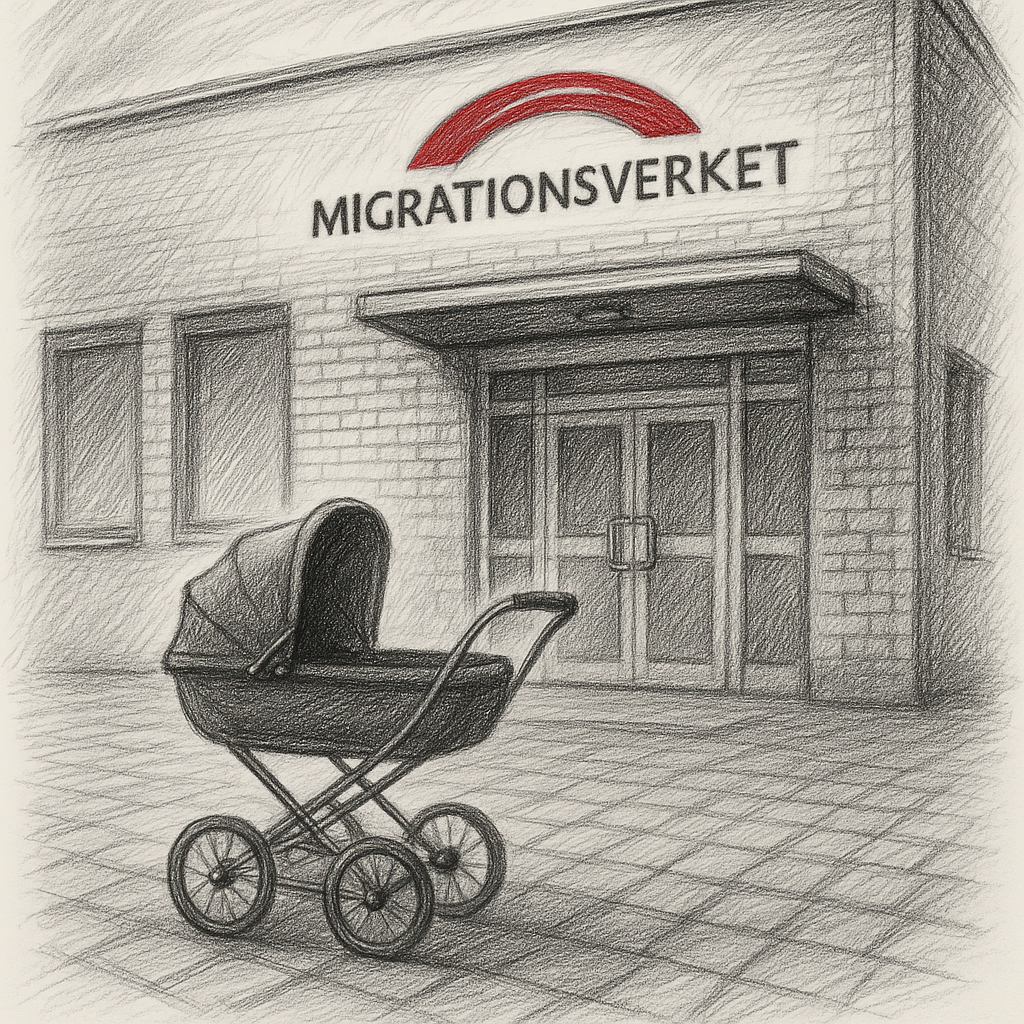
Sweden and the Non-Execution of CJEU Judgment C-195/25 on Asylum and Temporary Protection
A documented case of non-execution of CJEU Judgment C-195/25 in Sweden
Sweden and the Non-Execution of CJEU Judgment C-195/25 on Asylum and Temporary Protection

Executive Legal Statement
In Case C-195/25, the Court of Justice of the European Union held that temporary protection under Directive 2001/55/EC cannot be relied upon to block, suspend, or terminate access to asylum examination under EU law. Member States remain obliged to examine applications for refugee status and subsidiary protection in accordance with Directives 2011/95/EU and 2013/32/EU.
The judgment is binding erga omnes.
This article records a continuing situation in which Sweden has not given effect to that judgment.
Legal Obligations Following C-195/25
Following the judgment, national authorities were under a direct and unconditional obligation to:
— set aside the legal effects of asylum refusals based solely on the asserted existence of temporary protection; — restore access to substantive asylum examination, without requiring the submission of new applications; — adopt a formal and appealable position in cases where execution is declined, ensuring access to an effective national remedy.
These obligations arise directly from EU law, including the principle of primacy and the requirement of effectiveness. Administrative discretion is excluded.
Factual and Procedural Background in Sweden
The case concerns a family consisting of two adults and four minor children.
Reassignment to Temporary Protection
The family applied for asylum in Sweden in 2022.
In 2024, the Swedish Migration Agency reassigned the family to temporary protection under Directive 2001/55/EC. Residence permits under the Directive were issued, and the family’s asylum seeker documentation was withdrawn. This reassignment was justified on the assertion that the family had requested temporary protection.
That assertion was incorrect.
No application for temporary protection had been submitted. The family explicitly opposed being processed under Directive 2001/55/EC. The absence of any application was later confirmed in writing by the Migration Agency itself.
Despite this, temporary protection was treated as an established legal fact, notwithstanding the family’s repeated written objections and formal requests to have the status reviewed.
Administrative Record and Constructed Basis
At a later stage, an unsigned document referring to an extension of temporary protection appeared in the administrative file. The document: — lacked any signature; — did not correspond to the applicable application form; — referred to a procedural step that presupposes a prior valid application, despite the Agency’s own prior written confirmations that no such application had ever been submitted or registered.
The emergence of this document — dated to a time when the relevant protection status did not yet exist — was relied upon to uphold the imposed temporary protection framework under which asylum interviews were conducted and individual asylum refusals were issued to all family members solely on the ground that temporary protection was deemed to apply.
The origin, internal contradictions, and legal impossibility of this document are documented in detail, together with the Agency’s prior written confirmations regarding the absence of any application for temporary protection, in a separate, publicly available record: **“Sweden’s Migration Agency Fabricated an Application — and Turned a Refugee Family With a Newborn Into Targets of Administrative Reprisal.”**
That record provides the factual and documentary background relevant to the present non-execution of C-195/25.
Consequence for the Asylum Procedure
On this sole basis — the asserted existence of temporary protection — the family’s asylum applications were examined and refused within a procedural framework that treated temporary protection as an absolute bar to refugee status and subsidiary protection.
Asylum interviews were conducted and individual refusal decisions were issued to all family members, but no substantive assessment of refugee status or subsidiary protection was carried out. The existence of temporary protection was treated as dispositive.
As a result, the family was confined to a distinct and significantly more limited legal status, excluding access to rights and safeguards attached to refugee status and subsidiary protection under EU law, including those relating to residence security, social protection, and legal remedies.
This practice directly contradicts Swedish law and the binding interpretation of EU law established in Case C-195/25.
Formal Request for Execution and Administrative Silence
– execute the judgment in Case C-195/25; or — adopt a formal, reasoned, and appealable decision refusing execution.
The request expressly stated that references to new applications, informal explanations, or alternative procedures would not constitute execution of the Court’s judgment.
No formal decision was issued.
**On 12 January 2026, the Agency responded by email **only to state that a letter had allegedly been sent by ordinary post “with information regarding the CJEU judgment C-195/25”. No decision was attached, no legal position was stated, and no verifiable notification or appealable act was identified.
This communication constituted neither execution of the judgment nor a refusal decision subject to judicial review.
**On 13 January 2026, a procedural confirmation was therefore submitted,** recording that a reasonable time-limit had elapsed and that no appealable decision or verifiable execution measure had been adopted.
As of that date, the Agency had neither executed the judgment nor adopted a refusal decision, resulting in administrative silence combined with evasive communication and the absence of any effective national remedy against the non-execution of binding EU law.
Systemic Context
Judgment C-195/25 arose from a preliminary reference by a Swedish court, addressing a structural incompatibility between Swedish administrative practice and EU asylum law.
The present record shows that, following the judgment:
— no execution measures have been taken; — no formal refusal decision has been issued; — no procedure has been made available to obtain judicial review of the non-execution.
This is not a matter of interpretation or delay. It is a continued failure to give effect to a binding judgment of the Court of Justice.
Public Record and Continuity
Elements of the family’s situation were publicly documented in Swedish national media in August 2025.
The present record concerns a later and distinct legal issue: the continued non-execution of CJEU Judgment C-195/25 after its delivery, despite a formal request for execution and the absence of any lawful justification.
Closing Record
A binding judgment of the Court of Justice of the European Union has been delivered. Execution has been formally requested.
No execution measure has been adopted. No appealable refusal decision has been issued.
메타데이터
- post_id
- 004fb49f46cd
- slug
- sweden-and-the-non-execution-of-cjeu-judgment-c-195-25-on-asylum-and-temporary-protection-004fb49f46cd
- url
- https://medium.com/@agv82/sweden-and-the-non-execution-of-cjeu-judgment-c-195-25-on-asylum-and-temporary-protection-004fb49f46cd
- canonical_url
- https://medium.com/@agv82/sweden-and-the-non-execution-of-cjeu-judgment-c-195-25-on-asylum-and-temporary-protection-004fb49f46cd
- author_url
- https://medium.com/@agv82
- status
- ok
- fetched_at
- 2026-07-13 06:23:13