The Wind Only Carries One Way
He thought she hated him
The Wind Only Carries One Way
He thought she hated him
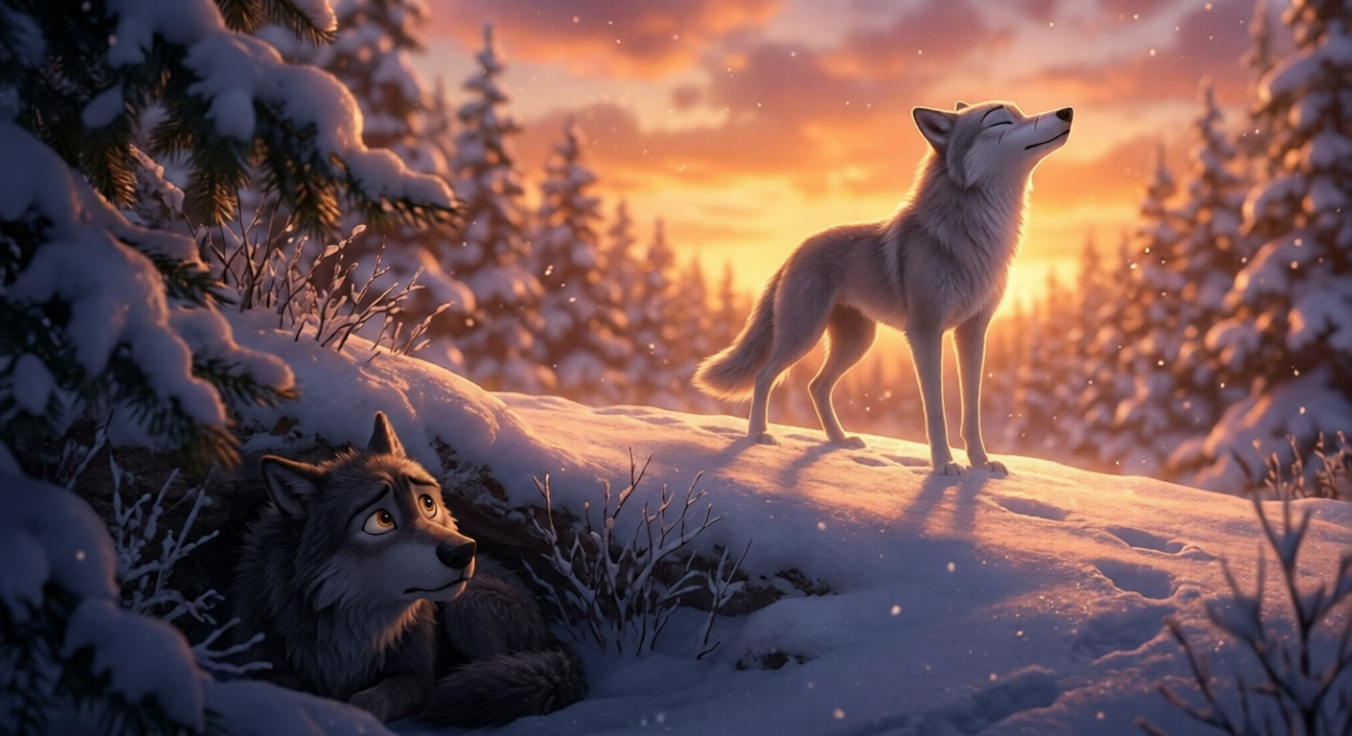
This image is generated using Gemini AI
There was a wolf who lived up in the winter country, on a ridge above a hollow where the snow stayed blue until the sun cleared the trees.
He was grey, going white at the muzzle. He slept in a scrape under a fallen spruce, and he woke before the light, and the first thing he did every morning was lift his nose and find out which way the wind was going.
North, off the snowfields, straight into his face. Good. He shook the frost out of his ruff and started along the ridge, and the cold brought him the hollow below. Old blood on the rocks where the pack had fed. And under that, thin and steady, the five of them bedded down there, and one scent among the five he had known longer than he had known anything.
He kept the wind in his face for an hour. Not once did he let it get behind him.
This is the wolf who bit his mate.
It happened in a hard winter, over meat, and he has not gone near her since. He doesn’t stay up here because he no longer wants her. He stays because the one thing he’s sure of is that she was safer before he came close.
That winter, the pack ran four days and killed nothing, and the young cow they finally opened had almost nothing on her. Every wolf went in at once. That’s what hunger does. It isn’t cruelty. It’s a body that has stopped asking.
He had his head down in the ribs. She came in beside him and pulled at the same strip of meat, and he didn’t look up. He turned on the thing tugging against him, the way any starving wolf turns, and his teeth were shut in her muzzle before he knew whose muzzle it was.
She screamed. She went backwards out of the carcass with the blood coming bright down her face, and she ran.
He stood there with her blood in his mouth and the meat still in front of him, and the hunger was gone. He had slept against her through two winters.
He had carried her the first good piece of everything he ever killed. And he had opened her face over a strip of gristle.
He left that summer. Nobody drove him out. He stopped coming back, and after a while, they stopped looking.
The wound closed by spring, and the fur grew back over it pale and crooked, a small wrong stripe he could see from a long way off.
She never came to him after that. He waited most of a year, and when she didn’t come, he worked it out the only way he knew how: she hated him now, and she was right to. He thought about going down anyway, all one autumn. Some mornings, he got as far as the top of the slope and stood there a long time. Then he remembered he hadn’t chosen it the first time. It had come up out of him before he knew it was coming. So he went back to his scrape. And in the morning, he walked up to the top of the slope again.
He stayed on the ridge, and he chose to be quiet. Quiet did mean nothing. Quiet meant doing everything from far enough back that she’d never find out it was him.
He fed last. Always. He lay in the rocks above a kill and waited out the whole pack, watching her eat from the hindquarters the way she always had, and came down only when the last of them slept. Frozen ribs, mostly. He never thought this was unfair. It was his portion, and some nights it was enough and some nights it wasn’t.
When the hunting went bad, he went out.
He knew before they did. A hungry pack smells different. So he came down alone in the black part of the night and took on things one wolf has no business taking on. He got opened along the shoulder in February and limped into April.
He hauled it to the edge of the willows, where the first wolf awake would walk into it, and went back up and licked whatever was torn. They woke to meat nobody had killed, circled it, ate it, and never worked out where it came from.
He could find her in the wind from half a valley off, and when her scent came up the slope, he was already moving, down through the alders and over the wet ground where the smell of him came apart.
Once she came right up the ridge before he caught her, and he went flat behind a boulder. She crested the rise thirty paces off, stopped, and lifted her head into the air. The wind was moving off her and up to him. It brought him her whole morning, that she was thin, that the crooked stripe had gone white. It brought her nothing back. She couldn’t smell him.
She stood a long while, turning her head. Then she went on down the other side.
The next spring, the old male didn’t come back from something, and a young one took the front of the pack. He watched her go to him. Watched her bed nearer, watched her fall in behind the new one’s shoulder on a run. Something in his chest went down and stayed down. He put his chin on his paws and let it, and he thought, “That’s right, that’s how it should be. That one had never had his teeth in her.”
He didn’t stop. Not one night of it.
Here is what he never learned.
That day on the ridge, she wasn’t crossing anywhere. She had come up with her nose down in his old trail, working the cold ground for a smell that wasn’t in it. She did that more often than anyone noticed.
She had never hated him. Every wolf in that hollow had been half out of their mind that day, and she knew it even with her face still open. What she couldn’t understand was why he wouldn’t come home. She thought he was ashamed, and she was waiting for him to be done being ashamed.
She was still waiting.
He didn’t know that, and he wasn’t going to. From up on the ridge, it looked simple to him. He had hurt her once without meaning to. Everything he had left to give her, he could give from here.
By summer, the meadow below was deep in grass, and the pack crossed it twice a day to water.
He never crossed it. He went around, down through the alders, and up the far side through the rocks. It added an hour. He did it every time, all season long.
By the end of the summer, there was a path worn into the grass where he walked—a thin brown line, curving wide around the open ground, going nowhere near the middle.
The wind moved over the meadow, and the grass leaned. The little path held its shape and stayed empty.
“…perhaps that withdrawal is the only suffering you might be able to avoid.” — Franz Kafka —
메타데이터
- post_id
- 005c705db530
- slug
- the-wind-only-carries-one-way-005c705db530
- url
- https://medium.com/tantalizing-tales/the-wind-only-carries-one-way-005c705db530
- canonical_url
- https://medium.com/tantalizing-tales/the-wind-only-carries-one-way-005c705db530
- author_url
- https://medium.com/@azurciel
- status
- ok
- fetched_at
- 2026-08-18 08:38:14