Amazon’s 16 Leadership Principles Decoded for Career Changers
Most candidates treat these as a memorization exercise. Here’s why that approach fails — and what career changers actually need to know.
Amazon’s 16 Leadership Principles Decoded for Career Changers
Most candidates treat these as a memorization exercise. Here’s why that approach fails — and what career changers actually need to know.
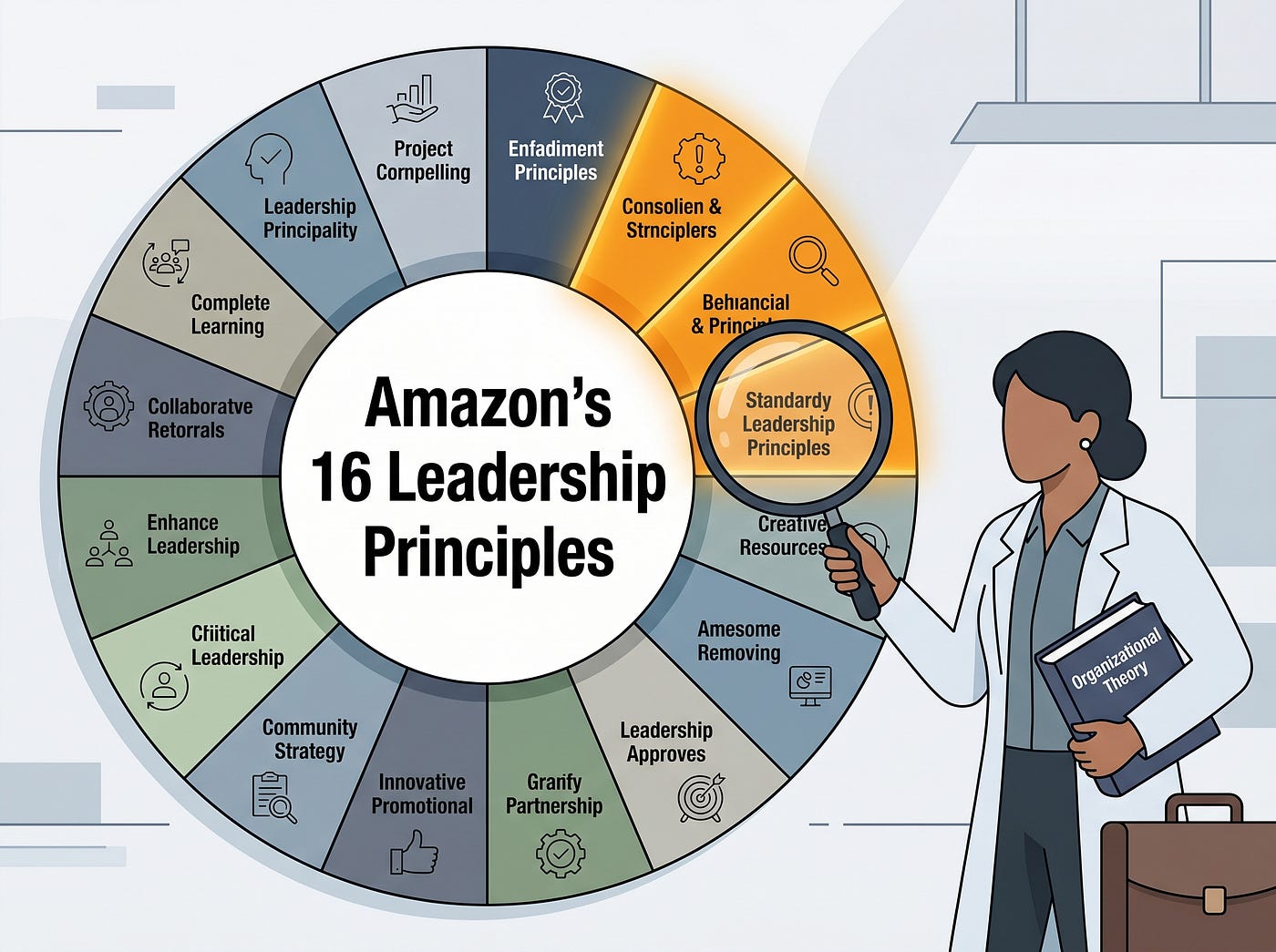
If you’ve started prepping for an Amazon interview, you’ve probably done what most candidates do: you pulled up the 16 Leadership Principles, read through them, and started trying to memorize definitions. Maybe you even wrote a list of stories mapped loosely to each principle.
That approach will get you through the screening call. It will not get you an offer.
The candidates who consistently land Amazon roles don’t just know what the principles say. They understand what interviewers are actually listening for — and that’s a very different skill, especially if you’re coming from a non-tech background where the natural instinct is to frame your experience in terms that don’t map cleanly onto Amazon’s language.
Why Career Changers Struggle With LPs Differently
Here’s something that doesn’t get said enough: Amazon’s behavioral interview is genuinely harder for career changers than for candidates with a traditional tech background. Not because your experience is weaker — it often isn’t. But because the translation problem is more acute.
Someone who’s spent three years as a software engineer at a mid-sized tech company has dozens of stories that fit LP frameworks naturally. They can reach for a “Deliver Results” story about shipping a feature under deadline. They have “Learn and Be Curious” stories about picking up a new framework. The vocabulary of their professional life already rhymes with Amazon’s vocabulary.
If you’re coming from academia, finance, consulting, biology, or any other non-tech field, your experience is just as real — but it’s stored in a different language. The gap isn’t in what you’ve done. It’s in knowing how to decode your own stories through the LP lens.
If that’s where you are, the BQ Preparation System is specifically built for this — it gives you the Story Bank framework and the LP-to-story mapping system that makes behavioral prep systematic instead of a guessing game.
The 3 LPs That Trip Up Career Changers Most
Not all 16 Leadership Principles are created equal in the interview context. Some are tested frequently, some rarely. Some are harder to demonstrate credibly from a non-tech background. Here are three that consistently cause problems:
Customer Obsession. This is Amazon’s most fundamental principle — it anchors almost every leadership conversation. The problem for career changers is that “customer” in the Amazon sense is broader than it sounds. Your thesis committee counts. Your students count. Your internal stakeholders count. The mistake most candidates from academic backgrounds make is assuming they don’t have customer-facing experience when they do. They just haven’t framed it that way. A researcher who redesigned an experimental protocol because a collaborator needed results in a different format demonstrated Customer Obsession. The story needs to be told in those terms.
Ownership. Amazon uses this LP to filter for people who act beyond their formal job description. The signal they’re looking for is: did you see a problem that wasn’t technically yours to fix, and did you fix it anyway? Career changers often have excellent stories here — you volunteered for cross-functional work, you solved something that fell between two teams, you took initiative during a transition period. But if you frame the story as “my manager asked me to look into it,” you’ve killed the Ownership signal. The phrasing matters.
Bias for Action. This one catches people who’ve worked in environments where deliberation is valued — which describes most academic and consulting contexts. Amazon wants to see that you can make decisions with incomplete information and move. The key is showing calculated speed: you gathered the available information, you recognized that waiting for more data would cost more than acting, and you moved. That’s very different from being reckless. But if you don’t explicitly surface the reasoning, it reads as luck.
What Interviewers Are Actually Listening For
Here’s the framework shift that makes the biggest difference: Amazon interviewers are not scoring you on whether you used the right LP vocabulary. They’re scoring you on whether your story demonstrates the behavior that the LP is trying to capture.
You don’t need to say “Customer Obsession” in your answer. You need to tell a story where you put the customer’s need ahead of your own convenience or your team’s default approach. The principle is the rubric. The behavior is the proof.
This means two things. First, over-indexing on vocabulary makes your answers sound rehearsed and hollow. Interviewers hear “I demonstrated Customer Obsession by…” a hundred times. It reads as surface prep. Second, you can demonstrate any LP without using its exact name — which is actually more convincing, because it shows you’ve internalized the concept rather than memorized the label.
The other thing interviewers are scoring is structure. Point-first delivery — leading with the conclusion or action, then walking through the context — reads as confident and senior. Candidates who start with two minutes of context and bury the insight at the end consistently score lower, even when the underlying story is strong. This is a learnable habit, but it requires deliberate practice.
The BQ Preparation System walks through the point-first delivery method with worked examples and gives you a story mapping template specifically designed for non-traditional backgrounds.
How to Decode Your Own Experience Through the LP Lens
The most useful exercise I know for career changers prepping for Amazon is this: don’t start with the 16 principles and try to find stories for each one. Start with your 10–12 strongest professional stories and then run each one through every LP to see which principles it demonstrates.
Most strong stories demonstrate two or three principles simultaneously. A story about navigating a difficult stakeholder situation might show Earn Trust, Disagree and Commit, and Customer Obsession all at once. Once you know that, you can adapt the emphasis of the story depending on which LP the interviewer cues you toward.
This approach also surfaces something important: you almost certainly have more relevant material than you think. A dissertation that you had to defend to skeptical committee members is a story about Dive Deep and Earn Trust. A research project where you had to pivot methodology halfway through is a Bias for Action story. A teaching role where you redesigned your curriculum because students weren’t retaining the content is a Customer Obsession story. The experience is there. It just needs to be decoded.
The One Mistake That Eliminates Candidates at the LP Round
If I had to name the single most common mistake career changers make in Amazon behavioral interviews, it would be this: ending the story at the action instead of the result.
Amazon’s interview rubric is heavily weighted toward demonstrated impact. “I did X” is not a complete answer. “I did X, and here’s what it produced” is. “I did X, and here’s what I would do differently now” is even stronger because it shows the kind of reflective learning Amazon calls Learn and Be Curious.
When you’re preparing stories, every single one needs a clear outcome: a number, a changed behavior, a decision that got made, a project that shipped. If you can’t name a concrete result, the story isn’t ready. This is uncomfortable to discover in prep — it’s worse to discover it mid-interview.
A Different Kind of Preparation
The candidates who handle Amazon’s LP round well aren’t the ones who memorized every principle. They’re the ones who built a small library of genuinely strong stories, practiced delivering them point-first, and know which LP each story speaks to. That’s a system — and like any system, it’s buildable with the right structure.
If you’re preparing for Amazon (or any top tech company that uses competency-based interviews), the work is worth doing properly.
Know exactly where you stand before you walk into any interview.
The First Tech Role Diagnostic Kit gives you 10 AI-powered prompts to diagnose your real gaps — covering resume readiness, behavioral interview prep, and job search strategy. It takes about 45 minutes and tells you exactly where to focus.
If you’re ready to build out a full behavioral prep system with story templates and LP mapping, the BQ Preparation System has everything structured and ready to use.
메타데이터
- post_id
- 0073b0b6cb09
- slug
- amazons-16-leadership-principles-decoded-for-career-changers-0073b0b6cb09
- url
- https://medium.com/@fortunesworkflow/amazons-16-leadership-principles-decoded-for-career-changers-0073b0b6cb09
- canonical_url
- https://medium.com/@fortunesworkflow/amazons-16-leadership-principles-decoded-for-career-changers-0073b0b6cb09
- author_url
- https://medium.com/@fortunesworkflow
- status
- ok
- fetched_at
- 2026-08-09 11:02:11