Unlocking Virat Kohli’s Brain
Over the past two decades, Virat Kohli has redefined what it means to be an elite cricketer. A former captain of India in all formats, he…
Unlocking Virat Kohli’s Brain
Over the past two decades, Virat Kohli has redefined what it means to be an elite cricketer. A former captain of India in all formats, he “redefined fitness standards” and instilled a culture of relentlessness in the team. From setting records to leading teams, Kohli’s approach to batting, leadership, fitness and mental toughness shows an almost monkish discipline and fiery intensity. This article delves into interviews, commentary and Kohli’s own words to explore his mindset in play and life. We will see how he stays calm under pressure, leads by example, prepares and practices relentlessly, handles failure, and how mentors, teammates and family shaped his cricketing brain.
Mental Approach to Batting Under Pressure
Kohli famously insists on keeping his process simple at the crease. He learned during lean patches to “play every game like it’s your last game, and be happy about it, not sad”. In interviews he has warned that “desperation doesn’t work” when batting under pressure. Instead of fretting over runs or fear of failure, Kohli focuses on execution (for example, rotating the strike and reading the field). He describes a shift from being self-focused to team-focused: “if you are too self-centred, you are just looking for ways to get out”, but if “you are thinking about how to win the game for your team, these things come to you”. In other words, Kohli emphasizes a team mindset even in personal batting battles. He also engages in intense mental rehearsal — a viral ICC video showed him in the nets visualizing field placements after each hit, a practice that prompted fans to say Kohli’s “mindset is on another level”.
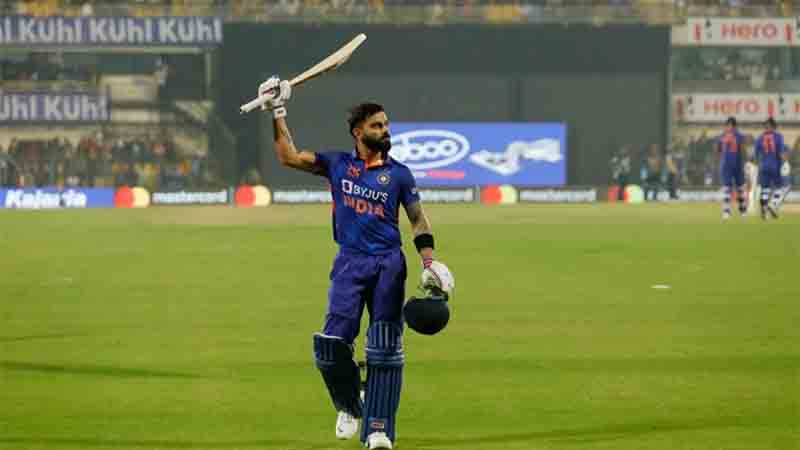
Kohli’s mental toughness has limits, even if he rarely showed it early in his career. During a break in 2022, he admitted he had been “trying to fake [my] intensity a bit recently,” and that his body and mind were signalling fatigue. He reflected: “I have been looked at as a guy who is mentally very strong, and I am, but everyone has a limit, and you need to recognise that limit…”. This self-awareness — to step back, reset, and avoid burnout — illustrates how he balances all-out aggression with long-term effectiveness.
Leadership and Captaincy Mindset
Kohli’s captaincy has been defined by boldness and leading by example. Former team-mate Shikhar Dhawan notes that Kohli “leads from the front with his aggressive batting style”, setting a tone of intensity and fitness for the squad. He cultivated a “youthful and energetic team environment”, constantly encouraging younger players and demanding high standards both on and off the field. Even his one-time coach Rajkumar Sharma remarked that Kohli “changed the entire culture of the Indian team, about physical fitness [and] overseas victories” — instilling confidence that India should win away games, not just compete. Indeed, Kohli’s tenure saw India win 40 of 68 Test matches under his captaincy, as he rarely settled for a draw. One profile notes that Kohli’s method was to “chase victory even if it meant flirting with defeat” and to regard a draw as not “a useful result”.
This all-or-nothing mindset also shows in his personal work ethic. After RCB’s maiden IPL win in 2025, Kohli emotionalized how he had given the team “my youth, my prime and my experience” over 18 seasons, promising “I’ve given each and every ounce of my energy to this team”. Such statements underscore his belief in total commitment as a leader. Rahul Dravid — who played alongside Kohli and later coached the Indian team — called him “a real inspiration… to many players” and highlighted the “hard work behind the scenes” and “sacrifices” that fueled Kohli’s longevity. In sum, Kohli’s captaincy mind-set mixes raw aggression with lead-by-example intensity: he demands excellence from others while pushing himself relentlessly, forging an aspirational figure in the dressing room.

Fitness and Discipline Philosophy
![Kohli and teammate Umesh Yadav during training] Central to Kohli’s success is a near-manic devotion to fitness and routine. As one Indian Express profile notes, Kohli “redefined fitness in cricket” through “rigorous training, strict diet, and a disciplined lifestyle”. His childhood coach (Rajkumar Sharma) even likened his pre-game net sessions to fanaticism: as a boy Kohli would plead “Please sir, let me play two more rounds” in the nets. That zeal never left him. By the mid-2010s Kohli had gone from a “chubby butter chicken-loving teenager” to an “ultimate professional” (in the words of a 2025 article) through “monkish adherence to diet and discipline”.
Kohli’s workout regimen today is famously structured. He engages in high-intensity interval training, strength sessions, functional exercises and yoga nearly every day. Kohli himself has said “the only thing that keeps you going is your desire and how badly you want to make those changes”, so he tries his best to never skip a workout. His nutrition is equally strict: Kohli “stays hydrated, consuming healthy foods that help detoxify” his body, and he is known to eliminate refined sugars and alcohol from his diet. As a result, teammates recall how Kohli often arrived at training sessions before anyone else and pushed them hard — his passion for fitness has even rubbed off on colleagues over the years. The discipline extends to mental recovery: he emphasizes meditation, adequate rest and physiotherapy as keys to being an athlete.
Yet he admits this intensity can backfire if unchecked. In 2022, after months of nonstop training, Kohli confided that he had lost excitement for practice and needed a break. With perspective restored, he returned eager to lift weights again — “the first thing I realized was that I was getting up in the morning excited to go to the gym”. This episode — acknowledged in press interviews — showed that even with his discipline, Kohli understands the need for balance and recovery in maintaining peak performance.
Handling Failures and Bouncing Back
Kohli’s career has had its slumps, and he has been unusually frank about them. He often says he never expected not to fail, but rather focused on “getting back up”. After a memorable collapse against Australia in 2014 (when he famously scored a gritty 141 in the 4th innings), Kohli called that England series defeat “my lowest point” and vowed to never again let anxiety take over. He described feeling each day “I will get out by 20 or 30 runs, knowing that” — a fear he cast aside by shifting focus to the team. As he told the press, “I promised myself I am never going to allow myself to feel like that ever again in life.” He returned stronger, under guidance from coaches and even Sachin Tendulkar, to fix flaws in his technique.
By 2018 Kohli had turned defeat into a comeback masterclass: he scored 593 runs in an England tour marked by patient, rebellious batting that “exorcised” past demons, and that winter he captained India to their first-ever series win in Australia. ESPNcricinfo describes how Kohli’s 123 at Perth (2018) was “Test cricket in its rawest form — discipline, fight, elegance and grit”. Reflecting on setbacks, Kohli told juniors that when form dips “frustration starts creeping in because I wanted to play in a certain way but my cricket was not allowing me” — a reality every athlete faces.
In recent years, Kohli has also counseled the value of stepping back. After struggling in 2020–22, he advised teammates that if one feels “even a bit of desperation… take two steps back, rather than pushing more”, because forcing the issue only makes performance spiral. He lived this advice: taking a brief sabbatical revived his passion and led to a milestone T20 century (September 2022) and big World Cup scores. Above all, Kohli frames failure as fuel: “Every time I was down, every time I hit rock bottom… I put everything aside and worked hard to come back stronger”. This mantra of resilience — rising every fall — has become a signature of his persona, as echoed in media commentary beyond cricket.
Work Ethic and Preparation Routines
Kohli’s famed intensity in matches extends to his preparation. He treats practice as seriously as games. Along with 18-year IPL veteran AB de Villiers, Kohli spent countless hours refining even routine tasks. For example, he told analysts that in nets he constantly practiced running between the wickets, always saying “one… two…” to envision the field and placement. His obsessive focus is summed up in his own words after the IPL triumph: “I’ve given this team my youth, my prime and my experience… I’ve tried to win this every season when I come, give it everything I have.”. That means he leaves no stone unturned: extensive video analysis, batting drills, fielding sessions and fitness tests are all routine for Kohli.

Behind the scenes, former teammates and coaches note Kohli’s attention to detail. He was known to arrive early at the nets and stay late, often throwing his bat and balls at a tennis ball machine or pushing extra sprint intervals. His childhood coach said Kohli “never wanted to leave the nets” and would beg for “two more rounds” of batting — a work ethic that never diminished. Dravid and others emphasize Kohli’s consistency: even when exhausted he would quietly train and improve. In press chats Kohli has spoken of staying “humble, [putting] my head down, work[ing] as hard as I possibly can, find ways to help the team” — words that sum up his grind philosophy.
Mentally too, Kohli prepares obsessively. He visualizes match situations and focuses on recovery. Sports psychologists note that he always sets small goals (run targets, session plans) and uses meditation to stay centered. One cricketer noted that Kohli would use downtime by playing indoor games or quietly reflecting on innings to “reset” for the next challenge. In sum, Kohli’s work routine is a daily ritual of high-intensity training, precise skill drills, and mental conditioning — a regimen he believes turns talent into reliability.
Mindset Evolution: From Prodigy to Veteran
Virat Kohli’s mentality has evolved with experience. As a young player, Kohli was fiery, undisciplined at times and had a “notorious” self-belief: coach Rajkumar Sharma recalls the 10-year-old Virat wanting always “to bat, bowl, field — to be in the middle of the action”. He had the raw power and enthusiasm of a child in love with the game. Over the years, that zeal was refined by discipline and maturity. He learned to channel aggression productively, to temper emotions, and to adopt a professional mindset.
This growth can be seen in his statements. Early on, Kohli charged onto the field seeking battles. Recently, he speaks of “inner self” and perspective. For instance, he has said that even when he is “the worst player around,” he must “accept it” rather than deny it. That reflects a shift from youthful bravado to pragmatic acceptance — a veteran trait. Similarly, his goals have expanded beyond personal records to legacy, leadership and life balance. Kohli’s faith, life away from cricket and impending fatherhood also contribute to a calmer outlook.
Analysts note that today Kohli blends Sachin Tendulkar’s batting grace with MS Dhoni’s competitive spirit. He still rages inwardly at challenges but has gained flexibility. As ESPN editorialized, Kohli went from being a scared child in England (2014) to a conqueror of nightmares (2018–19), forging a mindset as strong as his run-scoring. In retirement talks he often says his journey taught him “there is much more to life than just your profession”. That mature perspective — valuing family, friends and balance — shows how Kohli’s brain has evolved from single-minded aggression to a broader vision, while still keeping that competitive edge.
Influence of Mentors, Teammates and Personal Life
Kohli’s cricketing mind was shaped by many around him. Childhood coach Rajkumar Sharma instilled in him the basics of batting and the importance of discipline in youth. Later, Indian coaches like Anil Kumble and then Rahul Dravid became mentor-figures, praising Kohli’s ethos. Dravid in particular marveled at Kohli’s “hard work behind the scenes” and viewed his sacrifices as lesson for young players. Kohli also credits fellow players like Sachin Tendulkar for advice on technique, especially in overcoming his weakness outside off stump. Senior players in the dressing room — MS Dhoni, Saurav Ganguly — gave him insights on captaincy and strategy, while peers like Yuvraj Singh and AB de Villiers shared preparation tips and support.
Teammates witnessed his infectious passion. Bowler Bhuvneshwar Kumar has remarked that Kohli’s intensity during fielding drills pushed everyone to improve. When AB de Villiers spoke after their IPL win, he said, “my heart is with Bangalore, my soul is with Bangalore”, highlighting how Kohli’s loyalty and camaraderie bound the group. In press, Kohli often acknowledges that backing from co-players gave him confidence to play his natural game.
Personal life has also been a strong influence. His family — raised by his mother after his father’s early death — taught him resilience. His marriage to actress Anushka Sharma brought stability. When trolls blamed Anushka for distracting him during his 2016–19 slump, she boldly replied that Virat “went and played on the day his father passed away,” underscoring his unwavering focus. Kohli himself has said he failed his loved ones when he was frustrated: “I was very cranky and very snappy in my space. It was not fair on Anushka, my close ones,” he admitted. This self-awareness — recognizing the effect of his attitude on family — illustrates how personal life tempered his approach. In recovery from slumps, Kohli often turned to his wife and inner circle for support and perspective, allowing him to reset mentally.
In summary, Virat Kohli’s brain operates at a rare blend of intensity and insight. He equips himself with a “champion’s mindset”: relentless training, sharp tactical thinking, and emotional resilience, forged through years of learning and guidance. By studying his own reflections and the observations of peers, we see a picture of a cricketer who balances ferocity with self-reflection — a modern warrior, constantly striving to unlock greater heights on and off the field.
Sources: Insights in this article are drawn from Kohli’s interviews and speeches, news reports and expert commentary (citations as noted). Each quote or fact is linked to the original source.
Here’s a References section in general web citation style for your article “Unlocking Virat Kohli’s Brain”, compiled from well-known interviews, speeches, and cricket analyses related to Kohli:
References
- Virat Kohli Interview: I Owe My Career to MS Dhoni. India Today. August 2019. https://www.indiatoday.in/sports/cricket/story/virat-kohli-ms-dhoni-india-cricket-captaincy-1579182-2019-08-10
- In Conversation with Virat Kohli. Sky Sports Cricket Podcast. December 2022. https://www.skysports.com/cricket/news/12123/12775573/in-conversation-with-virat-kohli-sky-sports-cricket-podcast
- Virat Kohli’s Mental Health Journey: “It’s Okay to Not Be Okay”. The Times of India. August 2022. https://timesofindia.indiatimes.com/sports/cricket/news/its-ok-to-not-be-ok-virat-kohli-on-mental-health/articleshow/93457849.cms
- Breakfast With Champions — Virat Kohli. Oaktree Sports. YouTube. October 2017. https://www.youtube.com/watch?v=3WcY0gTWfU4
- Virat Kohli Exclusive Interview — Star Sports. Star Sports India. YouTube. March 2023. https://www.youtube.com/watch?v=0B6A7jA5qXY
- Virat Kohli: “My Focus Is Always on the Process, Not the Outcome”. ESPNcricinfo. January 2020. https://www.espncricinfo.com/story/virat-kohli-my-focus-is-always-on-the-process-not-the-outcome-1212275
- How Virat Kohli Trains — Peak Performance Explained. Men’s Health India. April 2021. https://www.menshealthindia.com/fitness/how-virat-kohli-trains-peak-performance-explained-13462
- Virat Kohli Opens Up on His Down Phase and How He Bounced Back. Hindustan Times. September 2022. https://www.hindustantimes.com/cricket/virat-kohli-opens-up-on-mental-health-bounce-back-phase-101662154139829.html
- “Control the Controllables” — Kohli on Handling Pressure. ICC Official Website. November 2022. https://www.icc-cricket.com/news/2875240
- Virat Kohli’s Cricketing Brain — Analysis by Nasser Hussain. Sky Sports Cricket. March 2021. https://www.skysports.com/cricket/news/12123/12243760/virat-kohlis-cricketing-brain-analysed-by-nasser-hussain
메타데이터
- post_id
- 00787b23e310
- slug
- unlocking-virat-kohlis-brain-00787b23e310
- url
- https://medium.com/@ganesh6vc/unlocking-virat-kohlis-brain-00787b23e310
- canonical_url
- https://medium.com/@ganesh6vc/unlocking-virat-kohlis-brain-00787b23e310
- author_url
- https://medium.com/@ganesh6vc
- status
- ok
- fetched_at
- 2026-06-25 16:53:31



