The Last Symposium at Jurassic Park: A Debate on Creation, Chaos, and Control
How Steven Spielberg Gathered a Creator, a Scientist, a Philosopher, and a Skeptic to Debate What Happens When Humanity Creates Life It Can…
The Last Symposium at Jurassic Park: A Debate on Creation, Chaos, and Control
How Steven Spielberg Gathered a Creator, a Scientist, a Philosopher, and a Skeptic to Debate What Happens When Humanity Creates Life It Can No Longer Define
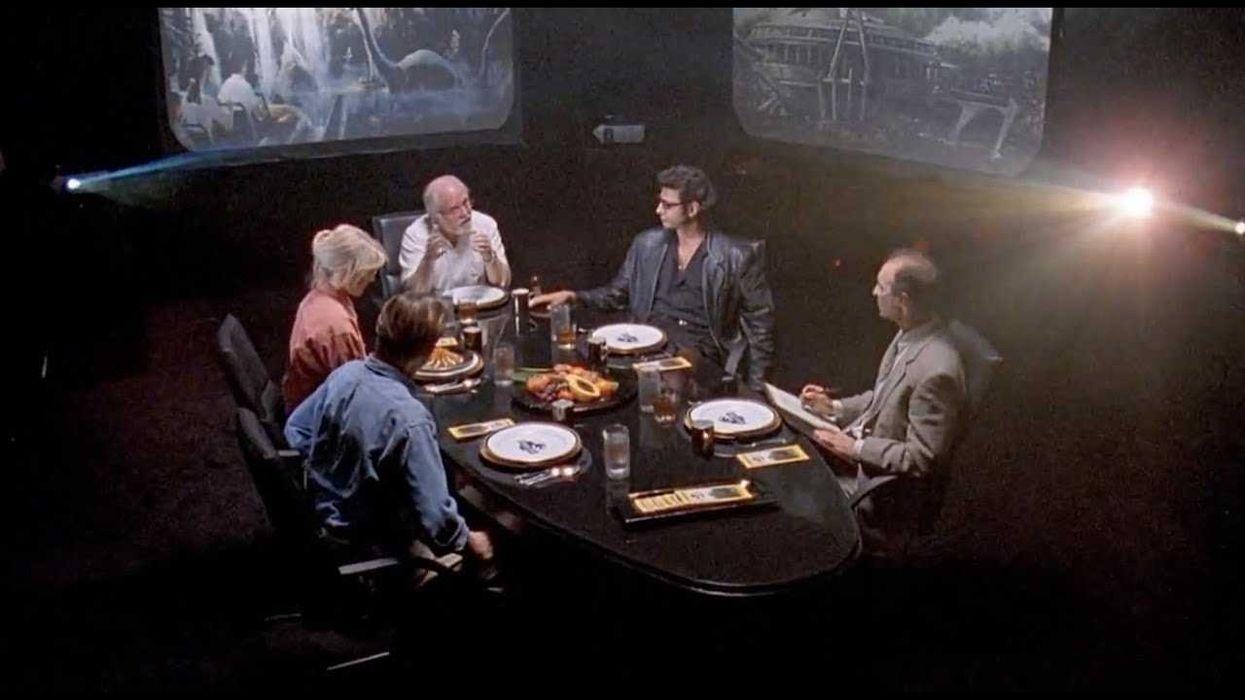
Image: Jurassic Park (1993). Directed by Steven Spielberg. Cinematography by Dean Cundey. Courtesy of Universal Pictures / Amblin Entertainment.
Part I: The Flea Circus
There is a moment near the end of Jurassic Park that almost everyone remembers — but few people stop to examine.
It doesn’t involve the Tyrannosaurus Rex.
It isn’t the kitchen sequence.
It isn’t even Ian Malcolm’s famous declaration that “life finds a way.”
Instead, it is an old man sitting quietly over melting ice cream, reminiscing about invisible fleas.
For a film celebrated as one of cinema’s greatest blockbusters, it is an oddly intimate scene. The dinosaurs have escaped. The illusion of control has collapsed. People are dead. Jurassic Park has failed.
And then John Hammond begins telling a story.
“I had a flea circus… They all moved, motorized of course, but people would say they could see the fleas… But with this place, I wanted to show them something that wasn’t an illusion. Something that was real. Something they could see and touch.”
On a first viewing, the speech feels like little more than a nostalgic confession from a disappointed dreamer.
After more than three decades, I think it’s the key that unlocks the entire film.
When Jurassic Park premiered in 1993, audiences understandably focused on what they had never seen before.
The dinosaurs.
Steven Spielberg’s seamless blend of animatronics and computer-generated imagery changed visual effects forever. Even today, the Brachiosaurus reveal retains an astonishing sense of reality. Laura Dern’s Ellie Sattler looks upward in disbelief. Sam Neill’s Alan Grant instinctively removes his sunglasses, as though no piece of glass should stand between him and what he’s seeing. John Williams’ score rises — not triumphantly, but reverently.
For a brief moment, cinema itself seemed to evolve.
We weren’t simply watching visual effects.
We were witnessing the impossible.
Looking back, it’s tempting to credit technology for that feeling.
But technology alone doesn’t create wonder.
Restraint does.
Spielberg withholds the dinosaurs for nearly an hour. We hear them before we see them. We glimpse movement in distant trees. We watch a cup of water tremble before we ever meet the animal causing it. The audience’s imagination is always one step ahead of the camera.
By the time the Brachiosaurus finally emerges from the forest, we’re already prepared to believe.
That’s what great illusionists understand.
The trick isn’t merely showing the impossible.
It’s preparing an audience to accept it.
Which brings us back to Hammond.
Most viewers remember him as the billionaire whose ambition destroyed his own creation.
That’s true.
But it isn’t the whole truth.
Hammond isn’t introduced as a conqueror.
He’s introduced as a showman.
Everything about Jurassic Park reflects that identity.
The guided tour.
The promotional film.
The gift shop.
The automated ride vehicles.
The carefully choreographed reveals.
Even the Visitor Center resembles a cross between a museum, a theater, and a theme park.
Hammond hasn’t merely cloned dinosaurs.
He’s constructed an experience.
That distinction matters.
Watching the film today, I no longer see Hammond simply as an entrepreneur.
I see him as a creator.
Perhaps even an artist.
That isn’t to suggest Hammond is Steven Spielberg.
Rather, Spielberg understands Hammond because they share the same creative impulse.
Both want audiences to experience something they’ve never seen before.
Both believe wonder has transformative power.
Both construct elaborate experiences that ask us to suspend disbelief.
The difference is that Spielberg never confuses illusion with reality.
Hammond does.
His flea circus wasn’t a failure because the fleas were mechanical.
It succeeded because people wanted to believe.
The audience completed the illusion.
Jurassic Park is Hammond’s attempt to remove that final act of imagination altogether.
No tricks.
No motors.
No invisible performers.
This time, the miracle itself would be real.
It’s one of the most revealing speeches in the film because Hammond is inadvertently describing the history of cinema.
Movies have always been elaborate flea circuses.
Actors pretending.
Painted sets.
Miniatures.
Animatronics.
Visual effects.
Editing.
Music.
Projected light.
We know none of it is real.
Yet we willingly believe.
For two hours, illusion becomes emotionally true.
Hammond is no longer satisfied with that arrangement.
He doesn’t merely want audiences to believe.
He wants to eliminate the need for belief altogether.
That desire transforms Jurassic Park into something far richer than a dinosaur adventure.
The film isn’t fundamentally asking whether humanity can clone dinosaurs.
It’s asking what happens when humanity becomes dissatisfied with illusion itself.
Museums are no longer enough.
Books are no longer enough.
Fossils are no longer enough.
Even cinema, in Hammond’s mind, is no longer enough.
He wants tangible miracles.
Living attractions.
Something people can see.
Touch.
Own.
Market.
The flea circus has become obsolete.
Only living dinosaurs will do.
Thirty years later, Hammond’s dream feels remarkably contemporary.
Whether through artificial intelligence, synthetic biology, gene editing, or virtual reality, we continue pursuing technologies that promise to erase the boundary between representation and reality.
We no longer settle for convincing simulations.
We increasingly seek the thing itself — or something so close that the distinction begins to disappear.
That is why Jurassic Park has aged so remarkably well.
Its dinosaurs may be fictional.
Its central question is not.
Yet Spielberg doesn’t answer that question with action.
Not immediately.
Before the Tyrannosaurus escapes.
Before the Velociraptors begin hunting.
Before Jurassic Park collapses beneath the weight of its own ambitions.
Spielberg quietly pauses the adventure.
He gathers his principal characters around a lunch table.
And for a few extraordinary minutes, one of cinema’s greatest blockbusters becomes something else entirely.
A symposium.
Not about dinosaurs.
But about creation, consequence, and whether humanity has already crossed a line from which there can be no return.
Part II: The Last Symposium
For a few remarkable minutes, Jurassic Park stops being an adventure.
There are no dinosaurs chasing vehicles.
No fences collapsing.
No frantic escapes.
Instead, Steven Spielberg does something almost unthinkable for the biggest summer blockbuster of 1993.
He lets people sit around a table and argue.
It is an astonishing act of confidence.
Most blockbusters build momentum by moving relentlessly from one set piece to the next. Jurassic Park deliberately interrupts its own momentum because Spielberg understands something many filmmakers don’t:
Ideas can generate suspense just as effectively as action.
Long before the Tyrannosaurus escapes, the audience has already been told exactly what is at stake.
Not through exposition.
Through debate.
This is why I think of the scene as the last symposium at Jurassic Park.
In ancient Greece, a symposium was more than a dinner party. It was a gathering where competing ideas were tested through conversation. Philosophers, poets, politicians, and scholars debated questions that could not be settled by force alone.
That is precisely what happens here.
Only instead of discussing justice, love, or politics, Spielberg gathers representatives of different disciplines around one extraordinary question:
What have we created?
Each character offers a different answer.
None of them yet realizes that the island itself is about to decide which answer survives.
John Hammond: The Creator
Hammond begins from wonder.
To him, Jurassic Park is not primarily a business.
It is the fulfillment of a lifelong dream.
That distinction matters because it prevents him from becoming a cartoon villain.
He isn’t trying to destroy the world.
He wants to astonish it.
His famous flea circus speech reveals that desire perfectly. He spent his life creating illusions, only to become dissatisfied with illusion itself. Jurassic Park is his attempt to replace imagination with reality.
For Hammond, creation is justification.
If something magnificent can be made…
why shouldn’t it be?
It is a deeply human impulse.
Artists feel it.
Scientists feel it.
Inventors feel it.
Filmmakers feel it.
The tragedy is not that Hammond dreams too boldly.
The tragedy is that he mistakes the ability to create something for the ability to govern it.
Ian Malcolm: The Philosopher
If Hammond speaks for ambition, Ian Malcolm speaks for humility.
Contrary to popular memory, Malcolm isn’t arguing against science.
Nor is he arguing against curiosity.
He is arguing against certainty.
His famous criticism isn’t really about dinosaurs.
It’s about the mindset that produced them.
“Your scientists were so preoccupied with whether or not they could, they didn’t stop to think if they should.”
That line has become one of cinema’s most quoted warnings because it extends far beyond genetic engineering.
Artificial intelligence.
Synthetic biology.
Autonomous weapons.
Every generation develops technologies whose creators celebrate possibility before society has fully considered consequence.
Malcolm isn’t predicting a dinosaur attack.
He’s identifying a pattern in human behavior.
His mathematics merely gives that pattern a name.
Chaos.
Alan Grant: The Observer
Grant occupies a fascinating position in the debate because he is both scientist and outsider.
Unlike Hammond or Wu, he didn’t create these animals.
Unlike Malcolm, he isn’t primarily interested in abstract philosophy.
Grant wants evidence.
Throughout the film, he repeatedly abandons systems in favor of observation.
The tour tells visitors where to look.
Grant gets out of the vehicle.
The computer says every dinosaur has been counted.
Grant discovers eggs in the wild.
The park insists everything is understood.
Grant keeps finding reasons to doubt that confidence.
His science is grounded not in control, but in attention.
He doesn’t ask what the dinosaurs are supposed to do.
He watches what they actually do.
Ellie Sattler: The Ecologist
Ellie notices what everyone else overlooks.
She isn’t dazzled by spectacle.
She’s studying the plants.
The soil.
The sick Triceratops.
The relationships between living things.
That difference is crucial.
Hammond believes he has recreated dinosaurs.
Ellie immediately recognizes that organisms do not exist in isolation.
An animal is never just an animal.
It belongs to an ecosystem.
To recreate one species without recreating its ecological history is to assume that life can be reduced to individual components.
Ellie quietly rejects that assumption before the park ever fails.
She understands something Hammond does not.
Nature is not a collection.
It is a relationship.
Donald Gennaro: The Investor
Gennaro often receives the least charitable readings because of his famous death.
Yet before any of that happens, he represents an essential perspective.
He sees Jurassic Park as value.
Potential.
Investment.
Return.
He’s not interested in cloning because of scientific discovery.
He’s interested because no one else can sell the experience.
The dinosaurs become assets.
Revenue streams.
Market advantage.
His presence reminds us that revolutionary ideas rarely remain purely scientific.
They almost immediately become commercial.
Henry Wu: The Engineer
Although Wu plays a relatively small role in the original film, his worldview permeates the entire park.
He believes life can be assembled.
Adjusted.
Improved.
Missing genetic information becomes a technical problem waiting for a technical solution.
If dinosaur DNA is incomplete…
fill the gaps.
If reproduction is undesirable…
make every animal female.
If survival outside the park is dangerous…
engineer dependency.
Wu thinks like an engineer because engineering has rewarded that mindset for centuries.
Every problem has a solution.
Every solution creates another problem.
The irony is that Wu never fully realizes he has created organisms rather than products.
Robert Muldoon: The Professional
Muldoon is perhaps the only person on the island who consistently treats the dinosaurs exactly as they deserve to be treated.
With respect.
Not admiration.
Not hatred.
Respect.
He understands predators.
He understands boundaries.
Most importantly, he understands that intelligence cannot be reduced to a security report.
When he says the Velociraptors are testing the fences, he isn’t describing monsters.
He’s describing animals learning.
That observation alone undermines Hammond’s confidence more effectively than any speech Malcolm delivers.
Dennis Nedry: The Inevitable Variable
Popular culture often remembers Nedry as the villain.
The film doesn’t.
Not really.
Nedry is certainly responsible for sabotage.
But Malcolm’s philosophy suggests something more unsettling.
If it hadn’t been Dennis Nedry…
it would have been something else.
A storm.
A software failure.
An overlooked mutation.
An unforeseen behavior.
Nedry isn’t chaos itself.
He is simply the form chaos happens to take.
That distinction changes the entire movie.
Hammond wants someone to blame.
Malcolm argues the system itself invited failure.
None of these people are fools.
That is what makes the symposium so remarkable.
Every person around the table possesses genuine expertise.
Every perspective contains some truth.
And every perspective is incomplete.
Hammond understands creation.
Wu understands genetics.
Grant understands extinct animals.
Ellie understands ecosystems.
Muldoon understands predators.
Gennaro understands markets.
Malcolm understands complexity.
Nedry understands the machinery holding everything together.
The problem is not ignorance.
The problem is fragmentation.
Each person understands one piece of Jurassic Park.
No one — not even Hammond — understands the whole.
That is why the conversation feels so prophetic.
The characters believe they are debating the future.
In reality, they are debating the present.
Everything they argue about has already happened.
The dinosaurs already exist.
The park has already opened.
The ethical decision has already been made.
All that remains is to discover whether reality agrees with Hammond’s optimism…
or Malcolm’s caution.
The answer arrives sooner than anyone expects.
But it will not come from another speech.
It will come from the dinosaurs themselves.
Part III: They Were Never Dinosaurs
One of the most revealing things about Jurassic Park is that almost everyone in the film believes they know what they’re looking at.
John Hammond sees dinosaurs.
Henry Wu sees engineered organisms.
Alan Grant sees living prehistory.
Donald Gennaro sees profitable attractions.
Dennis Nedry sees valuable intellectual property.
Ellie Sattler sees living systems.
Ian Malcolm sees something else entirely.
He sees life.
That distinction may seem subtle.
It changes everything.
For more than thirty years, audiences have casually referred to the animals in Jurassic Park as dinosaurs.
Strictly speaking, they aren’t.
At least, not in the way most people imagine.
The film itself tells us why.
The recovered dinosaur DNA is incomplete.
Entire sections of genetic code are missing.
Henry Wu’s team fills those gaps with DNA from modern species, most famously frogs.
What emerges from the laboratory is therefore not a perfect resurrection of a Cretaceous animal.
It is something humanity has never seen before.
These creatures are assembled from fragments of prehistory, fragments of the present, and the imagination of their creators.
They are neither ancient nor modern.
Neither entirely natural nor entirely artificial.
They are new life.
That is one of the film’s quietest — and most profound — ideas.
This also explains why Jurassic Park continually frustrates its own creators.
Hammond believes he has recreated the past.
Grant initially believes he is finally observing the animals he has spent his life studying.
Wu believes he has engineered predictable biological products.
Each assumption contains a measure of truth.
Each assumption is also incomplete.
The animals refuse to remain within the categories assigned to them.
They breed despite being engineered not to.
They learn despite carefully designed containment systems.
They adapt despite genetic safeguards.
They surprise everyone.
Not because the park made mistakes.
Because life does what life has always done.
It exceeds expectation.
This is where Ian Malcolm’s most famous line deserves a second look.
“Life finds a way.”
Popular culture has often reduced the quote to a joke about reproduction.
The film means something much larger.
Malcolm isn’t merely talking about breeding.
He’s describing the relationship between life and human certainty.
Human beings create categories.
Male.
Female.
Extinct.
Alive.
Natural.
Artificial.
Controlled.
Wild.
Product.
Animal.
Property.
Nature.
Life recognizes none of them.
The moment an organism exists, it begins responding to its own environment rather than humanity’s definitions.
Life doesn’t consult a business plan.
It doesn’t honor a patent.
It doesn’t respect an investor presentation.
It simply continues being alive.
That is Malcolm’s point.
The park’s greatest failure isn’t technological.
It’s philosophical.
Its creators believe naming something means understanding it.
The breeding population illustrates this perfectly.
One of Hammond’s proudest assurances is that every dinosaur has been engineered as female.
No males.
No reproduction.
No future beyond the park.
Then Grant discovers eggs.
The audience naturally experiences this as a plot twist.
It is much more than that.
It is the movie dismantling the central assumption upon which Jurassic Park was built.
Control wasn’t lost that afternoon.
Control never existed.
The illusion simply lasted until someone looked in the right place.
Notice how often the film contrasts maps with reality.
The computers count dinosaurs.
Grant discovers more dinosaurs than the system believes exist.
The fences define boundaries.
The animals ignore them.
The tour follows predetermined routes.
The real encounters happen off those routes.
Again and again, Spielberg places human systems beside living behavior.
The systems fail.
The life continues.
Ellie Sattler understands this almost instinctively.
She never treats the dinosaurs as isolated marvels.
Instead, she keeps asking ecological questions.
What are they eating?
Why is the Triceratops sick?
How are these organisms interacting with the island?
Ellie recognizes something Hammond overlooks.
Creating an organism does not create an ecosystem.
Life is never singular.
It is relational.
Every species exists within countless relationships — with food, climate, bacteria, parasites, predators, competitors, and the landscape itself.
Jurassic Park reconstructs bodies.
It cannot reconstruct sixty-five million years of ecological history.
Henry Wu represents the opposite impulse.
His confidence is understandable.
He solved an extraordinary scientific problem.
Missing DNA?
Fill the gaps.
Control reproduction.
Engineer dependency.
From an engineering perspective, every obstacle appears manageable.
Yet engineering assumes systems behave according to design.
Biology has always been more unruly than engineering.
Genes express differently.
Organisms adapt.
Environments change.
Unexpected relationships emerge.
The very success of Wu’s work ensures that the animals will eventually become more than the sum of his intentions.
Once they are alive, they stop belonging entirely to him.
That may be the deepest irony in the entire film.
Hammond believes he has brought dinosaurs back from extinction.
In reality, he has done something far stranger.
He has created a form of life that has never existed before.
Not dinosaurs.
Not frogs.
Not laboratory products.
Something genuinely new.
That newness matters because it places humanity in unfamiliar ethical territory.
If these creatures are simply restored dinosaurs, perhaps they belong in museums, preserves, or parks.
But if they are unprecedented organisms, then every assumption changes.
Who owns them?
Who is responsible for them?
What rights, if any, do they possess?
Can something created by humanity still become part of nature?
The film never answers those questions directly.
It leaves them hanging over every scene.
That lingering uncertainty also explains why one sequence from Jurassic World: Fallen Kingdom remains so emotionally devastating.
As Isla Nublar is consumed by volcanic fire, a lone Brachiosaurus is left behind on the dock, calling into the smoke as the island disappears beneath ash.
The image works because the audience no longer sees a monster.
Nor even a dinosaur.
It sees a living creature abandoned by the people who created the conditions of its existence.
The ethical question has changed.
Jurassic Park asks whether humanity should create new life.
Fallen Kingdom, however briefly, asks what responsibilities remain once that life already exists.
Those are not the same question.
Perhaps that is why Jurassic Park has only grown more relevant.
When the film premiered in 1993, cloning living animals belonged largely to speculative fiction.
Today, humanity has cloned mammals, edited genomes, and entered an age where synthetic biology and artificial intelligence continually challenge old definitions.
The dinosaurs remain fictional.
The philosophical problem does not.
Every technological generation believes it has finally mastered complexity.
Every generation eventually discovers that creation is only the beginning.
The moment life exists — whether biological, digital, or something we have yet to imagine — it begins interacting with a world far larger than the intentions of its creator.
Hammond believed he had recreated the past.
Malcolm understood something much more unsettling.
Humanity had not resurrected history.
It had introduced something new into it.
And once that happened…
the future no longer belonged to Hammond.
It belonged to life itself.
Part IV: Hammond Already Lost
Popular memory tends to remember Jurassic Park as the story of a park that failed because Dennis Nedry shut off the power.
That isn’t the story Spielberg tells.
It is certainly the story Hammond wants to believe.
If only Nedry hadn’t betrayed him.
If only the storm hadn’t arrived.
If only the fences had stayed online.
If only one thing had gone differently.
The park would have worked.
Ian Malcolm never believed that.
Neither, I think, does Spielberg.
One of the quiet triumphs of Jurassic Park is that it refuses to locate its catastrophe in a single act of sabotage.
Instead, it reveals failure as something systemic.
Nedry steals embryos.
The storm knocks out communications.
The Tyrannosaurus escapes.
The Velociraptors hunt.
The dinosaurs breed.
The computer’s animal count proves incomplete.
Every disaster emerges from a different corner of the park.
No single event causes Jurassic Park to collapse.
Each event simply exposes another assumption that was already waiting to fail.
That is chaos theory in dramatic form.
The catastrophe is not one domino.
It is hundreds.
This changes the way Dennis Nedry should be understood.
Popular culture often reduces him to the greedy programmer whose betrayal doomed everyone else.
He certainly bears responsibility for his actions.
People die because of choices he deliberately makes.
But Malcolm’s argument asks us to think beyond individual guilt.
If the park truly depended upon one disgruntled employee never making a catastrophic decision…
was it ever a stable system?
If it hadn’t been Nedry…
would it have been something else?
A software bug.
A maintenance failure.
A genetic mutation.
A hurricane.
A supply chain interruption.
A simple human mistake.
Malcolm never predicts Dennis Nedry.
He predicts inevitability.
Nedry is not chaos itself.
He is merely the form chaos happens to take.
That distinction is everything.
Notice what Hammond does throughout the crisis.
He searches for causes.
Malcolm searches for assumptions.
Those are not the same thing.
Hammond keeps asking:
“What went wrong?”
Malcolm has already answered:
“You asked the wrong question.”
Because the real question was never whether Jurassic Park could survive a perfect day.
The question was whether it could survive an imperfect one.
Every meaningful system eventually encounters the unexpected.
The test is not whether failure arrives.
The test is how failure behaves once it does.
Jurassic Park fails that test almost immediately.
The breeding dinosaurs provide the clearest example.
No employee caused that.
No sabotage produced it.
No storm created it.
Life itself quietly invalidated one of Hammond’s central assumptions.
By the time Grant discovers the eggs, the audience realizes something unsettling.
The park has already slipped beyond its creator’s authority.
The fences merely delayed everyone else from noticing.
This is why I think Hammond loses long before the helicopter leaves Isla Nublar.
His defeat isn’t financial.
It isn’t physical.
It isn’t even legal.
It is philosophical.
One scene captures it perfectly.
After the survivors regroup, Hammond sits with Ellie Sattler eating melted ice cream.
The optimism that defined him throughout the film has vanished.
He doesn’t defend Jurassic Park.
He doesn’t promise to rebuild.
He doesn’t insist they simply need better security.
Instead, he tells the story of the flea circus.
For the first time, Hammond stops arguing.
He reflects.
It is an extraordinary shift.
The man who spent the entire film insisting his dream would change the world quietly begins questioning the dream itself.
Ellie doesn’t attack him.
She simply refuses to indulge one final illusion.
Jurassic Park wasn’t betrayed by one dishonest employee.
It wasn’t unlucky.
It wasn’t almost successful.
It was fundamentally unsound.
Her words carry remarkable weight because they come from the one person who consistently viewed the park as an ecosystem rather than an attraction.
Hammond finally listens.
That is why the ending feels so different from most blockbusters.
There is no triumphant speech.
No declaration that humanity has learned its lesson.
No promise that the next version will work better.
The survivors simply leave.
The helicopter rises.
The island disappears beneath them.
Then Spielberg gives us one final image.
Pelicans flying over the ocean.
It is a deceptively simple shot.
Grant watches them quietly.
They are modern birds — descendants of ancient dinosaurs — continuing their lives entirely apart from Hammond’s ambitions.
Nature has not ended.
Life has not stopped.
The world continues.
Only Jurassic Park has failed.
The image quietly reinforces Malcolm’s philosophy.
Life always possessed its own trajectory.
Human beings merely imagined they were directing it.
This is also why The Lost World: Jurassic Park is more important than many people realize.
It doesn’t undo Hammond’s defeat.
It confirms it.
When we meet Hammond again, he is no longer trying to reopen Jurassic Park.
He isn’t searching for investors.
He isn’t designing improved containment systems.
He isn’t proposing Jurassic Park 2.0.
He has abandoned the central belief that drove him in 1993.
Instead, he wants to protect the dinosaurs from becoming another commercial attraction.
Whether one agrees with every decision Hammond makes in The Lost World is almost beside the point.
His worldview has fundamentally changed.
The creator has become the protector.
The man who once believed humanity should display living miracles now argues they should largely be left alone.
In a strange way, Hammond has finally arrived where Malcolm began.
Not because Malcolm persuaded him with words.
Because reality persuaded him through experience.
That transformation reveals something remarkable about Spielberg’s film.
Jurassic Park does not end with Hammond being punished.
It ends with Hammond being corrected.
There is an enormous difference.
Punishment satisfies audiences.
Correction changes people.
By the end of the film, Hammond has not become a villain defeated by heroes.
He has become a man forced to surrender one of the deepest convictions of his life.
That surrender is quieter than a dinosaur attack.
It is also far more tragic.
Viewed this way, the ending of Jurassic Park no longer feels like the beginning of a franchise.
It feels like the conclusion of an argument.
Hammond’s vision has been tested.
Malcolm’s philosophy has been tested.
Grant’s observations have been tested.
Ellie’s ecological understanding has been tested.
The dinosaurs themselves have rendered the verdict.
They do not speak.
They do not accuse.
They simply exist.
And by existing according to their own nature rather than humanity’s expectations, they answer every question raised during the symposium.
The debate is over.
Life has already delivered its judgment.
Part V: The Franchise Became Hammond
There is an irony at the heart of the Jurassic Park franchise so profound that it almost feels intentional.
The original film warns against confusing success with permission.
The sequels repeatedly do exactly that.
Not within the story.
As stories.
That doesn’t mean every sequel is a failure.
Far from it.
Some contain remarkable sequences.
Some introduce compelling ideas.
Some genuinely expand the emotional and ethical questions Spielberg first raised.
But taken together, the franchise gradually begins making the same mistake John Hammond made in 1993.
It assumes that because something extraordinary was created once…
it can simply be created again.
This is why The Lost World: Jurassic Park occupies such an interesting place in the series.
It isn’t merely “Jurassic Park again.”
Spielberg deliberately changes the question.
The original asked whether humanity should resurrect extinct life.
The sequel asks what happens after that life already exists.
The dinosaurs are no longer attractions waiting to be unveiled.
They have become wildlife.
Corporations no longer dream of creating them.
They dream of owning them.
Transporting them.
Displaying them.
Profiting from them.
The ethical argument shifts from creation to exploitation.
That is a logical continuation of Hammond’s defeat.
Whether one loves The Lost World or merely finds it decent, it still feels engaged with the philosophical concerns of the original.
It is arguing with Jurassic Park, not merely repeating it.
Jurassic Park III takes a different approach.
It strips away most of the corporate intrigue and philosophical debate, becoming a lean survival story.
In many ways, it resembles an adventure more than a meditation.
Yet even here, one moment stands out.
The Spinosaurus kills the Tyrannosaurus Rex.
For audiences, it was shocking.
The king was dead.
Or at least…
the king we thought we knew.
The scene works because it does something Jurassic Park always did well.
It reminds viewers that certainty is dangerous.
The assumptions carried over from the previous films no longer apply.
The familiar predator is no longer the dominant one.
Nature — or what passes for nature in this world — refuses to honor audience expectations.
It is one of the film’s strongest ideas, even if it isn’t explored much further.
Then came Jurassic World.
It is here that the franchise becomes truly fascinating.
Not because it abandons Spielberg’s ideas.
Because it accidentally confesses them.
The premise appears straightforward.
Jurassic Park has finally become operational.
Families visit every day.
Children stare at dinosaurs while eating ice cream.
Corporate executives discuss attendance numbers.
Marketing departments seek the next attraction.
The dream has succeeded.
And then one executive quietly admits something extraordinary.
People are no longer impressed by dinosaurs.
Think about that sentence for a moment.
Not the characters.
The filmmakers.
By 2015, audiences had spent more than twenty years living in a world where cinematic dinosaurs existed.
The miracle of 1993 had become familiar.
So what does the fictional corporation do?
It creates something bigger.
Smarter.
More dangerous.
More marketable.
The Indominus Rex.
What does Universal Pictures do?
It makes a bigger Jurassic Park.
Smarter effects.
Larger spectacle.
Greater scale.
The corporation inside the movie and the corporation producing the movie arrive at precisely the same conclusion.
Yesterday’s miracle is today’s expectation.
Tomorrow requires escalation.
It is one of the most unintentionally self-aware ideas in modern blockbuster filmmaking.
Ironically, Jurassic World’s greatest moment doesn’t belong to the Indominus Rex at all.
It belongs to the original Tyrannosaurus.
When Claire Dearing releases Rexy to confront the hybrid, something remarkable happens.
The audience isn’t cheering because a new dinosaur has appeared.
They’re cheering because an old one has returned.
John Williams’ music swells.
The queen of the franchise steps into frame.
And for a few brief minutes, the film reconnects with the emotional memory of 1993.
That scene works because Spielberg had already done the difficult work decades earlier.
The emotional investment wasn’t created in 2015.
It was recalled.
Nostalgia becomes the franchise’s most powerful special effect.
Jurassic World: Fallen Kingdom presents perhaps the most emotionally devastating image in the entire series.
As Isla Nublar is consumed by volcanic fire, the Brachiosaurus is left behind, disappearing into smoke while calling helplessly into the sky.
For a brief moment, the franchise rediscovers one of the original film’s deepest ethical questions.
What responsibility do creators owe the life they have already created?
The first film asks whether humanity should resurrect extinct species.
Fallen Kingdom asks something different.
Now that they exist…
can humanity simply abandon them?
Whether the film fully develops that question is open to debate.
But the image itself is unforgettable.
The dinosaurs are no longer attractions.
They are victims of decisions they never made.
Looking across the series, a pattern begins to emerge.
The best moments are almost always the moments that reconnect with Spielberg’s original philosophical instincts.
Wonder.
Restraint.
Moral uncertainty.
Respect for living creatures.
The weaker moments tend to move in the opposite direction.
Bigger dinosaurs.
Larger action scenes.
Greater spectacle.
Escalation becomes the goal.
Wonder becomes the product.
That progression mirrors Hammond’s own mistake.
He begins with awe.
He ends believing awe can be manufactured.
This is where the franchise quietly begins resembling Jurassic Park itself.
John Hammond wanted visitors to experience something so extraordinary that they would never forget it.
Universal wanted audiences to experience something so extraordinary that they would keep buying tickets.
Neither goal is inherently cynical.
Both begin from genuine admiration.
The problem arises when wonder becomes something expected.
Something scheduled.
Something measured through attendance figures and quarterly earnings.
The executives inside Jurassic World respond to audience familiarity by engineering a bigger dinosaur.
Hollywood responds to audience familiarity by engineering a bigger franchise.
The parallel is almost impossible to ignore.
Which brings us back to Ian Malcolm.
His warning was never really about dinosaurs.
It was about human beings.
About the temptation to confuse success with wisdom.
About believing that because something worked once…
it should continue indefinitely.
The original Jurassic Park understood that miracles lose their power when treated as routine.
Wonder depends upon rarity.
Upon restraint.
Upon mystery.
Hollywood often works according to the opposite philosophy.
If audiences love something once…
give them more.
If they love it again…
give them even more.
The franchise gradually follows that logic.
Ironically, it becomes the very attraction Hammond dreamed of building.
Not because the sequels lacked talent.
Not because audiences stopped loving dinosaurs.
But because the series increasingly treated wonder as something that could be reproduced on demand.
That may be the cruelest irony of all.
John Hammond spent an entire film learning that creation does not guarantee control.
The Jurassic franchise spent the next several decades demonstrating how difficult that lesson truly is to remember.
In trying to recreate the miracle of Jurassic Park, it slowly began repeating Hammond’s greatest mistake.
It believed that because wonder had once been manufactured…
it could simply be manufactured again.
The original film knew better.
It understood that genuine wonder cannot be engineered.
It can only be encountered.
And encounters, by their very nature, refuse to happen on command.
Part VI: Life Finds a Way
There is a temptation, when writing about Jurassic Park, to conclude by talking about dinosaurs.
After all, they are the film’s most recognizable achievement.
They transformed visual effects.
They inspired a generation of paleontologists.
They remain among the most convincing creatures ever brought to the screen.
Yet after spending more than three decades with Spielberg’s masterpiece, I have come to believe that the dinosaurs were never the destination.
They were the invitation.
The film’s real subject was always humanity.
That may explain why Jurassic Park feels more relevant today than it did in 1993.
When the film premiered, cloning belonged largely to science fiction.
Today, humanity has cloned mammals.
Gene editing has become an active field of research.
Synthetic biology continues redefining what organisms can become.
Artificial intelligence increasingly challenges old assumptions about creativity, labor, authorship, and even thought itself.
None of these developments are identical to Jurassic Park.
Nor should they be treated as direct parallels.
But they are variations on the same philosophical question.
What happens after humanity creates something it can no longer completely predict?
That is the question Hammond never asks.
It is the question Malcolm never stops asking.
For years, audiences have quoted Malcolm’s most famous line.
“Life finds a way.”
It has become a cultural shorthand for resilience.
For reproduction.
For survival.
I think the film is saying something even larger.
Life refuses ownership.
Life refuses permanence.
Life refuses categories.
Human beings build fences.
Life discovers gates.
Human beings patent genes.
Life mutates.
Human beings classify organisms.
Life evolves.
Human beings insist upon certainty.
Life answers with contingency.
The more I revisit Jurassic Park, the more I believe Malcolm isn’t talking about biology alone.
He is describing existence itself.
That realization transforms nearly every major character.
Hammond believes creation grants authority.
Wu believes engineering grants understanding.
Gennaro believes ownership grants value.
Nedry believes access grants power.
Grant believes observation grants knowledge.
Ellie believes ecology grants perspective.
Malcolm alone recognizes that none of those things grant control.
They grant participation.
Nothing more.
The moment life exists, it enters relationships far larger than its creator.
That is true whether the subject is a dinosaur…
or an ecosystem…
or an idea…
or perhaps, one day, an artificial intelligence.
Creation is never the end of responsibility.
It is only the beginning.
Looking back, I think that is why Jurassic Park has resisted becoming obsolete.
Many blockbusters become technological time capsules.
Their visual effects age.
Their spectacle diminishes.
Their surprises become familiar.
Jurassic Park somehow escaped that fate.
Not because its dinosaurs remain convincing — although they largely do.
Because its ideas continue asking questions no generation has fully answered.
Should every scientific achievement become a commercial product?
Does creating something imply understanding it?
Can complexity ever truly be mastered?
Where does stewardship begin?
When does confidence become arrogance?
Those questions have only grown more urgent.
The dinosaurs simply provided a language through which audiences could begin asking them.
I still remember seeing Jurassic Park for the first time while my family was on a camping vacation.
I wanted to see it so badly that I eventually wore my father down.
We all went together.
My father passed away in 1999.
Over the years, I realized that whenever John Williams’ score begins, I don’t simply remember the film.
I remember that afternoon.
I remember sitting beside him in a dark theater, watching impossible creatures step into the sunlight for the first time.
For a long time, I assumed that memory endured because of nostalgia.
Now I think something else was happening.
The movie never really left me because I was still trying to answer the questions it asked.
When I was a child, I thought Jurassic Park was about dinosaurs.
As an adult, I thought it was about chaos theory.
Now, I think it is about creation.
Not creation in the narrow religious sense.
Nor merely scientific creation.
But the profoundly human desire to bring something new into the world.
A work of art.
A technological breakthrough.
A scientific discovery.
A company.
A child.
Every act of creation contains the same hidden temptation.
To believe that because we made something…
we own it.
Control it.
Define it.
Jurassic Park quietly dismantles that belief.
Again and again.
Perhaps that is why John Hammond’s flea circus remains the most important story in the entire film.
For years, he created beautiful illusions.
Audiences completed them through imagination.
Jurassic Park was supposed to eliminate that final leap of faith.
No invisible performers.
No mechanical tricks.
No need to believe.
Only reality.
In the end, Hammond achieves exactly what he wanted.
He creates something real.
His tragedy is discovering that reality cannot be directed the way illusion can.
Steven Spielberg understood the difference.
Cinema is powerful because it remains an illusion.
It allows us to encounter impossible ideas without confusing them for ownership.
Hammond wanted to cross that boundary.
The film spends the next two hours explaining why he never could.
That is why I believe Jurassic Park is one of the greatest films ever made.
Not because it revolutionized visual effects.
Not because it gave us unforgettable dinosaurs.
Not because it launched one of Hollywood’s most successful franchises.
It endures because it understands something timeless about humanity.
We dream.
We discover.
We invent.
We create.
And every generation eventually confronts the same unsettling truth.
The things we create always become more than we intended.
John Hammond believed he had brought dinosaurs back from extinction.
Henry Wu believed he had engineered predictable organisms.
Donald Gennaro saw lucrative investments.
Dennis Nedry saw stolen property.
Alan Grant saw prehistoric animals.
Ellie Sattler saw living ecosystems.
Ian Malcolm saw something everyone else missed.
He understood that once life exists…
it no longer belongs to the people who created it.
It belongs only to itself.
That was true in 1993.
It is even truer today.
And if the future looks anything like the questions Jurassic Park imagined more than three decades ago…
it will still be true tomorrow.
Because in the end, the film’s most famous line was never really about dinosaurs.
It was about us.
Life…
finds a way.
메타데이터
- post_id
- 007c625e147e
- slug
- the-last-symposium-at-jurassic-park-a-debate-on-creation-chaos-and-control-007c625e147e
- url
- https://medium.com/cinecraft-within-the-film-forge/the-last-symposium-at-jurassic-park-a-debate-on-creation-chaos-and-control-007c625e147e
- canonical_url
- https://medium.com/cinecraft-within-the-film-forge/the-last-symposium-at-jurassic-park-a-debate-on-creation-chaos-and-control-007c625e147e
- author_url
- https://medium.com/@annalkuyperbellettiere
- status
- ok
- fetched_at
- 2026-07-17 08:01:25