How Stablecoin Routing Actually Works: A Developer’s Primer
Most developers encounter stablecoin routing the same way. They ship USDC on Ethereum, it works, and then a product requirement arrives…
How Stablecoin Routing Actually Works: A Developer’s Primer
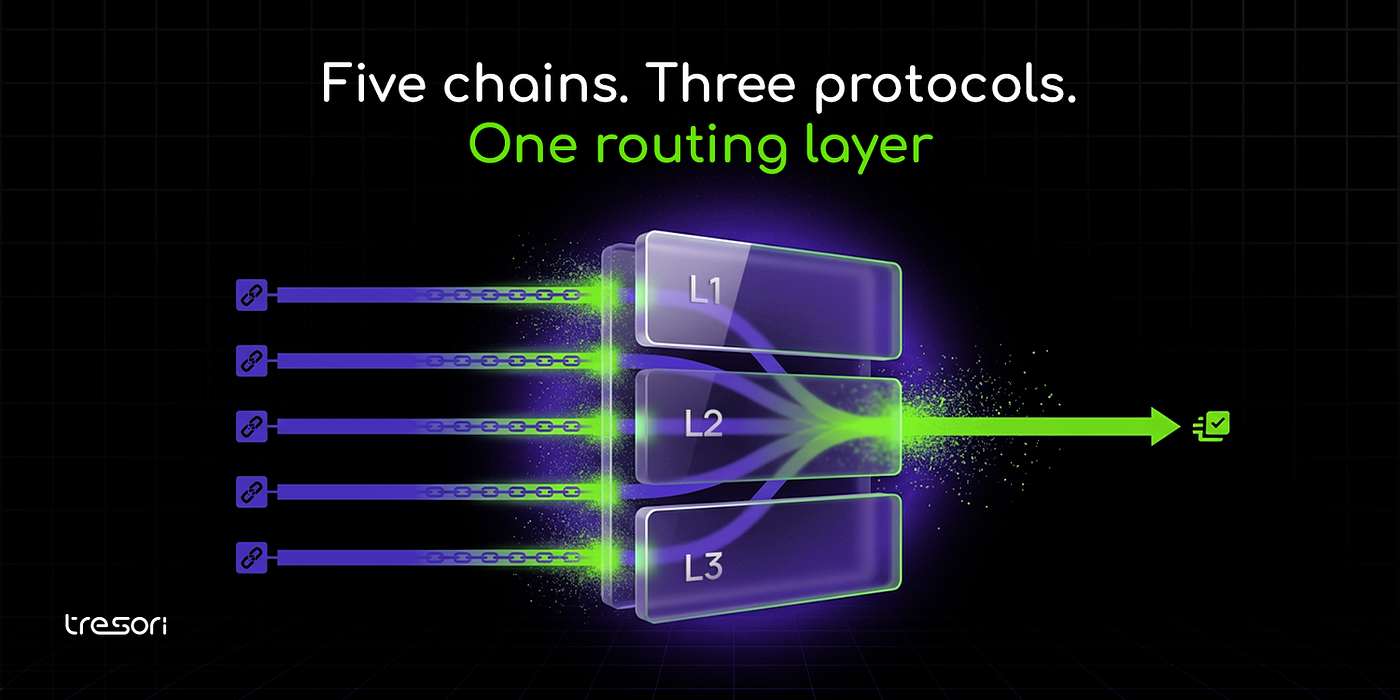
Most developers encounter stablecoin routing the same way. They ship USDC on Ethereum, it works, and then a product requirement arrives: “we need to support Solana.” They integrate a bridge. Then Base. Then Tron, because that is where USDT volume lives. By the fourth integration, they are maintaining four separate transaction flows, four sets of error handling, and four mental models for what “settled” means. The routing problem has not been solved — it has been deferred.
This primer explains how production stablecoin routing works: the decision logic, the protocol selection, the failure modes, and what a routing engine does that a hand-rolled integration cannot.
What a Stablecoin Routing Engine Actually Does
A **stablecoin routing** engine accepts an intent — asset, amount, source chain, destination chain, deadline — and resolves it to an execution path. The routing layer determines the best path, factoring in available liquidity depth, gas costs, bridge fees, and LP spread, all of which compound on high-volume flows.

In pseudocode, the core decision function looks roughly like this:
def route(intent: TransferIntent) -> ExecutionPath:
candidates = []
1. Native issuer rail — preferred when available
if cctp_supported(intent.asset, intent.src_chain, intent.dst_chain):
candidates.append(CCTPRoute(intent))
2. Canonical bridge — for Ethereum L2 pairs
if canonical_bridge_available(intent.src_chain, intent.dst_chain):
candidates.append(CanonicalBridgeRoute(intent))
3. Liquidity network — for speed or unsupported pairs
candidates += liquidity_network_routes(intent)
Score each candidate
scored = [
(route, score(route, intent.deadline, intent.max_slippage))
for route in candidates
]
return max(scored, key=lambda x: x[1]).route
def score(route, deadline, max_slippage) -> float:
speed_score = 1.0 / route.estimated_seconds
cost_score = 1.0 / (route.gas_fee + route.bridge_fee + route.lp_spread)
slippage_penalty = 0 if route.slippage <= max_slippage else -999
return speed_score + cost_score + slippage_penalty
The three candidate types map to the three route patterns that dominate **multi-chain stablecoin settlement** in 2026.
The Three Route Patterns
1. Native Issuer Rails (CCTP)
Circle’s Cross-Chain Transfer Protocol burns USDC on the source chain and mints equivalent USDC on the destination chain using Circle’s attestation service — no wrapped asset, no liquidity pool, no honeypot waiting to be drained. CCTP v2 introduced Fast Transfer mode compressing settlement to seconds on supported chains; Standard Transfer mode anchors to source chain finality, around 13–15 minutes from Ethereum.
When CCTP is available for your asset and chain pair, use it. It is the only route that delivers native USDC on the destination chain without wrapping risk. The tradeoff is chain support — CCTP covers Ethereum, Arbitrum, Base, Optimism, Avalanche, Polygon, and Solana, but not Tron, BNB Chain, or the long tail of L2s where real volume moves.
When to use: USDC transfers on supported chains where you need native asset delivery and can tolerate finality windows.
2. Canonical Bridges
Canonical bridges are the official bridge contracts deployed by L2 teams — Arbitrum’s bridge, Base’s bridge, Optimism’s bridge. They inherit the security of the L2’s rollup architecture and are the correct default for moving value between Ethereum and its rollup ecosystem.
The tradeoff is speed. Optimistic rollup withdrawals (Arbitrum, Optimism, Base in standard mode) require a 7-day challenge period for withdrawals back to L1. For deposits — Ethereum to L2 — settlement is typically 10–20 minutes. Most production payment flows go L1-to-L2 or stay within the L2 ecosystem, so the withdrawal delay rarely matters.
When to use: Ethereum-to-L2 or L2-to-L2 flows where security inheritance matters more than speed.
3. Liquidity Networks
Liquidity networks — Stargate, Across, deBridge, Hop — use pooled or solver-based liquidity to settle cross-chain transfers without waiting for canonical finality. Same-asset transfers on modern intent-based networks clear in under 20 seconds at sub-3 bps; cross-stable routes (USDC→USDT, USDT→USDS) clear in under 45 seconds.
The design distinction that matters for production deployments is pool-based versus intent-based. Pool-based bridges (Stargate) rely on locked liquidity on both chains — shallow pools cause slippage on large institutional transfers. Intent-based bridges (deBridge) use solvers that pull liquidity from wherever it is deepest at execution time — Curve on Ethereum, Jupiter on Solana, USDT reserves on Tron — delivering virtually unlimited depth for stablecoins without pool constraints.
When to use: Cross-chain flows where speed matters more than canonical security, or where the destination chain is not covered by CCTP or a canonical bridge.

The Variables Your Routing Engine Must Score
A naive routing implementation picks the cheapest route. A production routing engine scores across four dimensions simultaneously:
*Gas cost —* source chain gas plus destination chain gas plus any bridge-specific fees. These compound: a $500K transfer from [Ethereum to Solana](https://www.tresori.xyz/)** via a bridge that charges 4 bps plus $15 in gas costs $2,015 in fees before slippage.
Liquidity depth — shallow pools cause slippage on large institutional transfers. A route that looks cheap at $10K becomes expensive at $500K if the pool depth cannot absorb the transfer without price impact. Your routing engine should query on-chain pool depth before route selection, not after.
Finality definition — what “settled” means varies by route. CCTP Standard mode: 13–15 minutes from Ethereum. Across: typically under 2 minutes with fast fill. Canonical L2 bridge deposit: 10–20 minutes. Settlement ranges from 1 second (Solana) to 19 minutes (Ethereum with full finality). Your application needs to define which finality model it can accept before the routing engine can make a correct decision.
Route health — bridges go down. Pools drain. RPC endpoints lag. A production routing engine maintains a health registry and falls back to the next-best route when primary routes degrade. Hard-coding a single route is how production incidents happen.
What This Looks Like in Practice
A payment fintech routing $50K USDC from a wallet on Base to a supplier on Solana in 2026 would evaluate roughly as follows:
- CCTP: supported on both chains — burn on Base, mint on Solana, 400ms-to-seconds via Fast Transfer mode, sub-$1 in fees. Selected.
- Canonical bridge: Base canonical bridge does not route to Solana. Not available.
- Liquidity network: available via Stargate or deBridge, 15–45 seconds, 4–10 bps in fees. Fallback if CCTP unavailable.
The routing engine selects CCTP, constructs the transaction, submits the burn on Base, polls Circle’s attestation service, and submits the mint on Solana. The application receives a confirmation. The supplier receives native USDC. Neither party knows which route was used.
Routing engines decide when to move value on-chain, when to net internally, and how to minimize fees. Internal netting is the underused lever: if your platform has $100K flowing from Base to Solana and $80K flowing from Solana to Base, a production orchestration layer nets the positions and executes a single $20K transfer rather than two.
This is the gap between a multi-chain stablecoin integration and a **multi-chain stablecoin settlement infrastructure.** Tresori’s routing engine evaluates bridge options, gas costs, and liquidity depth per transaction and handles flow netting automatically — the kind of logic that takes a team months to build correctly and requires ongoing maintenance as chain conditions change.
FAQs:
How does stablecoin routing work?
A stablecoin routing engine accepts a transfer intent — asset, amount, source chain, destination chain — and evaluates available execution paths across native issuer rails (CCTP), canonical bridges, and liquidity networks. It scores each path against gas cost, liquidity depth, finality time, and route health, then executes the optimal path. The application sends an intent and receives a settlement confirmation.
What is CCTP and when should I use it?
Circle’s Cross-Chain Transfer Protocol burns USDC on the source chain and mints native USDC on the destination chain without wrapping. It is the safest and cheapest route for USDC transfers on supported chains — Ethereum, Arbitrum, Base, Optimism, Solana, and others. Use it whenever your asset and chain pair are supported. Fall back to a liquidity network for unsupported pairs or when speed requirements exceed CCTP’s finality window.
What is the difference between a canonical bridge and a liquidity network?
Canonical bridges use the L2’s own bridge contracts and inherit rollup security — correct for Ethereum-to-L2 flows. Liquidity networks use pooled or solver-based liquidity for faster settlement across a broader set of chains. Canonical bridges are slower but more secure. Liquidity networks are faster but introduce counterparty exposure to the bridge’s liquidity model.
Why does liquidity depth matter for stablecoin routing?
Shallow liquidity pools cause slippage on large transfers. A route that costs 4 bps on a $10K transfer may cost 40 bps on a $500K transfer if the pool cannot absorb the volume. A production **stablecoin routing** engine queries on-chain pool depth before selecting a route, not after.
What is flow netting in stablecoin settlement?
Flow netting aggregates opposing positions — if $100K is flowing A→B and $80K is flowing B→A, netting executes a single $20K transfer instead of two. It reduces gas costs, on-chain footprint, and settlement complexity significantly for high-volume **multi-chain stablecoin settlement** deployments.
Should I build a stablecoin routing engine in-house?
Building a stablecoin routing engine requires integrating CCTP, multiple canonical bridges, and at least two liquidity networks, plus health monitoring, fallback logic, and flow netting. The integration is achievable. The ongoing maintenance — as chains upgrade, bridges change security models, and liquidity conditions shift — is where in-house builds consistently underestimate the cost. For most teams, the correct answer is to use an orchestration platform that maintains this infrastructure and focus engineering resources on the product layer.
메타데이터
- post_id
- 007d4f1dfea4
- slug
- how-stablecoin-routing-actually-works-a-developers-primer-007d4f1dfea4
- url
- https://medium.com/@tresorinetwork/how-stablecoin-routing-actually-works-a-developers-primer-007d4f1dfea4
- canonical_url
- https://medium.com/@tresorinetwork/how-stablecoin-routing-actually-works-a-developers-primer-007d4f1dfea4
- author_url
- https://medium.com/@tresorinetwork
- status
- ok
- fetched_at
- 2026-08-09 06:38:11