The R – T Framework
Toward a Theory of Rotational – Translational Coherence in Physical, Biological and Engineering Systems
The R – T Framework
Toward a Theory of Rotational – Translational Coherence in Physical, Biological, and Engineering Systems
Author
Dr T.M.R. Tennakoon
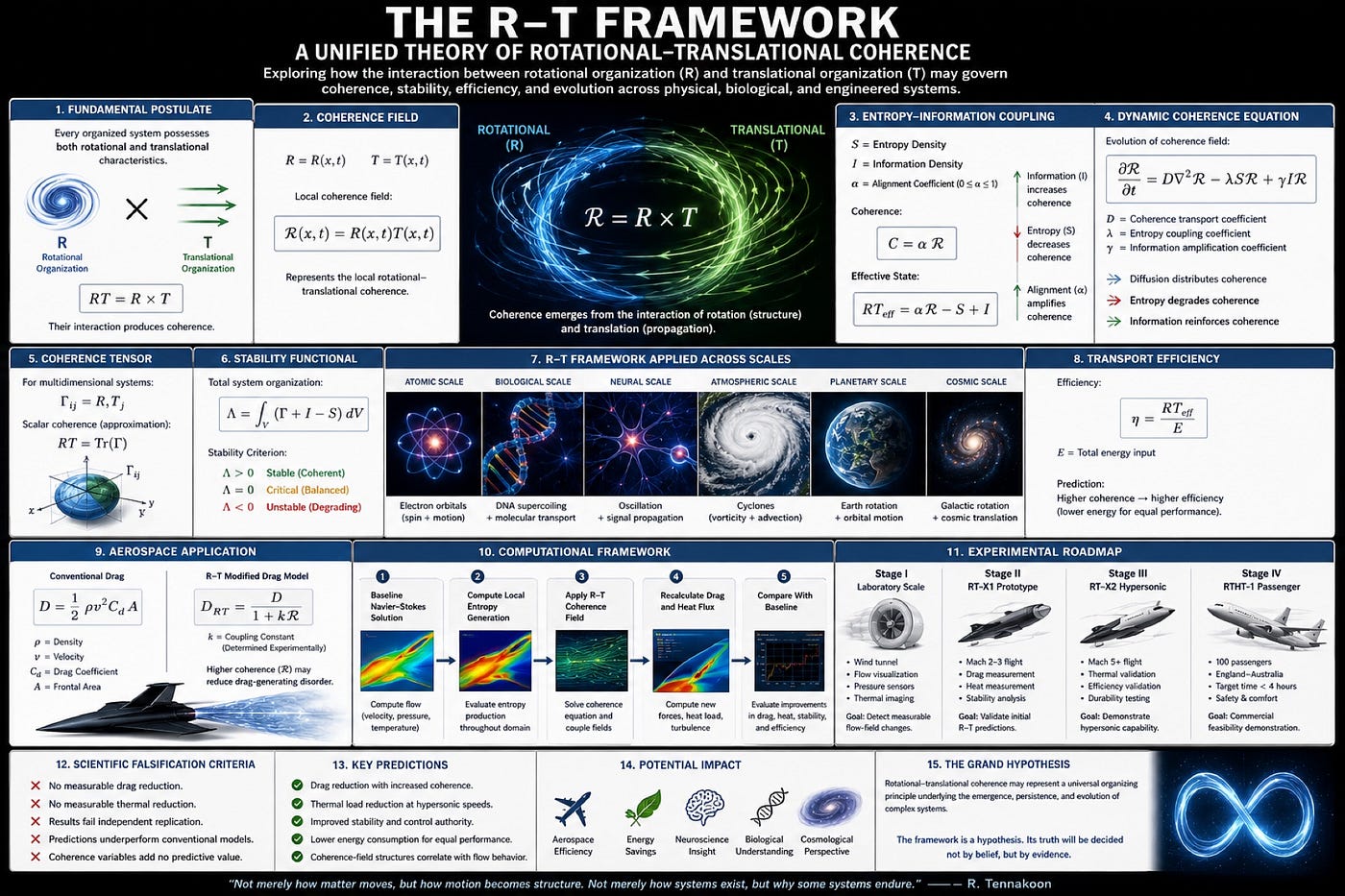
The R – T Framework: Exploring whether rotational translational coherence is a fundamental organizing principle underlying stability, transport, information, and complexity across nature. A hypothesis to be tested by mathematics, simulation, and experiment. not belief.
– R. Tennakoon
Abstract
Throughout nature, organized systems repeatedly exhibit a striking duality: they simultaneously rotate and translate.
From vortices in fluids to planetary systems, from molecular structures to neural networks, rotational and translational dynamics often appear together rather than independently.
This article introduces the Rotational – Translational (R – T) Framework, a theoretical research framework that explores whether the interaction between rotational organization and translational organization can be represented by a common mathematical language across multiple domains of science.
The framework introduces measures of coherence, entropy coupling, information density, transport efficiency, and system stability. It further proposes experimentally testable predictions in fluid dynamics, aerospace engineering, biological organization, and complex systems science.
The framework should be regarded as a hypothesis rather than an established theory. Its value depends entirely upon mathematical development, simulation, experimental testing, and independent verification.
⸻
Scientific Status
Before proceeding, it is important to state clearly what this work is – and what it is not.
The R – T Framework is not presented as established science.
It is not intended to replace existing theories in physics, biology, engineering, neuroscience, or thermodynamics.
Instead, it is proposed as a mathematical and conceptual framework designed to explore whether rotational – translational organization represents a useful and measurable property of complex systems.
The framework should therefore be judged according to the same standard applied to any scientific proposal:
Can it make predictions that reality can test?
Only evidence can answer that question.
⸻
- Introduction
Science has historically progressed by identifying quantities that remain hidden beneath apparently unrelated phenomena.
Force unified terrestrial and celestial motion.
Energy unified mechanics, heat, and electricity.
Information unified communication, computation, and biological coding.
The question explored here is whether another organizational quantity may exist.
Across scales, nature repeatedly produces structures exhibiting both rotational and translational characteristics:
- Atmospheric vortices move while rotating.
-
- Galaxies rotate while translating through space.
-
- Electromagnetic fields contain circulating and propagating components.
-
- Biological systems preserve structure while simultaneously transporting matter and information.
-
- Neural systems exhibit recurrent oscillations alongside propagating signals.
These observations motivate a simple question:
Could rotational and translational organization represent complementary aspects of a deeper coherence structure?
⸻
- Fundamental Postulate
The framework begins with a simple assumption.
Every organized system may be described by two components:
R = Rotational State Function
T = Translational State Function
The lowest-order coherence measure is defined as:
RT = R × T
This expression does not imply that rotation and translation are the only relevant variables.
Rather, it proposes that their interaction may provide a useful measure of organization.
Under this interpretation:
- Rotation contributes persistence.
-
- Translation contributes propagation.
-
- Their interaction contributes coherence.
⸻
- Continuous Field Representation
Real systems vary through space and time.
Accordingly:
R = R(x,t)
T = T(x,t)
Define:
𝓡(x,t) = R(x,t)T(x,t)
where:
𝓡(x,t)
represents the local rotational – translational coherence field.
The framework proposes that variations in this field may correlate with observable changes in stability, transport efficiency, and entropy generation.
⸻
- Information and Structure
Traditional mechanics focuses primarily on motion.
The R – T Framework introduces an additional perspective based on organization.
Let:
Ω(x,t)
represent the structural information state of a system.
The framework hypothesizes:
Ω = f(R,T)
In this interpretation:
Rotation contributes structural retention.
Translation contributes structural distribution.
Complex organization emerges through the interaction of both.
This viewpoint is intended as a complementary description rather than a replacement for existing information theory.
⸻
- Entropy – Information Coupling
Define:
S = Entropy Density
I = Information Density
Introduce an alignment parameter:
α
such that:
0 ≤ α ≤ 1
System coherence becomes:
C = α𝓡
The effective coherent state becomes:
RT_eff = α𝓡 − S + I
Interpretation:
- Entropy tends to reduce organization.
-
- Information tends to increase organization.
-
- Alignment determines the efficiency of interaction.
The framework predicts that systems exhibiting high coherence and low entropy production should operate more efficiently than systems exhibiting low coherence.
⸻
- A Possible Interpretation of Entropy
Classical thermodynamics provides a precise and well-established definition of entropy.
The R – T Framework does not replace that definition.
However, it proposes a complementary interpretation.
Entropy may be viewed as a reduction in rotational – translational alignment.
Symbolically:
S ≈ 1 − α
under specific idealized conditions.
Under this interpretation:
High alignment corresponds to higher coherence.
Low alignment corresponds to lower coherence.
Whether this interpretation proves useful remains an open scientific question.
⸻
- Dynamic Coherence Equation
To describe temporal evolution, define:
∂𝓡/∂t = D∇²𝓡 − λS𝓡 + γI𝓡
where:
D = coherence transport coefficient
λ = entropy coupling coefficient
γ = information amplification coefficient
Interpretation:
- Diffusion distributes coherence.
-
- Entropy degrades coherence.
-
- Information reinforces coherence.
This equation represents a proposed field model requiring future mathematical and experimental investigation.
⸻
- Tensor Extension
Complex systems require multidimensional descriptions.
Define:
Γᵢⱼ = RᵢTⱼ
where:
Γᵢⱼ
represents a coherence tensor.
The scalar equation:
RT = R × T
becomes the simplest approximation of a more general tensor structure.
Potential application areas include:
- Fluid dynamics
-
- Plasma physics
-
- Aerospace engineering
-
- Biological transport systems
-
- Neural networks
-
- Complex adaptive systems
⸻
- Stability Functional
Define:
Λ = ∫V (Γ + I − S)dV
The framework proposes three organizational regimes:
Stable:
Λ > 0
Critical:
Λ = 0
Unstable:
Λ < 0
This quantity is intended as a possible measure of net system organization.
Whether it possesses predictive value remains subject to testing.
⸻
- Biological Interpretation
Living systems continuously resist thermodynamic degradation through organized energy and information processing.
The framework proposes that biological systems may be interpreted as coherence-maintaining structures.
Examples include:
DNA:
Information storage.
Protein synthesis:
Information translation.
Cellular metabolism:
Organization maintenance.
Neural communication:
Information propagation.
Conceptually:
Life may be characterized by:
Γ + I > S
This expression is not presented as a biological law but as a structural interpretation that may guide future investigation.
⸻
- Neural Interpretation
The brain exhibits both recurrent and propagating dynamics.
Examples include:
Rotational characteristics:
- Oscillatory activity
-
- Recurrent circuits
-
- Synchronization patterns
Translational characteristics:
- Signal propagation
-
- Axonal communication
-
- Information transfer
The framework hypothesizes that conscious states may correspond to highly organized coherence states within finite biological constraints.
This remains speculative and requires extensive empirical investigation.
⸻
- Turbulence and Flow Organization
Turbulence remains one of the most challenging problems in classical physics.
The R – T Framework proposes that turbulence may be interpreted as competition between:
Rotational concentration
and
Translational redistribution
Under this interpretation:
Coherent vortices emerge when rotational organization dominates.
Breakdown occurs when coherence collapses.
This proposal suggests potential computational experiments that may be compared directly with conventional fluid-dynamics models.
⸻
- Transport Efficiency
Define:
η = RT_eff / E
where:
E = total energy input
The framework predicts:
Increasing coherence may increase transport efficiency.
This prediction is experimentally testable.
If validated, coherence could become a measurable engineering optimization parameter.
If invalidated, the hypothesis should be rejected.
- Aerospace Application
Classical drag is represented by:
D = ½ρv²CdA
The R – T Framework proposes a generalized modification:
D_RT = D/(1 + k𝓡)
where:
k = experimentally determined coupling constant
The hypothesis predicts that increased coherence may correlate with reduced drag-generating disorder.
This prediction remains entirely hypothetical until verified experimentally.
⸻
- Thermal Regulation Hypothesis
Hypersonic flight is limited primarily by thermal loading.
The framework proposes that increased coherence may reduce irreversible entropy production.
If true:
Thermal flux could decrease without reducing velocity.
This prediction provides one of the most direct opportunities for experimental falsification.
⸻
- Computational Validation Pathway
The framework can be investigated through simulation.
Stage 1:
Solve conventional Navier – Stokes equations.
Stage 2:
Introduce an R – T coherence field.
Stage 3:
Couple coherence, entropy, and flow dynamics.
Stage 4:
Compare predictions against baseline models.
Metrics include:
- Drag
-
- Thermal loading
-
- Stability
-
- Turbulence formation
-
- Energy consumption
⸻
- Experimental Validation Pathway
The framework proposes a progression of testing:
Laboratory Scale
Wind tunnels.
Thermal imaging.
Pressure measurements.
Prototype Scale
High-speed autonomous vehicles.
Flight stability measurements.
Hypersonic Scale
Drag verification.
Thermal verification.
Energy-efficiency verification.
The framework stands or falls according to measurable outcomes.
⸻
- Falsification Criteria
The framework should be considered invalid if:
- No measurable improvements are observed.
-
- Predictions fail replication.
-
- Conventional models consistently outperform the framework.
-
- Coherence variables provide no additional predictive capability.
A scientific idea earns credibility only by surviving attempts to disprove it.
⸻
- The Grand Hypothesis
The central claim of the R – T Framework is modest but ambitious.
It does not claim that rotation and translation are new discoveries.
They are not.
Instead, it asks whether the interaction between rotational and translational organization may represent a useful organizing principle across multiple classes of complex systems.
The answer is currently unknown.
That uncertainty is precisely why investigation is worthwhile.
⸻
Conclusion
The R – T Framework proposes that coherence may represent a measurable property linking organization, transport, stability, information, and entropy.
Whether this proposal ultimately proves correct is secondary to a more important principle:
A framework becomes scientific only when it risks being wrong.
The R – T Framework therefore stands not as a declaration of truth, but as a challenge to reality.
If nature supports its predictions, the framework may prove useful.
If nature rejects them, the framework should be revised or discarded.
Either outcome advances knowledge.
⸻
Author’s Reflection
For centuries, science has measured what systems possess:
Mass.
Energy.
Momentum.
Charge.
Information.
Perhaps an equally important question remains:
How is organization maintained?
The R – T Framework is an attempt to explore that question.
Not through belief.
Not through authority.
But through mathematics, experimentation, and evidence.
Nature alone will determine the answer.
About the Author

TMR. Tennakoon is an independent researcher and founder of R – T Innovation Labs, where he investigates first-principles approaches to complex systems, information dynamics, transport phenomena, biological organization, and mathematical models of coherence.
His work focuses on identifying common structural patterns that appear across traditionally separate disciplines, including physics, engineering, biology, neuroscience, and information theory. Through the development of the R – T Framework, he explores whether rotational – translational organization can provide a useful mathematical language for describing stability, transport, emergence, and complexity across multiple scales of reality.
Current areas of research include:
- Rotational – Translational (R – T) Dynamics
-
- Entropy – Information Systems
-
- Complex Adaptive Structures
-
- Fluid Dynamics and Turbulence
-
- Aerospace Transport Models
-
- Biological Organization and Coherence
-
- Mathematical Models of Emergence
-
- Information Geometry and System Stability
The objective of this research is not to replace established scientific theories, but to investigate whether additional organizational principles exist that may complement current understanding and generate experimentally testable predictions.
R. Tennakoon advocates a first-principles approach to inquiry, emphasizing mathematical consistency, falsifiability, experimental validation, and independent verification.
His guiding philosophy is simple:
“Ideas are not measured by how strongly they are believed, but by how rigorously they survive contact with reality.”
Author: R. Tennakoon
Affiliation: R – T Innovation Labs
Research Areas: Mathematical Physics, Complex Systems, Information Dynamics, Aerospace Concepts, Biological Organization, and Coherence Theory.
“I was not born to follow equations. I was born to become one.”
메타데이터
- post_id
- 008d7d51cb0f
- slug
- the-r-t-framework-008d7d51cb0f
- url
- https://medium.com/@ro317/the-r-t-framework-008d7d51cb0f
- canonical_url
- https://medium.com/@ro317/the-r-t-framework-008d7d51cb0f
- author_url
- https://medium.com/@ro317
- status
- ok
- fetched_at
- 2026-06-09 15:37:30