The Fahnbulleh Force: From Liberia’s “Doyen Diva” to the UK Parliament
From the Apollo Theatre to the UK Parliament: The enduring “Artivism” of Liberia’s Doyen Diva. The “Doyen Diva” Still Kicking It
The Fahnbulleh Force: From Liberia’s “Doyen Diva” to the UK Parliament
From the Apollo Theatre to the UK Parliament: The enduring “Artivism” of Liberia’s Doyen Diva. The “Doyen Diva” Still Kicking It
The Icon: Miatta Fahnbulleh, the Liberian singer who defied social taboos to become a global voice for justice.
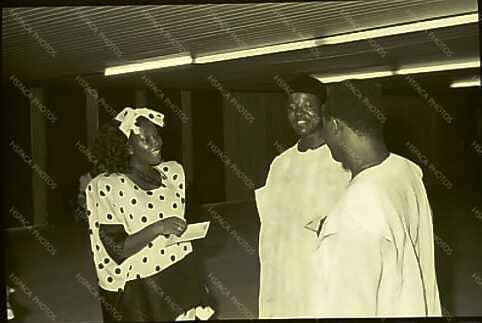
The Discovery: A rare 1990 edition of Arts Illustrated Weekly — preserved for 36 years — captures her at a theatre workshop in Lagos alongside Nobel Laureate Wole Soyinka.
The Publisher: These historical moments were documented by the legendary Hakeem Shitta, whose archive (HSPACA) remains a cornerstone of African cultural history.
The Legacy: While she launches her first album in 30 years — Still Kicking It, her niece and namesake, Dr. Miatta Fahnbulleh, is making history as a Minister in the UK Parliament.
There is a specific kind of gravity that follows Miatta Fahnbulleh. For over five decades, her name has been synonymous with the soul of West African music and an uncompromising pursuit of social justice. Known as Liberia’s “Doyen Diva,” her life has been a masterclass in defiance, defying the social norms that once forbid women of her status from singing, defying political silence during years of conflict, and now, at age 77, defying time itself.
A Harmonious Defiance
Born into Monrovia’s political elite, Miatta was the daughter of diplomat H. Boimah Fahnbulleh, Sr. and the legendary activist Mary Brownell. Despite her lineage, the path to the stage was blocked by tradition. In an era where public performance was deemed “unbecoming” for a diplomat’s daughter, she was forced to find her voice in exile. She traded the shores of Liberia for the grit of New York, studying at the American Musical and Dramatic Academy before gracing the stage of the Apollo Theater in Harlem.
By the time her 1979 hit “Kokolioko” hit the airwaves, she had become a bridge between worlds. Her music, a fusion of traditional folk, soul, and liberation lyrics transformed her into a cultural icon for a continent in transition.
The Lagos Connection: A 36-Year-Old Time Capsule
The sheer weight of her intellectual influence is perhaps best captured in a rare archival moment I recently uncovered while leafing through a vintage edition of Arts Illustrated Weekly (№28, Thursday 14th — Wednesday 20th June 1990). This magazine, a cornerstone of Nigerian cultural documentation, was founded and published by the esteemed photographer Hakeem Shitta.
Within its yellowed pages, published 36 years ago, lies a photograph captured by Shitta himself during a Theatre Workshop at the PEC Repertory Theatre in Lagos. The event, chaired by Nobel Laureate Professor Wole Soyinka, brought together a “who’s who” of Africa’s cultural elite, including Professor J.P. Clark, Dame Taiwo Ajai-Lycett, Nick Robertson (USIS), Elder Steve Rhodes, Tom Lycett, Sola Fosudo, and Professor Chuck Mike.
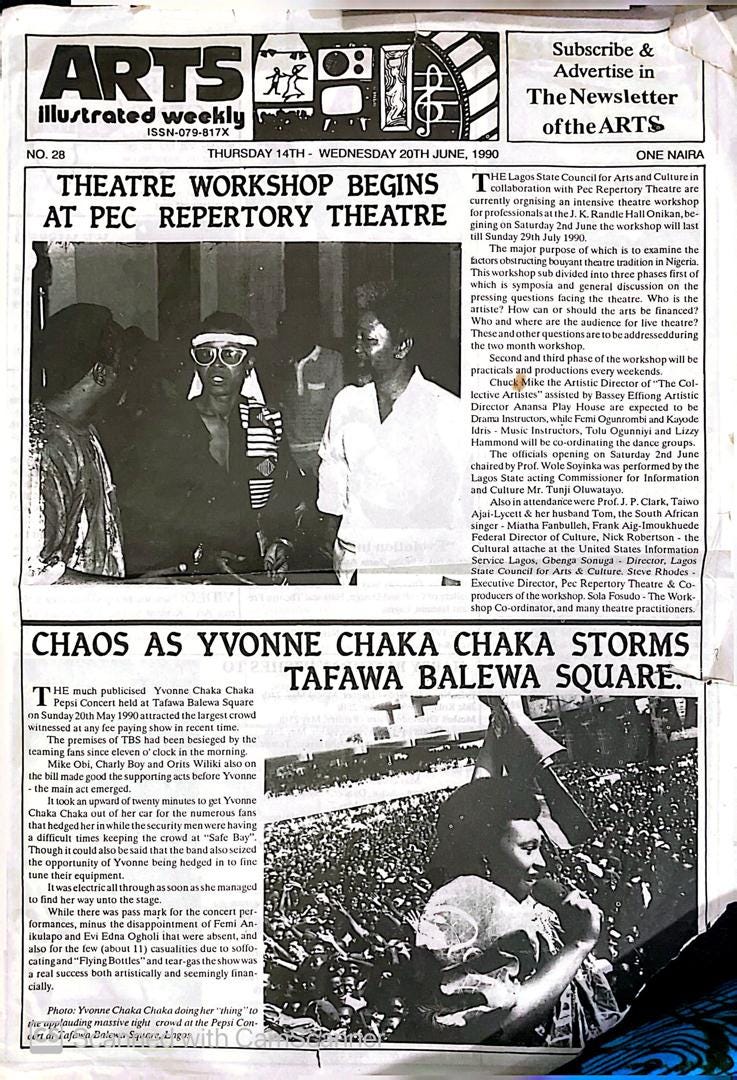
Front page of Arts Illustrated Weekly of 14–20 June 1990, Top picture is Miatta Fanbulleh standing between Oba Gbenga Sonuga and Nobel Laureate Professor Wole Soyinka at the J K Randle Hall during the Theatre Workshop organised by the Lagos State Council For Arts and Culture and PEC Repertory Centre, Photo by Hakeem Shitta. HSPACA
In the photo, Miatta is a peer among titans. The 1990 workshop focused on the “pressing questions facing the theatre,” and by engaging with figures like Soyinka, Miatta reinforced a vital truth: that African music and performance were twin engines of the same liberation movement.
From Stage to Statehood
Miatta’s activism has always been as resonant as her melodies. Upon returning to Liberia, she pivoted from the limelight to the frontlines of human rights. In 2005, she founded Obaa’s Girls Educational Outreach (OGEO), a transformative initiative that has provided over 180 scholarships to young women. Her goal was to ensure that the next generation of Liberian female leaders would never have to seek permission to find their voices.
Her work eventually moved into the halls of government, where she served as a Goodwill Ambassador for Maternal Mortality Reduction and made a bold bid for the Liberian Senate in 2014. For Miatta, the stage and the senate were the same, both were platforms to demand a seat at the table for the marginalized.
A Global Legacy and the British Connection
Today, the Fahnbulleh name carries a new weight on the world stage. Her niece and namesake, Dr. Miatta Fahnbulleh, was elected as the UK Member of Parliament for Peckham in July 2024. A former refugee turned esteemed economist, the younger Miatta now serves as a Minister in the British government. It is a poetic continuation of a family tradition: serving the public and speaking truth to power, whether in the UK Parliament or the streets of Monrovia.
Still Kicking It
Even as she approaches her eighth decade, the elder Miatta is refusing to fade into the background. In August 2025, she released her first studio album in over 30 years, appropriately titled Still Kicking It. Launched in Accra, Ghana, the project is a sonic testament to a spirit that remains unbroken.
“I’m 77, and I thank God I’m still doing it,” she remarked with her trademark spark. “The voice and body are still holding together… I’m still here — still kicking it.” From the vibrant jazz clubs of Harlem to the hallowed intellectual halls of the PEC Repertory Theatre in Lagos, Miatta Fahnbulleh remains a singular force of nature, reminding us that the music of justice gets louder with age.
A Note on the Archives Finding this 1990 photograph in the Hakeem Shitta archive felt like uncovering a hidden piece of history. It serves as a reminder that our cultural icons don’t just exist in memory, but in the physical records we fight to preserve.
I’d love to hear from you in the comments: What role do you think digital and physical archives like HSPACA play in preserving Africa’s cultural identity today? Should more be done to digitize these “yellowed pages” for the next generation?
/miatta-fahnbulleh-liberia-doyen-diva-hspaca-legacy/
메타데이터
- post_id
- 009700cbe7d7
- slug
- the-fahnbulleh-force-from-liberias-doyen-diva-to-the-uk-parliament-009700cbe7d7
- url
- https://medium.com/write-your-world/the-fahnbulleh-force-from-liberias-doyen-diva-to-the-uk-parliament-009700cbe7d7
- canonical_url
- https://medium.com/write-your-world/the-fahnbulleh-force-from-liberias-doyen-diva-to-the-uk-parliament-009700cbe7d7
- author_url
- https://medium.com/@seguncoladimeji
- status
- ok
- fetched_at
- 2026-07-13 06:23:13