Sculling on the River
Not to be confused with rowing or kayaking or canoeing
Sculling on the River
Not to be confused with rowing or kayaking or canoeing
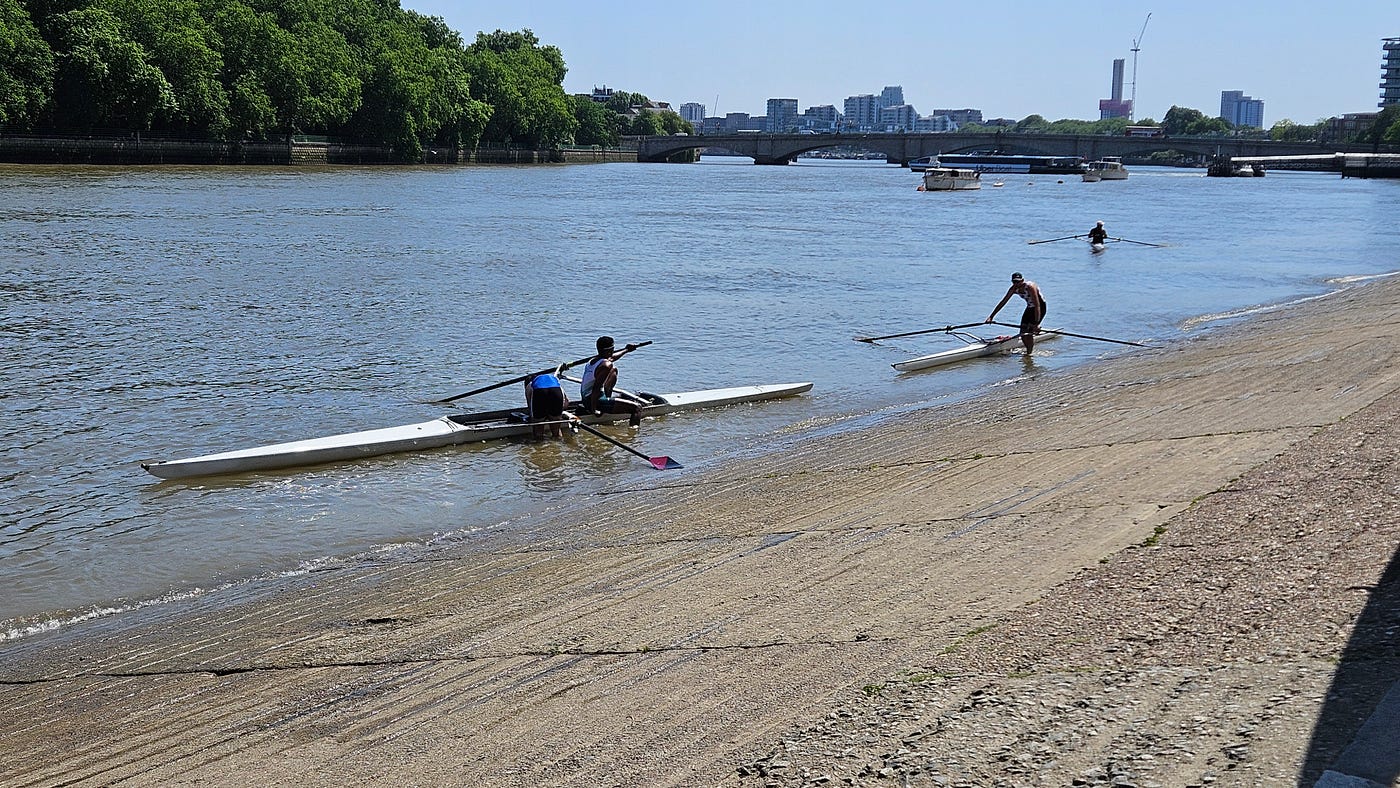
Three scullers at different stages along the river — Credit: Author
Introduction
There are subtle differences between these boating activities on the water, despite oars or paddles being used. There are also differences between the boats themselves. We’re going to delve further and discover what identifies one from the other.
In the main picture, there are three men in single, narrow boats with oars. They have taken part in a sport known as sculling, done in this picture by a single rower (sculler) per boat using two oars (or sculls), one in each hand.
The seats on the boats are sliding seats, and the scullers face backwards.
There are also differences between a scull and a skull — in case you misread the title! One refers to a light, narrow racing boat propelled by one or two people, while the other needs little explanation, but it goes together in the same context as bones.
Kayaking
Another confusion I’ve come across is the difference between a rowing boat and a kayak. Quite simply, the difference concerns the direction of propulsion. Rowers and scullers can’t see the direction they’re going in because they face backwards, while kayakers can see the direction they’re going in because they face forwards.
Furthermore, rowers and scullers use oars that are attached to the boat, as you can see in the main picture. Kayakers, on the other hand, use a paddle (not an oar) that is freely held. So, if nothing else, you can tell a kayaker from a rower or sculler by the direction they’re facing. Simple.
Another feature about kayaking is that the paddle is held in both hands and used on one side and then the other alternately to move forward.
Photo by Michael Hamments on Unsplash
Canoeing
While we’re identifying what’s what, do you know the difference between canoeing and kayaking?
Kayaking uses a double-bladed paddle (as each end needs to go in the water) held in the middle, while canoeing uses a single-bladed paddle held at one end. Remember, both the canoer and the kayaker face forward.
Photo by Lucas Canino on Unsplash
Rowing
Rowing — also known as sweep rowing because it uses sliding seats — is where each rower in the boat holds only one oar in both hands. It’s a different technique from sculling.
Below you can see how each rower has one oar on one side of the rowing boat and sits with their oars attached alternately along the boat.
Photo by David Trinks on Unsplash
The rower closest to the cox (who is sitting facing in the direction of travel) sets the stroke pace and rhythm. The rowers with oars on the same side of the boat as him are known as ‘stroke side’, whereas the rowers on the opposite side are known as ‘bow side’. This is because the front of the boat is known as the bow.
Still confused? Hopefully not! Certainly, searching for images on Unsplash revealed that there’s a lot of confusion naming one sport from another!
Below is another picture showing rowers with each holding an oar on one side alternately along the boat:

Rowers — Credit: Author
A solitary sculler
In the video below, a solitary sculler was with someone in a motorboat behind him, probably having a training session with a coach.
[embed]Credit: Author
Caught a crab
My husband, Andy, used to row when he was at Cambridge University, so he knows a thing or two about the sport. He loves to tell the story of his last row at Cambridge, where he ‘caught a crab’.
No, we’re not talking about a sea creature that walks sideways! Rowing has a vocabulary all of its own. Catching a crab in rowing terms means that, if one of the rowers is a little late in getting his oar out of the water during the normal stroke, it gets stuck in the water and lifts the rower out of his seat.
Unfortunately, on this occasion, Andy crashed so hard back onto the seat that the sliding seat wheels broke, and he could no longer row with the rest of the crew. So, the cox shouted an instruction never heard before:
Stroke side easy-oar while No. 4 leaves the boat!
‘Stroke side easy-oar’ means ‘Stop rowing!’ With that, Andy had to unclip the oar, leave the boat by jumping into the water, and take his oar with him. Meanwhile, he also had to duck and dive out of the way of the other boats, which were attempting to catch up and bump his boat to knock them out of the ‘bumps’ race.
And that, ladies and gentlemen, was the end of my husband’s rowing career at Cambridge University.
Finally…
I trust my explanations have clarified what’s what with boats, oars, and paddles, and brought you some hilarity about what can happen when things go wrong in the rowing world.
Here in London, there are enthusiasts out on the River Thames rowing, sculling, and whatever. The challenge for you now is to identify the sport correctly whenever you see it!
Thank you for reading and watching
People, who’ve asked to be tagged: Aidan Gerard Patrick McCarthy Lu Skerdoo
메타데이터
- post_id
- 00a4dc184a2a
- slug
- sculling-on-the-river-00a4dc184a2a
- url
- https://medium.com/gardening-birding-and-outdoor-adventure/sculling-on-the-river-00a4dc184a2a
- canonical_url
- https://medium.com/gardening-birding-and-outdoor-adventure/sculling-on-the-river-00a4dc184a2a
- author_url
- https://medium.com/@ella_58865
- status
- ok
- fetched_at
- 2026-07-09 05:53:33