Frustration, Emotion, and Injustice: Unraveling the Psychological Roots of the August 2025…
This social phenomenon shows that mass unrest does not arise from a vacuum, but from the accumulation of economic, political, and public…
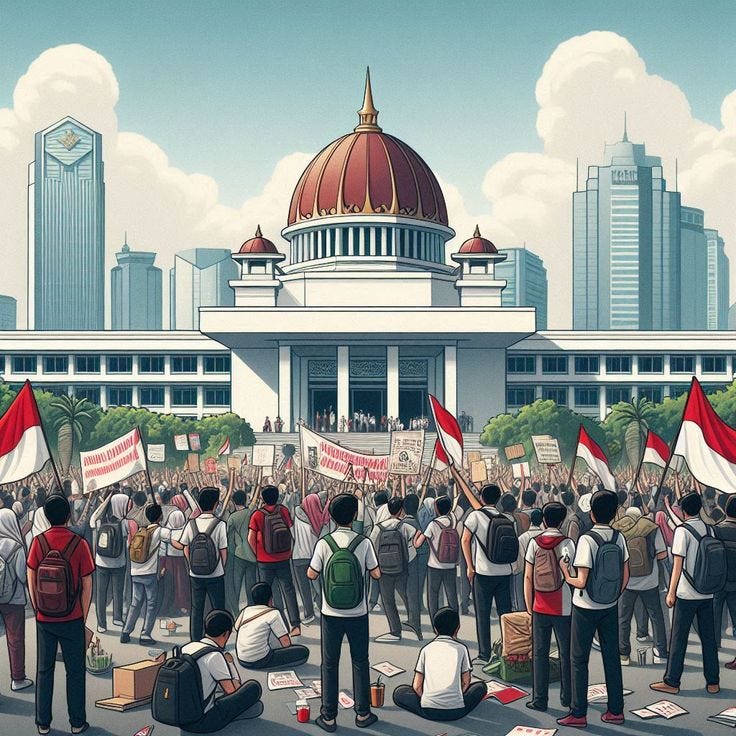
Image of demonstration, pinterest
Frustration, Emotion, and Injustice: Unraveling the Psychological Roots of the August 2025 Demonstrations
This social phenomenon shows that mass unrest does not arise from a vacuum, but from the accumulation of economic, political, and public emotional pressures.
Herdinar Arum Mardhika and Frikson Christian (Master of Psychology, UNIVERSITY of SURABAYA)
What happened in August 2025? The end of August was marked by mass protests in several major cities across Indonesia, with the sounds of car horns and the shouts of thousands of people filling the streets. Posters with demands were displayed in almost every corner of the city, while the air was still filled with tear gas. The demonstrations, which were initially peaceful, turned violent after a viral video circulated showing a tactical vehicle running over and killing an online motorcycle taxi driver. Public anger spread quickly online and triggered a wave of further protests in many areas. From the surge in prices of basic necessities, tax increases in several regions, to the widening gap between the people and public officials, the public felt marginalized by state policies that were supposed to favor the people. The National Human Rights Commission reported around eleven deaths and thousands of arrests during the demonstrations. Through social media, the people expressed their disappointment, betrayal, anger, and growing distrust of the government.
Demonstrations Represent Frustration From a social psychology perspective, demonstrations are understood as a form of collective behavior in which individual emotions, values, and social identities merge into a single social expression. This phenomenon can be understood through the frustration-aggression theory, proposed by Dollard et al (1939), which explains that when public expectations of welfare and justice are hindered by policies that are considered biased, frustration arises and seeks an outlet through aggressive behavior. This perspective is reinforced by further research by Breur and Elson (2017), which confirms that aggression born of frustration is not always destructive; if directed appropriately, it can become a social force that drives change. Mass can be understood not as an act of anger, but as a psychological expression of the need for justice and social recognition. This condition explains how structural pressure is transformed into collective psychological energy. Frustration due to social barriers is not only experienced by individuals, but spreads into public anger that unites the people in a single emotional goal. It can be concluded that when individuals or groups feel obstructed in achieving important goals, emotional tension arises that creates an urge to fight these obstacles. In the context of the 2025 demonstrations, these obstacles took the form of policies that were considered unfair, which triggered protests as a form of venting frustration.
Emotions That Must be Regulated Initially, the people staged demonstrations with the intention of voicing their aspirations peacefully. However, the dynamics on the ground were the opposite of what was planned. As the situation became more precarious and tense, emotions played an important role. Emotional regulation (is an individual’s ability to manage and channel their feelings adaptively) has a significant effect on the crowd’s reaction to provocation and the actions of the authorities (Gross, 2003; Gross & John, 2003). When negative emotions such as anger and disappointment are not managed properly, they become more contagious and increase the potential for violence. Gross (2003) also explains that failure to regulate emotions leads to impulsive reactions, while successful regulation allows angry emotions to be channeled into peaceful and organized action. Therefore, the ability to regulate emotions determines whether a demonstration turns violent or becomes a healthy form of public communication.
The spread of collective emotions in the digital age has further strengthened demonstrations, with social media becoming a platform that accelerates the transmission of emotions between communities, or what is known as emotional contagion (Barsade, 2002; Lui, Chi, & Gamler, 2019). In the 2025 demonstrations, the spread of visual information became explosive. When authorities respond with repressive measures, violence becomes inevitable. Public anger met with violence only widens the circle of social frustration, as explained by Gross (2003): failure to manage emotions can transform emotions that should be adaptive social signals into triggers for destructive actions.
What should be done? These two concepts in social psychology provide further insight into what kind of behavior is recommended to resolve the chaos that has occurred. Through Dollard et al.’s (1939) frustration-aggression theory, society can channel its energy of frustration into more constructive actions. This can be achieved through organized participation and a focus on the goal of change, such as forming discussion groups or peaceful movements to fight for common aspirations, garnering public support through healthy information campaigns, and avoiding provocations that could trigger violence. Furthermore, through Gross’s (2003) theory of emotion regulation, what can be done is to manage and direct emotions to remain adaptive in the midst of stressful situations. Steps that can be taken are to conduct group reflection before the action begins, make an agreement not to be provoked, calm each other down when the situation heats up, and maintain focus on the substantive message to be conveyed.
The next step is to practice emotional awareness in order to control emotions and become more productive. This requires long-term social emotional education for the community. Goleman (1995) explains that effective emotional education is carried out in three stages. The first stage is awareness, which involves increasing self-awareness of emotions that arise in social situations. Second, self-regulation, which trains individuals to manage negative emotions without suppressing or exploding them. Third, social skills, which channel emotions constructively in social interactions. With emotional intelligence, the community will understand that emotional management is done as an ability to channel emotions for better social purposes.
In this context, several theories, such as frustration aggression (Dollard et al., 1939) and emotion regulation (Gross, 1998; Goleman 1995), emphasize that demonstrations are a form of public communication which, if managed properly through emotional education, can become a means of positive social change.
메타데이터
- post_id
- 00a588dd146f
- slug
- frustration-emotion-and-injustice-unraveling-the-psychological-roots-of-the-august-2025-00a588dd146f
- url
- https://medium.com/@herdinarmardhika14/frustration-emotion-and-injustice-unraveling-the-psychological-roots-of-the-august-2025-00a588dd146f
- canonical_url
- https://medium.com/@herdinarmardhika14/frustration-emotion-and-injustice-unraveling-the-psychological-roots-of-the-august-2025-00a588dd146f
- author_url
- https://medium.com/@herdinarmardhika14
- status
- ok
- fetched_at
- 2026-07-23 18:19:11