Your Passport Is Not a Travel Document. It’s Infrastructure.
The BBC just ran a piece on it. I’ve been building frameworks around it for twenty years.
Your Passport Is Not a Travel Document. It’s Infrastructure.

The BBC just ran a piece on it. I’ve been building frameworks around it for twenty years.
https://www.bbc.com/travel/article/20260318-the-rise-of-the-backup-passport
The backup passport has gone mainstream.
Global citizenship firms are reporting a client base that looks nothing like the old stereotype — the discreet billionaire, the offshore planner, the tax exile. Today’s second-passport buyer is a founder with staff in three countries. A family whose children are approaching university age. An entrepreneur who watched the 2022 sanctions response and quietly asked: What if my banking depends on a government that has already demonstrated it can freeze anyone?
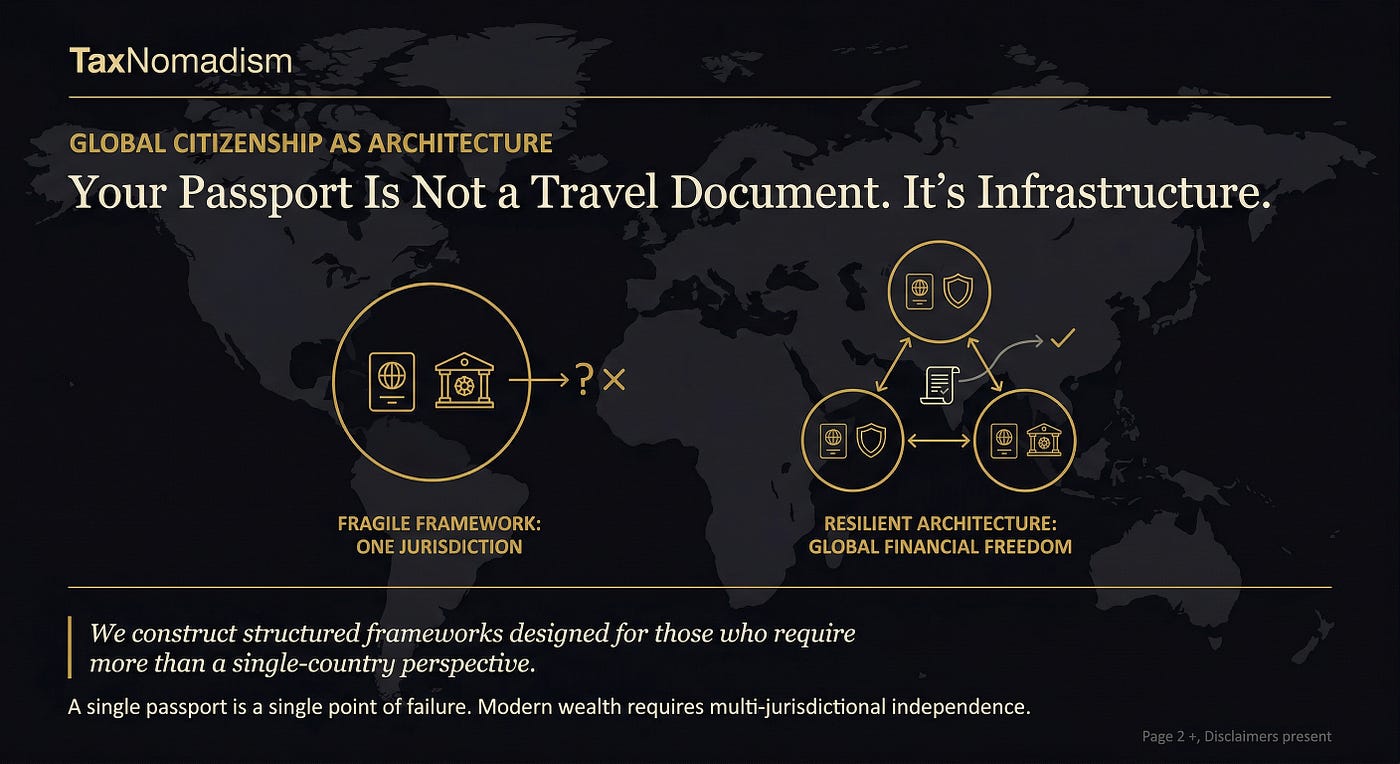
The BBC calls it the rise of the backup passport. I call it what it actually is: the belated recognition that citizenship is infrastructure, not identity.
And most people are still building it wrong.
The Moment Everything Changed
On February 25, 2026, the UK government tightened entry rules for dual nationals. Millions of British citizens living abroad — many of whom had never bothered renewing a UK passport they hadn’t used in years — discovered, abruptly, that their second nationality no longer got them home.
Boardings denied. Families scrambling. A 70-year-old British art historian in New Zealand weighing the cost of renunciation against the bureaucracy of reconnection.
This was not a crisis of terrorism or fraud. It was a digital systems update. The UK’s Electronic Travel Authorisation rollout simply required carriers to verify the right of abode before departure — and millions of people discovered that their citizenship, real and unambiguous as it was, had become unverifiable without the right document.
This is what happens when you treat your passport as a bureaucratic accessory rather than a structural asset.
But the UK dual-national story is the minor version of what I want to talk about.
First, a Distinction the Mainstream Keeps Getting Wrong
Before we go further, let’s name the confusion that runs through almost every popular article on this subject — including the BBC’s.
A residency permit and a second passport are not the same instrument. They are not interchangeable. And conflating them is one of the most common and costly mistakes in this space.
A Golden Visa gives you an address in a jurisdiction. A tax nexus. A banking anchor. The right to live there, potentially. It is a valuable tool — but it operates entirely at your home government’s discretion. If your home country imposes an exit ban, freezes your assets, or revokes your residency rights, a Golden Visa in another country does not protect your legal identity. It protects your mailing address.
A second citizenship gives you something categorically different: a legal identity that exists independently of your home government’s permission. When enforcement runs your data, a second passport means you exist in a different legal system — one the algorithm at 3:47 in the morning cannot reach through the same cascade.
This distinction is not semantic. It is the entire architecture.
In my TaxNomadism framework, I map it this way:
- Your citizenship and passports are your Hardware — the physical foundation on which everything else runs. This is the layer that determines what is fundamentally possible when systems come under stress.
- Your banking relationships are your Operating System — the layer that enables your wealth to function across borders.
- Your assets and investments are your Software — the applications that generate value.
A Golden Visa is an Operating System upgrade. A second citizenship is a Hardware upgrade. They solve different problems. They protect against different threats. And sequencing them incorrectly — or substituting one for the other — leaves you exposed in ways that only become visible when the cascade starts.
The Problem Isn’t the Travel Document. It’s the Architecture.
Most people spend years perfecting their Software. Some invest in their Operating System. Almost no one thinks systematically about their Hardware until it fails.
Hardware failures are the most catastrophic. Because they are the most immutable.
Here is the failure mode the mainstream conversation is beginning to name, but that very few advisors are trained to diagnose:
A second passport obtained without a banking strategy is a door with no building behind it.
I have seen it dozens of times. A family acquires a Caribbean CBI passport — legitimately, compliantly, at considerable expense — and then attempts to open a bank account in Singapore or Zurich with it. The compliance officer sees a St. Kitts document paired with a Frankfurt address, a Russian-origin name, and a business registered in a jurisdiction that flags for enhanced due diligence. The nexus doesn’t hold. The account doesn’t open.
They bought Hardware that doesn’t run any Operating System they actually need.
The reverse error is equally dangerous. A family acquires a UAE Golden Visa, establishes banking in Dubai, and believes they have achieved genuine jurisdictional independence. They have not. They have an Operating System anchor in one jurisdiction. Their Hardware — their legal identity, their algorithmic data points, their country of birth on every bank account ever opened — remains entirely inside their home enforcement zone.
Both errors feel like progress. Neither provides genuine sovereignty.
The Demonstration That Changed Everything
In February 2022, the world watched Western governments freeze billions in assets within hours. Most people saw it as something that happened to Russians.
I saw it as a live demonstration of capability — proof that the infrastructure to freeze anyone, anywhere, within hours, now exists permanently.
The same algorithms. The same compliance protocols. The same enforcement speed. Different targets.
A $250 political donation in Canada. A father’s government job from 2003. A WeChat comment about real estate policy. A legal business partnership with a Russian national.
Four people. Four continents. Four completely legal activities. Assets frozen, no judicial review, no prior warning.
The composite figure at the centre of my framework — I call her Elena Volkov — was a British citizen for fourteen years. Perfect compliance. £400,000 invested in elite advisors. Seventeen banks across six countries. Her Russian birthplace, declared transparently on every form that asked for it, triggered a compliance cascade that froze £47 million in four hours and twenty-nine minutes.
Her British passport could not reach the algorithm in time.
She had complexity without structure. Diversification without independence. And crucially, she had an Operating System that appeared sophisticated but ran entirely within a single enforcement zone. When that zone moved, all seventeen banks moved simultaneously.
Marcus Thompson witnessed the same event that morning but made a different decision. Eighteen months and £700,000 later — UAE Golden Visa for Operating System independence, Antigua citizenship for Hardware redundancy, banking across four genuinely non-coordinated jurisdictions — his net worth grew from £67 million to £89 million while Elena’s fell from £47 million to £28 million.
The difference was not intelligence. It was architecture — and the decision to build it in the right sequence, before it was needed.
The Implementation Sequence That Actually Works
Most people do this backwards. They optimize taxes first, acquire whatever passport is cheapest second, and wonder later why their structure fails a compliance review.
The correct sequence is:
Hardware independence first. Residency or citizenship in a non-allied jurisdiction, established before moving assets. This gives your legal identity somewhere to stand, outside the enforcement zone targeting you.
Operating System next. Banking relationships across genuinely independent jurisdictions — not five accounts in Five Eyes nations, but real positions in Singapore, UAE, or Switzerland, with established compliance history and a coherent nexus narrative.
Tax optimization last. Optimization built on fragile infrastructure is a better-looking prison. Once the Hardware and Operating System are sound, the tax layer compounds efficiently and durably. Done first, it creates visibility without protection.
The Windows That Are Still Open — And the Ones That Have Closed
Portugal’s Non-Habitual Resident regime: closed to new applicants.
The €100,000 Caribbean passport: permanently gone after the 2024 Memorandum of Agreement established pricing floors across the five Caribbean CBI programs.
CARF — the framework bringing cryptocurrency into the same automatic exchange regime as your bank accounts: live across 67 jurisdictions as of January 2026.
EU beneficial ownership registers, publicly searchable: July 2026.
What remains:
The Caribbean five — St. Kitts, Antigua, Grenada, St. Lucia, Dominica — still offer legitimate, compliant second citizenships for as little as $200,000 on the donation route, with processing times between three and nine months. Grenada’s E-2 treaty with the United States remains strategically irreplaceable for Americans considering expatriation. Antigua offers the best family pricing of the five.
Paraguay’s SUACE program combines territorial taxation, 100% renewable energy independence, and genuine supply-chain resilience — at an implementation cost accessible to families who consider Caribbean CBI pricing out of scope.
These windows are open. None of them is permanent.
The architecture my clients built in 2022 costs more to replicate today. What they build today will cost more in 2028. This is not a fear argument. It is a compounding one: every year of inaction costs more than the year before.
What the Mainstream Conversation Is Still Missing
The BBC article, and most of the coverage that follows it, frames the second passport as a mobility tool — visa-free access, travel convenience, the ability to queue in a different lane at the border.
That is not why my clients are moving.
They are moving because a single citizenship is a single point of failure in a system that has repeatedly and at scale demonstrated it can be used as an instrument of control. A passport is not just what you show at a border. It is a data point — immutable, algorithmic, attached to your name on every bank account you have ever opened.
And a residency permit, however prestigious the jurisdiction, does not change that data point.
Hardware redundancy means your legal identity can be processed through a genuinely different enforcement system when one zone moves against you. That requires citizenship — not a Golden Visa, not a tax address, not a property investment in a favourable jurisdiction.
It requires Hardware.
Oliver Camponovo is a Master of Economics (University of Basel), CIIA® holder, and former CFA charterholder who spent two decades advising multi-jurisdictional families across Switzerland, Dubai, and The Bahamas. His framework, TaxNomadism™, is the subject of his 2026 book.
To explore the full framework: **taxnomadism.com**
To book a consultation: **olivercamponovo.ch**
DISCLAIMER
This article is for informational and educational purposes only. It does not constitute legal, tax, financial, investment, immigration, or banking advice. All strategies referenced are intended to operate within applicable legal frameworks. Tax optimisation through legitimate means is distinct from tax evasion. Case studies are composite illustrations based on documented patterns; names and figures have been modified. Regulatory frameworks change continuously — consult qualified professionals licensed in your jurisdiction before taking any action.
메타데이터
- post_id
- 00a6eeed8f7a
- slug
- your-passport-is-not-a-travel-document-its-infrastructure-00a6eeed8f7a
- url
- https://medium.com/@olivercamponovo/your-passport-is-not-a-travel-document-its-infrastructure-00a6eeed8f7a
- canonical_url
- https://medium.com/@olivercamponovo/your-passport-is-not-a-travel-document-its-infrastructure-00a6eeed8f7a
- author_url
- https://medium.com/@olivercamponovo
- status
- ok
- fetched_at
- 2026-06-09 15:37:30