Building an AI-Driven CI/CD and Compute Automation Layer Using MCP
Engineering teams increasingly rely on CI/CD systems and high-performance compute clusters to support firmware builds, simulations, and…
Building an AI-Driven CI/CD and Compute Automation Layer Using MCP
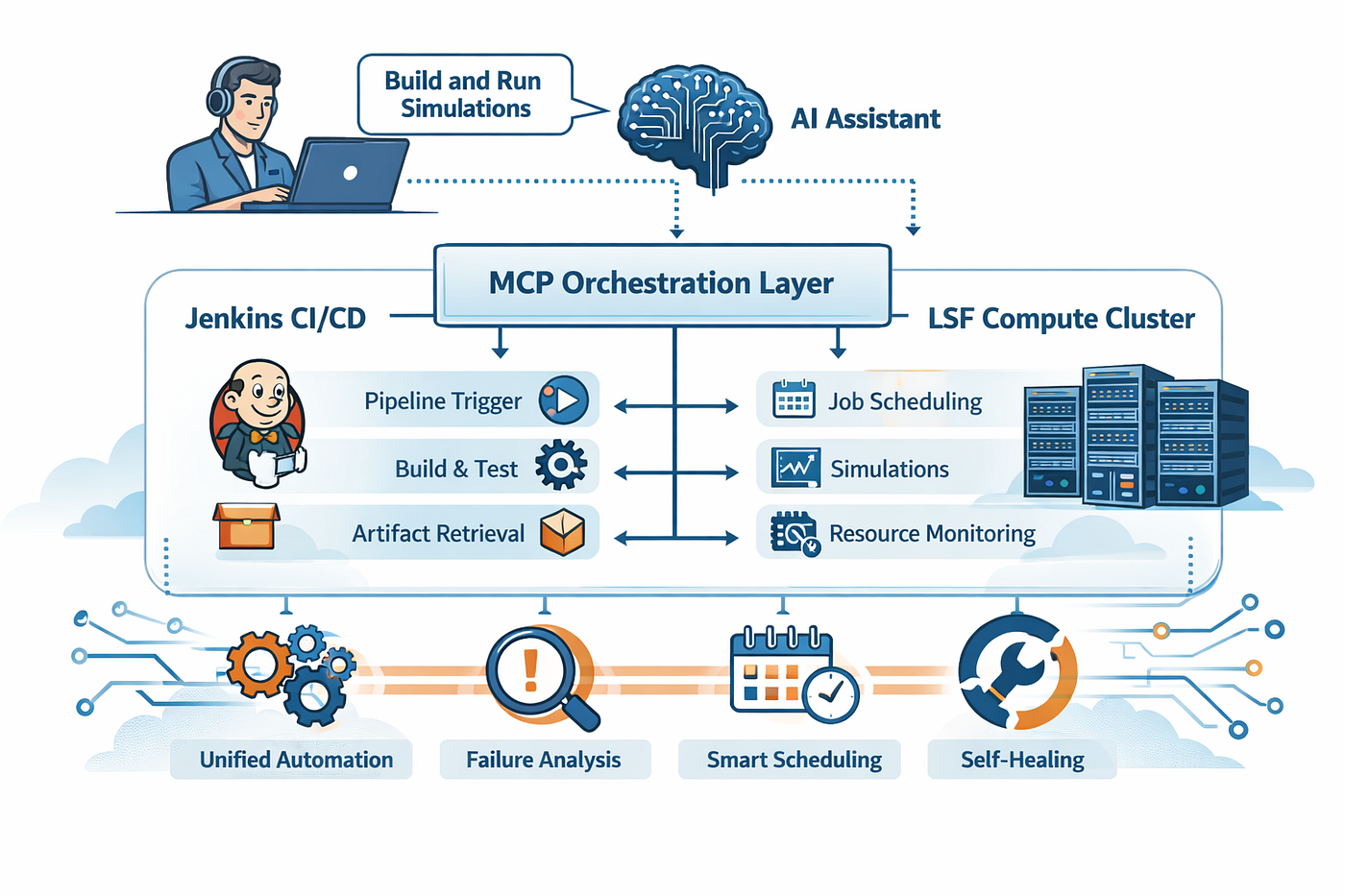
Engineering teams increasingly rely on CI/CD systems and high-performance compute clusters to support firmware builds, simulations, and large-scale regression testing. Jenkins orchestrates build and test workflows, while the LSF cluster handles compute-intensive simulations and protocol validation. These systems are powerful but traditionally operate in silos, requiring engineers to manually navigate dashboards, correlate logs, and manage resource constraints.
To address this fragmentation, I deployed an LSF Model Context Protocol (MCP) server and integrated it with an existing Jenkins MCP server, creating a unified automation layer that an AI assistant can control through natural language. This integration significantly improved workflow efficiency, failure diagnosis, and resource utilization across engineering teams.
Deploying the LSF MCP Server
The LSF MCP server exposes structured capabilities for job submission, queue monitoring, log retrieval, and cluster health inspection. It acts as a secure intermediary that translates high-level instructions into validated LSF operations. By abstracting job templates and enforcing cluster policies, the server enables safe and repeatable job management. Once deployed, the MCP-enabled AI assistant could submit jobs, retrieve logs, summarize failures, and monitor resources conversationally — removing much of the manual overhead associated with LSF.
Integrating With Jenkins
The next step was linking LSF with the Jenkins MCP server. This integration allowed the AI assistant to coordinate multi-system workflows: triggering Jenkins pipelines, monitoring stage-level execution, retrieving build artifacts, and correlating failures with related LSF jobs. Jenkins continues to manage CI/CD logic, but offloads compute-heavy stages to LSF, while the AI layer orchestrates both systems cohesively.
Key Capabilities Enabled
End-to-End Workflow Automation
A single natural-language instruction can now build firmware, distribute simulation workloads across LSF, track cluster progress, collect logs, and produce consolidated summaries. Tasks that once required several tools and dozens of clicks now happen seamlessly.
Unified Failure Diagnosis
Previously, debugging required manual correlation across Jenkins logs, LSF dashboards, node health data, and license usage. The AI assistant now synthesizes these signals automatically, identifying root causes such as node memory failures or license shortages that ripple into pipeline errors.
Resource-Aware Scheduling
With real-time visibility into LSF queues and host availability, Jenkins workloads adjust dynamically — reducing parallelism during congestion, increasing fan-out during idle periods, and scheduling around license constraints. This improves predictability and cluster efficiency.
Self-Healing Behaviors
The system can automatically retry failed jobs with updated parameters, reroute workloads away from faulty nodes, or selectively retry Jenkins stages. These automated recoveries drastically reduce human intervention during regressions.
Impact
The combined MCP framework delivered measurable benefits: faster regression cycles, reduced debugging time, higher cluster utilization, improved CI/CD reliability, and increased developer autonomy. By unifying Jenkins and LSF under an AI-driven control layer, previously fragmented workflows became coordinated, observable, and self-optimizing.
This deployment demonstrates how MCP can meaningfully elevate existing automation ecosystems, enabling intelligent orchestration without replacing proven tools.
A message from our Founder
Hey, Sunil here. I wanted to take a moment to thank you for reading until the end and for being a part of this community.
Did you know that our team run these publications as a volunteer effort to over 3.5m monthly readers? We don’t receive any funding, we do this to support the community. ❤️
If you want to show some love, please take a moment to follow me on LinkedIn, TikTok, **Instagram. You can also subscribe to our [weekly newsletter](https://newsletter.plainenglish.io/)**.
And before you go, don’t forget to clap and follow the writer️!
메타데이터
- post_id
- 00a7a722b13a
- slug
- building-an-ai-driven-ci-cd-and-compute-automation-layer-using-mcp-00a7a722b13a
- url
- https://ai.plainenglish.io/building-an-ai-driven-ci-cd-and-compute-automation-layer-using-mcp-00a7a722b13a
- canonical_url
- https://ai.plainenglish.io/building-an-ai-driven-ci-cd-and-compute-automation-layer-using-mcp-00a7a722b13a
- author_url
- https://medium.com/@dharabarani
- status
- ok
- fetched_at
- 2026-06-12 07:40:50