Eight Words That Made My AI Stop Repeating Itself
I used to think my AI was getting worse.
Eight Words That Made My AI Stop Repeating Itself
I used to think my AI was getting worse.
Not “slightly worse.” I mean actively boring.
You know the feeling: you ask for ideas… and it gives you the same three angles every time. You rephrase the question. You increase the temperature. You add a “be creative” line. Still the same.
At some point, you start blaming the model.
But here’s the uncomfortable truth I learned:
The model wasn’t stuck.
My prompt was collapsing the answer too early.
The weird problem no one talks about: AI “mode collapse” in normal life
There’s a term researchers use: mode collapse.
In plain English, it means the model keeps picking the “most typical” answer and ignores all the other valid ones. Not because the other answers don’t exist — but because the model is trained to be safe, aligned, and “helpful,” which often means predictable.
A recent research paper calls out a powerful driver behind this: typicality bias in preference data. Humans tend to reward answers that feel familiar, fluent, and conventional — and that pushes models toward the same well-worn responses after alignment.
So if you’re feeling like AI outputs are getting same-y…
…it’s not your imagination.
Why prompt engineering often fails (even when it looks smart)
Most prompt engineering advice is basically decoration:
- “Act as a world-class expert…”
- “Think step by step…”
- “Be more creative…”
- “Use a unique perspective…”
Those can help sometimes. But they don’t fix the core issue.
Because the core issue isn’t that the model can’t be creative.
It’s that you asked for one answer, and the model did what it’s optimized to do:
Pick the safest, most likely response… and stop.
That’s not a failure. It’s obedience.
The shift that changes everything
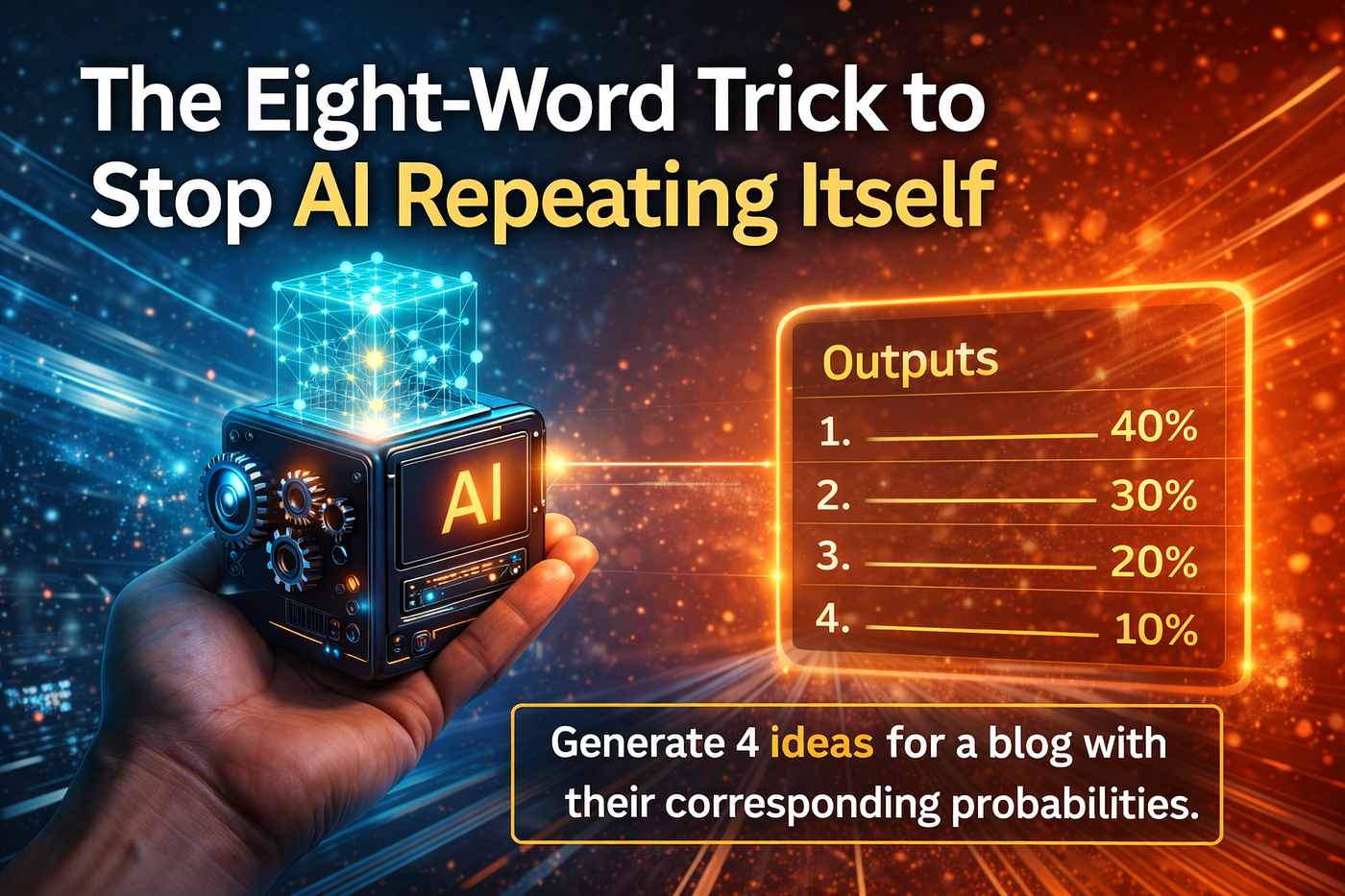
Instead of asking the model for one response, ask it for a distribution.
Not a metaphorical distribution.
An actual list of multiple plausible outputs with rough probabilities.
Researchers call this Verbalized Sampling (VS): you prompt the model to generate several candidates and “verbalize” a probability distribution over them.
This sounds technical, but in practice it’s ridiculously simple.
Here are the “eight words” version of the trick:
“…with their corresponding probabilities.”
That’s it.
Try it right now (copy/paste)
Instead of:
“Write me 5 ad hooks for protein powder.”
Try:
Generate 5 ad hooks for protein powder, with their corresponding probabilities.
Return as a list. Keep probabilities as percentages that sum to 100%.
Or if you want more variety:
Generate 8 distinct ad hooks for protein powder with their corresponding probabilities.
Prefer diversity over similarity. Avoid repeating the same angle.
What happens is subtle but powerful:
You’re forcing the model to show you options it normally hides.
Why this works (without the math)
Inside the model, there are always multiple valid continuations.
But typical prompting asks for one output, which encourages the model to “lock in” to the most typical path.
VS changes the job:
- Don’t pick one path
- Map the landscape
- Then tell me which paths are more likely
The paper reports that VS improves diversity in creative tasks by about 1.6–2.1×, can recover ~66.8% of the base model’s diversity, and tends to help more capable models even more — without sacrificing factual accuracy and safety in their evaluations.
Even if you ignore the numbers, you’ll feel it immediately.
The outputs become less “default internet.”
More angles. More personality. Less template.
Where it gets insane: business, marketing, and ideation
This is where the trick becomes more than a party piece.
Because in real work, you usually don’t want one answer.
You want:
- options
- tradeoffs
- exploration
So VS is basically a shortcut to better brainstorming.
Try it for:
Marketing
Generate 6 campaign angles for a new skincare brand, with probabilities.
Angles must be meaningfully different (science, lifestyle, emotional, social proof, etc.).
Product strategy
Generate 5 product positioning statements for a budgeting app, with probabilities.
Include 1 contrarian option.
Naming
Generate 10 brand names for an AI video ad tool, with probabilities.
Include rationale in one line per name.
The real takeaway: the model had the creativity already
This is the part that surprised me.
The creativity wasn’t missing.
It was compressed.
Alignment didn’t delete the model’s range — it made the model less likely to show the range when asked in a single-shot way.
VS is a way of politely telling the model:
“Don’t give me your safest answer. Show me your menu.”
Question for you (comment bait — but genuine)
Where do you feel “AI sameness” the most?
- writing
- coding
- marketing
- ideation
- customer support replies
- something else
메타데이터
- post_id
- 00aef031d7cb
- slug
- eight-words-that-made-my-ai-stop-repeating-itself-00aef031d7cb
- url
- https://medium.com/@ammanakhtar8/eight-words-that-made-my-ai-stop-repeating-itself-00aef031d7cb
- canonical_url
- https://medium.com/@ammanakhtar8/eight-words-that-made-my-ai-stop-repeating-itself-00aef031d7cb
- author_url
- https://medium.com/@ammanakhtar8
- status
- ok
- fetched_at
- 2026-06-26 12:24:55