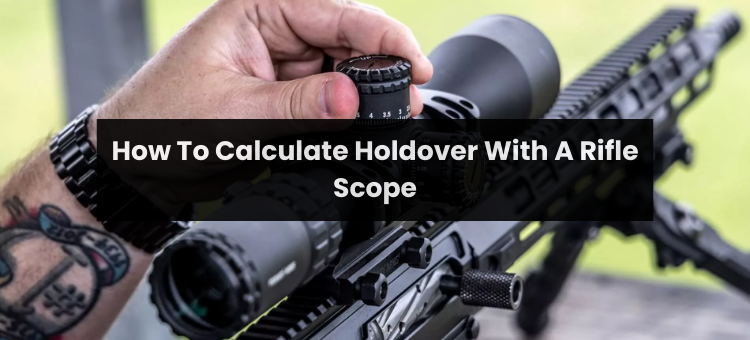
How To Calculate Holdover With A Rifle Scope?
Long-range shooting accuracy hinges on your ability to calculate holdover. The technique known as “holding over the target” involves…
How To Calculate Holdover With A Rifle Scope?
Long-range shooting accuracy hinges on your ability to calculate holdover. The technique known as “holding over the target” involves aiming over the target to counteract the bullet drop caused by gravity over long distances.
This blog post will provide a comprehensive explanation on using a rifle scope to calculate holdover, which will ensure that your target is struck accurately and consistently.
Explain Holdover.
A shooter makes a holdover, or aims above the intended point of impact, to accommodate for bullet drop.
A bullet drop occurs as the projectile approaches its target and is forced downward by gravity. Holdover adjustments become increasingly crucial as the bullet flies farther because it will drop more with distance.
Tools and Resources Required
rifle with a scope mounted on it
weapons unique to your rifle
Ballistic motion calculator or application
shooting range with targets positioned at various separations
For concept notation, use a computer tool or a pen and notebook.
Rangefinder is optional but recommended
Chronograph: optional for determining bullet speed
Rules for Determining Holdover
1. Know Your Rifle and Ammunition.
The ballistic properties of various firearms and ammunition differ. Crucial factors affecting bullet drop include:
Bullets that are heavier and less aerodynamic fall more quickly than bullets of the same weight and form.
Greater speed denotes a smaller drop over a certain distance.
Ballistic coefficient (BC) is a measure of a bullet’s ability to overcome air resistance; a higher BC corresponds to less drop.
2. Zero Yourscope
Aligning your scope such that the point of aim and the point of impact coincide at a specific distance (often 100 yards) is known as zeroing. This distance will be your starting point for calculating holdover. Observe these rules:
Make a 100-yard run for it.
Your gun will be easier to stabilize if you rest it or use a bench.
Do a three-shot group to determine the point of impact.
Adjust the windage and elevation turrets such that the point of impact and the point of aim line up.
Continue until all of the shots consistently land in the center of the target.
3. Muzzle Velocity Measurement
Comprehending the muzzle velocity of your ammunition facilitates the precise computation of holdover.
Use a chronograph to measure the bullet speed as it leaves your pistol. Note the average speed over a number of shots.
4. Consult a ballistic calculator.
A ballistic calculator simplifies holdover calculations by taking into account a variety of factors, such as bullet weight, muzzle velocity, BC, and ambient conditions. Follow these guidelines:
Put the muzzle velocity, bullet weight, BC, and zero distance into the calculator.
Indicate which ranges you plan to cover.
Add environmental factors like altitude, temperature, humidity, and wind speed if the calculator allows it.
The calculator will provide holdover statistics for different distances, often in minutes of angle (MOA) or mils.
**5. Compute Holdover Manually (Optional)
**Holdover (Optional)
If you would like to estimate holdover manually, follow these guidelines:
Determine Drop over Various Lengths: Using ballistic data or programs, find the bullet drop in inches at different distances.
Transform Drop into MOA or Mils.
At 100 yards, one MOA is equal to 1.047 inches.
To convert inches to MOA, use this formula:
Distance in yards / 100 / Drop in inches / 1.047
Drop from distance in inches/1.047/(yards/100)
First, convert inches to millimeters.
Inches dropped / 3.6 × Yards traveled / 100
Decleasing in inches/(3.6× Yards/100).
If your bullet drops 12 inches at 300 yards, for example:
Miles = 12 / 3.6 x 3.6; MOA = 12 / 1.047 / 3 = 3.82 Mils
6. Workouts and Adjustments
Visit the range with targets positioned at the holdover distances that you have decided upon.
Using the scope elevation adjustment or the holdover marks on the reticle, aim in the center of the target and apply the computed holdover.
Fire a few rounds to see if your holdover calculations match.
Adapt as necessary based on the actual effects.
7. Arrange the Data
Take note of your multiple-distance holdover data. This material is extremely valuable for quick modifications on the field and future reference.
Take note of your surroundings as well, since they may have a significant impact on the trajectory of the bullet.
Suggestions for Accurate Holdover Calculation
Regular Shooting Technique:
Maintain a consistent shooting stance and technique to ensure accuracy.
Practice frequently and at various distances to get comfortable with your gun’s operation.
Awareness of the Environment:
Always be aware of the environmental factors, such as wind, temperature, and humidity.
Regular Inspections of the Scope Regularly check the alignment of your scope and ensure that each mount is stable.
Finally
Comprehending holdover with a rifle scope is essential for long-range shooting.
By familiarizing yourself with your firearm and ammunition, zeroing your sight, using ballistic calculators, and practicing often, you can achieve precise and accurate shots.
Maintaining a steady shooting technique and keeping track of your achievements will help you hit targets at varying distances.
메타데이터
- post_id
- 00bb5d64df37
- slug
- how-to-calculate-holdover-with-a-rifle-scope-00bb5d64df37
- url
- https://medium.com/@uniformviolation/how-to-calculate-holdover-with-a-rifle-scope-00bb5d64df37
- canonical_url
- https://medium.com/@uniformviolation/how-to-calculate-holdover-with-a-rifle-scope-00bb5d64df37
- author_url
- https://medium.com/@uniformviolation
- status
- ok
- fetched_at
- 2026-08-15 13:17:38