Cutting Customer Support Response Time in India Without Hiring More Agents
Every growing business eventually hits the same wall in customer support. Ticket volume climbs faster than the support team can, and the…
Cutting Customer Support Response Time in India Without Hiring More Agents
Every growing business eventually hits the same wall in customer support. Ticket volume climbs faster than the support team can, and the usual fix, hiring more agents, is slow, expensive, and does not scale down again if volume drops. Before reaching for headcount, it is worth asking a more basic question. How many of these tickets are actually complex enough to need a human, and how many are simple status checks that a well designed automated flow could close in seconds.
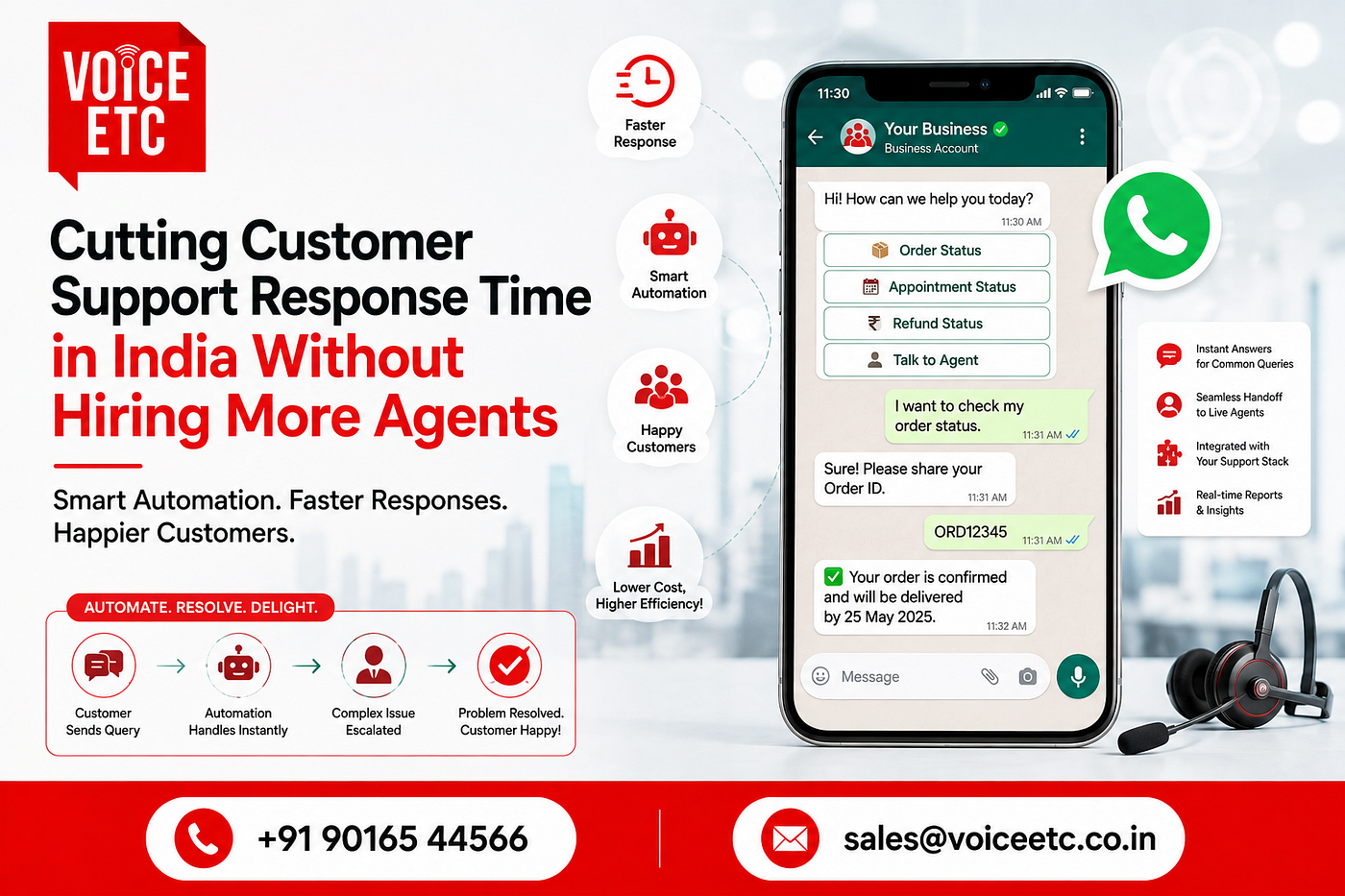
WhatsApp Business API has become the channel where that question gets answered most cleanly, mainly because customers already default to it. A support ticket raised through a web form or email can sit unread for hours. A message sent to a business WhatsApp number gets checked the same way a personal message would, which puts pressure on the business to respond quickly but also opens the door to automating the responses that do not need a human at all.
Order status, appointment confirmation, refund status, and account balance queries are the classic examples, and in most support queues they make up a disproportionate share of total ticket volume. A structured WhatsApp flow, built around quick reply buttons and a connection to the backend system that already holds this data, can resolve these instantly without ever touching an agent’s queue. The agents left in the queue are handling the tickets that genuinely need judgment, which is a far better use of a support team’s time than typing out the same order status answer fifty times a day.
This does not mean removing the human element, it means placing it correctly. A well designed WhatsApp support flow should escalate to a live agent the moment a customer’s request falls outside what the automated flow can handle, and it should do so without making the customer repeat everything they already typed. Losing that context during a handoff is one of the most common complaints customers have about automated support everywhere, not just on WhatsApp, and it is entirely avoidable with the right setup.
Response time is the metric that moves fastest once this is in place. A support desk that used to average several hours on email can often bring first response time on WhatsApp down to minutes, simply because the channel itself creates that expectation and the automated layer handles the volume that would otherwise sit in a queue. Faster first response consistently correlates with higher customer satisfaction scores, even when the underlying resolution time for complex issues stays roughly the same.
Multi agent routing becomes important once volume passes a certain point. A single WhatsApp Business number can be connected to a proper contact center setup where incoming conversations get distributed across a team based on availability or specialization, rather than piling up in one inbox that only one person can see at a time. This is where WhatsApp support stops being a side channel run from someone’s personal phone and starts functioning as a genuine extension of the support desk, with the same reporting and accountability a call center would expect.
Language flexibility is worth mentioning too, since it is a genuine advantage for support teams operating across India. A customer typing in Hindi, Gujarati, or a regional language mixed with English is far more comfortable doing that on WhatsApp than filling out an English only web form, and a support flow built to recognize and route these conversations appropriately closes a gap that many businesses did not realize they had until they started paying attention to how customers actually write to them.
Getting this right depends heavily on the underlying platform and the provider managing it. Template approval speed, uptime during high volume periods, and how well the API connects to an existing helpdesk or CRM all vary meaningfully between providers, even though the base technology is identical. This breakdown of the factors that separate a genuinely capable **WhatsApp Business API provider in India** from one that simply resells access is a useful reference for any support team evaluating vendors before committing to a contract.
Voice ETC’s approach to this connects WhatsApp support directly to its cloud contact center tools, so a business scaling its support operation is not stitching together a messaging vendor and a call center vendor separately, it is running both from the same dashboard with the same team.
The cost comparison against traditional call center scaling is worth putting in plain numbers, because it is usually what convinces a finance team to approve the investment. Adding one additional voice agent to handle overflow calls carries a recurring salary cost every month regardless of how ticket volume fluctuates. A WhatsApp automation layer handling the same volume of repetitive queries carries a largely fixed platform cost that does not climb in the same way as ticket volume grows, which makes it a far more predictable line item for a support budget that is already under pressure to do more with the same headcount.
Reporting is the part of this that support managers tend to appreciate most once it is running. A WhatsApp based support setup connected to a proper contact center platform produces the same kind of data a call center dashboard would, first response time, resolution time, conversation volume by category, and agent performance, which gives a support manager visibility into exactly where the bottlenecks are instead of relying on anecdotal impressions of how the team is doing. That visibility is what makes it possible to keep improving the automated flow over time rather than setting it up once and leaving it untouched for years.
Support teams that treat WhatsApp automation as infrastructure rather than an experiment tend to see the clearest results, not because the technology is complicated, but because getting the escalation logic and the human handoff right takes deliberate design, and that design pays for itself every time a ticket gets resolved without adding a single new hire to the roster.
메타데이터
- post_id
- 00d568fd0db3
- slug
- cutting-customer-support-response-time-in-india-without-hiring-more-agents-00d568fd0db3
- url
- https://medium.com/@voiceetccall/cutting-customer-support-response-time-in-india-without-hiring-more-agents-00d568fd0db3
- canonical_url
- https://medium.com/@voiceetccall/cutting-customer-support-response-time-in-india-without-hiring-more-agents-00d568fd0db3
- author_url
- https://medium.com/@voiceetccall
- status
- ok
- fetched_at
- 2026-08-08 12:46:18