Node.js vs NestJS: The Truth About Which One You Should Learn First
Most Developers Are Asking the Wrong Question and It’s Costing Them Months
Node.js vs NestJS: The Truth About Which One You Should Learn First
Most Developers Are Asking the Wrong Question and It’s Costing Them Months
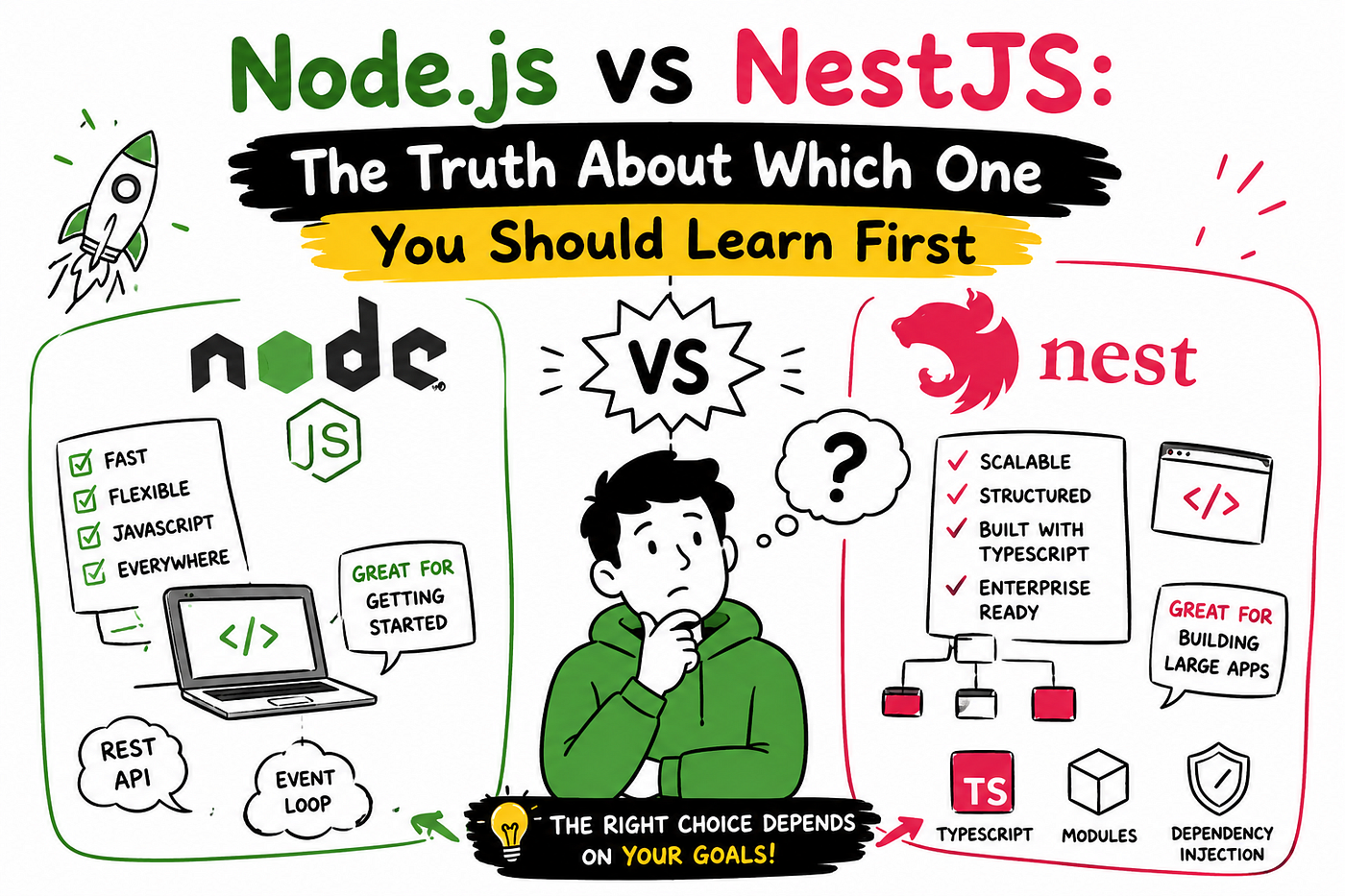
There’s a question that surfaces in every junior backend developer’s learning path, usually around the time they’ve built their first Express API and started Googling what to learn next. “Should I learn NestJS?” And honestly, the answers they find online are mostly useless. Half the posts say NestJS is the future and you should switch immediately. The other half insist that frameworks are a crutch and real engineers work closer to the metal. Neither camp is helping anyone ship better software.
I’ve been building production Node.js services for over a decade. I’ve watched teams adopt NestJS when they didn’t understand what problem it was solving. I’ve also watched teams resist it long past the point where it would have saved them from themselves. The question isn’t which one is better in some abstract sense. The question is what you’re actually trying to accomplish, where you are in your learning journey, and what kind of engineer you want to be. Get the sequencing wrong and you either build on sand or waste months learning ceremony before you understand the fundamentals it’s wrapping.
This article is not going to tell you NestJS is amazing. It’s also not going to tell you to avoid frameworks and write everything raw. It’s going to give you the honest, nuanced picture that most tutorials skip because nuance doesn’t get clicks.
What Node.js Actually Is (And Why This Distinction Matters)

Node.js is not a framework. It’s a runtime environment. When you write a Node.js backend, you’re working with a JavaScript engine built on V8, an event loop, and a set of core APIs for things like file system access, HTTP, streams, and networking. The framework layer, whether that’s Express, Fastify, Koa, or nothing at all, is something you choose to put on top of it.
This distinction matters enormously for how you think about learning. When you learn Node.js, you’re learning how HTTP servers actually work, how the event loop handles I/O, why non-blocking code matters, and what a middleware pipeline does at a mechanical level. These things are not specific to any framework. They transfer everywhere. A developer who genuinely understands Node.js can pick up any Node-based framework in a few days because they understand the substrate beneath it.
When developers skip this layer and jump straight into NestJS, something subtle but damaging happens. They learn the framework but not the runtime. They learn how NestJS handles a request lifecycle but not why it works that way. I’ve interviewed senior NestJS developers who couldn’t explain what process.nextTick does, couldn't describe how the event loop handles async I/O, and had no intuition for why a particular piece of middleware was causing a subtle memory issue. The abstraction had hidden the engine from them.
The analogy I use with junior engineers on my teams is cars. You don’t need to be a mechanic to drive. But if you’re going to be a professional driver, racing or doing cross-country hauls in conditions that punish mistakes, understanding what happens under the hood changes everything. You notice sounds that warn you something is wrong. You make better decisions under pressure. You don’t just follow the dashboard.
What NestJS Actually Is (And What Problem It Solves)

NestJS is an opinionated framework for building Node.js applications. It’s built on top of Express (or optionally Fastify) and introduces a structured architecture heavily inspired by Angular, using TypeScript decorators, dependency injection, modules, controllers, and providers as its core building blocks. The pitch is consistency, scalability, and convention over configuration, especially for large teams.
The important word in that description is opinionated. NestJS makes choices for you. It tells you where your controllers go, how your services are injected, how modules are organized, and how your application bootstraps. If those choices align with your problem, you gain a massive amount of structure for free. If they don’t, you spend significant time fighting the framework to do something it wasn’t designed for.
Where NestJS shines is in large codebases with multiple developers who need to navigate the same project. When you join a NestJS project from a different company, you can orient yourself quickly because the structure is familiar. The module system enforces clean separation of concerns. The dependency injection container makes testing easier because you can swap implementations without touching business logic. These are real, production-level benefits. I’ve seen projects where NestJS adoption genuinely made the difference between a codebase that scaled with the team and one that became unmaintainable.
But those benefits are only accessible if the engineers using the framework understand what it’s doing. Dependency injection is not NestJS magic. It’s a design pattern with real implementation costs and tradeoffs. When a developer treats the @Injectable() decorator as an incantation rather than a decision, they create circular dependencies, mismanage provider scope, and build services that are nearly impossible to test in isolation. The framework intended to enforce good architecture instead becomes a mechanism for producing structured mess.
The Real Cost of Learning NestJS Without Node.js Foundations

I inherited a project two years into its lifecycle that was built entirely in NestJS by a team that had jumped straight in from frontend React work. The codebase was architecturally correct in the NestJS sense. Modules were organized, services were injected, controllers were clean. But there was a streaming endpoint that was timing out under load, and nobody on the team could explain why.
The issue was that whoever had written it had used await inside a loop that was processing a large dataset, one database call per iteration, with no understanding of how Node's event loop handles I/O-heavy async operations. They knew how to write async/await in NestJS. They didn't understand what was happening in the runtime beneath the decorators. Fixing it required a refactor to batch the queries, but explaining why it was broken required teaching the event loop from scratch, which is not a conversation you want to have during an incident.
This is the real cost. It’s not that NestJS is bad or that the team was incompetent. It’s that they had skipped the layer of understanding that tells you when something is wrong before production tells you first. Node.js fundamentals give you a mental model of what your code is actually doing. That mental model is what separates engineers who can debug production incidents from engineers who can only write code that works in development.
There’s also a hiring and career consequence. Developers who know NestJS but not Node.js are difficult to transfer to other projects. They become framework-dependent in a way that limits them. The Node.js ecosystem is enormous and diverse. Serverless functions, streaming APIs, CLI tools, real-time systems, WebSocket servers, none of these necessarily map cleanly onto the NestJS application model. An engineer who understands the runtime can work across all of them. An engineer who only knows the framework is stuck in the parts of the ecosystem where the framework is appropriate.
Where Express Fits Into This Conversation

You cannot have an honest conversation about Node.js and NestJS without talking about Express, because Express is what most people mean when they say “raw Node.js backend development.” Express is a minimal, unopinionated web framework that gives you routing, middleware, and request/response handling without telling you how to organize your application. It’s been the dominant Node.js web framework for years, and understanding it deeply is still one of the most valuable things a backend JavaScript developer can do.
Express teaches you to make decisions. Where does business logic go? How do you organize routes? How do you structure error handling? How do you share context across middleware? Express doesn’t answer any of these questions for you. This is simultaneously its greatest strength as a learning tool and its greatest weakness at scale. The answers you come up with, the patterns you develop, become the architecture of your application. If you make thoughtful choices, you get a lean, well-understood codebase. If you don’t think it through, you get what I’ve seen too many times: a routes folder with 40 files, business logic scattered between route handlers and vaguely named utility functions, and error handling that's inconsistent across every endpoint.
NestJS is, in part, an answer to the question of what happens when you don’t think those things through. It provides the architectural skeleton that Express leaves to you. But if you’ve never built with Express and wrestled with those organizational decisions, you won’t fully appreciate what NestJS is giving you. The conventions will feel like arbitrary bureaucracy rather than the hard-won solutions they actually represent.
Learning Express after NestJS is like reading the answer key before working the problems. You get to the right place without building the judgment to know why it’s right.
When NestJS Is the Right Tool

NestJS is genuinely excellent for specific contexts, and being clear about what those contexts are is more useful than generic praise or dismissal. It excels in enterprise-scale REST APIs and microservice architectures where multiple developers need to contribute to the same codebase with predictable patterns. The module system and dependency injection model map well onto domain-driven design, making it easier to enforce clean boundaries between different parts of a large system.
It’s also a strong choice for teams with a significant TypeScript investment and Angular experience on the frontend. The architectural patterns are deliberately similar, which lowers the cognitive overhead for developers moving between layers of the stack. I’ve seen this benefit underestimated by teams that don’t have that background and overestimated by teams that do. The familiarity is real, but it only pays off if the team has genuine TypeScript proficiency, not just enough to make the compiler stop complaining.
For greenfield projects with clear domain boundaries and a team of three or more backend developers who will all be working in the same service, NestJS is a legitimate architectural choice from day one. The structure it enforces prevents a certain class of mistakes that tend to accumulate in Express projects as they grow. The testing infrastructure it encourages, with injectable services and a built-in testing module, is genuinely better than what most teams build organically in Express.
The contexts where NestJS is clearly the wrong choice are equally important to name. Single-developer projects, scripts and tools, serverless functions that run for seconds, or real-time systems that need maximum performance with minimum overhead are all places where NestJS introduces more cost than it removes. It also tends to be wrong for teams early in their backend JavaScript journey, not because the framework is harmful but because the learning curve of NestJS and the learning curve of Node.js are both substantial, and conflating them produces gaps in understanding that are hard to fill later.
The Dependency Injection Problem Nobody Warns You About

NestJS’s dependency injection container is powerful and, when properly understood, enables genuinely clean architecture. When it’s not understood, it becomes a source of subtle, hard-to-debug problems that can derail a project. This is worth spending time on because it’s the part of NestJS that most tutorials present as magic and most developers accept as magic until something goes wrong.
The most common mistake I see in NestJS codebases is provider scope mismanagement. NestJS providers default to singleton scope, which means one instance is created and shared across the entire application. For stateless services, this is fine. For services that maintain any kind of per-request state, this creates race conditions and data leakage that only appear under concurrent load. I reviewed a codebase where a developer had stored user context in a singleton service during request processing. Under low traffic in development, it worked perfectly. Under load in production, user A was occasionally seeing user B’s data because the service instance was being shared between concurrent requests. The fix was straightforward once you understood provider scope. Finding the bug required understanding how the DI container actually works.
Circular dependencies are another NestJS trap that Express doesn’t present. When module A imports module B and module B imports module A, NestJS will throw a circular dependency error or, worse, silently resolve with undefined depending on the version and configuration. This is a symptom of architectural coupling, and NestJS is right to surface it. But developers who don’t understand why the error is happening will reach for forwardRef() as a fix rather than restructuring their dependencies properly. I've seen codebases riddled with forwardRef() calls as a kind of architectural debt, papering over design problems that compound over time.
None of this means dependency injection is bad or that NestJS is wrong to use it. It means that using NestJS responsibly requires understanding the patterns it’s built on, not just the syntax it provides. If you’ve spent time building with Node.js and Express, you’ve had to think about how to share context across layers of an application. That thinking gives you the background to understand what the DI container is doing and why it makes the choices it makes.
The Learning Path That Actually Works
The question of whether to learn Node.js or NestJS first has a clear answer if you approach it honestly: learn Node.js first. But the more useful question is what that actually looks like as a learning sequence.
Start with core Node.js. Understand the event loop. Build a basic HTTP server with the http module before you ever touch a framework. Write some file system operations. Understand streams at a basic level. This is not glamorous work and it doesn't produce impressive portfolio projects, but it builds the mental model that everything else rests on. Spend two to four weeks here, depending on your experience level.
Then build with Express. Build a real API, not a todo app. Something with authentication, database access, error handling, and at least a few endpoints that do meaningful work. Make the architectural decisions Express leaves to you. Watch how the codebase evolves as you add features. Feel the points where the lack of convention creates friction. This is important: the friction is the lesson. You’re learning what problems structured frameworks are solving.
After that, NestJS is a genuine upgrade rather than a confusing starting point. You’ll recognize what the module system is doing for you. The dependency injection will make sense because you’ve already thought about how to organize service dependencies. The controller and service separation will feel obvious because you’ve probably already discovered something similar through painful iteration. What was friction in Express becomes structure in NestJS, and you understand why.
The whole sequence takes longer than jumping straight to NestJS. That’s the tradeoff. But the engineer who takes that path is genuinely more capable than the one who skipped ahead, and that difference compounds over a career.
What Senior Engineers Actually Think About Framework Choice

I want to be direct about something that most framework comparison articles avoid: senior engineers generally don’t have strong framework loyalty. The engineers I respect most are the ones who can articulate why they’d choose a framework for a specific problem and why they’d choose differently for a different problem. Framework advocacy is usually a sign that someone knows the tool without understanding the problem space.
The engineers who have been around long enough have seen the hype cycle play out multiple times. There was a time when Meteor was going to change everything. There was a period when Sails.js was the Node.js answer to Rails. Frameworks rise and fall. The underlying runtime, the patterns of good software design, the ability to debug and reason about systems under load: these persist.
This doesn’t mean framework skills don’t matter. Deep NestJS knowledge is genuinely valuable in the contexts where NestJS is the right choice, and that’s a large portion of enterprise Node.js development right now. But it’s valuable as a layer on top of solid fundamentals, not as a substitute for them. The developer who can explain what happens when a NestJS request hits the controller before any framework lifecycle kicks in is substantially more valuable than the one who can only configure the lifecycle.
Conclusion
The Node.js vs NestJS debate is a distraction from the real question, which is what foundation will make you capable across a wide range of problems rather than dependent on a single tool. Node.js first is the right answer not because NestJS is bad but because NestJS is a solution to problems you need to experience before you can appreciate them.
Build things that break. Write Express code that becomes messy and understand why. Make the architectural mistakes that NestJS prevents so you recognize what it’s preventing. Then add NestJS to your toolkit and use it in the contexts where it genuinely helps: large teams, complex domains, codebases that need to survive years of contributors.
The engineers who understand both layers are the ones who can evaluate a system, identify where the abstraction is helping and where it’s hiding a real problem, and make decisions about architecture that the framework evangelists on either side of this debate cannot. That’s the kind of engineer worth being.
If this article helped you think more clearly about backend architecture and framework choice, follow for more practical lessons from real-world development, system design, and engineering career growth.
Call to Action
👏 If this article reminded you of one unforgettable debugging session, clap so other developers can find it.
💬 What’s the most misleading error message you’ve ever chased?
🔁 Share this with a developer who has spent hours debugging dependency issues.
📩 Follow me for no-BS software engineering stories and lessons learned from real production and freelance projects.
메타데이터
- post_id
- 00d65665d652
- slug
- node-js-vs-nestjs-the-truth-about-which-one-you-should-learn-first-00d65665d652
- url
- https://medium.com/skillstuff/node-js-vs-nestjs-the-truth-about-which-one-you-should-learn-first-00d65665d652
- canonical_url
- https://medium.com/skillstuff/node-js-vs-nestjs-the-truth-about-which-one-you-should-learn-first-00d65665d652
- author_url
- https://medium.com/@techbyrahmat
- status
- ok
- fetched_at
- 2026-07-08 21:45:35