The Infrastructure Patterns Behind Reliable AI Agents
Most conversations about AI agent reliability focus on the model: which foundation model to use, how to tune prompts, how to structure…
The Infrastructure Patterns Behind Reliable AI Agents

Most conversations about AI agent reliability focus on the model: which foundation model to use, how to tune prompts, how to structure context windows. The model matters. But it’s not where reliability breaks.
Reliability breaks in the infrastructure layer — the systems that wrap the model, manage state, orchestrate workflows, handle failures, and ensure that what worked in testing still works six months into production.
Enterprises learning this the hard way have discovered a consistent pattern: agents that perform well in demos degrade in production not because the model fails, but because the infrastructure around it wasn’t designed for the operational realities of autonomous systems.
The gap isn’t intelligence. It’s engineering discipline.
Why Agent Infrastructure Is Different from Application Infrastructure

Traditional backend systems are built on predictable execution paths. A request comes in, logic executes, a response goes out. Failures are explicit: timeouts, exceptions, malformed inputs.
Agents operate differently. They reason across multiple steps, make decisions that branch unpredictably, call external tools that may or may not be available, and generate outputs that vary even with identical inputs.
This creates infrastructure challenges that standard patterns weren’t designed to solve:
- State management across non-linear workflows: Agents don’t follow fixed paths. They adapt based on intermediate results, retry failed steps, and backtrack when conditions change.
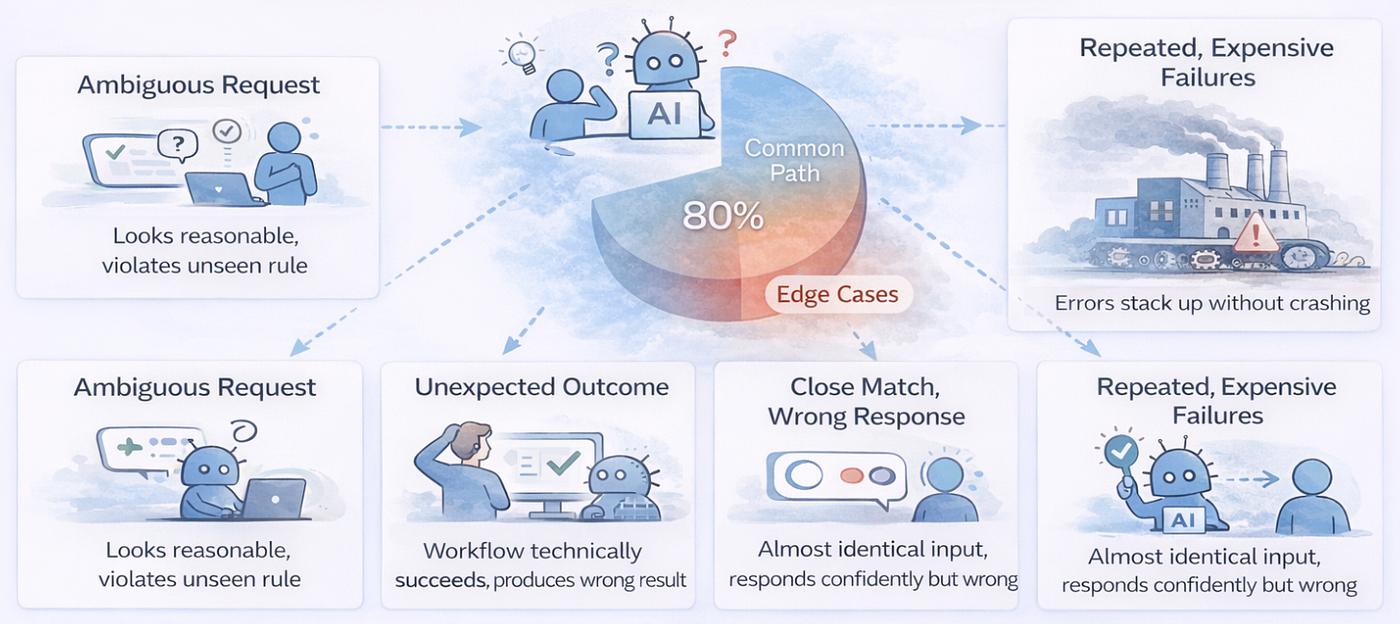
- Graceful degradation without silent failures: When a tool call fails, the agent shouldn’t crash — but it also shouldn’t proceed as if nothing happened.
- Versioning and rollback for reasoning systems: Code versioning is well understood. Prompt versioning, memory versioning, and workflow versioning are not.
- Cost control in probabilistic execution: Agents can spiral into expensive retry loops or redundant API calls without clear signals that something is wrong.
These aren’t model problems. They’re system design problems — and solving them requires infrastructure patterns purpose-built for autonomous reasoning.
The Core Patterns Emerging in Production
Teams that have successfully scaled agents in production are converging on a set of infrastructure patterns. These aren’t vendor-specific solutions. They’re architectural principles that address the fundamental challenges of running agents at scale.

Pattern 1: Workflow Orchestration with Decision Checkpoints
Agents can’t be trusted to operate as black boxes. Reliable agent infrastructure breaks workflows into discrete, observable steps — each with explicit success criteria.
Instead of:
“Agent processes customer request and returns result”
Production systems implement:
“Agent validates input → retrieves context → evaluates policy constraints → generates response → logs decision path”
Each step is instrumented. If the agent skips a checkpoint, fails to meet a constraint, or produces an output that doesn’t pass validation, the system catches it before the response reaches the user.
This pattern turns agents from opaque reasoning engines into auditable decision pipelines.
Pattern 2: State Isolation and Context Boundaries
One of the most common production failures is context bleed — when information from one session leaks into another, or when the agent retains assumptions that are no longer valid.
Reliable infrastructure enforces strict state isolation:
- Session-level state is ephemeral: Each interaction starts with a clean slate unless explicitly configured otherwise.
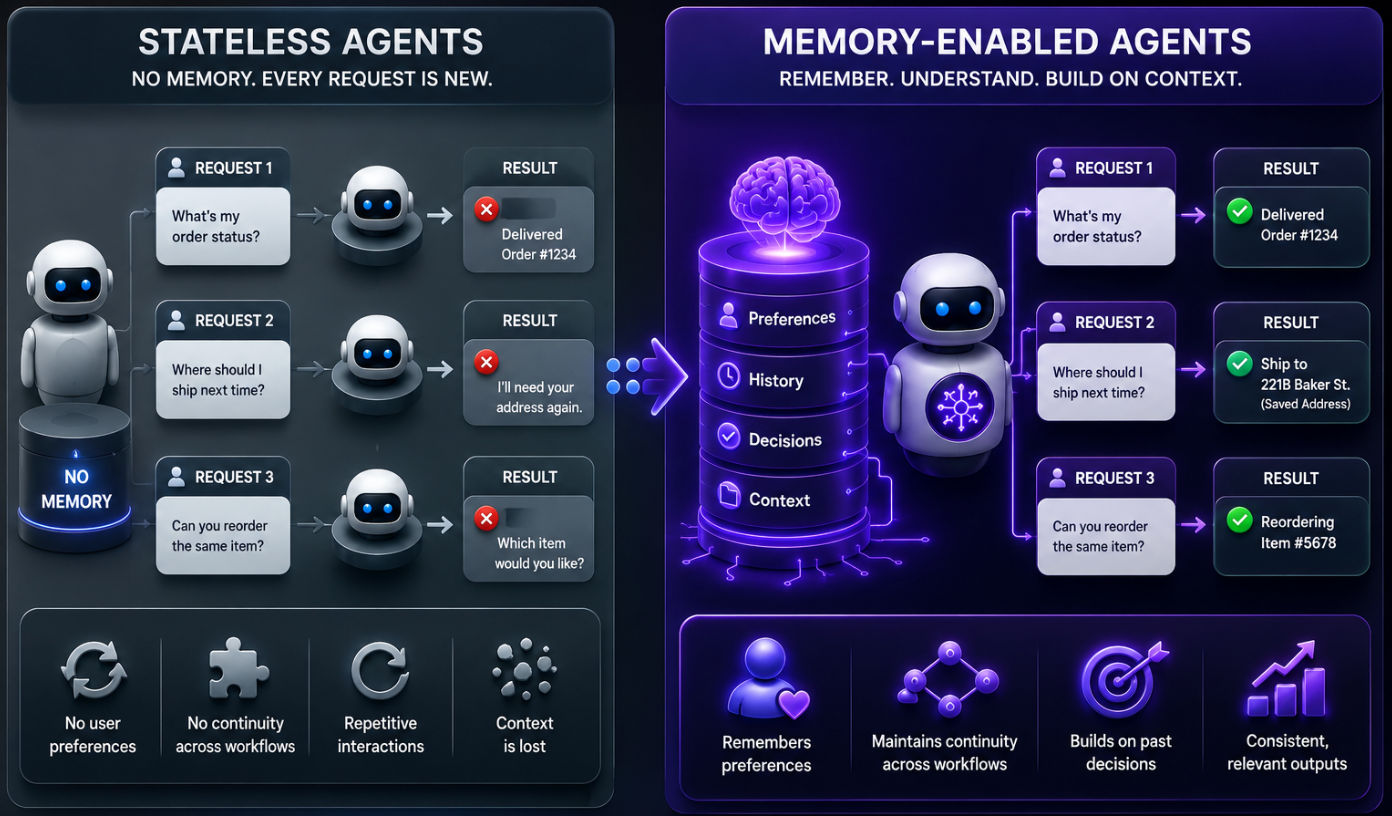
- Persistent state is versioned and scoped: Shared memory, user preferences, and learned behaviors are stored separately from real-time context.
- Context windows are managed defensively: Critical information is prioritised. Less important details are summarised or discarded before they push out essential data.
This prevents the agent from making decisions based on stale, incorrect, or irrelevant information — a failure mode that’s invisible to standard monitoring.
Pattern 3: Tool Call Resilience and Fallback Logic
Agents rely on external tools: APIs, databases, search engines, internal systems. In production, these tools are unreliable. They timeout. They return partial data. They change without notice.
Reliable infrastructure doesn’t assume tools will always work. It builds resilience into the workflow:
- Timeouts are explicit and enforced: If a tool doesn’t respond within a defined window, the agent doesn’t wait indefinitely.
- Failures surface as signals, not silent gaps: When a tool call fails, the agent knows it failed and can adjust behavior accordingly.
- Fallback strategies are predefined: If primary data isn’t available, the agent uses cached data, requests clarification, or escalates to a human — it doesn’t improvise.
This pattern prevents agents from confidently hallucinating answers when they lack the information needed to respond correctly.
Pattern 4: Cost Guardrails and Execution Budgets
In deterministic systems, cost is predictable. In agent systems, it’s not.
An agent can burn thousands of tokens on a single request through retry loops, redundant tool calls, or inefficient reasoning paths. Without guardrails, costs spiral invisibly.
Production infrastructure enforces execution budgets:
- Token limits per request: The agent has a maximum token budget. If it exceeds it, the workflow terminates.
- Retry caps on tool calls: The agent won’t retry a failed tool call indefinitely.
- Efficiency metrics tracked per workflow: Teams monitor not just total cost, but cost per successful outcome.
This keeps agents economically viable at scale.
Pattern 5: Versioned Prompts and Testable Workflows
Code gets versioned, tested, and deployed through CI/CD pipelines. Prompts often don’t — and that’s where drift happens.
Reliable infrastructure treats prompts as code:
- Every prompt change is versioned: Teams can roll back to previous versions if a new prompt degrades performance.
- Prompts are tested before deployment: New versions run through synthetic scenarios to validate behaviour before reaching production.
- A/B testing at the workflow level: Multiple prompt versions run in parallel, with real traffic distributed to measure which performs better.
This prevents the common failure mode where a well-intentioned prompt tweak silently degrades agent behaviour across thousands of interactions.
Pattern 6: Semantic Validation, Not Just Syntax Checking
Traditional validation checks whether an output is well-formed. Agent infrastructure needs to check whether it’s correct.
This means implementing:
- Policy enforcement at runtime: The agent’s output is validated against business rules before it’s returned.
2. Hallucination detection: Outputs are checked for factual consistency with retrieved data.
3. Intent alignment verification: The agent’s response is evaluated against the user’s original intent, not just the surface-level request.
These checks catch failures that wouldn’t trigger alerts in traditional systems — the agent responded, the response was grammatically correct, but the content was wrong.
Why These Patterns Matter More Than Model Selection
Teams often obsess over which model to use: GPT-4, Claude, Llama, Gemini. The model choice matters, but infrastructure choices matter more.

A powerful model without robust infrastructure will:
- Hallucinate confidently when tools fail
- Drift silently as data distributions change
- Burn budget on inefficient execution paths
- Produce inconsistent outputs across identical requests
A less powerful model with strong infrastructure will:
- Fail gracefully and explicitly
- Maintain consistent behavior over time
- Operate within defined cost boundaries
- Surface problems before they reach users
Reliability is a property of the system, not the model.
The Operational Discipline Required
Implementing these patterns requires treating agents as long-running production systems, not experimental features.

Teams that succeed:
- Budget for infrastructure alongside inference: Orchestration, state management, validation, and monitoring are line items, not afterthoughts.
- Define success criteria before deployment: Every workflow has explicit metrics for correctness, efficiency, and alignment.
- Assume failure and design for recovery: Agents will make mistakes. Infrastructure ensures those mistakes are caught, logged, and corrected.
- Iterate based on production signals, not intuition: Changes are driven by data — hallucination rates, retry depth, cost per outcome — not guesses.
This is less about AI innovation and more about systems engineering rigor.
How AlignX Supports Infrastructure Maturity
AlignX AI helps teams implement these patterns by treating agent workflows as versioned, testable systems. Teams use AlignX to define decision checkpoints and validate behaviour at each step, enforce semantic validation and policy constraints before outputs reach users, test prompt versions across scenarios to prevent silent degradation, and monitor efficiency, correctness, and alignment continuously in production.

By providing infrastructure for workflow-level governance, AlignX enables teams to move from ad hoc agent deployment to engineered reliability — ensuring agents don’t just work in demos, but operate predictably at scale.
Closing Insight
AI agents don’t become unreliable because the models aren’t good enough.
They become unreliable because the infrastructure around them wasn’t designed for probabilistic reasoning, adaptive workflows, and operational unpredictability.
The enterprises building agents that last are the ones investing in the patterns that make autonomy sustainable: orchestration with checkpoints, state isolation, tool resilience, cost guardrails, versioned prompts, and semantic validation.
These aren’t cutting-edge AI techniques. They’re production engineering fundamentals — applied to systems that reason instead of execute.
The future of reliable AI agents won’t be won by better models.
It will be won by better infrastructure.
**Book a Demo with [AlignX AI](https://alignx.ai/)** to experience how workflow-level evaluation, and continuous production monitoring transform agent experimentation into engineered resilience.
Connect with us **Linkedin | X | info@alignx.ai**
메타데이터
- post_id
- 00da71ea3370
- slug
- the-infrastructure-patterns-behind-reliable-ai-agents-00da71ea3370
- url
- https://medium.com/@AlignX_AI/the-infrastructure-patterns-behind-reliable-ai-agents-00da71ea3370
- canonical_url
- https://medium.com/@AlignX_AI/the-infrastructure-patterns-behind-reliable-ai-agents-00da71ea3370
- author_url
- https://medium.com/@AlignX_AI
- status
- ok
- fetched_at
- 2026-07-13 06:23:13