The Invisible Brake: Decoding India’s Female Driving Deficit
Globally, the gender split behind the wheel is reaching a balanced 50/50 ratio. Yet in India, women hold only about 11% to 15% of active…
The Invisible Brake: Decoding India’s Female Driving Deficit
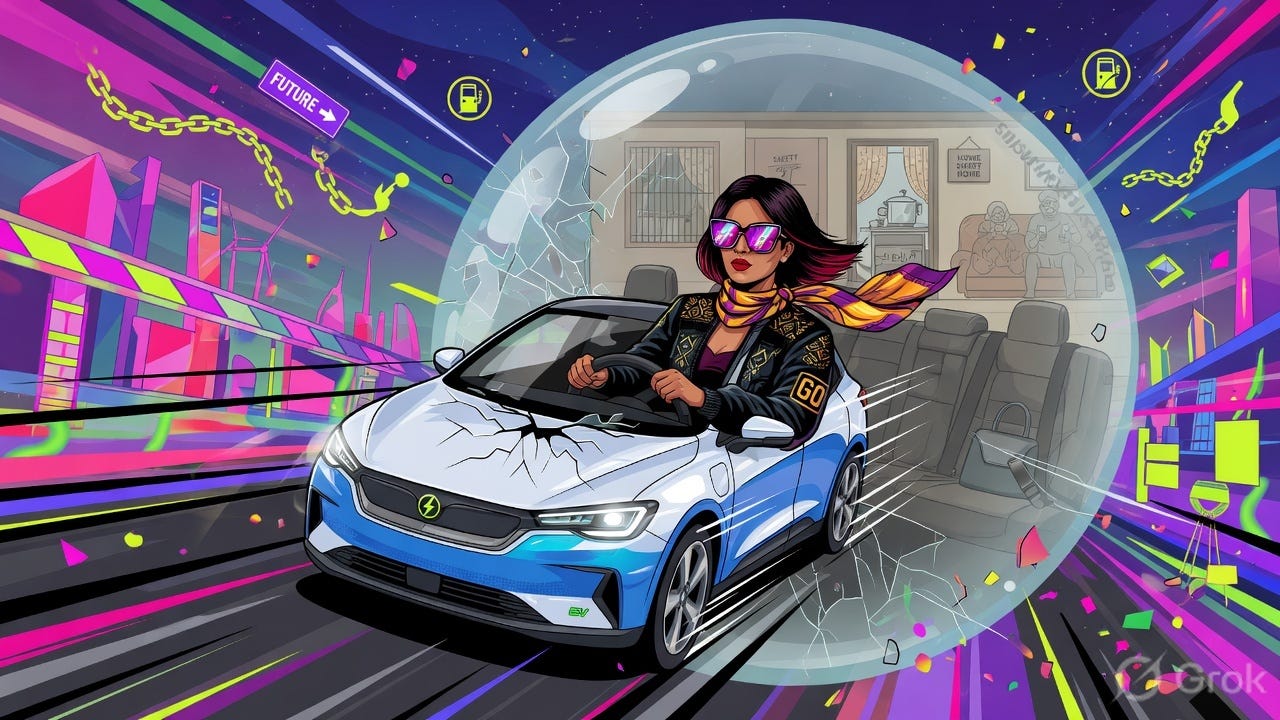
Globally, the gender split behind the wheel is reaching a balanced 50/50 ratio. Yet in India, women hold only about 11% to 15% of active driving licenses, with the overall historical average across all motor vehicle licenses dipping as low as 6%. This massive deficit is not just an infrastructure or financial issue; it is a complex psychological handbrake pulled by cultural upbringing, street environment, and societal conditioning.
1. Independence Milestones vs. Protective Insulation
In the West, getting a license at 16 or 18 is a celebrated rite of passage essential for self-reliance. Conversely, many Indian households prioritize “safety through isolation.” Instead of training daughters to conquer chaotic public spaces, families shield them by offering male-driven rides. This well-meaning insulation breeds a cycle of dependency and stunts spatial confidence during formative years.
2. Academic Focus vs. The Rebel Mindset
Indian girls are routinely conditioned to seek validation through academic discipline and compliance. Caught in intense educational grinds, they often deprioritize driving as a low-priority distraction, delaying it until adulthood when learning anxiety is much higher. Meanwhile, boys are socialized to seek peer status through risk-taking and aggressively demand the car keys. Today, this dynamic is proving personality-based rather than purely gendered: studious, introverted young men who skip the rebellious key-demanding phase face the exact same driving hesitation in their twenties.
3. Spatial Intelligence and the Stereotype Threat
Spatial mapping — estimating distances and object speeds — is a trained muscle. While boys grow up with remote-controlled cars and outdoor sports that sharpen this skill, girls are often funneled into verbal and social toys, forcing them to start their spatial mapping from zero. This gap is widened by Stereotype Threat: if a man stalls a car, it’s an individual mistake; if a woman does it, she feels the paralyzing anxiety of “proving” the sexist myth that women cannot drive. Furthermore, chaotic traffic accelerates learning for thick-skinned, rebellious minds who drive with spite, while polite, compliant learners internalize road hostility as personal failure and retreat.
4. Traffic Psychologies: The Jungle vs. The Library
Driving environments dictate baseline anxiety. In nations like Sweden, roads operate like a Library — quiet, orderly, and strictly rule-bound, guaranteeing safety if you comply. Indian roads function like a Jungle, rewarding defensive aggression, persistent honking, and physical dominance. For women socialized to be cooperative and non-confrontational, this environment creates an intense psychological mismatch.
5. Cultivated Apathy and Learned Helplessness
When a child continuously observes a domestic setup where Dad is always the pilot and Mom is the passive passenger, the brain normalizes a rigid framework: men drive, women are driven. Lacking a visible payoff or active encouragement, young women develop a psychological defense mechanism known as learned helplessness. Parents often misinterpret this quiet retreat as a natural “lack of interest,” choosing to focus their tuition efforts entirely on their sons.
6. The Asset Priority Index and Escape Vehicles
In single-car middle-class households, an unwritten priority index reserves the vehicle for the male breadwinner’s daily utility, categorizing a woman’s travel needs as secondary. This systemic lack of access explains why women heavily gravitate toward gearless scooters. This choice is a logical calculation of Control and Escape. Inside a heavy car, a minor collision or gridlock leaves a driver trapped and exposed to street confrontation. A lightweight scooter allows a rider to put her feet down, navigate tight spots, or easily walk away if threatened, reducing baseline vulnerability.
7. Administrative Friction and the “Pink Tax”
The institutional barrier of the Regional Transport Office (RTO) presents a distinct hurdle. Historically perceived as intimidating, bureaucratic, and male-dominated, women experience an unstated administrative friction. Research indicates that female applicants are 2.5 to 2.7 times more likely to rely on third-party middle-men, paying a premium “Pink Tax” just to avoid navigating the stressful RTO corridors alone.
8. Shared Passages: International Parallel Barriers
India’s low female driving metrics mirror global regions where the public road is treated as a masculine combat zone:
- Pakistan and Bangladesh: Share a similar social fabric, keeping female driving metrics in the low single-to-double digits due to a volatile public sphere.
- Egypt and Jordan: Intense public scrutiny and aggressive behavior from male motorists restrict women mostly to localized driving.
- South Africa and Brazil: Acute roadside vulnerability and fear of carjackings create a psychological gridlock that discourages solo driving, especially at night — a safety fear heavily echoed by urban Indian women.
9. Global Interventions: Redesigning the Machine and the Road
Forward-thinking nations have treated low female mobility as a systemic flaw and deployed structural fixes:
- Japan’s Kei Cars: Popularized compact, highly visible vehicles engineered with lighter controls and parking assists, wiping away mechanical intimidation for urban drivers.
- Saudi Arabia’s Academies: Following the lifting of the driving ban, the state bypassed social awkwardness by establishing state-of-the-art, women-only driving schools utilizing high-tech simulators to build confidence in a judgment-free zone.
- Sweden’s Vision Zero: Engineered roads to eliminate human friction and pioneered crash-test dummies designed around female and pregnant anatomy, shifting the narrative to show that the system is structurally built to protect women.
10. The Macroeconomic Dividend: A Multi-Trillion Dollar Unlock
Restricting independent transit places a multi-trillion dollar brake on national wealth. McKinsey and the World Bank establish that independent mobility is directly tied to financial growth. Achieving gender parity in the workforce could expand India’s GDP by 27%. However, a labor force cannot mobilize if half its talent relies on others for a ride. Without cars, highly educated women are routinely forced to accept lower-paying positions simply because they are closer to home or located along secure public transit lines.
Beyond the Judgment Seat: Rewriting the Script
Dismantling this deficit requires a profound cultural shift that begins at birth. True equality means a gender-neutral upbringing, de-gendering both the toys we give our toddlers and the life skills we expect from young adults. We must stop limiting our daughters under the guise of protection and start preparing them by treating a driver’s license as a basic, non-negotiable life tool.
Simultaneously, we must stop evaluating personal character through the lens of driving. For decades, society has weaponized the steering wheel — shaming men who choose not to drive as passive, while dismissing women who hesitate as incapable. Driving is a mechanical utility, not a psychological reflection of courage or worth. Every individual deserves the right to decide whether they wish to operate a vehicle, completely free from societal taunts or rigid gender roles. True progress will arrive only when sitting in the driver’s seat is treated as a matter of personal preference rather than an interrogation of identity.
“Your story matters — take 2 minutes to share your driving journey in our anonymous survey and help us map the hidden psychology of the road.” https://forms.gle/mM2XbSuirGTqwRBu5
“Curious what the rest of India thinks? Complete the survey to unlock instant, real-time access to our live interactive data dashboard!” https://docs.google.com/forms/d/1URXa_dLLBdXOF5VoJy77b-lcbMW0jKYNXDsGH6Dshto/viewanalytics
“Want more deep dives, visual breakdowns, and behind-the-scenes content? Follow the conversation on our Instagram page!” https://www.instagram.com/mystic_lens_00/
메타데이터
- post_id
- 013c2e2f5aa1
- slug
- the-invisible-brake-decoding-indias-female-driving-deficit-013c2e2f5aa1
- url
- https://medium.com/@mystic.lens1708/the-invisible-brake-decoding-indias-female-driving-deficit-013c2e2f5aa1
- canonical_url
- https://medium.com/@mystic.lens1708/the-invisible-brake-decoding-indias-female-driving-deficit-013c2e2f5aa1
- author_url
- https://medium.com/@mystic.lens1708
- status
- ok
- fetched_at
- 2026-07-09 10:05:04



