Sleeping Less to Perform More? Here’s Exactly How Little You Can Get Away With
The High Performer’s Guide to Balancing High Pressures and Sleep Time
Sleeping Less to Perform More? Here’s Exactly How Little You Can Get Away With
The High Performer’s Guide to Balancing High Pressures and Sleep Time
There is something almost romantic about the grind. That founder who is at their desk at 2am, coffee in hand, building something from nothing. The early alarm at 4:30am to get ahead of the world before the world wakes up. If you have ever built something — a business, a team, a product, a movement — you know that it demands everything from you. Not just your money, your time, or your ideas; it demands your body too.
Sometimes, it’s your sleep that takes the back burner because you’ve got to stretch! You need to stretch your hours, stretch your capacity, and stretch yourself beyond what feels comfortable. This is because companies don’t build themselves, and organisations don’t grow on autopilot. There is a season in every founder’s journey where the sheer weight of what needs to be done is heavier than the hours available to do it. Investors to meet, products to ship, staff to manage, fires to put out — all at once, all urgent. Sometimes, even the Eisenhower matrix can only save so much.
Anyone who tells you that building something meaningful is a nine-to-five exercise has either never built anything meaningful or is not being honest with you. The reality is that sacrifice is the price of entry, and sometimes that sacrifice bleeds into your sleep time.
But here is the question that does not get asked enough: how much is too much? At what point does sacrificing sleep stop being a short-term investment and start becoming a tax on the very thing you are trying to build?
What the Research Actually Says
We already know that the science here is not subtle. Study after study has shown that consistently getting less than the recommended 7–9 hours of sleep begins to erode two of the most important tools in a founder’s arsenal – response time and judgment. Not dramatically at first, and that is what makes it so dangerous. You will not feel incompetent or broken. You will just be slightly slower, slightly less sharp, slightly more irritable. You may not make wrong decisions, but you’re not going to be making the best ones either.
One of the most striking bodies of research on this comes from the world of sport. A landmark study by Mah et al. found that when athletes were allowed to extend their sleep — simply sleeping more — their performance measurably improved across the board. Speed, accuracy, reaction time, and even mood all went up. The athletes were seemingly functioning well before the study, but they were not functioning at their peak (and you need this as a high performer). Proper sleep pushed them there.
If that is true for a professional athlete whose job is mainly physical, imagine what it means for a founder whose entire competitive advantage lives between their ears.
So Where Is the Line?
Here is the practical reality for those of you who cannot simply “sleep more” because the business demands otherwise. The goal is not to pretend the grind does not exist. The goal is to be strategic about it.
1. Understand when a push is genuinely necessary. Not every late night is justified. Some are habits, some are poor planning, some are avoidance disguised as hustle. Learn to tell the difference. When a genuine high-demand period hits — a launch, a crisis, a critical window — acknowledge it as a sprint, not a lifestyle.
2. Build in catch-up sleep between hard stretches. Sleep debt is real, and the body is remarkably capable of recovering from short periods of disruption — provided you give it the chance. If you had a brutal week, protect the weekend. If you pulled an all-nighter on Tuesday, guard your Wednesday night ferociously. Recovery is not weakness. It is maintenance on your most important asset.
3. Schedule proper sleep around the all-nighters. Before a known all-nighter, bank sleep ahead of time. After it, plan the recovery. Treat it the way an athlete treats a competition — with deliberate preparation and deliberate recovery. The all-nighter that comes after a good night and is followed by a recovery sleep is manageable. The third consecutive all-nighter with no recovery plan is when things fall apart.
4. Know that you are not at your best — and plan around it. This is perhaps the most important point of all and the one most founders ignore. When you are sleep-deprived, you are not operating at full capacity. You may feel fine, you may feel sharp, but the research says otherwise. So be honest with yourself: try as much as possible to save the high-stakes decisions for when you are well rested. Save the all-nighters for the areas where you are already deeply skilled, where muscle memory carries you, where the work requires execution rather than creative or strategic thinking. Do not sign contracts, negotiate equity, or make hiring decisions at 3am on three hours of sleep.
The Soldier Standard
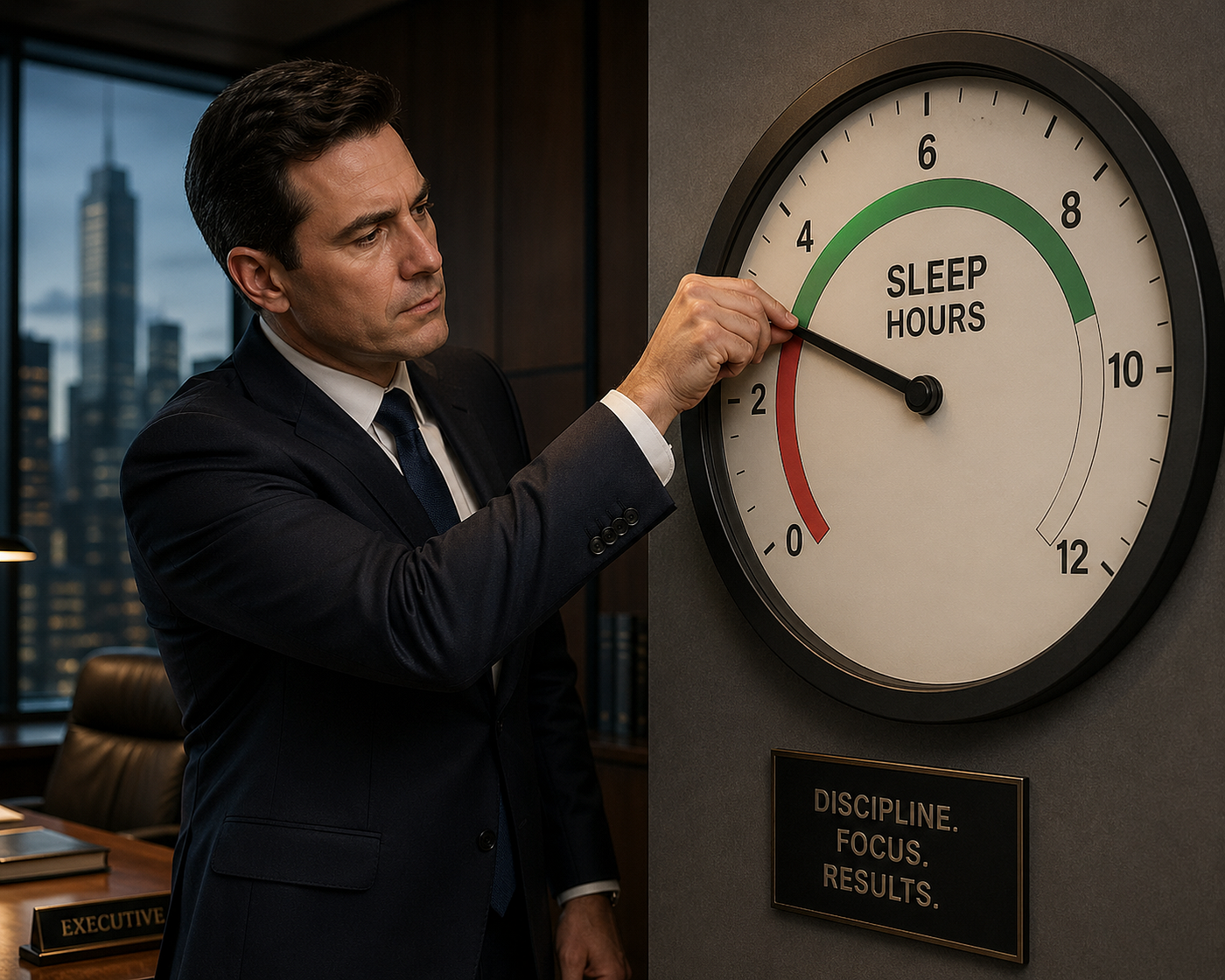
Research conducted for the United States military — arguably the most demanding high-performance environment on earth — recommended a minimum of 4 hours of sleep during periods of extreme operational demand. Not zero, not two, four. Even soldiers in the field, making life-or-death decisions under pressure, were given a biological floor below which performance deteriorated to an unacceptable level.
You can apply this same principle to your busiest seasons. If things are truly intense and sleep is genuinely limited, protect your four hours as a non-negotiable minimum. Use whatever time you can find to catch up. And critically, do not let this become your routine. The four-hour standard is an emergency protocol, not a productivity philosophy. It is a bridge to get you through, not a bridge to live on.
The Real Foundation
Here is the thought to carry with you:
Your business is first built in your mind.
Everything your company will ever be — every idea, strategy, relationship, decision, and pivot — originates in your mind before it exists in the world. The health of your business is, at its root, a reflection of the health of your thinking, and nothing degrades your thinking faster, more silently, or more consistently than chronic sleep deprivation.
The most optimised version of your business requires the most optimised version of you. Not the version running on caffeine and adrenaline, convincing yourself that tiredness is just a mindset. The version that is rested, sharp, and capable of seeing clearly.
Push when you must, but recover when you can. Protect your mind like the most valuable business asset it is — because it is.
Work hard. Rest smart. Build well.
메타데이터
- post_id
- 01531d7124bc
- slug
- sleeping-less-to-perform-more-heres-exactly-how-little-you-can-get-away-with-01531d7124bc
- url
- https://medium.com/@Dr_Aniara/sleeping-less-to-perform-more-heres-exactly-how-little-you-can-get-away-with-01531d7124bc
- canonical_url
- https://medium.com/@Dr_Aniara/sleeping-less-to-perform-more-heres-exactly-how-little-you-can-get-away-with-01531d7124bc
- author_url
- https://medium.com/@Dr_Aniara
- status
- ok
- fetched_at
- 2026-07-13 06:23:13