Industrial Camera Design: Key Requirements & Challenges
Most engineers treat a camera as a peripheral. In industrial settings, it is the system. A failure in industrial camera design does not…
Industrial Camera Design: Key Requirements & Challenges
Industrial Camera Design
Most engineers treat a camera as a peripheral. In industrial settings, it is the system. A failure in industrial camera design does not produce a blurry image it shuts down a production line, passes defective parts downstream, or triggers a regulatory flag. The global machine vision market, valued at over USD 14 billion in 2023 and projected to grow at a compound annual growth rate above 7% through 2030 (source: Grand View Research), reflects how deeply imaging has embedded itself into manufacturing and automation. Yet despite that scale, industrial camera design remains one of the most underestimated disciplines in hardware engineering.
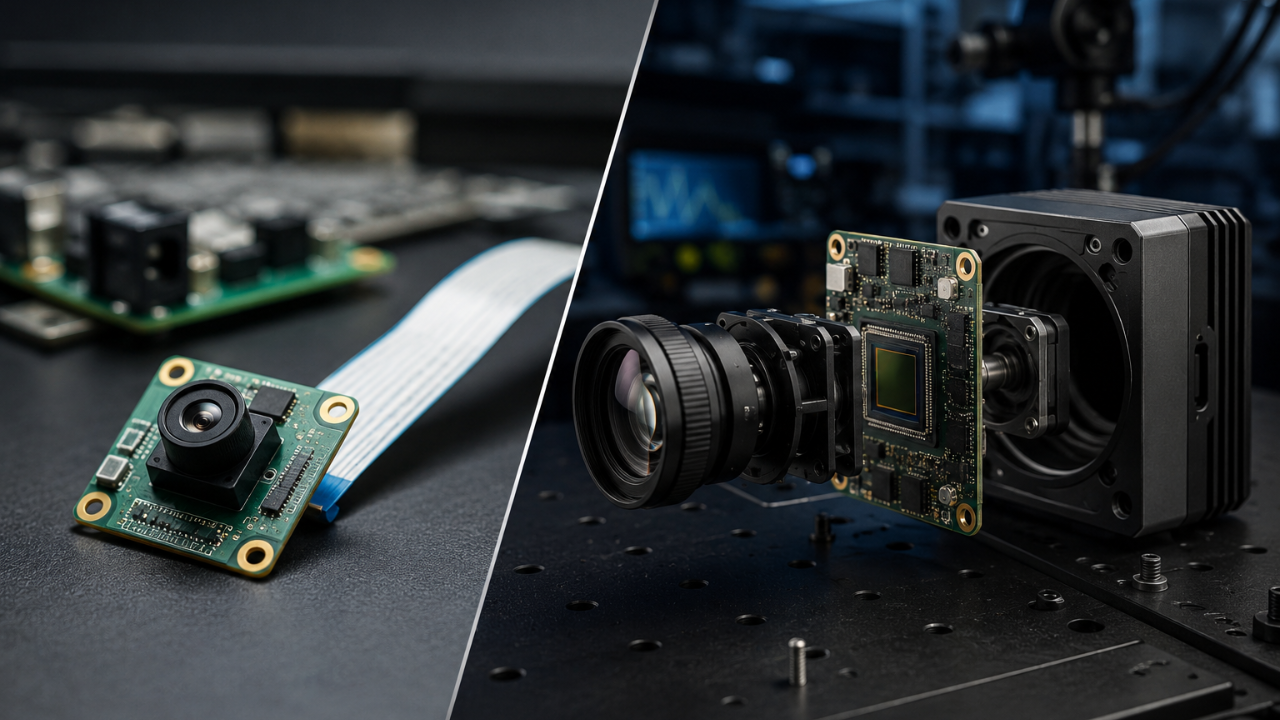
A traditional surveillance camera captures context. An industrial imaging system captures evidence precise, repeatable, machine-interpretable evidence. The gap between those two purposes determines everything about how an industrial camera is designed, validated, and deployed. Industrial camera design must account for sensor physics, optical geometry, thermal behavior, firmware determinism, and system-level integration simultaneously. This blog breaks down what that process actually involves.
Why Industrial Camera Design Is a Distinct Engineering Problem
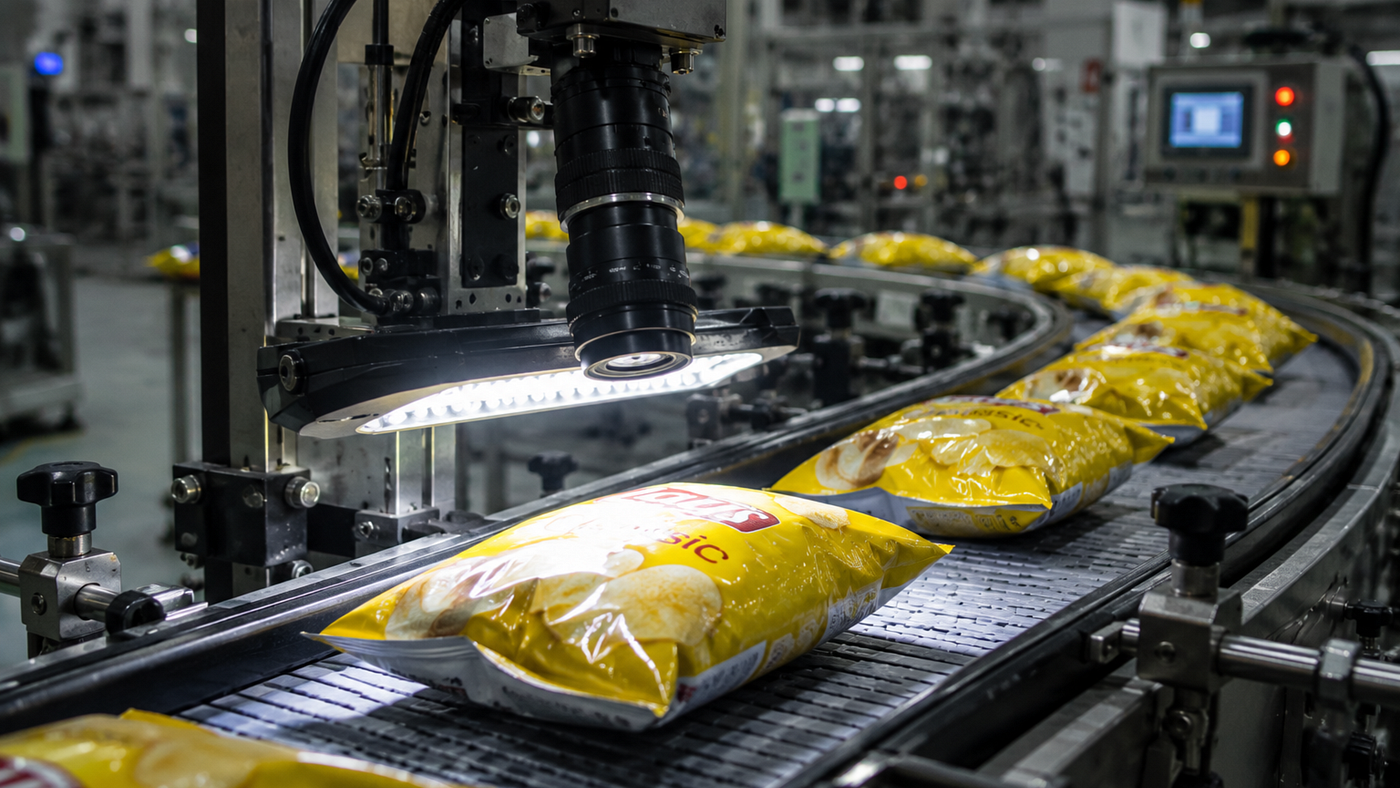
Consumer and security cameras optimize for human perception. A human viewer tolerates motion blur, color variation, or slight distortion because the brain fills in the gaps. Machine vision camera design cannot afford that tolerance. The downstream algorithm, whether it performs dimensional measurement, defect classification, barcode decoding, or optical character recognition, depends on pixel-accurate consistency across every frame.
Industrial camera design must solve problems that do not exist in commercial imaging. The object being inspected may move at several meters per second. The environment may include vibration, electromagnetic interference, chemical exposure, and temperature swings of 40 degrees Celsius or more. The camera must deliver the same image quality on day one and day one thousand, without recalibration or human intervention.
Machine vision camera design also operates under hard real-time constraints. Missing a frame in a streaming video is a cosmetic defect. Missing a frame on an automotive assembly line is a quality escape. The system architecture, from sensor readout to image transfer to processing, must be deterministic. Latency targets are specified in microseconds, not milliseconds.
Sensor Selection and the Physics of Industrial Imaging
Global Shutter vs. Rolling Shutter
Every industrial camera design conversation starts with the sensor. The most consequential early decision is shutter type. Rolling shutter sensors read pixel rows sequentially, which introduces spatial distortion when either the camera or the subject moves during readout. For static scenes or slow-moving objects, this is manageable. For high-speed industrial inspection, it produces geometric errors that corrupt dimensional measurements.
Global shutter sensors expose all pixels simultaneously and read them out after exposure completes. This eliminates motion artifacts entirely. For machine vision camera design targeting conveyor-based inspection, robotic guidance, or any application involving fast-moving parts, global shutter is not optional. The cost and power trade-offs of global shutter sensors are real, but they are non-negotiable constraints in most industrial imaging systems.
Pixel Size, Dynamic Range, and Sensitivity
Pixel pitch determines how much light each photodiode collects. Larger pixels collect more photons, which improves sensitivity and signal-to-noise ratio at the cost of resolution for a given sensor format. Industrial camera design must balance this against the application’s minimum feature size. A surface-mount component inspection camera targeting 01005 resistors requires higher resolution than a presence-absence detection system on a packaging line.
Dynamic range matters in environments with uneven illumination reflective surfaces, highly absorptive materials, or mixed lighting sources. Industrial imaging systems operating in foundries or outdoor installations face illumination variation that exceeds the dynamic range of standard sensors. High dynamic range sensor configurations, or structured illumination with narrowband filtering, compensate for this. Both options affect industrial camera design at the hardware level.
Monochrome vs. Color Sensors
Monochrome sensors outperform color sensors in sensitivity and spatial resolution for a given pixel pitch because they lack the Bayer color filter array that sacrifices light throughput and spatial sampling density. Most precision machine vision camera design uses monochrome sensors combined with controlled, spectrally defined illumination. Color sensors are selected when the inspection task requires hue discrimination label verification, ripeness grading in food processing, or paint defect detection.
Optics and Illumination in Machine Vision Camera Design
The lens system is as critical as the sensor in industrial camera design. A high-resolution sensor paired with an inadequate lens delivers low-quality images regardless of downstream processing. Fixed focal length lenses, known as machine vision lenses, are specified for low distortion, flat field, and controlled chromatic aberration across the full sensor area. These properties are not inherent they require careful optical design and manufacturing tolerances.
Telecentric lenses eliminate perspective error by ensuring that only rays parallel to the optical axis reach the sensor. This makes the image scale independent of object distance variation, which matters enormously in dimensional measurement applications. Industrial imaging systems using standard lenses introduce measurement uncertainty proportional to object distance. Machine vision camera design for metrology applications typically defaults to telecentric optics.
Illumination is half the imaging equation. Industrial camera design teams that treat lighting as a deployment detail consistently produce systems that fail in production. The angle, spectral content, and intensity distribution of the light source determine whether a defect is visible at all. Coaxial illumination highlights surface irregularities on specular surfaces. Diffuse dome illumination eliminates highlights on curved or textured objects. Dark field illumination reveals surface scratches on polished materials. Each illumination architecture is a design choice, not an afterthought.
Interface Standards and Data Throughput in Industrial Imaging Systems
Image data volume scales with resolution and frame rate. A 12-megapixel sensor running at 60 frames per second generates over 5 gigabits per second of raw data. Industrial imaging systems must transport that data without packet loss, latency jitter, or protocol overhead that introduces uncertainty in image timing. The choice of interface standard shapes industrial camera design from the connector to the host processing platform.
GenICam, the generic interface for cameras standard, provides a common software abstraction layer across physical interfaces. It decouples application software from camera-specific register maps, which simplifies integration in multi-vendor industrial imaging systems. Industrial camera design that targets broad ecosystem compatibility implements GenICam compliance alongside the physical interface standard.
Embedded Processing and Edge Intelligence in Industrial Camera Design
The boundary between camera and processing system has shifted. Early industrial camera design separated image capture from computation entirely the camera delivered pixels, and an external frame grabber or PC performed all analysis. Modern industrial imaging systems increasingly integrate processing capability within the camera enclosure itself, enabling inference at the sensor.
Embedded smart cameras implement image processing, feature extraction, and classification within the camera housing. This architecture eliminates the bandwidth and latency costs of transmitting full-resolution images to a host system. The camera outputs inspection results, not image data. Industrial camera design for these platforms involves selecting and integrating a system-on-chip or system-on-module that provides sufficient compute for the target workload, along with the thermal management infrastructure to sustain that compute under continuous operation.
Neural processing units integrated into modern SoCs have expanded what embedded industrial imaging systems can accomplish without cloud connectivity. Convolutional neural network inference for defect classification, pose estimation for robot guidance, and optical character recognition for traceability all run on current embedded platforms at frame rates compatible with production-line speeds. Industrial camera design that incorporates these capabilities must handle model quantization, memory bandwidth constraints, and inference pipeline latency as first-class design parameters.
Thermal Management as a Core Constraint in Machine Vision Camera Design
Heat is the silent killer of imaging performance. Image sensors exhibit dark current, a thermally generated signal that adds to the photoelectrode signal and increases with temperature. As sensor temperature rises, dark current increases, fixed-pattern noise increases, and image quality degrades in ways that confound downstream algorithms. Machine vision camera design that ignores thermal management produces a system whose performance varies with ambient temperature and duty cycle.
High-resolution sensors and embedded compute elements generate significant power dissipation within the camera enclosure. Industrial camera design must provide thermal paths from the heat-generating components to the enclosure surface or to an external heat sink. Thermal interface materials, heat spreaders, and PCB thermal vias all contribute to the thermal solution. For sealed cameras rated to IP67 or higher, convective cooling through ventilation is unavailable, and thermal design becomes substantially more constrained.
Industrial imaging systems deployed in high-ambient-temperature environments in steel mills, automotive paint shops, outdoor infrastructure require active thermal management or de-rating analysis that defines the operating envelope accurately. Machine vision camera design for these environments includes thermal simulation during the design phase, not as a post-silicon validation exercise.
Firmware Architecture and Real-Time Control in Industrial Imaging Systems
Firmware in industrial camera design carries responsibilities that go far beyond image capture. The camera firmware controls sensor configuration, exposure timing, gain setting, trigger response, image pre-processing, and output formatting. Each of these functions must execute deterministically in response to external events or internal schedules.
Trigger synchronization is a fundamental capability of industrial imaging systems. External triggers from encoders, PLCs, or motion controllers signal the camera when to expose. The firmware must respond to that trigger within a specified latency, typically under 10 microseconds, and complete the exposure within a defined window. Jitter in trigger response introduces positional uncertainty in the captured image, which corrupts measurements in motion-synchronized applications.
Board support packages in industrial camera design must provide stable, deterministic behavior across the firmware lifecycle. A camera deployed in a production system may run continuously for three to five years without a firmware update. Industrial camera design teams validate firmware not just for functional correctness but for long-term stability, memory integrity, and recovery from unexpected conditions including power interruption during write operations.
Mechanical Design and Environmental Hardening
An industrial camera operates in environments that would destroy consumer hardware within days. Vibration from motors, pneumatics, and conveyors subjects the camera to continuous mechanical stress. These environmental contaminants damage electrical connections and optics. Thermal cycling between power up and power down causes fatigue of solder joints and mechanical fasteners. Enclosure design is a crucial part of machine vision camera design that should provide adequate protection against all of these forms of degradation.
Ingress protection levels (IP) refer to the level of protection against foreign objects and liquid intrusion. In the majority of cases, production line machine vision cameras require IP65 protection that means total protection against solids and protection from water projected by a nozzle in any direction. Food processing plants and drug production require IP67 or even IP69K protection from temporary immersion and high-pressure/temperature water jet. Machine vision camera design for such conditions requires proper sealing of connectors, chemically stable material for enclosures, optical glass windows.
Vibration resistance requires attention to PCB design, component selection, and enclosure mounting. Through-hole components tolerate vibration better than surface-mount packages in high-g environments. Conformal coating protects populated PCBs from moisture and chemical contaminants. Industrial camera design for severe vibration environments may also require potting of critical assemblies, which adds thermal resistance and must be balanced against the thermal management requirements.
The Role of a Camera Design Company in Industrial Imaging Development
Building an industrial camera from sensor characterization through volume production is not a linear process. It requires parallel streams of hardware development, firmware development, optics qualification, regulatory compliance, and manufacturing process development that interact with each other continuously. An experienced camera design company manages this complexity as its core competency.
Hardware design in industrial camera development begins with system architecture and ends with production-ready schematics and layout. A camera design company brings validated reference designs for high-speed sensor interfaces, power integrity solutions for sensitive analog front ends, and PCB stack-up strategies that meet both signal integrity and thermal requirements. These are not generic PCB design skills they are domain-specific capabilities built through repeated engagement with the specific constraints of machine vision camera design.
Firmware and board support package development for industrial imaging systems requires embedded engineers who understand both the camera hardware and the real-time operating environment. A camera design company with this capability delivers firmware that handles sensor initialization sequences, I2C register management, DMA-based image transfer, trigger timing, and thermal monitoring as an integrated system, not as a collection of loosely coupled modules.
AI integration in modern industrial camera design involves model selection, quantization for target hardware, inference pipeline optimization, and integration with the image pre-processing chain. A camera design company that has implemented AI on embedded platforms understands the interaction between model complexity, memory bandwidth, thermal headroom, and inference latency. This knowledge prevents the common failure mode of selecting a model that performs well in simulation but cannot sustain production-line frame rates on the target hardware.
Validation in industrial camera design spans electrical characterization, optical performance measurement, environmental testing, and regulatory compliance testing. A camera design company structures validation to identify failure modes early, when corrections cost engineering time rather than tooling changes or product recalls. EMC pre-compliance testing during development, thermal cycling before environmental qualification, and accelerated life testing before production release all contribute to a product that performs reliably in service.
Regulatory Compliance and Certification in Industrial Camera Design
Industrially used image sensors supplied in international markets need to meet the EMC compliance standards within the respective jurisdictions. CE labeling in Europe is subject to compliance with both the EMC Directive and, as necessary, the Machinery Directive. FCC Part 15 is applied to the emissions from devices marketed in the US. UKCA labeling applies to products marketed in the UK following Brexit. Engineering teams responsible for designing industrial cameras tend to experience layout changes, shields, and filters whenever they postpone decision making related to EMC to the testing phase.
Camera design for applications in the food and drug industries would be subjected to both electrical and materials certificates. The materials used need to be traceable, nontoxic, and compatible with acceptable cleaning products. This information becomes part of the camera design at the stage of material selection.
Common Failure Modes in Industrial Camera Design Projects
Most industrial camera design failures are predictable. Insufficient sensor characterization at temperature extremes leads to algorithms that work in the lab and fail in production. Underestimated power consumption leads to thermal problems discovered during qualification. Connector selection without environmental specification leads to field failures from corrosion or mechanical fatigue. Firmware developed without real-time constraints leads to trigger response jitter that corrupts measurement data.
Machine vision camera design projects also fail from interface mismatch between the camera and the host system. The camera delivers images in a format, color space, or timing that the host did not anticipate. GenICam compliance reduces this risk but does not eliminate it. End-to-end system integration testing with the actual host hardware and software, conducted before production release, is the only reliable mitigation.
Industrial imaging systems that skip optics validation in production encounter field units with field curvature, decentering, or contamination that impairs performance. Each lens unit varies within manufacturer tolerance. Production-level industrial camera design includes incoming inspection procedures for optical components and a calibration process that characterizes and compensates for per-unit variation.
Conclusion
Industrial camera design is a systems engineering problem that spans physics, electronics, firmware, optics, thermal management, manufacturing, and regulatory compliance. Machine vision camera design done well produces hardware that delivers consistent, accurate, and reliable imaging performance across years of continuous industrial operation. Done poorly, it produces a system that passes laboratory evaluation and fails in service.
The technical requirements discussed here sensor selection, shutter architecture, interface standards, embedded compute integration, thermal management, firmware determinism, environmental hardening, and production-scale validation are not independent decisions. They interact, and managing those interactions is the central challenge of industrial camera design.
For engineering teams building industrial imaging systems without deep camera hardware expertise in-house, the right approach is partnership with a specialist. Silicon Signals is a camera design company that focuses specifically on camera module development, from initial architecture through production release. Their team covers hardware design, firmware and BSP development, AI integration for edge inference, and full validation and compliance workflows. For organizations that need a production-ready industrial camera without building that capability from scratch, Silicon Signals provides the engineering depth that industrial imaging system development requires.
메타데이터
- post_id
- 015b2bef2f3a
- slug
- industrial-camera-design-key-requirements-challenges-015b2bef2f3a
- url
- https://medium.com/@siliconsignals.io/industrial-camera-design-key-requirements-challenges-015b2bef2f3a
- canonical_url
- https://medium.com/@siliconsignals.io/industrial-camera-design-key-requirements-challenges-015b2bef2f3a
- author_url
- https://medium.com/@siliconsignals.io
- status
- ok
- fetched_at
- 2026-06-27 23:56:40