The Best Python Libraries for Building AI Agents
Tools for orchestration, memory, workflows, and model integration
The Best Python Libraries for Building AI Agents
Tools for orchestration, memory, workflows, and model integration
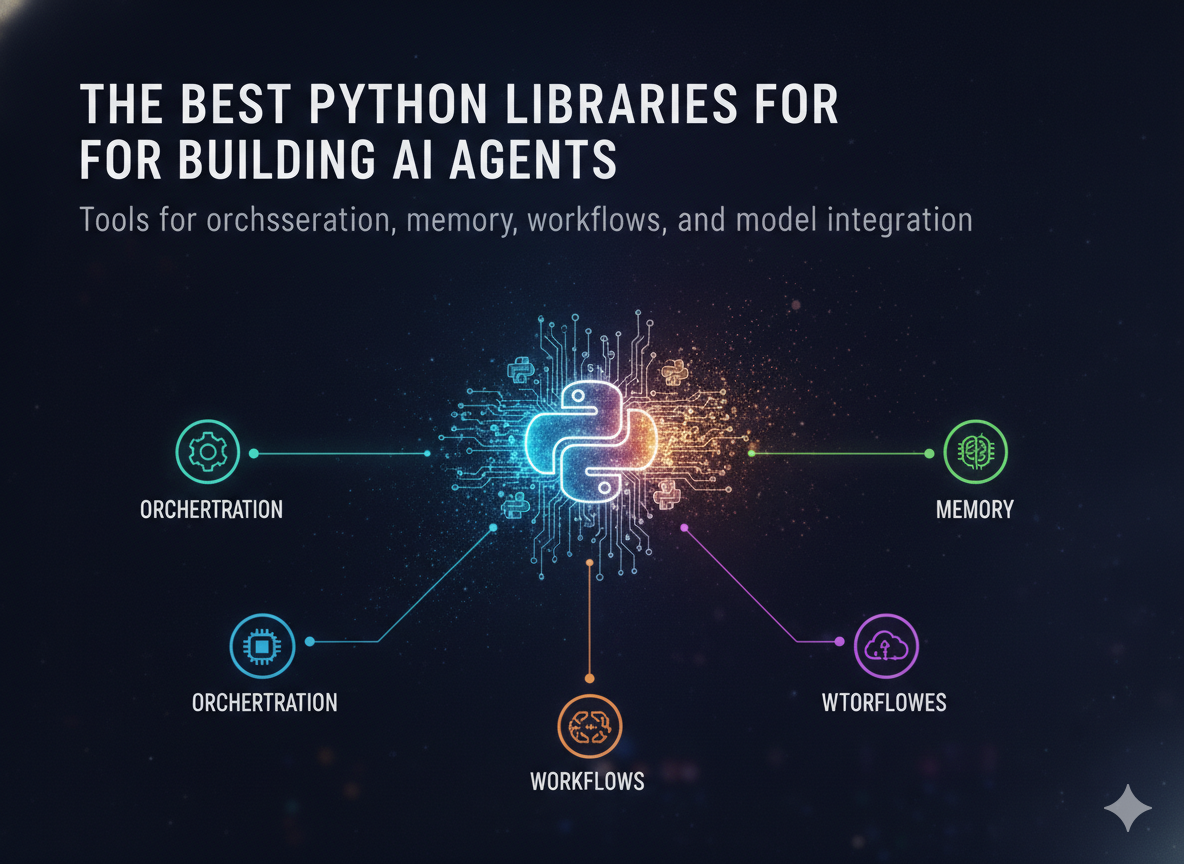
Google AI studio by Author
1. I Stopped Looking for One Library That Does Everything
I used to approach agent libraries the wrong way. I wanted one framework that would handle orchestration, memory, tool calling, retrieval, evaluation, and deployment without making me think too hard about the boundaries. That sounds efficient until you actually build something real. Then the seams matter, and the seams are where most of the hard engineering lives.
The libraries that matter today each solve a different part of the problem. LangChain gives you a highly configurable agent harness and a huge integration surface. LangGraph gives you durable, stateful orchestration for long-running workflows. PydanticAI is built around type safety and validated agent behavior. LlamaIndex is strongest when the agent is built over your data. CrewAI pushes hard on multi-agent workflows with crews and flows. AutoGen still matters for multi-agent conversation patterns, but Microsoft now labels the project as maintenance mode, which changes how I would treat it for greenfield work.
2. LangChain Is the Default When I Need Breadth
LangChain is still the library I reach for when I want the widest set of building blocks and provider integrations without starting from scratch. The current docs describe create_agent as a minimal, highly configurable harness built from the model, tools, prompt, and middleware, and they explicitly position LangChain as the agent framework while LangGraph handles lower-level orchestration. The ecosystem is large enough that it often feels less like a single library and more like an agent engineering surface area.
What changed my opinion over time was this: LangChain is not the library I pick because I expect it to be the most opinionated. I pick it because I expect the architecture to keep evolving, and I want a framework that does not trap me inside one rigid mental model. That makes it a strong fit for application teams that are still figuring out the final shape of the agent loop. It also helps that LangChain’s docs now frame agents as the model plus the harness around it, which is a more honest way to think about the work.
3. LangGraph Is What I Use When the Workflow Has to Survive Reality
LangGraph is the first library on this list that made me stop thinking of agents as simple loops. Its docs say it provides low-level infrastructure for long-running, stateful workflows or agents, and they model workflows as graphs with state, nodes, and edges. They also emphasize durable execution, streaming, human-in-the-loop control, persistence, and subgraphs. That is the kind of architecture that starts to matter once a prototype stops being a prototype.
I trust LangGraph more when the workflow is not just “ask model, call tool, return answer.” I trust it when the agent needs checkpoints, recovery, branching, human approval, or reusable subflows. The memory story is especially important here: LangGraph distinguishes short-term, thread-scoped memory from long-term memory across sessions, with persistence handled through checkpointers and stores. That separation feels like something built by people who have seen agent state go wrong in production.
4. PydanticAI Is the Cleanest Choice When I Care About Type Safety
PydanticAI feels like the most disciplined option in the group. The project describes itself as a Python agent framework for production-grade applications and workflows, and the docs frame its design around Pydantic validation, model-agnostic providers, and type-safe agent construction. The model layer is explicit, the tool layer is explicit, and the framework leans into dependency injection and structured behavior instead of vague magic.
That matters more than people admit. I have seen a lot of agent code fail not because the model was bad, but because the surrounding contract was sloppy. PydanticAI makes the contract harder to ignore. Its tool system is built for general-purpose actions and retrieval, and its docs describe toolsets as a way to register collections of tools in one go. That makes it a strong fit when I want the agent to feel like a typed Python service rather than an improvised prompt wrapper.
5. LlamaIndex Is the Best Pick When the Agent Lives on Top of Data
LlamaIndex is the one I think about first when the core problem is context, retrieval, and data access. The framework positions itself as a leading framework for building LLM-powered agents over your data, and its docs emphasize context augmentation, RAG, agents, and workflows. That distinction matters because many real agent systems are not primarily reasoning systems; they are data access systems with a reasoning layer on top.
The memory work in LlamaIndex is also more practical than I expected. The docs describe a Memory class that can hold short-term memory as a FIFO queue of messages and optionally long-term memory by extracting information over time. Their agent workflow docs also frame AgentWorkflow as an orchestrator for one or more agents, which makes LlamaIndex feel more capable than a simple retrieval library. I would use it when the agent’s job is shaped by documents, indexes, structured retrieval, and repeated interaction with a knowledge base.
6. CrewAI Makes Sense When the Team Thinks in Roles and Tasks
CrewAI is the library I associate with explicit multi-agent coordination. Its docs describe it as an open-source framework for orchestrating autonomous AI agents and building complex workflows, and they frame the system around agents, tasks, crews, and flows. Agents can use tools, collaborate, maintain memory, and delegate tasks when allowed. That structure is very attractive when the application already maps naturally to roles and handoffs.
I do not think CrewAI is the best fit for every agent architecture. It is the best fit when the architecture already has social structure baked into it. Researcher, reviewer, planner, executor, verifier. That kind of decomposition is where CrewAI feels most natural. The docs also say Flows are the recommended way to structure production apps because they own state and execution order, while agents do the work inside the crew step, which is a detail I would not ignore.
7. AutoGen Still Matters, But I Would Treat It Differently Now
AutoGen has been important in the evolution of multi-agent Python systems. Microsoft’s docs describe it as a programming framework for building conversational single and multi-agent applications, and the older 0.2 docs emphasize multi-agent conversation, tool use, and human-in-the-loop workflows. The newer core docs describe event-driven, distributed, resilient systems built around the actor model. That is a genuinely useful design space.
But there is an important change: the GitHub repo now labels AutoGen as being in maintenance mode, and Microsoft’s newer Agent Framework documentation says the Agent Framework is the direct successor, combining ideas from AutoGen and Semantic Kernel. That changes the recommendation. I would still study AutoGen if I am learning multi-agent patterns or maintaining an existing system, but for new work I would be cautious about making it my default choice.
8. The Library I Choose Depends on the Failure Mode I Expect
After enough projects, I stopped asking which library is “best” in the abstract. I ask what kind of failure I can tolerate.
If I want breadth and fast integration, I start with LangChain. If I want durable orchestration and stateful control, I move toward LangGraph. If I want strict typing and clean contracts, PydanticAI is the one that feels most honest. If the system is really about data and retrieval, LlamaIndex usually fits better than people expect. If the application is naturally split into collaborating roles, CrewAI gives that structure a first-class shape. If I am exploring conversation-heavy multi-agent patterns or maintaining an older stack, AutoGen is still relevant, though I would keep the maintenance-mode warning in mind.
What surprised me over time is that the library choice usually reveals the architecture more than the other way around. Teams often think they are choosing tooling. In practice, they are choosing how much structure, validation, orchestration, and memory discipline they are willing to carry forward. That is why the decision feels small at first and expensive later.
9. My Default Stack Has Become More Boring, Which Is Probably Good
I no longer chase the fanciest framework. I care more about whether the stack makes the system readable six months later, when the agent has state, the prompts have drifted, the tools have multiplied, and someone else has to debug the behavior at 2 a.m.
That is why I now think in layers instead of brands. A harness for the agent loop, a runtime for long-lived state, a typed boundary for tools and outputs, and a retrieval layer if the agent needs real context. Sometimes that means one library. Often it means two or three. The cleaner answer is not always the one with the most features. It is the one that makes the next failure easier to understand.
메타데이터
- post_id
- 015dc04ff1e7
- slug
- the-best-python-libraries-for-building-ai-agents-015dc04ff1e7
- url
- https://medium.com/top-python-libraries/the-best-python-libraries-for-building-ai-agents-015dc04ff1e7
- canonical_url
- https://medium.com/top-python-libraries/the-best-python-libraries-for-building-ai-agents-015dc04ff1e7
- author_url
- https://medium.com/@michaelpreston515
- status
- ok
- fetched_at
- 2026-06-21 15:33:18